

You want crisp, magazine-ready portraits but you don’t know what gear to trust. If you’ve ever typed ‘what camera does annie leibovitz use’ you’ll be relieved this piece cuts through the noise. We’ll map her journey from early film cameras to today’s high-end digital backs, and explain why she switches formats depending on the job.
You’ll get practical payoffs: sharper shots, cleaner tones, steadier handling, and faster editorial workflows. We’ll also unpack one surprising myth about equipment loyalty that most people assume is true. You’ll also see how format choices trade resolution for speed in real shoots, without jargon.
This guide helps intermediate and pro portrait shooters, studio photographers, and fast-paced editorial teams. Whether you’re shooting a quiet studio portrait or a frantic magazine day, the explanations are practical and visual. If you want clearer decisions on format, lenses, and workflow—keep reading because the fix is simpler than you think.
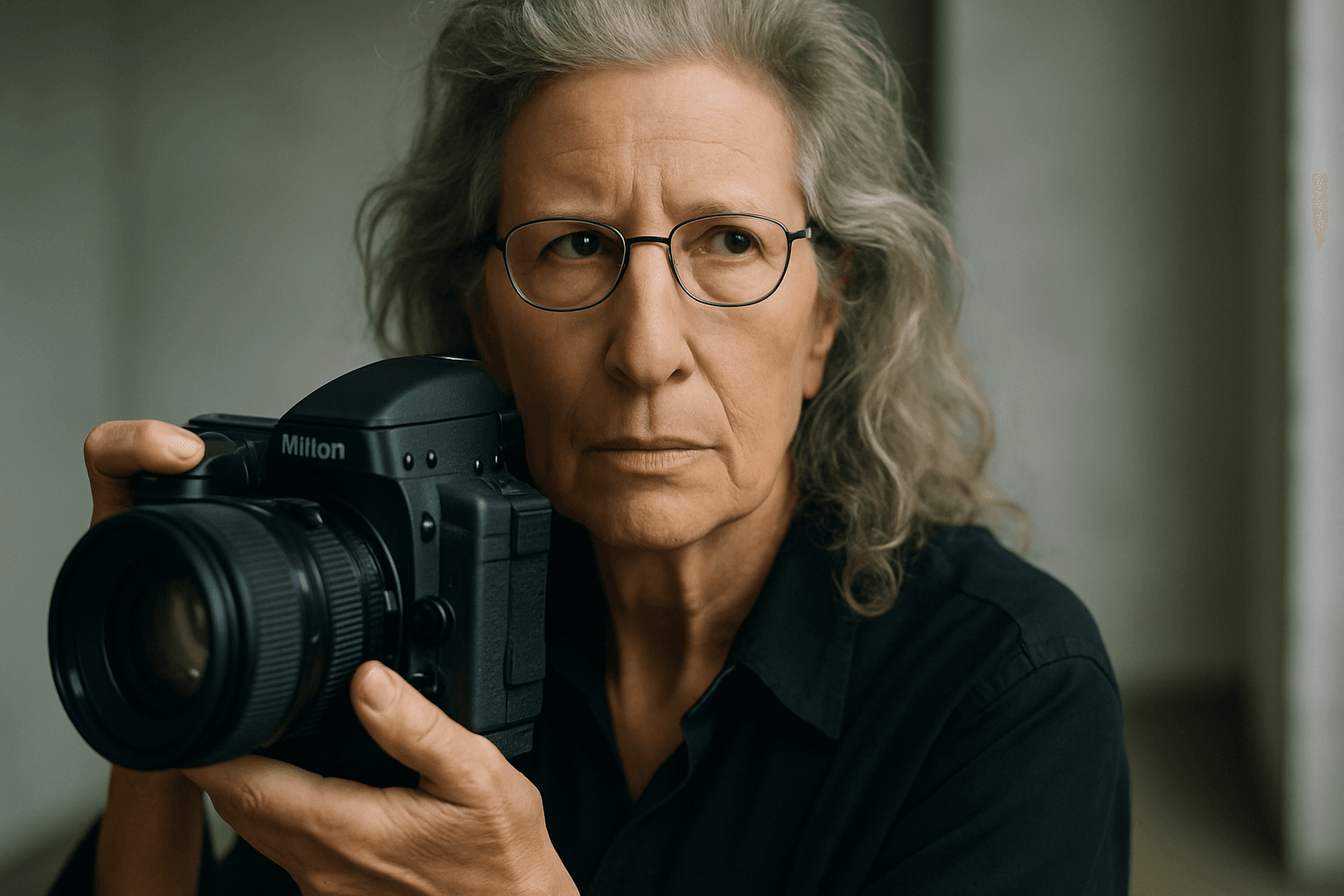
Early career cameras and lenses
When people ask what camera does Annie Leibovitz use, I start with her film roots. She learned to see with simple, reliable tools, and that shaped her voice.
In the 1970s, 35mm film cameras were the newsroom standard. Compact bodies and fast lenses let her move quickly and react to unfolding stories.
The classic trio—35mm, 55mm, and 105mm—covered wide, normal, and short-telephoto needs. Those focal lengths still teach beginners how distance shapes character and context.
Minolta SRT-101 & Nikon F
The Minolta SRT-101 was her first camera, a fully manual SLR that rewarded patience and practice. It taught exposure discipline and the muscle memory of focusing under pressure.
For assignments, the Nikon F became a workhorse. Paired with a 35mm for scenes, 55mm for everyday moments, and 105mm for portraits, it balanced speed with storytelling clarity.
Leica M6 in the 1990s
In the 1990s, the Leica M6 complemented her documentary instincts. Its quiet shutter and compact form helped her work intimately without breaking the moment.
Rangefinder focusing slowed the process in a good way. You pre-visualize, step in with intention, and let the subject breathe inside the frame.
Transition to medium format (1970s–2000s)
As her portrait work expanded, so did her negative size. Medium format brought richer tonality and smoother transitions between light and shadow.
The move wasn’t about abandoning spontaneity; it was about honoring faces with more detail. Subjects gained presence, and prints held up at scale.
By the mid-1980s into the 2000s, medium format became a mainstay for editorial portraits. It defined the look that many of us associate with her era.
Mamiya RZ67 and Hasselblad 500 C/M
The Mamiya RZ67 delivered big 6×7 negatives and bellows focusing for gorgeous close-ups. The rotating back made verticals effortless without disturbing the setup.
The Hasselblad 500 C/M excelled in controlled studios. Leaf shutters synced with strobes beautifully, and square framing encouraged bold, centered compositions; see medium-format information for context.
Switch to digital (early 2000s)
Around 2003, she leaned into digital workflows as editorial deadlines tightened. Immediate review transformed collaboration with stylists and subjects on set.
The new era began with full-frame DSLRs that finally matched print requirements. Color consistency and tethered shooting improved creative control.
She used the Canon 5D family as digital matured, then adopted faster bodies for demanding schedules. The learning curve was short because the vision stayed constant.
Canon 5D and 1DX series
The Canon 5D marked a pragmatic entry into professional digital. It balanced image quality, file integrity, and manageable file sizes for magazines.
For high-speed editorial needs, the Canon 1DX series brought dependable autofocus and ruggedness. It kept up with fleeting expressions and tight production windows.
Current camera setup and high-end digital backs
On major portrait commissions, she often pairs a Hasselblad body with a Phase One digital back. Files are deep, clean, and flexible under heavy retouching.
Alongside that, 35mm digital bodies like the Nikon D810 and the Sony Alpha 1 fill agile roles. They’re perfect for travel days, tight spaces, and fast-moving moments.
If you’re wondering what camera does Annie Leibovitz use today, think hybrid. Medium format for hero portraits, and nimble 35mm digital for everything surrounding them.
Sony Alpha and Fujifilm GFX usage
The Federer and Nadal portraits were shot on a Sony Alpha 1 for speed and silent precision. You can browse Sony shoot reports for coverage and context.
On other recent assignments, confirmed EXIF shows Fujifilm GFX 100 II usage. Its large sensor and robust color science suit editorial-grade portraits beautifully.
Brand agnosticism and format flexibility
She’s famously brand-agnostic, choosing Nikon, Sony, Leica, Canon, Hasselblad, or Fujifilm as each job demands. The brief dictates the tool, not the other way around.
That flexibility answers the question of what camera does Annie Leibovitz use more honestly. She uses what best supports the subject, location, and timeline.
If you’re mapping her gear history, you’ll find helpful gear details. But remember, the camera is a means, not the message.
Lens choices and typical focal lengths
Historically, she leans on primes for portraiture: 28/35mm, 50mm, and 85/105mm. Primes simplify decisions and bottle a consistent look across a series.
In candid or journalism modes, 28/35mm keeps you close and engaged. For studio portraits, 85/105mm gives flattering compression and comfortable working distance.
Medium-format equivalents shift those numbers slightly. What stays constant is intention—choosing focal length for how it shapes faces and space.
Studio environment, backdrops and visual style
Her studio portraits often meet an Oliphant backdrop and controlled lighting. That combination creates painterly depth while keeping attention glued to a subject’s eyes.
Backdrops are not just backgrounds; they’re tone-setters. Texture, color, and falloff harmonize with the camera format to carry mood.
With medium format, micro-contrast in fabric and skin elevates simple setups. The subject feels sculpted by light rather than trapped by it.
Technical advantages: medium format vs. 35mm digital in her work
Medium format brings tonal fidelity, smoother gradients, and commanding detail for double-page spreads. It shines when the portrait must anchor a campaign.
Thirty-five millimeter digital wins for speed, autofocus, and high ISO flexibility. It’s ideal for candid moments that evaporate in a heartbeat.
She has praised digital color fidelity and realism when tuned well. That preference aligns with contemporary retouching pipelines and demanding print standards.
Notable recent shoots: case studies
For Federer and Nadal, the Sony Alpha 1 offered silent shooting and fast tracking. Athletes could move freely without the intrusion of shutter noise.
IKEA campaigns favored consistent color and manageable file sizes for high-volume deliverables. Here, 35mm digital helped maintain pace across complex sets.
When confirmed Fujifilm GFX 100 II files appeared, the choice pointed to hero portrait needs. Big sensors render skin tones and textiles with editorial finesse.
Practical workflow: studio versus candid photography
In studio, a Hasselblad with a Phase One back is my suggested path for high-end portraits. Tethered capture invites collaboration and quick refinements.
On location, I’d switch to a Sony Alpha 1 or Nikon D810 for mobility. You react faster, carry less, and still deliver robust files.
Think of it as a two-speed system. Resolution and depth for set pieces; speed and stealth for everything in between.
Annie Leibovitz’s camera-selection philosophy
Her philosophy treats cameras as tools to realize a vision, not objects of nostalgia. The subject and story decide the kit.
She adopts new digital technologies when they improve fidelity and representation. That pragmatism keeps the work contemporary and dependable in print.
So, when asked again what camera does Annie Leibovitz use, the honest answer is: whichever best serves the picture. That clarity is the real constant.
What People Ask Most
What cameras has Annie Leibovitz used throughout her career?
I’ve used a wide range of gear, starting with a Minolta SRT-101 and Nikon F bodies, then Leica M6, Mamiya RZ67 and Hasselblad 500 C/M on film, and later Canon 5D/1DX, Nikon D810, Sony Alpha 1 and Fujifilm GFX and Hasselblad bodies with Phase One backs in digital years.
Which medium format camera is Annie Leibovitz most associated with?
I’m most associated with the Mamiya RZ67 for large-portrait negatives, while the Hasselblad 500 C/M was a go-to for more controlled studio portrait work.
Does Annie Leibovitz prefer digital or film cameras?
I pick the tool to match the project: I lean toward digital for color fidelity and speed, but I still use medium‑format film and digital backs when I need the extra resolution and tonal depth.
When did Annie Leibovitz switch from film to digital cameras?
I began adopting digital in the early 2000s, around 2003, first using cameras like the Canon 5D and later moving to higher‑speed bodies like the 1DX series.
What is Annie Leibovitz’s current primary camera?
For high‑end portrait commissions I primarily use a Hasselblad body paired with a Phase One digital back, and I rely on 35mm digital bodies like the Nikon D810 and Sony Alpha 1 for other assignments.
Has Annie Leibovitz used Sony cameras for any shoots?
Yes — I used the Sony Alpha 1 for high‑profile shoots such as the Federer/Nadal session, demonstrating its suitability for fast, high‑resolution work.
What lenses does Annie Leibovitz typically use for portrait photography?
I traditionally favor primes for portraiture, typically working with 28/35mm, 50mm and 85/105mm focal lengths, and I choose specific glass depending on whether I’m in the studio or shooting candidly on location.
Final Thoughts on Annie Leibovitz’s Gear Choices
If you came here asking what camera does annie leibovitz use, the article lays out her progression from SLRs and medium-format film to high-end digital backs and modern mirrorless bodies. That journey answers the opening hook—your curiosity about how technique, lenses, and format shape her signature portraits—by translating gear choices into practical trade-offs rather than mystique.
The real benefit of that perspective is seeing gear as a means to an image, not an end, so you can pick tools to realize an idea instead of imitating a name; that insight should change how you approach purchases and shoots. Still, don’t expect kit alone to make the picture—experience, lighting, and subject rapport are the true equalizers, and some formats won’t suit every budget or schedule. Portrait and editorial photographers, plus serious enthusiasts, will gain the most by adopting this project-first mindset.
By tracing her move from film through medium format to contemporary digital systems, the piece removes the mystery and gives a simple framework for choosing tools that serve your vision. Take that framework, adapt it to your workflow, and go shoot with intent.


0 Comments