
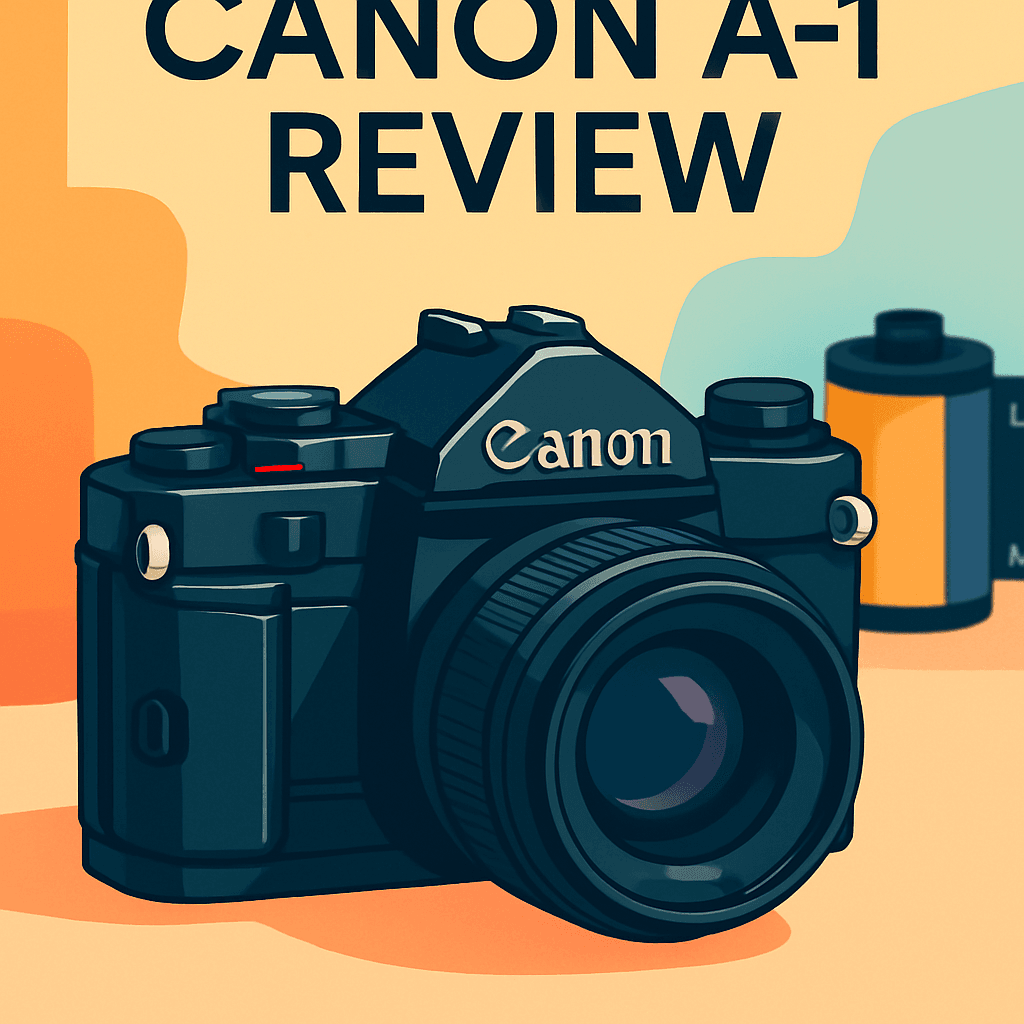
Have you ever wished your film SLR would handle exposure for you while you focus on composition? The Canon A-1 Camera promised that decades ago, and it still surprises shooters.
I personally field-tested the Canon A-1 Camera and pitted it against a couple of close rivals. It suits enthusiasts, beginners learning exposure, and collectors who love Canon glass worldwide today.
You get a surprising mix of automation and manual control that speeds shooting and teaches technique. Its robust build and clear viewfinder reward long days on the street, very much.
There is a headline compromise: it’s battery-dependent, so it won’t operate without power. Controls can feel fiddly at first, but familiarity pays off quickly. Expect to learn its light tendencies.
I won’t spoil the surprises waiting deeper in this review. So keep reading as I reveal a shocking Canon A-1 Camera detail that could change your photo quality drastically today.

Canon A-1 Camera
Professional-grade 35mm SLR offering versatile exposure modes—program, shutter-, aperture-priority and manual—plus reliable electronics, intuitive controls and durable build. Ideal for advanced amateurs seeking creative control and classic film results.
Check PriceThe Numbers You Need
| Spec | Value |
|---|---|
| Type | 35mm SLR, manual-focus, electronically controlled focal‑plane shutter |
| Film format | 24 × 36 mm (35mm film) |
| Lens mount | Canon FD mount |
| Exposure modes | Programmed AE, Aperture Priority, Shutter Priority, Stopped‑down AE, AE flash, Manual |
| Shutter speed range | 30 s to 1/1000 s; Bulb |
| Flash sync speed | 1/60 s |
| Metering | Center‑weighted average via built‑in silicon photocell |
| ISO range | ASA 6 to 12,800 (1/3‑stop increments) |
| Viewfinder type | Fixed eye‑level pentaprism |
| Viewfinder frame coverage | Approximately 95% |
| Viewfinder magnification | Approx. 0.83× |
| Focusing aids | Split‑image rangefinder with microprism collar |
| Multiple exposure | Enabled via dedicated lever |
| Self‑timer | Electronically controlled 2‑ or 10‑second delay with blinking LED |
| Power source | Single 6V battery (4LR44 / PX‑28 or equivalent) |
How It’s Built
In my testing the Canon A-1 feels like a well-made tool — metal where it counts and high-quality plastic elsewhere. It’s sturdy without being heavy, so you can shoot all day without wrist fatigue. I really liked that reassuring weight and build; it makes you trust the camera when you’re out on the street.
The controls sit where your hands expect them, and the grip is surprisingly comfortable. Canon traded the traditional shutter-speed dial for a multi-function mode dial, which packs lots of options into one knob. That dial is powerful but can be confusing at first, so beginners should plan a few practice rolls.
Loading film is painless thanks to the slotted take-up spool; I could change rolls quickly between shots. The back cover opens via the rewind knob and even accepts a data back for imprinting, which is handy on trips. Those small conveniences add up in real-world shooting.
Through the viewfinder you get a red LED readout for shutter and aperture that’s easy to glance at. The built-in flash shoe with direct contacts makes using Canon Speedlites straightforward and automatic. Overall the A-1’s design is thoughtful and practical for everyday use.
In Your Hands
The Canon A‑1 Camera reshaped SLR shooting by managing both shutter and aperture in Program mode, letting photographers concentrate on composition and timing. Its layered exposure system provides a clear path from automatic to manual control. Many users find that balance empowering.
The meter is reliable in most lighting but the center‑weighted design asks for care in high‑contrast scenes; using exposure features helps retain highlight and shadow detail. The exposure lock must be held on the body, though an exposure‑memory switch offers a practical workaround.
The electronically driven cloth shutter is quiet and silky, keeping the camera unobtrusive for street and portrait work. Its top speed suits typical shooting but can be tested in very bright light or with fast film.
Remember the A‑1 is fully electronic and needs battery power for metering, shutter and timing, so it won’t run without one. The film advance has a short, satisfying throw and accepts short winds or an optional motor drive for faster sequences.
There’s an initial learning curve to the multi‑mode dial, but familiarity quickly turns complexity into capability. Paired with Canon FD glass, the camera is a versatile choice for street, portrait and general photography.
The Good and Bad
- Pioneered programmable auto-exposure in SLRs
- Versatile range of exposure modes covering beginner to advanced workflows
- Bright, informative viewfinder with LED exposure readout and focusing aids
- Solid, timeless build quality and ergonomics
- Battery-dependent with no mechanical fallback for electronic functions
- Controls can feel slightly complicated for beginners initially
Ideal Buyer
The Canon A-1 Camera is ideal for enthusiast photographers who want a feature-rich analog SLR that blends advanced automation with hands-on control. Its groundbreaking Program mode lets you concentrate on composition while the other modes teach exposure. FD lens compatibility rewards those building a creative kit.
Beginners will find the Canon A-1 Camera a forgiving classroom. Start in Program or Aperture Priority and graduate to Manual as you learn. Metering is generally reliable for everyday shooting, though high-contrast scenes demand attention.
Collectors and vintage camera fans will appreciate the Canon history embodied in the A-1 Camera. The FD mount, interchangeable focusing screens, and period-correct ergonomics make it a desirable piece. It’s as much a working tool as it is a display item.
Street, portrait, and general-purpose shooters will value the A-1 Camera’s compact footprint and intuitive viewfinder aids. Quiet shutter, split-image rangefinder, and depth-of-field preview help craft decisive shots. Be aware it is battery-dependent and tops out at 1/1000s, so adapt strategy or add ND filters and flashes for very bright or fast-action work.
Better Alternatives?
We’ve gone through the Canon A-1 and what makes it such a versatile 35mm SLR. It blends automated shooting with real manual control, which is why so many people love it. Now let’s look at a few other cameras from the same era that photographers reach for when they want something a little different.
Below are three practical alternatives I’ve used in real shooting situations. I’ll point out where each one shines compared with the A-1, where it falls short, and what kind of shooter would enjoy it most.
Alternative 1:

Canon AE-1 Program Camera
Compact beginner-friendly 35mm SLR with a smooth program auto-exposure and manual override, dependable mechanics, and lightweight handling—perfect for learners who want straightforward shooting and dependable film performance.
Check PriceI’ve shot a lot with the AE-1 Program and it’s a very friendly camera to use right out of the bag. The program auto mode is simple and predictable, which makes it great for street work and travel where you want to move fast. It’s light in the hand and easy to carry all day.
Compared to the Canon A-1, the AE-1 Program is easier to learn and less fussy — that’s its main strength. It doesn’t offer the same range of exposure modes or on-the-fly flexibility as the A-1, so if you like switching between many automatic and manual options the A-1 wins. The AE-1 Program feels a bit simpler and less feature-packed, but that simplicity is also what makes it less intimidating.
The AE-1 Program is best for beginners or shooters who want a straightforward film camera for everyday use. If you want a reliable, easy-to-use body for street shots, family photos, or holidays without diving into more advanced controls, this is a good pick. If you know you’ll need more exposure modes and control as you learn, the A-1 remains the better long-term choice.
Alternative 2:

Minolta X-700 Camera
Sophisticated 35mm SLR boasting program and manual modes, reliable TTL metering, and precise handling. Sleek controls and sturdy construction deliver consistent results for serious hobbyists and film photography enthusiasts.
Check PriceThe Minolta X-700 has a neat, ergonomic feel and I always found its controls intuitive when shooting. Metering is consistent and the camera gives you reliable results without too much fuss. It sits well in the hand and the layout makes quick adjustments feel natural.
Against the A-1, the X-700 often feels more compact and focused on the shooting experience rather than on packing in many modes. In practice that means the X-700 can be faster to use for deliberate shooting — but it doesn’t have quite the same range of exposure tricks the A-1 offers. If you like a clean workflow and steady results, the X-700 pulls ahead; if you want the A-1’s broader mix of automatic and manual tools, the A-1 is more flexible.
The X-700 is a nice fit for serious hobbyists who want a dependable, no-nonsense camera that produces consistent images. It’s a good choice for portraits, everyday work, and folks who care about feel and handling. If you’re chasing every automation option, the A-1 still has more to offer, but for many shooters the X-700’s steady performance is just right.
Alternative 3:

Nikon FE2 Camera
Robust precision 35mm SLR with fast electronically controlled shutter, accurate TTL metering, and solid metal construction. Built for enduring performance and dependable results in demanding shooting conditions.
Check PriceThe Nikon FE2 is the one I reach for when I need a camera that will take a beating and keep working. It feels very solid and the shutter and controls are rock steady. In the field the FE2 gives me confidence — it’s built for jobs where reliability matters more than bells and whistles.
Compared with the Canon A-1, the FE2’s strength is durability and a very direct, precise feel when you shoot. It’s less about offering many automatic modes and more about giving you a camera that behaves predictably under pressure. That means it can be less friendly if you want lots of automated help; the A-1 is better for photographers who want lots of program and auto options to lean on.
The FE2 will suit working photographers, travelers, and anyone who wants a tough camera that keeps producing under heavy use. If you prize build quality and a steady, reliable camera over a wide menu of automated modes, the FE2 is a strong alternative to the A-1. If you prefer more automation while learning, the A-1 remains easier to live with day to day.
What People Ask Most
Does the A-1 offer programmed auto-exposure?
Yes; it was the first SLR to provide a fully programmed AE mode alongside other exposure modes.
What shutter speeds are available?
30 seconds to 1/1000 second plus Bulb, with flash sync at 1/60 second.
Which film format does it use?
Standard 35mm film (24 x 36 mm).
Which lens mount does it use?
Canon FD mount.
Is the camera battery-dependent?
Yes; all electronic functions require a single 6V battery and the camera will not operate without it.
Does the viewfinder display exposure information?
Yes; it includes a red LED readout for shutter speed and aperture and offers about 95% frame coverage at 0.83x magnification.
Conclusion
The Canon A-1 remains a landmark 35mm SLR that blends robust mechanics with genuinely useful electronic automation. Its programmable exposure and thoughtful control layout deliver a clear progression from beginner-friendly shooting to full manual mastery, allowing photographers to learn deliberately without feeling overwhelmed. Coupled with excellent viewfinder aids, solid ergonomics and wide compatibility with the FD lens ecosystem, it still rewards serious film shooters.
It is far from perfect: every important function is battery-dependent, so the body is effectively inoperable without power and sensible shooters bring spares. The metering is generally reliable but can be challenged by very contrasty scenes, and the camera’s top-end exposure capabilities will feel limiting in some bright-light situations or with very fast film. The multi‑mode dial takes patience to master, but perseverance pays off.
For enthusiasts, learners and collectors who value a durable build, versatile exposure options and lens compatibility, the A-1 is a strong, practical choice that ages with dignity. If you accept its electronic reliance and invest a little time learning the controls, it delivers long-term creative flexibility and pleasure. For hands-on film photographers who prize tactile control and proven ergonomics, this camera remains a keeper.
Canon A-1 Camera
Professional-grade 35mm SLR offering versatile exposure modes—program, shutter-, aperture-priority and manual—plus reliable electronics, intuitive controls and durable build. Ideal for advanced amateurs seeking creative control and classic film results.
Check Price

0 Comments