
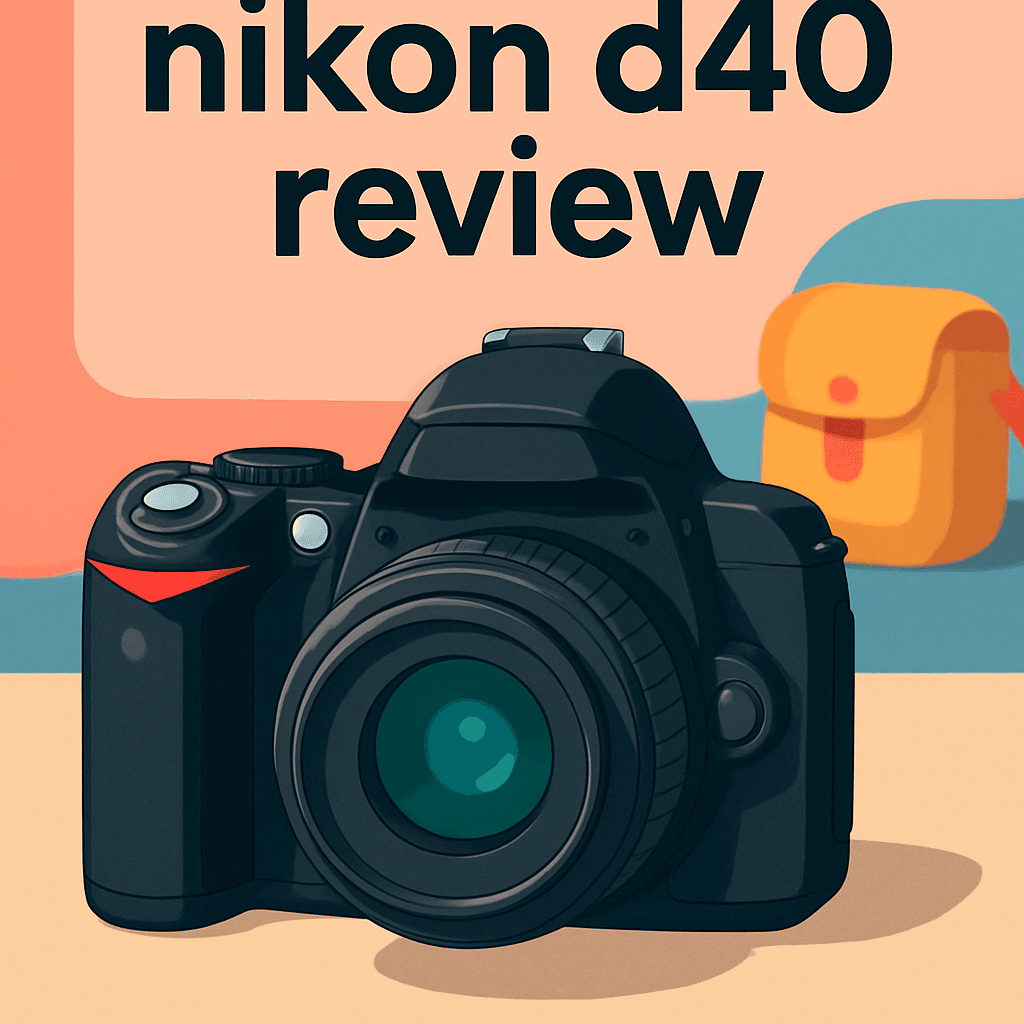
Want a lightweight DSLR that feels like a real camera but won’t weigh down your average day?
I field-tested the Nikon D40 Camera and pitted it against a couple of close rivals. I’ll share hands-on surprises you won’t find in spec lists or glossy marketing copy.
If you’re moving up from a point-and-shoot, this camera was built for you. It’s simple, light, and doesn’t hide crucial controls to help you learn basics.
Real-world payoffs include comfortable handling and consistently reliable exposures. Images look vibrant at base settings, and files are forgiving for learning photographers.
The main compromise is lens compatibility — it won’t autofocus with older, non-motor lenses. That can surprise new buyers looking to use thrift-store glass.
I’ll also show one shocking trick that can improve Nikon D40 Camera image quality more than you’d expect. You’ll want that before you buy or shoot much; keep reading.

Nikon D40 Camera
A beginner-friendly, lightweight DSLR delivering crisp images and intuitive controls. Reliable autofocus, wide lens compatibility and comfortable handling make it ideal for new photographers learning exposure, composition and on-the-go shooting.
Check PriceThe Numbers You Need
| Spec | Value |
|---|---|
| Sensor | 6.1MP DX-format APS-C CCD (23.7 x 15.6 mm) |
| ISO sensitivity | 200–1600 (expandable to ISO 3200, HI-1) |
| Continuous shooting | Up to 2.5 frames per second |
| Autofocus system | 3-area phase-detection AF |
| AF lens compatibility | Requires AF-S or AF-I lenses for autofocus (no in-body AF motor) |
| Viewfinder | Optical pentamirror; ~95% coverage, 0.44x magnification |
| LCD | 2.5-inch, 230,000-dot fixed color screen |
| Memory card | SD / SDHC |
| File formats | JPEG (three levels), 12-bit compressed NEF (RAW), RAW+JPEG |
| Metering | 420-pixel 3D Color Matrix Metering II; center-weighted and spot |
| Exposure modes | Program, Aperture Priority, Shutter Priority, Manual, + 7 Digital Vari-Program scene modes |
| Built-in flash | Pop-up speedlight; flash sync up to 1/500 sec |
| Battery | EN-EL9 |
| Body | Compact, lightweight DSLR (smaller and lighter than D70/D50) |
| Live view & video | Not available (no live view or video capability) |
How It’s Built
In my testing the D40 felt like a pocketable DSLR — small and light enough that I didn’t mind carrying it all day. One thing I really liked was how easy it was to toss in a jacket or sling bag and still have a proper DSLR ready. That made it perfect for street walks and family shoots when I wanted to travel light.
The body is mostly plastic, but it never felt cheap in hand. I found the textured finish and tight seams gave it a surprisingly solid feel when bumped around in my camera bag. In real use that means you get a light camera that won’t be a worry on day trips.
Controls are simple and uncluttered, which helped me learn the basics fast without feeling overwhelmed. The grip sits nicely for small to average hands and kept the camera stable during longer walks or quick shoots. For beginners that means less fumbling and more chance to focus on getting the shot.
The LCD is bright and useful for checking exposure and focus on the fly. The viewfinder, however, is a smaller pentamirror and it feels a bit dimmer and less immersive than pricier viewfinders. That smaller viewfinder is the one real thing I’d like to see improved because it makes composing in low light a little harder.
In Your Hands
The Nikon D40 still surprises with image quality that feels punchy and dependable for its era; colors are vibrant straight out of the camera and images hold up well for everyday prints and online sharing. Sharpness is reassuringly good at lower sensitivities, delivering the kind of crisp results that make learning composition rewarding. It’s a camera that encourages taking pictures rather than fretting about settings.
In practical low-light situations the D40 performs in a pragmatic way — usable through moderate sensitivities, while higher settings introduce noticeable noise that’s manageable in a pinch. Autofocus is quick and confident when paired with compatible AF-S/AF-I lenses, though older lenses without a built-in motor require manual focus. Startup and shutter response feel snappy, so spontaneous moments are rarely missed.
Exposure and metering are among its quiet strengths, offering consistent results across varied lighting so beginners can trust the frame they see. The built-in flash serves well for fill or a little extra illumination, and battery life is solid for casual days out, though serious all-day shoots benefit from a spare. Image review on the clear rear screen is straightforward and reassuring.
For real-world use the D40 is a compact, pleasant tool that makes DSLR shooting approachable — its scene modes and pared-down controls help novices get great results quickly. The one recurring caveat is lens compatibility for autofocus; beyond that limitation it’s a reliably simple, point-and-shoot DSLR with a pleasingly tactile feel.
The Good and Bad
- Easy to use — great for DSLR beginners
- Compact and light — easy to carry and handle
- Reliable metering and exposure — consistent results across varied lighting
- Good image quality for its class — sharp and colorful at base ISO
- No in-body AF motor — autofocus limited to AF-S/AF-I lenses
- No live view or video capabilities
Ideal Buyer
The Nikon D40 is ideal for first-time DSLR users stepping up from compact cameras who want better image quality without complexity. Its small, lightweight body and straightforward controls make learning basic exposure and composition easy. The camera’s approachable layout keeps photography fun rather than technical.
Travelers, students, and casual hobbyists will appreciate the D40’s portability and dependable metering. It delivers vibrant, sharp files at base ISO and starts up quickly so you won’t miss moments. For anyone who values an optical viewfinder and tactile controls, it feels familiar and satisfying.
Be realistic about the D40’s era-specific limits before buying. There’s no live view or video, resolution is modest, and autofocus works only with AF-S or AF-I lenses. Low-light performance degrades at higher ISOs, so plan to shoot in good light or pair the camera with fast lenses.
If you want a simple, budget-friendly entry into DSLR shooting or a compact backup body for street and travel work, the D40 remains a compelling choice. If you require modern features, higher megapixels, or broad lens compatibility, a newer model will serve you better.
Better Alternatives?
We’ve gone over the Nikon D40 and what made it a great little DSLR for beginners back in the day. It’s simple, light, and gets the job done for stills—but cameras have moved on a lot since then. If you like the D40’s ease but want more speed, better low-light shots, live previews or video, there are easy upgrades to consider.
Below are three mirrorless Nikon options I’ve actually used in the field. I’ll tell you what each one does better and where it falls short next to the D40, and who I think will get the most out of each choice.
Alternative 1:

Nikon Z50 Camera
Compact APS-C mirrorless designed for enthusiasts who want sharp photos and smooth 4K video. Fast autofocus, tilting screen and durable build empower travel, everyday shooting and quick-action capture.
Check PriceI used the Z50 on a weekend trip and the first thing I noticed was how much quicker it focuses compared with the D40. Faces and moving kids lock on far more reliably, and the camera gives you a real-time preview of exposure in the electronic viewfinder so you don’t have to guess. It also shoots 4K video—something the D40 can’t do at all—so it’s a proper hybrid for photos and clips.
Where the Z50 isn’t as nice as the D40 is in battery life and simple handling. The D40’s optical viewfinder and long battery life mean you can shoot all day without fuss; the Z50 needs more charging if you use the EVF and screen a lot. Also, lenses for the Z mount can be pricier than older Nikon F glass, so budget-wise it’s a step up.
Choose the Z50 if you want a compact camera that’s clearly better for low light, autofocus and video than the D40. It’s great for travel photographers, hobbyists who want faster results, and anyone moving from a very old DSLR toward mirrorless without diving into a big, heavy camera.
Alternative 2:

Nikon Z fc Camera
Retro-inspired mirrorless combining classic controls with modern imaging. High-quality sensor, customizable dials and an articulating touchscreen deliver expressive street and lifestyle photos with tactile handling and stylish flair.
Check PriceThe Z fc feels different in your hands—its retro dials and layout make shooting feel intentional, which I really liked for street and lifestyle work. Like the Z50 it gives you fast autofocus, live previews and video, but the tactile controls help you work more like you did with manual cameras. The flip-out screen is handy for low shots or shooting from odd angles, which is a clear win over the fixed screen on the D40.
On the downside, the Z fc is more about style and shooting experience than pure battery endurance or raw simplicity. It won’t last as long on a single charge as the D40, and the menus can feel deeper than the D40’s basic layout. Also, it’s pricier than a used D40 body, so it’s an investment for the look and handling as much as the imaging.
Pick the Z fc if you care about how a camera feels while you shoot and like the idea of modern imaging with classic control dials. It’s a fun choice for street shooters, lifestyle photographers, and anyone who shoots a lot of color, moments and portraits and wants a camera that’s enjoyable to carry.
Alternative 3:

Nikon Z30 Camera
Compact vlogging camera engineered for creators: excellent autofocus, vertical video support, clean HDMI and clear audio options. Lightweight, selfie-ready design simplifies streaming, social clips and daily content production.
Check PriceThe Z30 is built for video and content, and that shows when you actually shoot with it. Autofocus is quick and smooth, the screen works great for selfies and vlogs, and the camera handles vertical framing and live streaming much more easily than the D40 ever could. If you’re making social clips or short films, you’ll notice how much faster the workflow is compared with lugging a D40 and external video gear.
What the Z30 gives up compared to the D40 is the traditional camera feel and optical viewfinder. If you love composing through a glass viewfinder and prefer longer battery life for long photo walks, the D40 still has some charm. The Z30 also leans small and light, which is great for handheld video but means a smaller grip for long stills sessions.
Go for the Z30 if your main goal is video, streaming or quick social content and you want a simple, light camera that focuses and records reliably. It’s ideal for vloggers, creators, and anyone who needs strong video features without carrying a lot of extra kit. If you mainly shoot stills and crave the old-school DSLR feel, you might still prefer the D40’s simple approach.
What People Ask Most
Is the Nikon D40 good for beginners?
Yes, it was designed as an entry-level DSLR with simple controls, compact/light body, and helpful scene modes that make learning easy.
Does the Nikon D40 shoot video or have live view?
No, it predates those features and does not offer live view or video recording.
What lenses will autofocus on the D40?
Autofocus works only with lenses that have built-in AF motors (AF-S or AF-I); older non-motor Nikon lenses can be mounted but must be focused manually.
What kind of image quality can I expect?
Image quality is good for its era with vibrant colors and acceptable sharpness at base ISO, though the 6.1MP resolution is low by modern standards.
What ISO range and low-light performance does it have?
Native ISO is 200–1600 with expansion to 3200 (HI-1); it’s usable up to about ISO 800, while higher settings become noticeably noisy.
Does the D40 use common memory cards and batteries?
Yes, it uses SD/SDHC cards and the EN-EL9 battery; battery life is decent for casual shooting but spares are recommended for long days.
Conclusion
The Nikon D40 remains a genuine beginner-focused DSLR that delivers unexpectedly good image character for its era, producing vibrant, pleasing results that reward basic technique and a steady eye. It is strikingly approachable, with a compact, lightweight body and uncluttered controls that let newcomers concentrate on framing and exposure without intimidation. Reliable metering and responsive handling speed the learning curve and make it easy to walk away from a shoot with usable images.
That simplicity comes with uncompromising trade-offs that are impossible to ignore today, namely modest resolution, limited modern conveniences, and a lens compatibility constraint that stems from requiring lenses with their own focus motors. Autofocus limitations and the absence of live view or video functionality put the D40 well behind contemporary entry-level options for versatility. If you need broad native lens support, advanced low-light performance, or video capture, the D40 will feel dated quickly.
In practice the D40 occupies a clear niche: it’s an excellent training camera and a charming, portable option for photographers who value simplicity, tactile controls, and a no-frills shooting experience. It offers genuine value at the right price and is particularly rewarding for learners or as a lightweight backup when modern bells and whistles are unnecessary. My verdict is firm — buy it if you want an honest, easy-to-use DSLR with character; skip it if you depend on contemporary features and broad lens freedom.
Nikon D40 Camera
A beginner-friendly, lightweight DSLR delivering crisp images and intuitive controls. Reliable autofocus, wide lens compatibility and comfortable handling make it ideal for new photographers learning exposure, composition and on-the-go shooting.
Check Price

0 Comments