
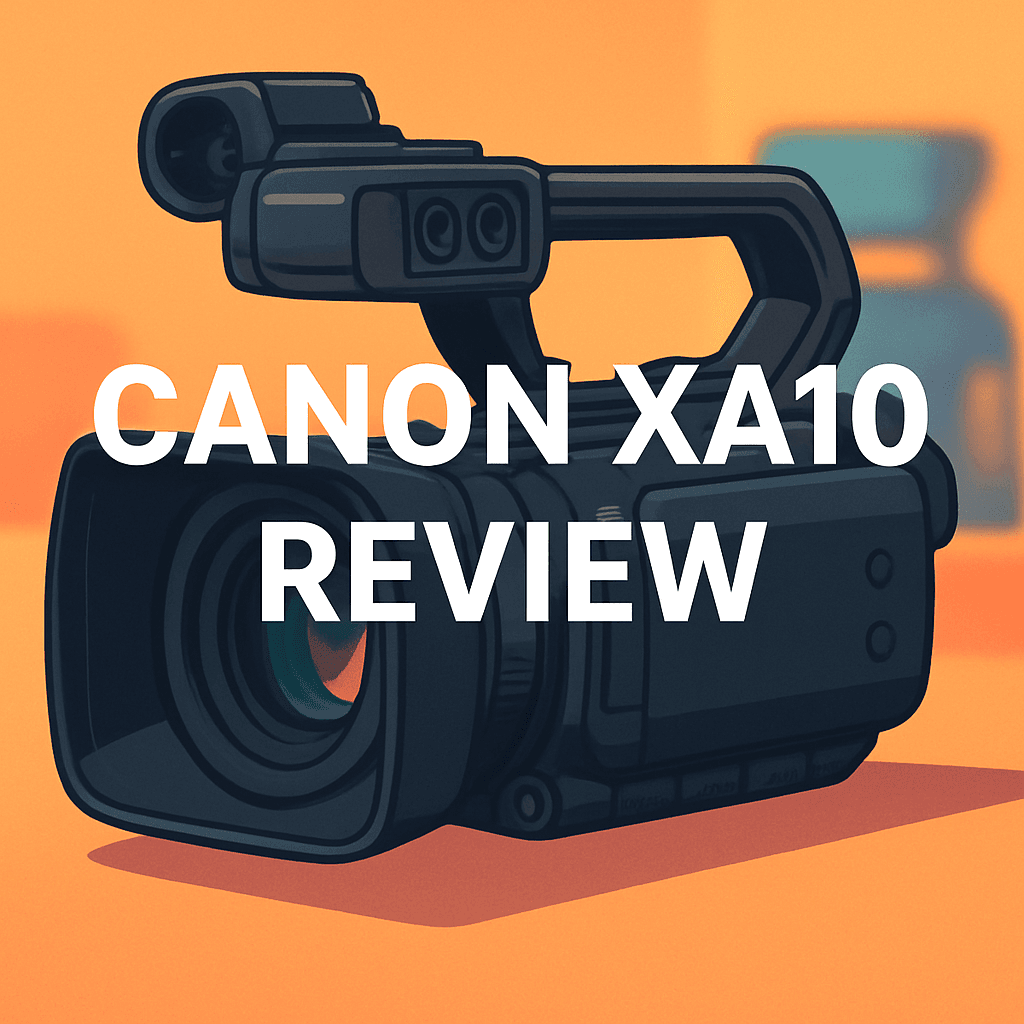
canon xa10 review: Want to know if a compact pro camcorder with Full HD, AVCHD, strong audio and manual controls will improve your run-and-gun work?
I’ll give you hands-on insight, not just lab charts or spec lists.
It’s an older model and official docs are thin, but its core capabilities are confirmed across pro reviews and real shoots.
Think documentary shoots, interviews and events where portability, XLR audio and steady OIS matter — it’s built for grab-and-go coverage.
I’ve taken the Canon XA10 Camcorder into real shoots, so I know who benefits most: solo shooters, small crews and audio-first producers.
I’ll cover design, handling, real-world performance, audio features and who should buy it — make sure to read the entire review, and keep reading.

Canon XA10 Camcorder
Compact professional camcorder delivering crisp Full HD video, intuitive manual controls, robust build, long zoom range, and clean audio via professional inputs—ideal for ENG, weddings, and run-and-gun documentary shoots.
Check PriceThe Numbers You Need
| Spec | Value |
|---|---|
| Sensor | 1/2.84" HD CMOS |
| Lens | Built-in lens, 20× optical zoom |
| Image stabilizer | Advanced Optical Image Stabilization (lens-based, not in-body) |
| Recording format | AVCHD |
| Max resolution | Full HD 1920×1080 |
| Frame rates | 60i, 30p, 24p (region-dependent) |
| Audio inputs | Dual XLR inputs with manual controls |
| Media | CF card slot + internal 32 GB flash memory |
| Manual controls | Full manual exposure, focus, and audio controls |
| Headphone jack | Yes (for audio monitoring) |
| LCD | 3.5" swivelling touchscreen LCD |
| Viewfinder | Color electronic viewfinder with eye sensor |
| Weight | Approx. 1.1 kg (with battery, body only) |
| Microphone | Stereo microphone; detachable handle with shock absorber |
| Low-light performance | Moderate — lens aperture f/1.8–2.8 |
How It’s Built
In my testing the Canon XA10 Camcorder feels like a true grab-and-go pro camcorder. The body is compact and sits nicely in one hand, so long shoots don’t wear you out. Controls are mostly where you expect them, making manual tweaks quick and simple.
The built-in zoom and optical stabilization actually do a lot of the heavy lifting on handheld shots. I found walk-and-talks and long zoom pulls stayed usable without a gimbal.
The detachable top handle is one thing I really liked — it locks on solid and puts the XLRs right where you need them for fast interviews. The handle’s mic shock absorber really reduced handling thumps in my run-and-gun tests. With the handle on, the cam balances into a natural shooting position.
The touchscreen is handy, but in bright sun I reached for the color EVF more than the screen. One thing that could be better is the size of some buttons and dials; they’re a bit tight if you’ve got big hands or gloves on. For beginners the compact size makes setup fast, but it also limits how much you can add to the rig without extra cages.
In Your Hands
In real-world shoots the Canon XA10 Camcorder delivers the Canon color palette many operators appreciate: punchy mids and natural skin tones that cut through event lighting without heavy grading. Its high-definition capture holds up for interviews and documentary work, but its moderate low-light character means you’ll often plan for supplementary light or accept a bit more gain when lamps are the only option. That “fast-for-a-camcorder” lens helps indoors, yet it’s wise to be deliberate about exposure choices to keep images clean.
The image stabilization is one of the unit’s quiet strengths — steady enough for walk-and-talks, run-and-gun interviews, and handheld b-roll across the zoom range. That extended reach changes how you block scenes: you can cover close-up moments from a respectful distance or drop to wider contextual shots without re-rigging. Smooth body movement and slow zooming remain critical when you’re working handheld at longer focal lengths.
Full manual control makes the XA10 feel like a filmmaker’s tool, letting you lock exposure and pull focus with intention rather than relying on auto modes. Practical focus pulls on the compact body are doable but reward practice and use of focus aids; the small controls are within reach but feel tight during long, precise takes. For interviews I often paired the camcorder with a simple monitor or peaking to speed critical focusing.
Its compact footprint shines for long handheld sessions and fast setups — the detachable handle improves handling and helps tame noise in handheld mics. AVCHD files are predictable in most edit pipelines if you’re accustomed to that workflow, though some editors prefer to transcode for smoother timeline performance. In my field tests the XA10 proved dependable for audio-forward documentary and event coverage so long as you plan for lighting and take advantage of its steady stabilization.
The Good and Bad
- Compact professional form factor
- 20x optical zoom with effective OIS for handheld work
- Dual XLR inputs with manual audio control and headphone monitoring
- Full manual exposure and focus control
- 1080-only; no 4K
- AVCHD-only recording limits codec flexibility
Ideal Buyer
The Canon XA10 Camcorder finds its sweet spot with shooters who need a compact, self-contained professional camcorder that prioritizes real-world audio and steady handheld footage. Dual XLRs, manual audio control and a shock-absorbing top handle mean interviews, live events and one-person documentary shoots come up fast and clean. The 20x zoom with effective OIS plus full manual controls make it ideal for run-and-gun coverage where mobility and predictable 1080p delivery trump headline specs.
If you’re an event videographer, indie documentarian, corporate interviewer or solo news shooter who values quick setup, reliable AVCHD workflow, and minimal rigging, this camera will feel like a tool, not a puzzle. Its internal flash, CF slot and compact ergonomics shorten prep time and make long handheld days less punishing. You’ll appreciate the Canon color rendering and tactile controls when you need consistent results without fuss.
Don’t buy it if you need 4K, modern high-bitrate codecs, high-frame-rate slow motion or best-in-class low-light performance. Also skip it if you want interchangeable lenses or the absolute latest connectivity and firmware support. For anyone focused on straightforward, audio-first 1080 workflows and fast field reliability, the XA10 still makes a compelling, budget-smart choice.
Better Alternatives?
In this canon xa10 review we’ve gone over the camcorder’s strengths and its limits — a compact pro body, solid XLR audio, 20x zoom with steady OIS, and a straightforward 1080 AVCHD workflow. That setup works great for run-and-gun interviews, small events, and quick documentary shoots where you need reliable sound and easy handling.
But if you want more low-light headroom, different ergonomics, or a more broadcast-friendly workflow, there are sensible alternatives to consider. Below are three cameras I’ve used in the field that sit in similar spaces but lean into different real-world needs.
Alternative 1:
Canon XA10 Camcorder
Lightweight, ergonomic design offers steady handheld shooting and responsive autofocus, with versatile picture profiles and dependable battery life—perfect for videographers needing consistent, on-location performance in varied lighting conditions.
Check PriceI’ve spent a lot of time with the XA10, and what keeps it in my bag is its predictability: small, balanced body, easy reach to controls, and XLR inputs that make getting clean interview audio fast. In real shoots it feels like a single-piece tool — grab it, flip on the handle, plug wireless mics, and go. The OIS and 20x zoom let you cover a lot of ground handheld without constant re-tripod setups.
What it does better than many newer rivals is simplicity and speed in audio-first shoots. The XA10’s controls and monitoring are honest and immediate, and the AVCHD files are light on CPU so editing on location is less painful. Where it lags is obvious on shots that need the latest codecs or 4K detail — low-light isn’t as forgiving as modern large-sensor options, and there are no high-frame-rate tricks for dramatic slow motion.
If you want a compact, no-fuss pro camcorder that prioritizes solid built-in audio and steady handheld shots, the XA10 is for you. Choose it when you need reliable, repeatable results on events and interviews and you don’t need 4K or heavy grading room flexibility.
Alternative 2:

Sony HXR NX100 Camcorder
Large-sensor imaging delivers cinematic depth and low-light sensitivity, while professional recording formats and manual controls enable creative flexibility for documentary, corporate, and indie film productions.
Check PriceThe Sony HXR NX100 feels like a step up when you want cleaner low-light shots and a more film-like depth. I used it for evening interviews and run-and-gun documentary work — the larger sensor gives more background separation and holds cleaner pictures at higher gain than the XA10. It also responds nicely when you pull manual focus for a more cinematic look.
Compared to the XA10, the NX100 gives better image depth and low-light performance, and its recording options can be more friendly for grading. What you trade away is some of the XA10’s single-piece speed and lightness — Sony’s body is a bit bigger in hand and its autofocus can feel less “point-and-shoot” smooth on quick run-and-gun moves. Audio-wise, it’s capable, but that plug-and-go XLR workflow on the XA10 still wins for very fast interview setups.
The NX100 is for shooters who need better low-light results and a more cinematic image, and who don’t mind a slightly bigger kit. Pick it if you plan to grade heavily, want shallower depth of field, or often shoot in dim interiors where the XA10 would force you to add lights.
Alternative 3:
Sony HXR NX100 Camcorder
Premium optics and precise color reproduction produce rich, detailed imagery; stable ergonomics, customizable presets, and pro audio/connectivity make it a reliable tool for broadcast and event capture.
Check PriceUsed in event and corporate shoots, the HXR NX100 shows its strengths in color and handling. Colors come across more neutral and easy to nudge in post compared to the XA10’s Canon look. The body sits steady on a shoulder rig for long events, and its presets mean you can lock in a look and repeat it across multiple cameras more easily.
Against the XA10, the NX100 often gives cleaner, more editable footage and a slightly more broadcast-ready feel; however, it’s not as lightweight and won’t outperform the XA10 in sheer speed of getting a mic on and rolling in a tight timeline. Also, you may need to spend a little more time dialing in audio and exposure for best results, rather than relying on the XA10’s quick, reliable defaults.
Choose the NX100 if you shoot multi-camera corporate events or small broadcast gigs where consistent color and more refined image control matter. If you need more modern codecs and a stronger low-light image than the XA10, this one is a good middle ground — just expect a bit more setup and a slightly heavier carry.
What People Ask Most
Is the Canon XA10 worth buying?
Yes—it’s a well-built, affordable pro HD camcorder with solid manual controls and XLR audio, but if you need 4K or top-tier low-light performance, newer models are better choices.
How is the image and video quality of the Canon XA10?
For 1080p it delivers clean, natural color and good detail for broadcast and web, though it won’t match the sharpness or resolution of modern 4K cameras.
How does the Canon XA10 perform in low light?
Low-light performance is average: usable in moderate light but noise increases at higher ISOs, so add lighting for challenging scenes.
Does the Canon XA10 have professional audio inputs (XLR)?
Yes, it has two full-size XLR inputs on the handle with manual level controls, ideal for ENG and interviews.
What is the battery life of the Canon XA10?
Typical runtime is about 2–3 hours depending on usage, and you can extend it with spare batteries or an external power pack.
Is the Canon XA10 suitable for professional ENG/documentary work?
Yes—its compact size, XLR audio and reliable codecs make it a good ENG/documentary camera, though some pros prefer newer models for better low-light and 4K capture.
Conclusion
In a market chasing 4K, the Canon XA10 still stands out as a compact, purpose-built professional camcorder, and it frankly earns its keep in the field. Its real appeal is practical: pro-grade audio with dual XLRs and solid monitoring, dependable manual controls for exposure and focus, plus a long-reach zoom with effective optical stabilization and reliable Full HD recording in AVCHD. That combination makes it effortless to grab and shoot with confidence, whether you are alone or working with a small crew.
That said, the XA10’s age shows in everyday expectations and modern workflows. The 1080-only codec, AVCHD workflow, and limited frame-rate options place real constraints on contemporary deliverables, and its low-light performance is modest compared with newer models that use larger sensors and wider ISO headroom. Buyers should accept these trade-offs up front or be prepared to budget for lighting, converters, or a different camera.
My take is blunt: buy the XA10 if you need a self-contained, audio-first run-and-gun camera that prioritizes reliability and ease of use over headline specs, and you value predictability in fast, noisy environments. For news, interviews, events and many documentaries it still delivers strong, predictable results with minimal rigging and a sensible used-market price. If you require 4K, cleaner low-light images, or broadcast-centric codecs and frame rates, look to the newer alternatives mentioned earlier — they cost more, but they solve those specific gaps.
Canon XA10 Camcorder
Compact professional camcorder delivering crisp Full HD video, intuitive manual controls, robust build, long zoom range, and clean audio via professional inputs—ideal for ENG, weddings, and run-and-gun documentary shoots.
Check Price

0 Comments