
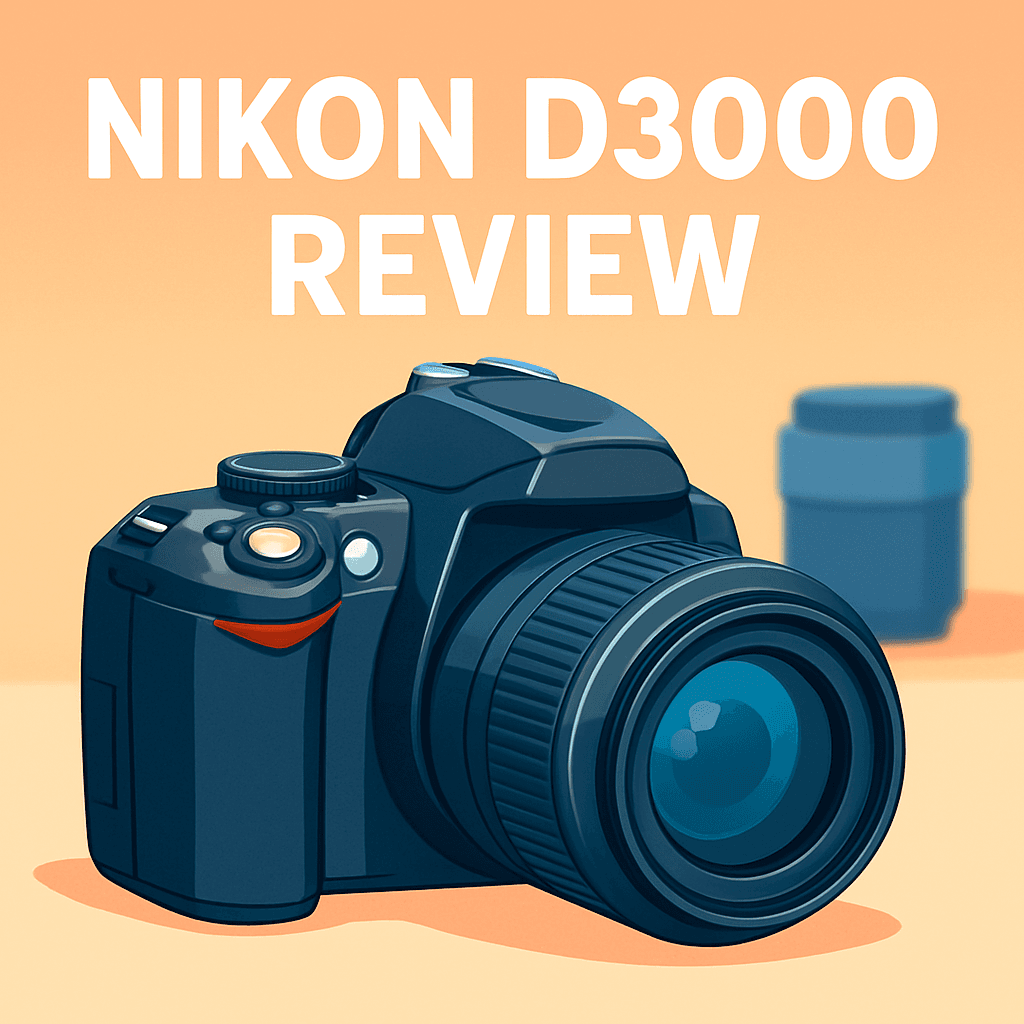
Curious if a basic DSLR can seriously upgrade your photos? This nikon d3000 review examines whether the Nikon D3000 Camera’s the right, easy step up for beginners.
I’ve shot one in the field, so you’ll get hands-on notes about image quality at base-to-mid ISO, autofocus reliability, and how the viewfinder and LCD feel in real use.
It’s aimed at still-focused beginners, travelers, and hobbyists who value simple, reliable results, and it works with Nikon F glass (full AF with AF-S/AF-I). Keep reading.

Nikon D3000 Camera
Lightweight, entry-level DSLR delivering crisp 10.2MP images, user-friendly controls, and guided shooting modes—perfect for first-time photographers seeking versatile performance and reliable image quality for everyday adventures and learning.
Check PriceThe Numbers You Need
| Spec | Value |
|---|---|
| Sensor | 10.2 MP DX-format CCD |
| ISO Range | 100–1600 (expandable to 3200) |
| Autofocus Points | 11-point AF system |
| Continuous Shooting | 3 fps |
| LCD Screen | 3-inch TFT, 230,000 dots |
| Viewfinder | Optical pentamirror, 0.8x magnification |
| Video Recording | VGA 640 x 480 at 30 fps |
| Shutter Speed | 30 sec to 1/4000 sec |
| Metering | 420-pixel RGB sensor with 3D Color Matrix Metering II |
| Built-in Flash | Yes, with slow sync and rear-curtain sync |
| Storage Media | SD/SDHC card compatible |
| Battery | EN-EL9 rechargeable Li-ion |
| Weight | Approximately 485 grams (body only) |
| Dimensions | 126 x 94 x 64 mm |
| Lens Mount | Nikon F mount (AF-S/AF-I lenses for full autofocus) |
How It’s Built
In my testing with the Nikon D3000 Camera, the body felt pleasantly light and easy to carry all day. The grip is comfortable with a typical kit zoom attached, so you can shoot family events without arm fatigue. It’s friendly for beginners who don’t want a bulky camera.
The rear screen is useful for menus and quick image checks, and I found it straightforward to navigate. Don’t expect to nail critical focus from the screen alone, though — it’s fine for everyday use but not for pixel-level inspection. I really liked how simple the menus are.
The optical viewfinder gives a clear, honest image for composing and shooting. That said, the view is a bit small compared to higher-end bodies, so manual focusing and tight framing can take more practice. One thing that could be better is the viewfinder size for new shooters.
Controls are well placed and click into place with reassuring feedback when you press them. The built-in flash offers creative sync options, and using common memory cards keeps things painless when you’re out shooting. The battery life means bringing a spare for long days is a smart move.
Overall the build feels solid for everyday use without being intimidating. There’s a little flex in the plastic here and there, but nothing that worried me during normal handling. For beginners this is a dependable, easy-to-learn body that won’t slow you down.
In Your Hands
The Nikon D3000 Camera’s autofocus, anchored by an 11-point AF system, feels confident in everyday light and frames subjects reliably for most casual shooters. Lens choice matters: AF-S/AF-I glass lets the AF sing, while older screw-drive lenses can slow things and require a touch more patience from the photographer. In practice the AF coverage is sensible for travel and family scenes, if not built for sporty action.
Continuous shooting is modest rather than sporty, delivering a steady stream for kids, pets, and holiday moments without the breathless chatter of pro rigs. You get short, usable bursts that let you capture expressions and small movements without feeling like you’ve missed the shot.
In daylight the camera’s native sensitivity range yields clean, pleasing files, and the extended high setting is a rescue option when light fades — at the expected cost in noise and contrast. The shutter range offers the flexibility to tame bright apertures or settle in for deliberate long exposures, making creative night or daylight work straightforward.
Nikon’s 3D Color Matrix Metering II generally nails exposure across varied scenes, though tricky backlit or high-contrast situations sometimes benefit from a touch of exposure compensation. The built-in flash is handy and creative thanks to slow-sync and rear-curtain options that produce natural-looking portraits and intentional motion trails.
Video is a simple, grab-and-go feature suited to short clips rather than cinematic work, so stills remain the main attraction. Day-to-day responsiveness is solid: the D3000 wakes and cycles with a reassuring, tactile feel that keeps you shooting without fuss.
The Good and Bad
- Lightweight, compact body
- Eleven-point AF system for flexible composition
- Low-base ISO and long exposure capability for tripod and night creative work
- Built-in flash with slow sync and rear-curtain sync for creative lighting
- Modest megapixel resolution limits cropping headroom by modern standards
- ISO ceiling limits low-light performance
Ideal Buyer
The Nikon D3000 Camera is best for shooters who put stills first and video second. If you spend most of your time in good light and care about clean base-ISO images, this body rewards you with dependable color and consistent metering. Casual action like kids and pets is well within reach thanks to its 11-point AF and modest burst rate.
Travelers and hobbyists will appreciate the compact, lightweight DSLR form and the honest optical viewfinder experience. It packs enough control to learn exposure and composition without overwhelming menus or flashy video features. Its battery and SD/SDHC convenience make it an easy companion for weekend trips and family events.
Beginners or shooters stepping up from a phone will find the ergonomics intuitive and the 3-inch LCD useful for framing and playback. Owners of Nikon F glass get the most value if they already have or plan to buy AF‑S/AF‑I lenses for full autofocus support. If you prize straightforward controls and reliable metering over megapixels and Hi‑Def video, this is a sensible pick.
This camera isn’t for low‑light specialists or hybrid shooters who need full HD video or extended high‑ISO flexibility. If you crave greater resolution or cleaner high‑ISO performance, consider newer D3x00 models. But for still‑focused photographers who want a simple, trustworthy DSLR, the D3000 hits the sweet spot.
Better Alternatives?
We’ve gone through the nikon d3000 review and what that camera does well in real shooting: a simple, lightweight body, reliable metering, and a focus system that works fine in good light. If you like the D3000’s feel but want more from your pictures or video, there are a few close options worth thinking about.
Below I’ll walk through three alternatives I’ve used in the field. I’ll point out what each one does better and where it falls short compared with the D3000, and who would most likely prefer each body.
Alternative 1:

Nikon D3100 Camera
Compact, beginner-friendly DSLR with enhanced 14MP sensor and full HD video capture, intuitive Guide Mode, and excellent low-light performance—ideal for hobbyists upgrading their photographic skills.
Check PriceI used the D3100 a lot when I wanted slightly better pictures without changing how I shoot. Compared with the D3000 it gives noticeably cleaner images at higher ISOs and a bit more detail thanks to its newer sensor. In practical terms that means fewer noisy shots indoors and more usable frames when the light drops, which feels like a real upgrade if you shoot family events or travel in dim places.
The D3100 also adds full HD video, which the D3000 lacks. I found the video quality a step up for short clips and casual movies — better color and sharper footage when handheld. The handling stays very close to the D3000, so there’s almost no learning curve. Where it’s worse, the D3100 doesn’t change the basic autofocus feel or burst speed much, and it still relies on the same type of AF-S lenses for full autofocus, so action shooting isn’t dramatically improved.
If you’re a hobbyist who wants better low-light shots and the ability to record decent HD clips without leaving the Nikon family, the D3100 is a good pick. If you’re chasing very fine detail or need faster autofocus for sports, you might want something stronger than this entry-level step up.
Alternative 2:

Nikon D3200 Camera
High-resolution 24MP sensor, refined image processing, and full HD video in a compact body—delivers crisp detail, responsive autofocus, and creative controls for enthusiasts who demand sharper, professional-looking results.
Check PriceThe D3200 is the one I reach for when I want a lot more detail without moving to a bigger, heavier camera. In real shooting it gives much sharper files than the D3000 — you can crop more and still keep good detail for prints or web use. For landscapes and portraits where clarity matters, the difference is obvious: the D3200 renders textures and small details much better.
That higher resolution also has trade-offs. On cheap kit lenses the extra megapixels will reveal softness you didn’t notice on the D3000, so lens choice matters more. Files are bigger, which means more card space and a slightly slower workflow when culling and editing. Autofocus and handling feel similar to the D3000, so you don’t gain faster action performance — you mainly gain image detail and better overall image quality.
Buy the D3200 if you want sharper photos for landscapes, portraits, or travel where cropping matters, and you don’t mind managing larger files. It’s best for an enthusiast who wants a noticeable image-quality jump but still wants to keep a light, easy camera to carry.
Alternative 3:
Nikon D3200 Camera
Compact enthusiast DSLR offering 24MP resolution, expanded ISO range, and lively color reproduction; intuitive controls and lightweight design make it great for travel, portraits, and high-detail landscape photography.
Check PriceSeen from a travel and portrait shooter’s point of view, the D3200 brings lively color and plenty of detail in a small package. When I used it on trips I noticed skin tones and greens looked more pleasing straight out of camera than on the D3000, and the extra pixels meant I could crop tightly on a distant subject and still keep good quality — handy when you can’t get closer.
Where it’s worse than the D3000 is in how demanding it is on lenses and storage. If you keep using the basic kit zoom, you’ll see its limits more clearly than on the D3000. Also, bigger files slow down your editing unless you upgrade cards and storage. The camera itself stays light and easy to hold, but you’ll want a sharper prime or a better zoom to get the most from that 24MP sensor.
If your priority is travel, portraits, or landscape detail and you’re willing to invest in a better lens or more storage, the D3200 is the best fit here. It’s for shooters who want more image quality from a compact DSLR and who care about final picture detail more than raw speed or advanced controls.
What People Ask Most
Is the Nikon D3000 a good camera for beginners?
Yes — it’s a simple, entry-level DSLR that’s easy to learn on and handles basic photography tasks well, though it lacks many modern features.
What are the pros and cons of the Nikon D3000?
Pros: easy to use, affordable used, and solid image quality for its era; Cons: older sensor, limited autofocus, no video or live view, and weaker high-ISO performance.
How good is the image quality of the Nikon D3000?
Image quality is decent at low ISO and for daylight shooting, but dynamic range and high-ISO noise fall short of newer cameras.
Nikon D3000 vs D3100: what are the differences?
The D3100 adds HD video, a better sensor and improved low-light/AF performance, while the D3000 is simpler and usually cheaper on the used market.
Can the Nikon D3000 record video?
No — the D3000 does not have video recording; Nikon introduced video with the D3100.
Is the Nikon D3000 still worth buying?
It’s worth it only as a very cheap learning camera or for someone who already has compatible lenses; if you want video or better low-light performance, buy a newer model.
Conclusion
The Nikon D3000 Camera remains a tidy entry-level DSLR that excels where it was always meant to: straightforward stills, dependable shooting and uncomplicated handling. It feels light in the hand and gets out of the way so you can concentrate on composition. In this nikon d3000 review I treat it as a purposeful tool, not a do‑everything gadget.
Its metering is reliable and the autofocus system is sensible for everyday work, making it easy to capture family, travel and daylight scenes. The optical viewfinder and simple flash controls keep creative options accessible without a steep learning curve. For shooters who prioritize clear stills over video bells and whistles, its balance of features is persuasive.
Expect tradeoffs: resolution, low‑light latitude and movie capability all lag behind more recent entry models. The screen and viewfinder make critical checking tougher, and older non‑modern lenses limit autofocus convenience. If you need more cropping room, cleaner high‑ISO performance or full‑HD video, this body will feel dated.
For buyers who shoot mostly in good light and want a light, reliable DSLR with familiar Nikon lens options, the D3000 still offers real value. If you want obvious upgrades, look at the D3100, D3200 or cross‑shop a Canon Rebel T5 as sensible next steps.
Nikon D3000 Camera
Lightweight, entry-level DSLR delivering crisp 10.2MP images, user-friendly controls, and guided shooting modes—perfect for first-time photographers seeking versatile performance and reliable image quality for everyday adventures and learning.
Check Price



0 Comments