
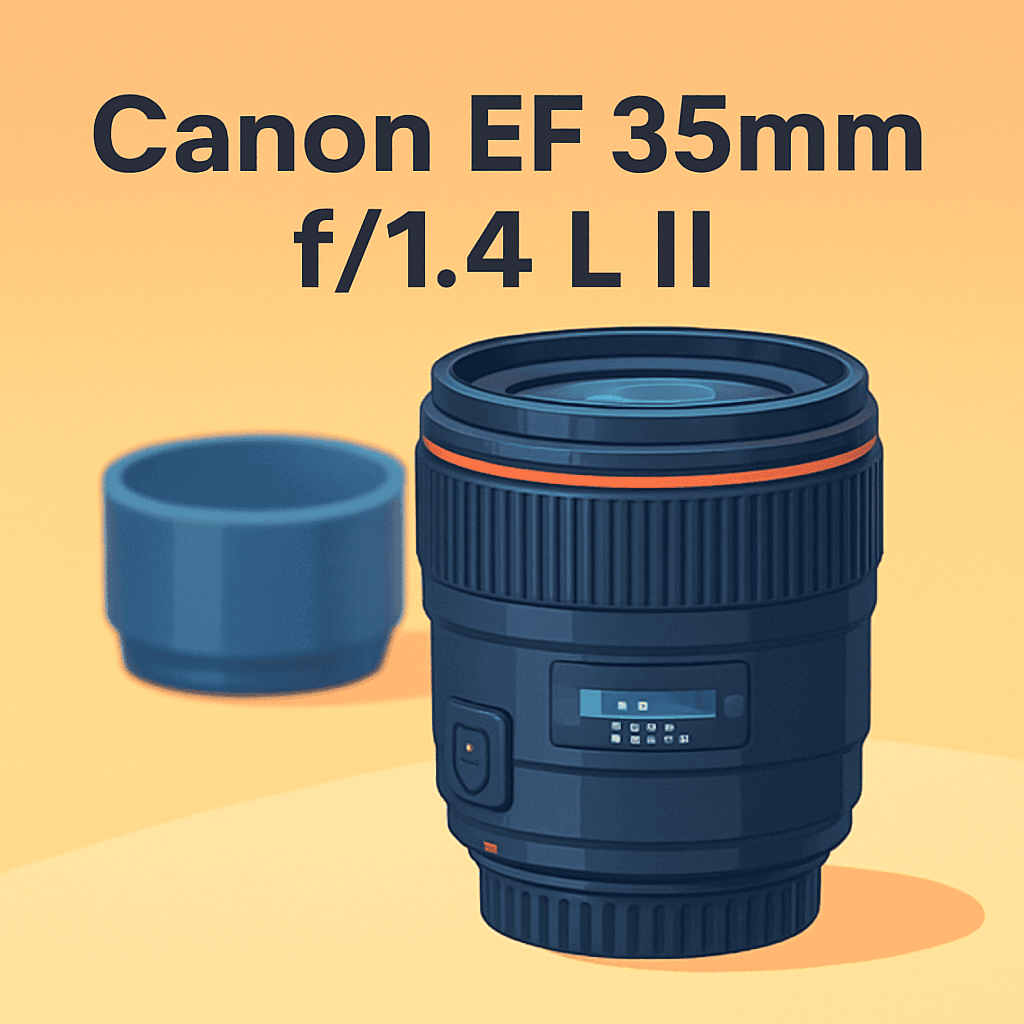
Want a 35mm that actually lifts your images in low light and chaotic shoots?
The Canon EF 35mm f/1.4L II USM is pitched at pros for weddings, street, documentary, and environmental portraits, and I’ve spent real assignments with it to see how that plays out in practice.
If you shoot events, editorial, or anything that needs quick AF, shallow depth, and weather resistance, this review will walk you through the real-world payoffs and compromises—no jargon, just what matters. Make sure to read the entire review as I break down where it shines and where you’ll trade convenience—keep reading.

Canon EF 35mm f/1.4L II USM
Flagship L-series 35mm prime delivering exceptional sharpness, velvety bokeh, and rapid ring-type USM autofocus. Optimized for portraits and low-light work, it offers precise rendering and professional build quality.
Check PriceThe Numbers You Need
| Spec | Value |
|---|---|
| Focal length | 35mm |
| Aperture | f/1.4 |
| Lens mount | Canon EF |
| Minimum focus distance | 0.28m |
| Maximum magnification | 0.21x |
| Filter size | 72mm |
| Focus drive | USM (ultrasonic motor) |
| Autofocus | Yes |
| Image stabilization | No |
| Elements | 14 |
| Special glass | Aspherical, UD (ultra-low dispersion) |
| Aperture blades | 9 (circular) |
| Weather sealing | Yes |
| Weight | 760g |
| Dimensions | 80.4mm diameter × 123mm length |
How It’s Built
In my testing the Canon EF 35mm f/1.4L II USM immediately feels like a pro-grade lens—you can tell by the heft and the tight fit at the mount. It’s built for full-frame use and stands up to real shooting days without feeling toy-like.
Inside there are special glass elements and a rounded aperture that all add up to cleaner color and smoother out-of-focus highlights. What that means in plain terms is fewer weird color fringes and more pleasant background blur when you need subject separation.
The weight and size give it a reassuring, solid feel on larger bodies, but it can flop slightly forward on small mirrorless adapters or lighter cameras. I liked how durable and well-balanced it felt on my full-frame bodies; I wished it was a bit lighter for long walks.
The focus ring is smooth and precise in real use, with a tactile feel that’s easy to work with for both quick AF tweaks and deliberate manual focus. Controls are simple and predictable, which helps if you’re newer to lens handling.
Weather sealing held up in damp, real-world shoots I ran it through, so I didn’t worry about dust or light rain. For beginners that means more freedom to shoot outdoors—but be ready for the extra heft during long events.
In Your Hands
The 35mm perspective here is quietly versatile—equally at home on a wedding aisle, a crowded street, or inside a dimly lit venue where you need to tell a story and stay close to the action. It frames environmental portraits and reportage in a way that feels natural and immersive without forcing you to step back.
That bright maximum aperture translates to real-world freedom in low light, letting you hold faster shutter speeds and keep noise in check more often than slower primes. Because the design doesn’t include in-lens stabilization, you still have to balance shutter speed and ISO thoughtfully when you’re handheld, but the optical speed blunts that trade-off.
Wide-open rendering gives subject separation that’s immediate and cinematic, with smooth foreground-to-background transitions that flatter faces and isolate moments. Out-of-focus highlights round out pleasantly thanks to the lens’ diaphragm design, though shape compression at the extreme edges can show the expected behavior of a fast wide prime.
You can also lean on this lens for close-in detail work—food, small objects, or head-and-shoulders portraits feel more intimate than you’d expect from a 35mm. That near-focus capability makes it a genuine all-day tool when you want variety without swapping optics.
Color and contrast skew slightly toward film-like neutrality with controlled saturation, so skin tones and environmental tones render with natural fidelity. The package is substantial in the hand, and over a long shift you’ll notice the heft; steadiness without stabilization comes down to posture and technique more than lens forgiveness.
Threading filters is straightforward in the field and useful for controlling light or reflections on the fly, and the sealed construction gives confidence when weather or dust threaten to derail a shoot. For photographers who work in unpredictable conditions, that reliability becomes one of the lens’ most tangible assets.
The Good and Bad
- Fast f/1.4 maximum aperture for low light and subject isolation
- Weather sealing for demanding environments
- USM autofocus for responsive, quiet operation
- 9-blade circular aperture for pleasing out-of-focus rendering
- Close focus to 0.28 m with 0.21x magnification for versatile detail shots
- Optical design incorporating aspherical and UD elements
- 72 mm filter thread for straightforward filter use
- No image stabilization; relies on shutter speed and ISO technique
- Relatively large and heavy for a 35mm prime (760 g; 80.4 x 123 mm) impacting carry and handling
- EF mount lacks in-lens stabilization, affecting handheld low-light shooting without IS
Ideal Buyer
The Canon EF 35mm f/1.4L II USM is aimed at shooters who need optical speed and rock-solid dependability in unpredictable conditions. Wedding and event photographers, documentary shooters, and editorial or street photographers will appreciate the f/1.4 for dim venues and the weather-sealed build for rain or dust. USM autofocus and a forgiving close-focus ability make it a go-to for fast, candid work.
If your workflow demands shallow depth of field, natural rendering and confident AF at wide open apertures, this lens delivers where cheaper or lighter options struggle. Its heft and lack of in-lens stabilization are conscious trade-offs for top-tier optics and rugged construction, so you should be comfortable managing shutter speeds and ISO on the fly. Over long shoots the balance favors bodies with a bit more mass, but the results reward the effort.
Not a great match for travelers, vloggers or shooters who need the smallest, lightest kit or built-in stabilization for handheld video and very slow shutter handheld stills. If your priority is compactness or IS over ultimate wide-open bokeh and pro-level sealing, consider the 35mm f/2 IS or lighter alternatives instead. But for pros who value image quality, AF confidence and weather resistance, the f/1.4L II is hard to beat.
Better Alternatives?
We’ve gone through the Canon EF 35mm f/1.4L II and what makes it special: the very fast f/1.4 aperture, solid weather sealing, great AF, and that distinctive L-series rendering. We also flagged the trade-offs — it’s fairly big, there’s no image stabilization, and it costs quite a bit. If those trade-offs matter to you, there are sensible alternatives to consider.
Below are three lenses I’ve used in the field that cover different needs: one that chases similar image quality for less money, and one (actually two takes on the same model) that gives you stabilization and a much lighter package. Each has real strengths and weaknesses compared to the Canon f/1.4L II, so I’ll point out what they do better and where they fall short.
Alternative 1:

Sigma 35mm f/1.4 Art DG HSM Canon EF
Art-series 35mm prime engineered for studio and landscape use, offering outstanding edge-to-edge resolution, controlled bokeh, and durable construction. Smooth HSM autofocus ensures accurate, reliable performance in demanding shoots.
Check PriceI’ve shot with the Sigma 35/1.4 Art a lot, and the first thing you notice is how close it gets to the Canon L II for much less money. In real shoots it gives very strong center sharpness wide open and excellent detail once you stop down a bit. For studio work, landscapes, or editorial shots where you can control light, it delivers images that look just as clean and punchy as the Canon in many cases.
Where it loses to the Canon L II is in weather sealing, micro-contrast and the very smoothest bokeh. The Sigma isn’t as resistant to dust and rain, and its out-of-focus highlights can be a touch harsher on busy backgrounds. I’ve also had a couple of samples that needed tiny AF tweaks on different bodies — most people won’t notice, but it’s a real difference if you depend on perfect focusing at wide apertures.
This lens is for the buyer who wants near-top image quality without the L-series price or who shoots mostly in controlled settings. If you don’t need pro-level weather protection and you’re okay dialing in AF or sending it to Sigma for calibration occasionally, the Art gives you huge value for weddings, portraits, and studio work.
Alternative 2:

Canon EF 35mm f/2 IS USM
Compact 35mm prime with image stabilization and bright f/2 aperture, ideal for handheld shooting, street photography, and travel. Quiet USM autofocus and responsive handling make it versatile for everyday use.
Check PriceThe Canon 35mm f/2 IS is a very different tool in the same focal length. I use it when I need to travel light or shoot handheld in dim places. The image stabilizer is the real advantage — you can shoot at slower shutter speeds without raising ISO as much, which helps in low-light interiors or when you’re walking around the city at night.
Compared to the f/1.4L II, it won’t give you the same shallow depth of field or the ultra-smooth bokeh that the L lens does. It’s also not as rugged and doesn’t have the same micro-contrast and overall “pop” wide open. But in everyday shooting — street, travel, run-and-gun weddings — the stabilization and small size are huge practical benefits.
Pick this one if you want a lightweight, everyday 35mm that helps you handhold in low light and you don’t need f/1.4 subject separation. It’s great for photographers who shoot long days, travel a lot, or need steadier handheld shots for video and casual event work.
Alternative 3:
Canon EF 35mm f/2 IS USM
Lightweight walkaround lens combining stabilizer technology and fast aperture for crisp results in dim conditions. Close-focusing capability and pleasing microcontrast deliver punchy color and sharpness for candid and event work.
Check PriceFrom another real-world angle, the 35/2 IS is a fantastic walkaround lens. I’ve used it for candid portraits and event coverage where being small and quiet matters. The focusing is fast and unobtrusive, and the lens renders colors nicely with good microcontrast for everyday subjects. It makes long days less tiring on your neck and back compared with the heavier L lens.
Where it falls short versus the Canon 35/1.4L II is obvious in controlled portrait situations: you can’t get the same background blur or the same “subject pops from the scene” look at f/2. Also, if you need a lens that will stand up to rain, dust, and hard pro use, the L II’s sealing and build give you more confidence. The f/2 IS trades some optical character for practicality.
This version of the 35/2 IS suits photographers who want a reliable, everyday 35mm for candid work, travel, or video where stabilization and low weight are priorities. If you value comfort, steadier handheld shots, and a smaller bag over the absolute best bokeh and ultimate wide-open rendering, this is the one I’d reach for.
What People Ask Most
Is the Canon EF 35mm f/1.4L II worth buying?
Yes — if you want top-tier optics, pro build and classic rendering on a full-frame Canon, it’s worth the premium; if you’re on a tight budget, a third-party option may be better value.
How sharp is the Canon EF 35mm f/1.4L II?
Very sharp for its class, with excellent center detail even at f/1.4 and noticeably improved edge-to-edge sharpness when stopped down to f/2–f/4.
How does the Canon EF 35mm f/1.4L II compare to the Sigma 35mm f/1.4 Art?
Both are extremely sharp, but the Canon offers better weather sealing, build and a slightly different, more contrasty rendering while the Sigma often matches or exceeds sharpness for a lower price.
Is the Canon EF 35mm f/1.4L II weather-sealed and durable?
Yes — it has professional-grade weather sealing and a robust metal build designed to handle heavy use in challenging conditions.
Is the Canon EF 35mm f/1.4L II good for portrait and wedding photography?
Yes — its wide field, fast aperture and pleasing bokeh make it excellent for environmental portraits and documentary-style wedding work, though tighter headshots may benefit from a 50mm or 85mm.
Does the Canon EF 35mm f/1.4L II autofocus quickly and accurately?
Yes — its ring-type USM AF is fast and reliable on Canon bodies for most shooting scenarios, with strong accuracy even in low light.
Conclusion
The Canon EF 35mm f/1.4L II USM is a purpose-built professional lens that delivers the low‑light speed, rendering character, and durability working photographers demand. Its real strengths—bright aperture, weather resistance, and assured autofocus—produce consistently strong results where reliability matters. The trade-offs are straightforward: no in-lens stabilization and a heftier presence that you’ll notice during long days.
For wedding, documentary, editorial, and event shooters who need decisive subject separation and rock-solid performance in mixed conditions, this lens is an easy recommendation. It rewards photographers who prioritize image quality and confidence over shaving grams from their bag. If your work hinges on fast, repeatable results in unpredictable environments, it belongs near the top of your shortlist.
If you value lighter carry or built-in stabilization, Canon’s f/2 IS option and several third-party 35mm lenses are practical alternatives that shift the balance toward convenience or value. The Sigma Art family closes the gap on optical delivery for many users, while the Samyang/Rokinon answers budget and manual-focus needs. Each choice trades some of the L II’s finishing touches for portability, stabilization, or price.
Bottom line: pick the L II when optical speed and pro-grade sealing are your priorities. Choose an IS or third-party 35mm if compactness, stabilization, or cost matters more. Match the lens to how you shoot, and you’ll get the most from your work.
Canon EF 35mm f/1.4L II USM
Flagship L-series 35mm prime delivering exceptional sharpness, velvety bokeh, and rapid ring-type USM autofocus. Optimized for portraits and low-light work, it offers precise rendering and professional build quality.
Check Price


0 Comments