
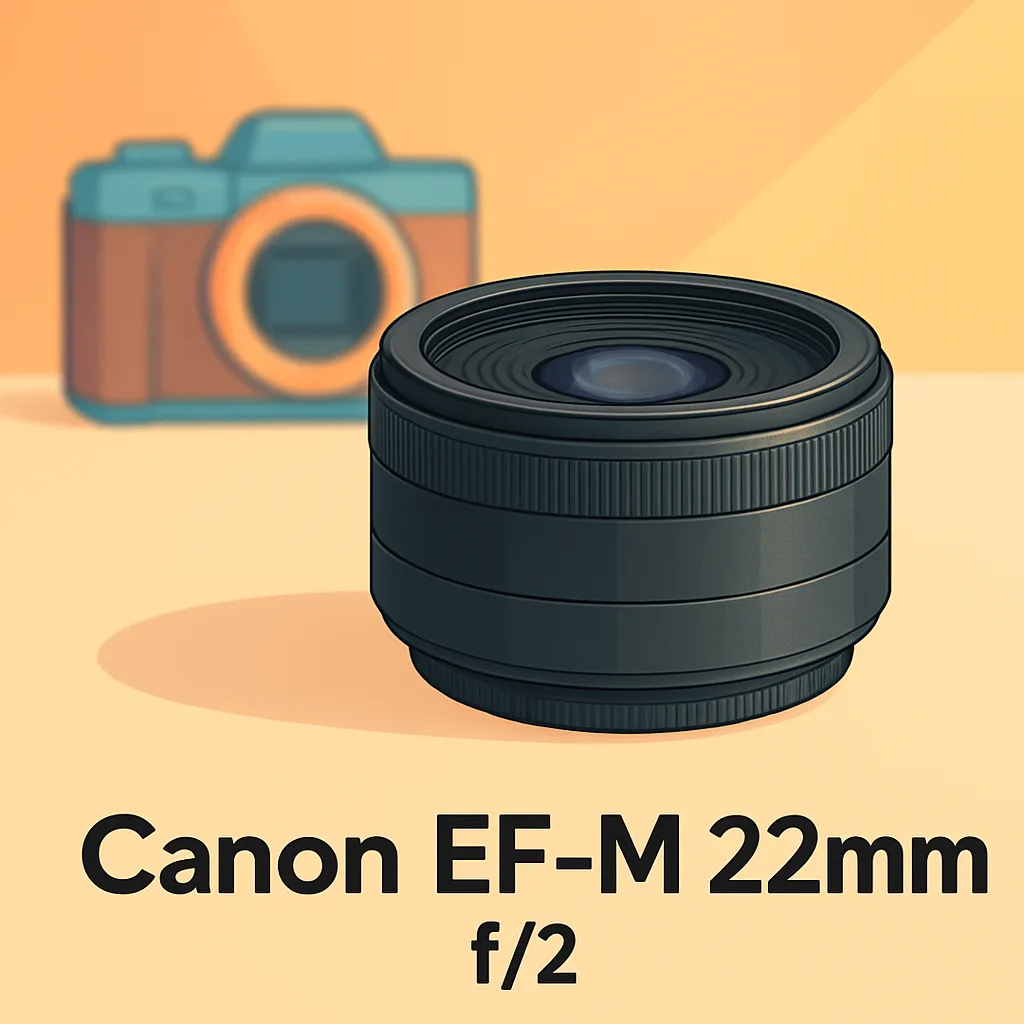
Want a lens that disappears on your camera but still helps you make better street and travel photos? The Canon EF-M 22mm f/2 is that compact, bright wide-normal prime that many EF-M shooters reach for when they want low-profile, usable optics.
It’s tiny, light, and gives you a usable f/2 for low-light and subject separation, plus quiet STM-like autofocus and surprisingly close close-focus for detail shots. After taking it out on several long walks and shoots, I quickly saw where it shines in real-world use.
It won’t be for everyone — think plastic construction, no optical stabilization, and very simple controls — but if you’re after pocketable discretion and everyday versatility, this review’s worth your time. Make sure to read the entire review as we dig into handling, image character, and whether it should be your always-with-you lens — keep reading.

Canon EF-M 22mm f/2
Ultra-slim pancake prime delivering bright, sharp images in a compact form factor. Ideal for street and travel photography with natural perspective, quick autofocus, pleasing background separation, and excellent low-light performance.
Check PriceThe Numbers You Need
| Spec | Value |
|---|---|
| Focal Length | 22 mm |
| Maximum Aperture | f/2 |
| Lens Mount | Canon EF-M |
| Format Compatibility | APS-C |
| Angle of View | Approx. 63° |
| Lens Type | Pancake wide-normal prime |
| Autofocus | STM (Stepping Motor) |
| Minimum Focus Distance | 0.15 m (15 cm) |
| Maximum Magnification | 0.21× |
| Optical Construction | 7 elements in 6 groups |
| Diaphragm Blades | 7 (rounded) |
| Filter Size | 43 mm |
| Lens Dimensions (Diameter × Length) | Approx. 60.9 mm × 22.8 mm |
| Weight | Approx. 105 g |
| Special Features | Compact, lightweight design suited for street and everyday photography |
How It’s Built
In my testing the Canon EF-M 22mm f/2 feels like a true pocket lens — tiny, light, and barely there on the camera. That makes it a joy to carry all day and to pull out for quick street grabs without drawing attention. For real-world shooting that “always-with-you” vibe matters more than you’d think.
I really liked how unobtrusive the profile is; it simply invites more shooting when you’re out and about. What could be better is the plastic, non-sealed construction — it’s fine for daily use but I’d be careful in rain or gritty environments. In short, great for travel and cafés, less so for stormy hikes.
The controls are simple, which is good for beginners who don’t want a lot of fiddly bits. After using it for a while I missed a physical aperture ring when I wanted fast, tactile changes. Still, the streamlined layout keeps the learning curve low and speeds up candid work.
On small EOS M bodies the balance is pleasantly neutral and it slips into coat pockets or tiny pouches with no fuss. The small filter and cap are practical — inexpensive to replace and easy to stow. Overall it feels well finished for the price, just not built for abuse.
In Your Hands
The Canon EF-M 22mm f/2’s tiny footprint makes it a consummate street and travel companion, slipping onto a mirrorless body without shouting for attention. Its wide‑normal field of view frames environmental portraits, cityscapes and candid moments in a natural, unobtrusive way that encourages spontaneous shooting. Carrying it feels like carrying a camera rather than a lens, which changes how often you reach for the camera.
That bright aperture opens practical low‑light possibilities, letting you lean on available light and handheld shooting more often than with slower walkaround glass. Without optical stabilization you do trade a margin of shutter‑speed flexibility, so steady posture, deliberate breathing and slightly higher ISO choices become part of the workflow—especially for video or dim interiors. The result is usable, characterful frames rather than a constant hunt for a tripod.
Close‑focus capabilities are a pleasant surprise for food, street detail and product snippets, letting you isolate small subjects while still showing a hint of context. At the closest distances the perspective feels slightly wide, which can be creative for telling visual stories rather than tight macro reproduction. Background separation is modest but pleasing, and highlight rendition is smooth thanks to the rounded diaphragm character.
The pancake design also reduces social friction; people notice a small lens less, and that translates into more honest expressions and moments. Ergonomically it balances well on compact bodies, and the minimalist control set keeps shooting simple—though the plastic, non‑sealed construction and the small front cap can feel fiddly over long outings. Autofocus use during extended walks didn’t appreciably drain battery when used sparingly, but continuous live‑view AF sessions will shorten runtime compared with conservative shooting habits.
The Good and Bad
- Ultra-compact pancake design; approx. 22.8 mm length and 105 g weight
- Bright f/2 aperture for a wide-normal prime
- Close focusing: 0.15 m minimum focus, 0.21x magnification
- STM autofocus motor
- 43 mm filter size keeps accessories small and affordable
- Purpose-built for street and everyday photography (discreet profile)
- Plastic, non-sealed construction
- No optical stabilization
- Minimal external controls; no physical aperture ring
Ideal Buyer
The Canon EF‑M 22mm f/2 is aimed squarely at EF‑M shooters who want a lens they forget they’re wearing until the decisive moment arrives. Its pancake profile, roughly 105 grams and bright f/2 aperture combine to make it exceptionally pocketable for daily carry while retaining usable low‑light punch. Close‑focus ability and a wide‑normal field of view suit street, travel and environmental portrait work where discretion and compositional flexibility matter most.
Treat it as an always‑on companion for documentary days, café nights and quick product or food detail shots at 0.15 meters without hauling extra glass. The STM autofocus is quiet and unobtrusive, helping preserve candid moments, and the small 43mm filter thread keeps accessories light and affordable. Mounted on EOS M bodies it balances naturally, encouraging handheld shooting and long walks without fatigue.
You should look elsewhere if your priorities include rugged weather sealing, a metal build or any form of image stabilization for slower shutter work. Photographers who demand extreme subject separation or the very fastest apertures will prefer larger, faster alternatives. But for most EF‑M owners who prize stealth, simplicity and an always‑ready wide‑normal prime, the 22mm f/2 is a compelling everyday choice.
Better Alternatives?
We’ve gone through what the Canon EF‑M 22mm f/2 does best: a true pocketable, “always‑with‑you” lens that keeps your camera small and lets you shoot quietly and quickly on the street. It’s great when you want to stay unnoticed, move fast, and carry almost nothing. But that compactness comes with tradeoffs — plastic body, no weather sealing, and a modest f/2 aperture compared with some faster options.
If you want a lens that leans more into build quality, low‑light power, or a different field of view and look, there are a few clear alternatives worth considering. Below I’ll run through three I’ve used in real life and explain what each one gives you compared to the Canon, and who would be happiest with each choice.
Alternative 1:

Fujifilm XF 23mm f/2 R WR
Weather-sealed compact prime offering crisp optics and a fast aperture for detailed image rendering. Built for reliability in challenging conditions, it produces smooth bokeh, punchy colors, and versatile street-to-landscape performance.
Check PriceThe Fujifilm XF 23mm f/2 R WR feels like a tougher, more grown‑up version of the Canon. I’ve used it in rain and dusty city walks and the weather sealing gives real peace of mind — you can keep shooting without worrying about light showers or grit. It also has an aperture ring, which makes quick exposure tweaks feel natural and faster than digging through camera menus.
In actual shooting, the Fuji tends to give slightly punchier contrast and a bit more micro‑detail than the Canon, especially when you stop down a touch. It’s not a huge leap in look, but the handling and reliability in bad weather are where it shines. The tradeoff is size and weight: it’s bigger and more noticeable on a small camera, so it’s less “stealth” for candid street work than the EF‑M pancake.
If you shoot a lot outdoors, travel in mixed weather, or just want nicer tactile controls, the Fujifilm will appeal to you. If your priority is absolute pocketability and being as unobtrusive as possible while shooting street or travel, stick with the Canon.
Alternative 2:

Sigma 30mm f/1.4 Contemporary Sony E
Bright standard prime with ultra-fast aperture for dramatic low-light capability and creamy bokeh. Robust build, precise autofocus and exceptional edge-to-edge sharpness make it a favorite for portraits and everyday shooting.
Check PriceThe Sigma 30mm f/1.4 is a different animal: it’s much faster and gives you real low‑light power and creamy background separation. I’ve shot bars, small cafes, and dim indoor events with this lens and it lets you pull off shots the Canon simply can’t without raising ISO or using flash. The look is more “portraity” — subjects pop off the background much more.
That advantage comes with downsides. The Sigma is noticeably bigger and heavier, so you lose the pocketable, always‑carry benefit of the EF‑M 22mm. The field of view is tighter too, so you’ll need to step back or rethink framing for street scenes and interiors. Also, if you want to stay invisible while shooting quick candids, the Sigma draws more attention.
This lens is for shooters who want the shallow depth and low‑light freedom — portraitists, event shooters, and anyone who prioritizes subject separation over ultimate compactness. If you want small, fast, and invisible, the Canon still wins; if you want more creative control over blur and exposure in hard light, pick the Sigma (on a Sony body).
Alternative 3:
Sigma 30mm f/1.4 Contemporary Sony E
Engineered for mirrorless systems, this lens delivers stunning subject separation and high-resolution rendering even wide open. Compact yet solid, it balances sharpness, beautiful out-of-focus rendition, and responsive AF for creatives.
Check PriceThinking about the Sigma again from a different angle: it’s a lens that forces you to work differently. With the Canon I find myself getting close and blending scenes; with the Sigma I step back and isolate subjects. Its rendering wide open is very pleasing — smooth highlights, crisp eyes, and strong subject separation that changes how a story is told in a frame.
The downside, once more, is practicality. The Sigma adds bulk to a small mirrorless kit and can upset the balanced, low‑profile setup you get with the EF‑M 22mm. For video, its AF on good Sony bodies is quick and quiet, but on smaller or older bodies the size and focus behavior feel less nimble than the tiny Canon pancake.
Choose this Sigma if you’re after a creative tool that changes your shooting style — more separation, more low‑light options, and a different look. If your goal is small size, quick candid captures, and the lightest possible kit, the Canon EF‑M 22mm still makes more sense.
What People Ask Most
What is the full-frame equivalent focal length of the Canon EF-M 22mm f/2 on an EOS M camera?
On an EOS M (APS-C) body the 22mm focal length multiplies by 1.6x, giving roughly a 35mm full-frame equivalent.
Is the Canon EF-M 22mm f/2 good for low-light and night photography?
Yes — f/2 is bright enough for handheld low-light and night street shots, but you’ll often need higher ISO or a tripod since the lens has no stabilization.
How sharp is the Canon EF-M 22mm f/2 at f/2 compared to stopped down?
Center sharpness at f/2 is good for most uses, and overall sharpness and edge performance improve noticeably when stopped to f/4–f/8.
Does the Canon EF-M 22mm f/2 have image stabilization?
No — the lens does not include optical image stabilization, so stabilization must come from the camera or your technique.
Is the Canon EF-M 22mm f/2 suitable for street and travel photography?
Yes — it’s compact, lightweight and offers a natural 35mm-equivalent view that’s ideal for discreet street and travel shooting.
Can the Canon EF-M 22mm f/2 autofocus reliably with moving subjects?
Autofocus is fast and quiet for everyday moving subjects and street work, but it can struggle with very fast or erratic action and in low light.
Conclusion
The Canon EF-M 22mm f/2 is a pocketable, no-nonsense prime that makes carrying a camera feel effortless. Its compact silhouette, bright aperture and close-focusing ability turn a mirrorless kit into a discreet, always-ready tool for street and daily shooting. It’s the kind of lens that gets used because it’s easy to live with.
You get genuine creative freedom in a tiny package: low-light handheld shooting, quick candid framing and near-subject detail are all within reach. Autofocus is quiet and confidence-inspiring for stills and run-and-gun video. For many photographers, that simplicity is the lens’s most persuasive asset.
That convenience comes with tradeoffs. The build is lightweight and not weather-sealed, there’s no optical stabilization, and controls are deliberately minimal—factors that steer this lens away from rough conditions, heavy video work, or shooters who crave tactile dials. That means you’ll need to be more deliberate with technique and kit choices.
If you shoot on an EF-M body and prioritize discretion, portability and a bright, dependable normal field of view, this lens is a smart, high-value companion. If you need ruggedness, faster glass, or more manual control, look to the alternatives; otherwise this is an excellent everyday choice. For its intended audience it punches above its modest size.
Canon EF-M 22mm f/2
Ultra-slim pancake prime delivering bright, sharp images in a compact form factor. Ideal for street and travel photography with natural perspective, quick autofocus, pleasing background separation, and excellent low-light performance.
Check Price



0 Comments