
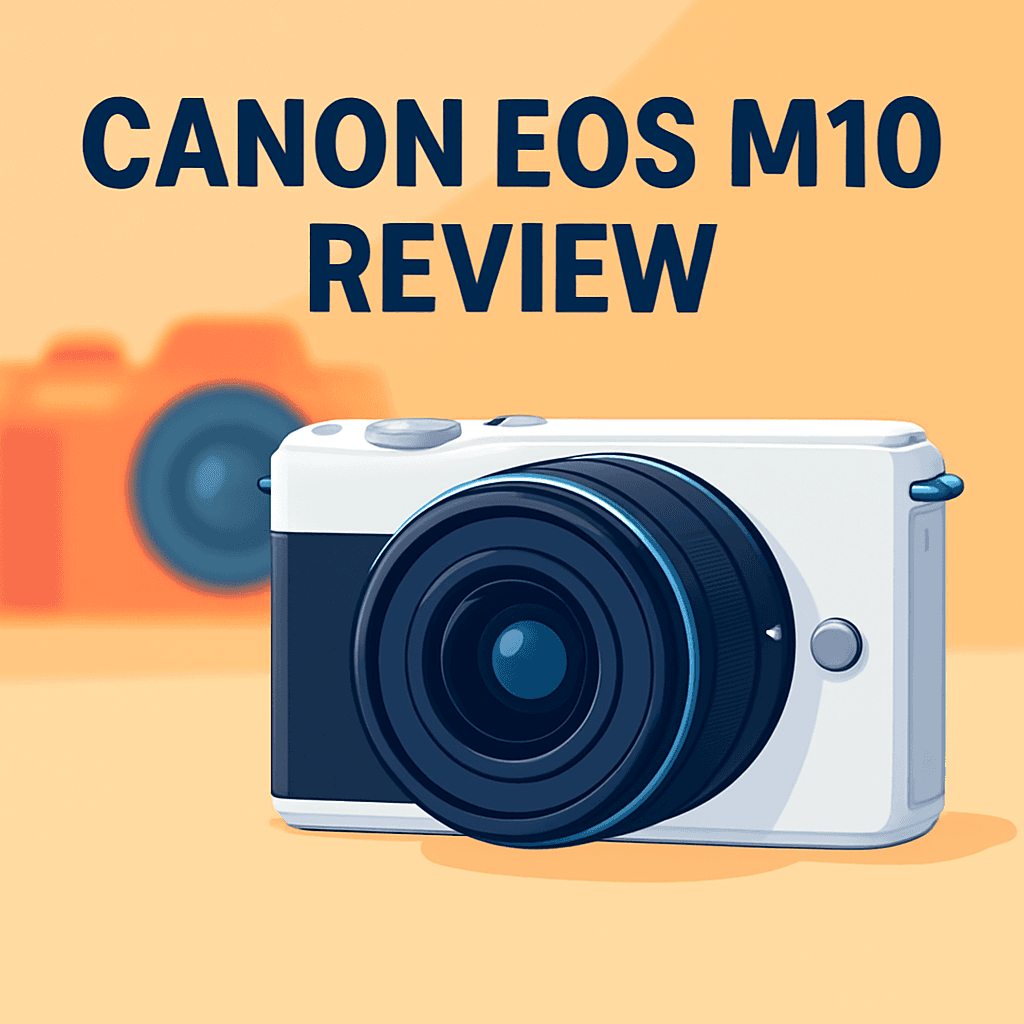
Want better photos than your phone without lugging around a bulky camera? The Canon EOS M10 Camera is a compact APS‑C mirrorless that promises easy sharing and a flip‑up touchscreen for selfies and vlogging.
I’ve spent time shooting streets, portraits, and travel with it, so you’ll get a hands‑on look at how it behaves in real situations. I’ll evaluate handling, autofocus in everyday use, image quality across ISO, video practicality, and how it stacks up against similarly small rivals.
If you’re a beginner, traveler, or social creator who values portability, simple controls, and wireless sharing, this review will help you decide whether the M10 is a keeper. Make sure to read the entire review as I break down where it shines and where it falls short — keep reading.

Canon EOS M10 Camera
A compact mirrorless designed for beginners and travelers, featuring an APS-C sensor for crisp images, intuitive controls, built-in Wi‑Fi for instant sharing, and a flip-up touchscreen for effortless selfies and vlogging.
Check PriceThe Numbers You Need
| Spec | Value |
|---|---|
| Sensor | 18 MP APS-C CMOS |
| Processor | DIGIC 6 |
| Lens mount | Canon EF-M |
| Autofocus | Hybrid CMOS AF II (contrast-detect) |
| Screen | 3.0″ 1.04M-dot LCD, flip-up touchscreen |
| Viewfinder | None (no EVF) |
| ISO | 100-12800 (expandable to 25600) |
| Continuous shooting | 4.6 fps |
| Video | 1080p Full HD at 30 fps |
| Wi-Fi | Built-in |
| NFC | Yes |
| Storage | SD/SDHC/SDXC |
| Battery | LP-E12 |
| Weight | Approx. 301g (body only) |
| Dimensions | 108 x 67 x 35 mm |
How It’s Built
In my testing the Canon EOS M10 is delightfully small and light. The plastic body makes it easy to carry, but it doesn’t feel as solid as bigger cameras.
With a compact EF‑M kit zoom the balance stays friendly for street shots. The tiny grip works for short sessions, though your fingers can hunt for the small buttons. For beginners it’s comfy but not built for long pro shoots.
The flip-up touchscreen is great for selfies and vlogging. In my use the touch was quick and the angle makes framing simple, though the screen isn’t very bright in strong sun.
There’s no viewfinder, so composing under bright sky can be awkward and you end up squinting at the screen. There’s also no built-in flash, which means casual night snaps need an external light or higher ISO.
The EF‑M mount keeps lenses small and the SD card door is easy to reach when swapping cards. The LP‑E12 battery handled a day of casual shooting; Wi‑Fi and NFC paired quickly with my phone and didn’t change how the camera felt in hand. What I liked most was the lightweight flip-up design; what could be better is the plasticky feel and lack of a viewfinder.
In Your Hands
It powers up quickly and is ready to shoot almost immediately thanks to Canon’s responsive processing. Menus and image playback stay snappy, which keeps the rhythm when you’re moving between shots. That immediacy is welcome when shooting candid street scenes or quick family moments.
Autofocus is steady for stills and street portraits, and the flip-up screen helps lock onto faces with confidence. In dim light the system can hunt and gains are modest with moving subjects, so a small pause to reacquire focus is often needed. Portraits shot using the screen feel natural and forgiving for beginners.
Burst shooting suits short action bursts like kids playing or pets at a window, but it’s not built for extended sequences. After a run you’ll wait briefly before shooting again, which is fine for casual use but limiting for fast sports. It’s best approached as a tool for capturing decisive micro-moments rather than long action sequences.
The touchscreen is responsive and makes touch-to-focus/shutter and menu navigation intuitive for everyday shooting. Wi‑Fi and NFC pairing and transfers work reliably, turning on-location sharing and remote shooting into a simple, repeatable step. The pairing process is quick in practice and doesn’t interrupt a fast-moving shoot.
Full HD video is practical for travel clips; autofocus during recording is serviceable but leans toward cautious re-acquisition rather than seamless tracking, and handheld footage benefits from a steady grip. Battery life comfortably covers a day of casual outings if you lean on power-saving habits and avoid long continuous recording.
The Good and Bad
- 18 MP APS-C sensor in a very compact, lightweight body.
- DIGIC 6 processing for responsive general operation and pleasing JPEGs.
- 3.0″ flip-up touchscreen aids selfies, vlogging angles, and touch AF.
- Built-in Wi‑Fi and NFC simplify mobile sharing and remote control.
- EF-M mount keeps the package small with native lenses.
- No EVF; composing in bright light can be challenging.
- No built-in flash; casual night/indoor snapshots require an external solution.
- 1080p/30 fps video only; no higher frame rates or 4K.
- 4.6 fps burst is modest for action.
- AF system is contrast-detect based; less suitable for fast-moving subjects.
- Plastic build feels less robust than higher-tier bodies.
- EF‑M lens ecosystem is smaller than competing mounts (see Alternatives).
Ideal Buyer
The Canon EOS M10 is perfect for beginners and casual shooters who want better image quality than a phone without the bulk. Its compact APS‑C body and flip‑up touchscreen make framing and sharing effortless.
Travelers and everyday documenters will appreciate how it slips into a small bag and stays out of the way while you shoot. You sacrifice an EVF and pro controls, but gain a camera that encourages quick, honest pictures rather than technical tinkering. For city streets and vacation albums the trade feels right.
Social‑media creators who are comfortable with 1080/30p video and modest burst rates will find a very friendly companion here. The flip screen and fast Wi‑Fi pairing make selfies, vlogs and same‑day uploads simple. Just temper expectations for tracking fast action and heavy cropping.
If you plan to push low‑light flash work you’ll need an external shoe unit and a light bag of expectations. Likewise, photographers eyeing a broad lens future might pause — EF‑M is compact but limited compared with other mounts. Buy the M10 if portability, straightforward operation and quick sharing matter more than speed.
Better Alternatives?
We’ve gone through the Canon EOS M10 and covered what it does well: a tiny APS-C body, a flip-up touchscreen, easy sharing, and a friendly feel for casual shooters. That combo works great for travel, selfies, and everyday snaps, but some photographers want faster autofocus, different color looks, or a bigger lens choice.
Below I’ll point out three real alternatives I’ve used in the field. I’ll say what each one does better and where it falls short compared with the M10, and who I’d recommend each for. I’ll keep it practical—what you’ll notice when you’re shooting, not just what a spec sheet says.
Alternative 1:

Sony a5100 Camera
Lightweight mirrorless with a 24MP APS-C sensor and lightning-fast hybrid autofocus, delivering sharp, action-ready shots and smooth continuous shooting. Ideal for street photographers seeking portability, speed, and clear low-light performance.
Check PriceI’ve used the Sony a5100 for street work and family outings, and the first thing you notice versus the M10 is how quickly it locks focus. Moving kids and street moments simply hit focus more often than the M10 did for me. The extra resolution also gives a bit more punch when you crop, so you get sharper-looking images straight out of the camera.
Where it’s worse than the M10 is in how it handles color and touch controls for selfies—Sony’s colors can feel cooler and less flattering for skin unless you edit. The a5100 also shares the M10’s lack of a viewfinder, so framing in bright sun still means using the screen. Battery life and grip feel are roughly similar, though I found the M10 slightly more comfortable for longer walks with a kit zoom.
Pick the a5100 if you want snappier autofocus and more detail in your shots but still want a very small camera. It’s great for street shooters who chase fast moments and parents who need to catch unpredictable action without lugging a bigger body.
Alternative 2:

Fujifilm X-A3 Camera
Retro-styled compact offering a 24MP APS-C sensor and vivid color science for beautiful skin tones. Features a large tilting touchscreen, built-in filters, and easy controls—perfect for lifestyle and portrait shooters.
Check PriceThe Fujifilm X-A3 stood out to me for how good skin tones and out-of-camera color looked on day-to-day shoots. For portraits and lifestyle work I did, I spent less time in post because the files have that pleasing Fujifilm look. The tilting screen and simple controls make it as easy to use as the M10 for selfies and social posts.
Compared with the M10, the X-A3 doesn’t necessarily win on raw autofocus speed—depending on the scene it can be about the same. It’s also not a video powerhouse and the handling is a bit heavier in the hand than the tiny M10. But the X-mount lens choices give you more creative options as you grow beyond the kit lens.
If you’re into portraits, lifestyle, or travel photos where color and skin tones matter and you want a camera that makes images look nice straight away, the X-A3 is a smart pick. Choose it if you value pretty JPEGs and an easy, friendly shooting experience over faster tracking AF.
Alternative 3:

Fujifilm X-T10 Camera
Enthusiast-focused mirrorless with tactile exposure dials and a responsive EVF for precise composition. Delivers rich film-simulation colors, fast autofocus and solid build—ideal for street, travel, and creative photographers.
Check PriceThe Fujifilm X-T10 feels like a small step up from the M10 in build and control. It has a viewfinder and physical dials, so when I shot in bright sun or wanted precise exposure changes on the fly, it was much more pleasant. The EVF makes a real difference for composition and steady shooting compared with the screen-only M10.
What it does worse than the M10 is size and simplicity—it’s a bit bulkier and less “pocketable,” and it’s not as immediately friendly for selfie-style shooting. If you rely on the flip-up screen on the M10 for vlogs or selfies, you’ll feel that compromise. Also, it usually costs more, though you do get a more tactile camera that encourages manual control.
The X-T10 is for someone who wants a small-but-serious camera: an enthusiast who wants a viewfinder, quick access to settings, and richer in-camera color options. Choose it if you plan to grow your skills and want a camera that handles better in varied light and more controlled shooting situations.
What People Ask Most
Is the Canon EOS M10 worth buying?
It’s a cheap, compact starter mirrorless that still takes nice photos in good light, but it lacks modern features and better autofocus found on newer models.
How good is the image quality of the Canon EOS M10?
The 18MP APS-C sensor delivers good detail and color in daylight and moderate ISO, but high-ISO noise and dynamic range lag behind newer cameras.
Is the Canon EOS M10 good for beginners?
Yes — it’s simple to use with a touchscreen and beginner modes, making it a solid entry-level camera, though you may outgrow it as you advance.
Does the Canon EOS M10 shoot RAW and offer full manual controls?
Yes — it records RAW (CR2) files and provides PASM/manual exposure modes so you can control shutter, aperture and ISO.
What lenses are compatible with the Canon EOS M10?
It uses Canon’s EF-M mount lenses natively, and you can use EF or EF-S lenses with Canon’s EF‑EF-M adapter for a much larger lens selection.
How does the Canon EOS M10 compare to the Canon EOS M50?
The M50 is a clear upgrade with an electronic viewfinder, better autofocus, newer features and improved video, so choose the M50 if you want more speed and versatility.
Conclusion
The Canon EOS M10 Camera is a small, straightforward APS-C option that delivers exactly what it promises: pocketable handling, a flip-up touchscreen that makes framing and sharing effortless, and built-in wireless tools that speed workflow. It’s an approachable camera for photographers who want good-looking results without a steep learning curve. In short, it’s an effective everyday companion.
It also comes with clear compromises. You won’t get a viewfinder or onboard flash, the video and burst abilities are modest, and the autofocus is best with casual subjects rather than fast action. Those limits aren’t fatal, but they define who will be happiest with it.
If your priority is portability, easy selfie/vlog framing and instant sharing, the M10 is a smart, economical choice. If you shoot serious sports, fast-moving kids, or you insist on an electronic viewfinder, plan to look elsewhere. For everyday travel and social use it simply makes life easier.
Put bluntly, the Canon EOS M10 Camera is best for beginners and on-the-go shooters who want simplicity and results without fuss. Choose it for size and convenience; choose a rival if you need faster focus, a broader lens selection or a different color character. It’s not a one-size-fits-all camera, but it’s an excellent pick for its intended audience.
Canon EOS M10 Camera
A compact mirrorless designed for beginners and travelers, featuring an APS-C sensor for crisp images, intuitive controls, built-in Wi‑Fi for instant sharing, and a flip-up touchscreen for effortless selfies and vlogging.
Check Price

0 Comments