
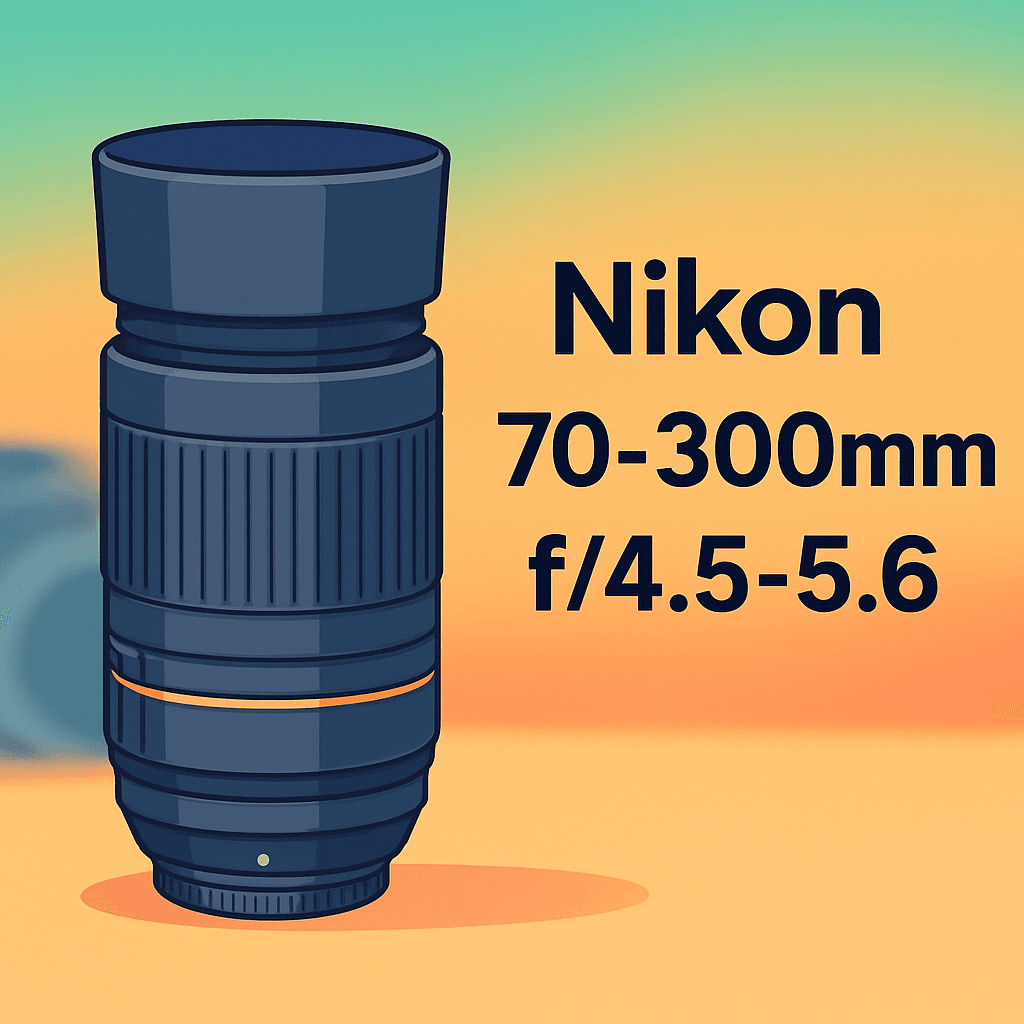
Want a telephoto that gives you reach without turning your bag into a workout?
I’m looking at the Nikon AF-P NIKKOR 70-300mm f/4.5-5.6E ED VR — a compact 70–300 that pairs vibration reduction with a whisper-quiet AF‑P motor. After field-testing it on travel and wildlife shoots, I’ll show how it behaves in the real world.
It’s aimed at Nikon F‑mount shooters who need stabilized reach for portraits, events, sports, and distant wildlife, though you should confirm your body supports AF‑P. Make sure to read the entire review as I break down where it shines, where it compromises, and whether it’s worth your bag — keep reading.

Nikon AF-P NIKKOR 70-300mm f/4.5-5.6E ED VR
Smooth, near-silent stepping motor and ED optics deliver crisp telephoto performance with effective vibration reduction for sharp handheld shots. Compact full-frame reach ideal for sports, wildlife, and travel telephoto needs.
Check PriceThe Numbers You Need
| Spec | Value |
|---|---|
| Focal length | 70-300mm |
| Maximum aperture | f/4.5-5.6 |
| Lens mount | Nikon F mount (FX and DX format compatible) |
| Vibration Reduction (VR) | Yes — optical image stabilization included |
| Autofocus | AF-P stepping motor for fast and quiet AF |
| Lens construction | 14 elements in 10 groups |
| Special lens elements | 3 Extra-low Dispersion (ED) elements |
| Minimum focus distance | 1.1 meters (3.6 feet) |
| Maximum reproduction ratio (macro) | 0.22x |
| Filter size | 67 mm |
| Diaphragm blades | 7 rounded blades |
| Dimensions | Approx. 80 mm diameter × 146 mm length |
| Weight | Approx. 550 grams (1.21 lbs) |
| Focus override | Manual focus override available in autofocus mode |
| Compatibility | Designed for Nikon DSLRs with AF-P lens support and VR system |
How It’s Built
In my testing the Nikon AF-P NIKKOR 70-300 feels solid without being a burden. It mates easily to Nikon F bodies and sits well on both full-frame and crop cameras. The finish and build give a sense of quality you’d be happy carrying on shoots all day.
I found the zoom and focus rings to be smooth and predictable, with just the right resistance for quick adjustments. The barrel does extend as you zoom toward the long end, which helps reach but shifts the balance a bit. Manual focus override works while in autofocus and is handy for fine tweaks on tricky shots.
Controls are simple and placed where your hand naturally falls, so toggling stabilization or changing focus feels intuitive out in the field. After using it for a while the lightweight feel meant less fatigue on hikes and at events, so I kept shooting longer than I expected.
One thing I really liked was how balanced and travel-friendly it feels in real use. One thing that could be better is the mostly plastic construction, which makes me a little cautious in rough conditions. For beginners this means easy handling and long days without a sore shoulder, but treat it with reasonable care.
In Your Hands
The Nikon AF-P NIKKOR 70-300mm feels like a Swiss Army knife for shooters who need reachable telephoto without hauling a pro super-tele. It covers portrait compression, event candids, travel scenes and distant wildlife with a confidence that keeps you shooting instead of swapping lenses.
Vibration Reduction is the practical headline here — it reliably raises the keeper rate when hand‑holding at longer reach and in lower light, so more shots come back sharp from the field. That said, VR calms camera shake, not subject motion, so fast action still demands faster shutters.
Autofocus operation is quietly impressive; the stepping motor is smooth and near‑silent, a real benefit for unobtrusive event work and run‑and‑gun video. Manual focus override lets you make subtle corrections on the fly, and the overall handling feels balanced and intuitive. Be sure your Nikon body fully supports AF‑P lenses to enjoy that refined AF behavior.
Close‑up performance is handy for larger blooms and product detail — useful without carrying a macro — while the lens’s modest size and weight make it comfortable for daylong carry. It accepts common screw‑in filters, so polarizers and NDs are straightforward to use though they add a bit of handling bulk. In practice VR lets you shoot at much slower shutter speeds than without it, but the lens’s relatively narrow aperture at the long end will occasionally force tradeoffs between ISO and shutter speed in dim light.
The Good and Bad
- VR optical stabilization
- AF-P stepping motor for quiet, responsive AF
- FX and DX compatibility
- 0.22x maximum reproduction for useful close-ups
- Variable maximum aperture f/4.5–5.6 (dimmer at the long end)
- AF-P compatibility requirement may exclude some older Nikon bodies
Ideal Buyer
If you shoot with a Nikon F‑mount DSLR that supports AF‑P lenses and VR, this is the lens to consider. The Nikon AF‑P NIKKOR 70‑300mm f/4.5‑5.6E ED VR was designed for bodies that can take full advantage of its modern AF and stabilization systems.
Travel shooters who want true telephoto reach without hauling a pro lens will like its balance of range and weight. Wildlife and outdoor sports photographers will appreciate the 300mm reach and VR for higher keeper rates. Event and portrait shooters benefit from the compression and the quiet AF for candid moments and video work.
Hybrid shooters who switch between FX and DX bodies get useful versatility from a single optic. At roughly 550 grams and 146 mm long it’s light enough for day‑long walks and fits easily into most travel kits.
This isn’t the lens for photographers who demand a fast constant aperture or 1:1 macro magnification. Also check body compatibility first, because older Nikon DSLRs may not support AF‑P. If you need very low‑light speed or true macro work, look to faster or specialized alternatives instead.
Better Alternatives?
We’ve already gone through what the Nikon AF-P NIKKOR 70-300mm f/4.5-5.6E ED VR brings to the table — stabilized reach to 300mm, quiet AF-P focusing, and solid all-around handling for Nikon DSLR shooters. If that lens doesn’t quite match your needs or budget, there are a few clear alternatives that trade one strength for another.
Below are three lenses I’ve used in the field that people commonly consider instead. I’ll point out where each one shines compared to the Nikon 70-300 E VR, where it falls short, and what kind of buyer I think should choose it.
Alternative 1:

Nikon AF-P DX NIKKOR 70-300mm f/4.5-6.3G ED VR
Lightweight APS-C telephoto with swift stepping-motor autofocus and ED elements, paired with vibration reduction for steadier handheld images. Offers reach for wildlife, sports, and travel while remaining compact and affordable.
Check PriceWhat it does better: On an APS-C (DX) Nikon body this DX 70-300 feels like a true travel tele — it’s lighter, smaller, and gives you extra effective reach compared to the FX 70-300. I’ve carried it on hikes and noticed how easy it is to shoulder for long walks. The AF-P motor and VR behave very similarly to the full‑frame E version, so for everyday wildlife and travel shots you don’t lose much in handling.
What it does worse: The trade-off is the darker long end (f/6.3) and the fact that it’s a DX lens — on full-frame bodies it’s not ideal. In low light I found AF confidence drops sooner than on the E VR, and image quality at the extreme long end isn’t quite as consistently sharp on FX-format shots. The build also feels a touch cheaper compared to the E model.
Who should pick it: If you shoot mainly with a DX Nikon body and want a lightweight, budget-friendly long lens for travel, birds at a distance, or casual sports, this is a sensible pick. Avoid it if you use FX bodies regularly or need the best low-light AF and full-frame corner performance.
Alternative 2:

Tamron Canon EF 70-300mm f/4-5.6 Di LD
Affordable full-frame telezoom optimized for Canon EF mount, featuring low-dispersion glass for reduced chromatic aberration and a balanced, lightweight design. Delivers reliable reach and sharpness for hobbyists and enthusiasts.
Check PriceWhat it does better: For Canon shooters, the Tamron EF 70-300 gives you a full-frame tele for a lower price than many brand-name equivalents. I used it on a Canon body for landscapes and portraits and liked the reach and the way it handled when stopped down — you can get pleasing results in good light without spending a lot.
What it does worse: Compared to the Nikon AF-P 70-300 E VR, the Tamron I used lacked the same level of stabilization and the AF felt slower and a bit louder. In real shoots that meant more keepers on the Nikon in lower light and moving-subject situations. Optically, the Tamron softens more at the long end unless you stop down, and chromatic aberration can be more apparent on high-contrast edges.
Who should pick it: This is a good option for Canon owners who want an inexpensive full-frame tele for trips, portraits, and occasional wildlife, especially if you shoot mostly in daylight or use a tripod. Don’t choose it if you rely on fast, quiet AF and strong stabilization for handheld action work.
Alternative 3:
Tamron Nikon F 70-300mm f/4-5.6 Di LD
Budget-friendly long telephoto for Nikon F users, sporting low-dispersion elements to control fringing and a compact build that balances handling with reach — great for portraits, wildlife, and outdoor action.
Check PriceWhat it does better: The Tamron Nikon F 70-300 I used is straightforward and cheap — you get long reach without much weight or cost. In sunny conditions it produced usable shots and the lens can get you closer-in framing for wildlife and headshots when your budget won’t stretch to Nikon’s newer 70–300.
What it does worse: In my experience the Tamron falls short of the Nikon AF-P 70-300 E VR in two big ways: stabilization and AF speed/quietness. The Nikon E VR keeps more shots sharp hand‑held at slower shutter speeds, and its AF-P motor is noticeably quieter and quicker for tracking. The Tamron also tends to be softer wide open at 300mm and shows more fringing on contrasty edges.
Who should pick it: This one makes sense for Nikon users who need a cheap tele for fair-weather shooting, portraits, or tripod work and don’t mind sacrificing some AF speed and VR. If you shoot a lot of hand‑held low‑light action or need the quietest AF for events and video, the Nikon AF-P 70-300 E VR remains the better fit.
What People Ask Most
Is the Nikon 70-300mm f/4.5-5.6 a good lens for wildlife and sports?
Yes for casual wildlife and slower sports in good light thanks to its reach, but the variable f/4.5-5.6 and mid-level AF mean it struggles with fast action and low light compared to faster pro lenses.
Does the Nikon 70-300mm f/4.5-5.6 have vibration reduction (VR)?
Some versions do include VR, but there are non‑VR variants—check the exact model before buying.
Is the Nikon 70-300mm f/4.5-5.6 compatible with Nikon DX and FX cameras?
Yes, it mounts on both DX and FX bodies; on DX you get extra effective reach, and on FX it covers full frame but double-check AF compatibility with older bodies.
How sharp is the Nikon 70-300mm f/4.5-5.6?
Center sharpness is good at shorter focal lengths and when stopped down; expect softer corners and reduced contrast at the long end.
What is the minimum focusing distance and maximum magnification of the Nikon 70-300mm f/4.5-5.6?
Minimum focus is about 1.5 m (4.9 ft) with a maximum magnification around 0.2–0.25×, so it’s okay for occasional close-ups but not true macro work.
Is the Nikon 70-300mm f/4.5-5.6 worth buying compared to the 70-200mm or 55-200mm lenses?
It’s a great budget option if you want more reach than a 55-200 and don’t need the pro build or faster aperture of a 70-200, but if low-light performance and fast AF matter, a 70-200 (or faster zoom) is the better choice.
Conclusion
The Nikon AF-P NIKKOR 70-300mm f/4.5-5.6E ED VR is a versatile telephoto that gets a lot right for everyday Nikon shooters. Its stabilized reach, whisper‑quiet AF, and refined optical design deliver consistently usable results from portraits to wildlife. The balance of performance and portability is its clearest selling point.
There are compromises to accept, and they’re practical rather than fatal. The variable maximum aperture and limited close‑focusing mean it won’t replace faster primes or a dedicated macro lens. Older Nikon bodies without AF‑P support can’t unlock the lens’s full potential.
In the field it proved easy to carry and capable of producing pleasing images under a wide range of conditions. VR noticeably raises keeper rates for handheld shooting, and the AF‑P motor keeps operation unobtrusive for candid work and video. For many shooters this combination beats heavier, louder alternatives.
If your priority is the fastest glass or extreme magnification, look elsewhere. But if you want a lightweight, stabilized telephoto with quiet autofocus and solid optics for travel, events and distant subjects, it’s a smart, balanced buy. Confirm body compatibility and your shooting priorities, and you’ll know if this lens belongs in your bag.
Nikon AF-P NIKKOR 70-300mm f/4.5-5.6E ED VR
Smooth, near-silent stepping motor and ED optics deliver crisp telephoto performance with effective vibration reduction for sharp handheld shots. Compact full-frame reach ideal for sports, wildlife, and travel telephoto needs.
Check Price


0 Comments