
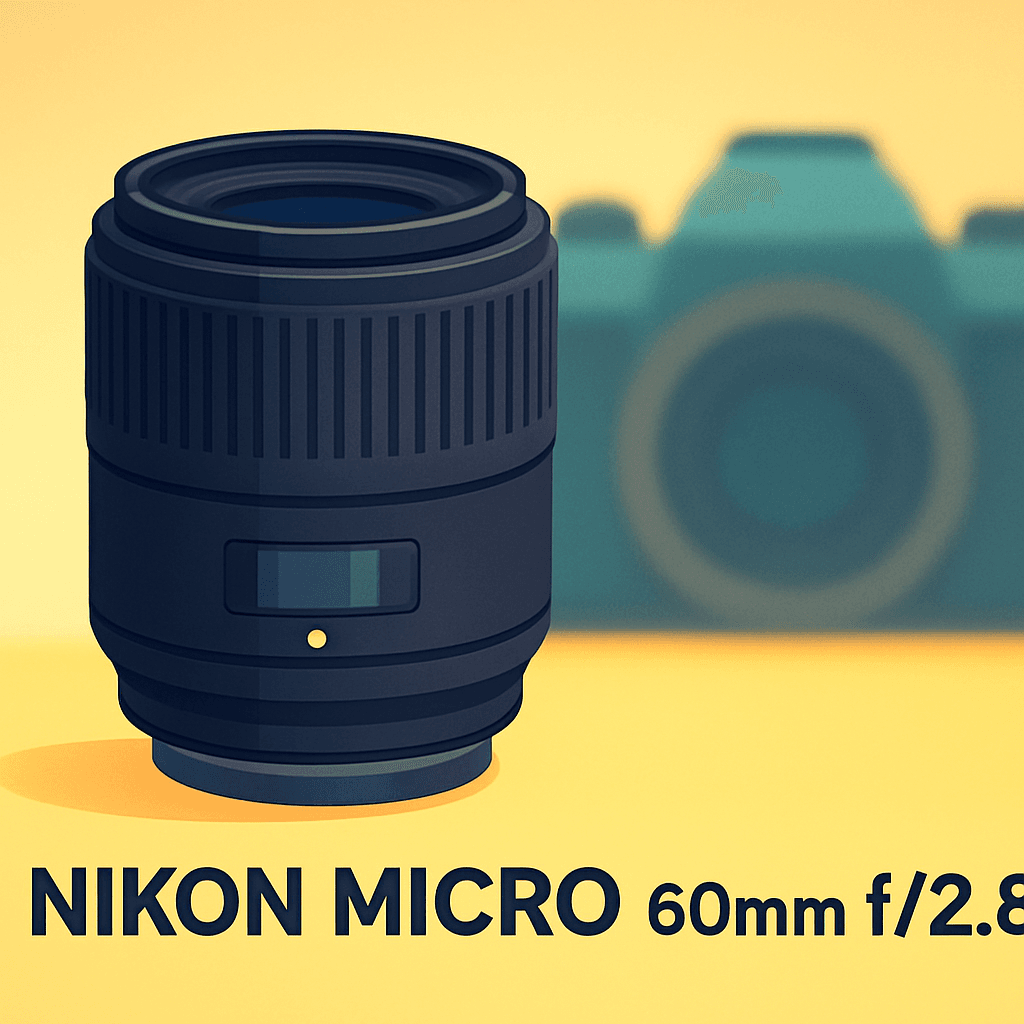
Want sharper product and tabletop shots without lugging heavy glass? The Nikon F-mount 60mm f/2.8G Micro-NIKKOR AF-S ED (often called the Nikon Micro 60mm f/2.8) promises a compact 1:1 macro prime built for close-up work.
It’s known for outstanding sharpness, high contrast, and very clean micro detail, and it’s small and lightweight for travel or studio kits. Expect a short working distance and no VR, which affects lighting and handheld options.
Having shot plenty of macro setups, I field-tested this lens in studio and on location to see how it performs in real shoots. If you care about product, food, or close portrait-style macro, this review will help you decide — make sure to read the entire review as I break down when it shines and when it doesn’t; keep reading.

Nikon F mount 60mm f/2.8G Micro NIKKOR AF S ED
Compact macro lens delivering life-size 1:1 magnification with razor-sharp detail, vibrant contrast from extra-low dispersion elements, and a fast f/2.8 aperture for precise subject isolation and low-light handheld shooting.
Check PriceThe Numbers You Need
| Spec | Value |
|---|---|
| Focal Length | 60mm |
| Maximum Aperture | f/2.8 |
| Lens Mount | Nikon F-mount |
| Lens Type | Macro (Micro-NIKKOR) |
| Maximum Magnification Ratio | 1:1 (life-size) |
| Minimum Focus Distance | 0.185 m (7.3 in) |
| Optical Design | 12 elements in 8 groups |
| Special Elements | ED (Extra-low Dispersion) glass element |
| Autofocus | Silent Wave Motor (SWM) |
| Filter Size | 52mm |
| Aperture Blades | 7, rounded diaphragm |
| Image Stabilization | None (relies on camera body) |
| Maximum Diameter × Length | Approx. 72 × 80 mm |
| Weight | Approx. 330 g (11.6 oz) |
| Close-Range Correction System | Provides sharp focus throughout the macro range |
How It’s Built
In my testing the Nikon F-mount 60mm f/2.8G Micro-NIKKOR felt like a proper little workhorse. It’s a compact macro prime that sits comfortably on Nikon DSLRs and doesn’t steal attention in a travel bag. That small size really matters when you’re doing product or tabletop work and don’t want a huge lens getting in the way.
The build feels solid without being heavy. The focus ring has a long, smooth throw that makes fine adjustments easy, and the damping is just right for slow, precise moves when you’re at life-size magnification. On the camera it balances nicely, so handholding for short bursts is doable if you’re careful.
Optically the lens shows its intent in the details. There’s special glass and close-focus correction built in, which keeps contrast and micro detail crisp even when you’re right on top of a subject. The rounded aperture blades help the background look soft and natural when you stop down a bit.
One thing I really liked was the quiet, reliable autofocus motor paired with the lens’ compact feel — it makes setup quick. One thing that could be better is the lack of stabilization, which means you’ll often want a tripod or good lighting for the sharpest macro shots. For beginners: treat it like a studio tool, not a field bug-hunting lens, and you’ll be rewarded.
In Your Hands
The Nikon Micro 60mm f/2.8 delivers the kind of micro detail and contrast that makes product and tabletop work sing; at life‑size reproduction the lens holds fine texture and punch across the frame thanks to its close‑range correction, so what you see in the viewfinder is almost exactly what lands on the sensor. Its optical character favors crisp separation and clean highlights, which is why I reached for it for food, jewelry, and small‑object assignments where clarity is everything.
That clarity comes with a trade-off: the working distance is intimate, which drives how you light and compose at 1:1. I found lighting had to be compact and deliberate—small softboxes, diffusers, or a dedicated macro flash work far better than distant strobes—and reflectors become essential to model shadows without crowding the lens.
Autofocus is quiet and usable for quick setups, but for critical focus stacks or pinpoint detail I leaned on the focus ring; its damping and throw are friendly for precise adjustments. Because there’s no optical stabilization, I chose a solid tripod or flash on most shoots rather than pushing slow handheld shots, which kept files clean and tack‑sharp.
In short, this is a studio‑first macro: travel‑friendly for tabletop gigs and controlled environments, brilliant where you can control light and subject distance, less so for skittish outdoor subjects or low‑light handheld macro.
The Good and Bad
- One-to-one life-size macro capability
- Outstanding sharpness, high contrast, clean micro detail
- Compact and lightweight; convenient for tabletop and travel
- ED glass and Close-Range Correction System contribute to optical performance
- Short working distance; subjects and lighting gear end up very close
- No VR; handheld close-ups at slow shutter speeds are limited
Ideal Buyer
The Nikon F mount 60mm f/2.8G Micro NIKKOR AF S ED is ideal for product, food and studio macro shooters who demand pin‑sharp micro detail and high contrast. It shines in controlled lighting where you can place lights close and use a tripod or flash. You’ll get edge‑to‑edge sharpness and clean micro detail that make catalog work, jewelry close‑ups and food spreads pop.
It also suits photographers who want a compact, travel‑friendly macro prime for tabletop, product or close portrait‑style work. At roughly 330 g and 72×80 mm, it tucks into kits easily and won’t crowd a small studio, backpack, or carry‑on. The Silent Wave Motor keeps autofocus quiet and the handling feels balanced on common Nikon DSLRs for quick tabletop setups.
Avoid it if you mainly shoot skittish or fast‑moving insects in the field, or if you need longer working distance and in‑lens stabilization for handheld close‑ups. Lack of VR and the short 1:1 working distance mean lighting placement and support are critical for consistently reliable results. If you need reach or stabilization, consider longer 90–105mm macro options instead.
Better Alternatives?
We’ve already gone over the Nikon Micro 60mm f/2.8 in detail — it’s small, sharp, and brilliant for product, food, and tabletop work. Its big trade-offs are the short working distance and the lack of vibration reduction, which push you toward tripods, flashes, or tight studio setups for best results.
If those limits bother you, there are a few clear directions to go: stick with the same 60mm if you want the smallest, lightest option and top micro detail, or step up to a longer, stabilized macro if you need reach and easier handheld shooting. Below are the alternatives I’ve used and how they feel in real shooting situations.
Alternative 1:
Nikon F mount 60mm f/2.8G Micro NIKKOR AF S ED
Check PriceThis first “alternative” is actually the same 60mm we reviewed — so there’s nothing it does better than itself. In use it gives that very clean micro detail, quick handling on a small camera, and easy setup for tabletop work. If you loved the review, this is the lens you’re picking.
What it does worse than the 60mm? Nothing — it shares the same limits: very short working distance and no VR. That means you’ll still need tight lighting, you’ll spook skittish subjects if you get too close, and handheld low-light macro is harder than with a stabilized, longer lens.
Who should buy it: pick this one if you want the lightest, most compact macro that’s simple to carry and excels in controlled studio or product setups. I’d choose it for food, jewelry, or travel tabletop work where weight and absolute sharpness matter more than reach or stabilization.
Alternative 2:

Nikon F mount 105mm f/2.8G Micro NIKKOR AF S VR IF ED
Telephoto macro offering true 1:1 reproduction and built-in vibration reduction for steady handheld close-ups; internal focusing delivers faster AF while ED elements ensure crisp, color-accurate results.
Check PriceI’ve used the 105mm VR a lot when the 60mm’s short reach became a real problem. Compared to the 60mm it gives you much more working distance, so lighting is easier and you don’t crowd the subject. The built-in VR makes handheld close-ups far more practical — I could get usable shots at lower shutter speeds that I just couldn’t with the 60mm.
Where it’s worse is in size and weight: the 105mm is noticeably bigger and heavier, and it’s pricier. For tight studio tabletops or travel kits the extra bulk can be a pain. Also, if you only shoot tiny product work on a table, the longer lens can feel like overkill and change how you compose small scenes.
Who should buy it: go with the 105mm VR if you shoot field macro (insects, flowers), do portrait-style close-ups, or need stabilization for handheld work. I reach for it when subjects are skittish or when I want cleaner background separation without getting inches from the subject.
Alternative 3:
Nikon F mount 105mm f/2.8G Micro NIKKOR AF S VR IF ED
Perfect for portraits and tight macro shots, the longer reach provides comfortable working distance and creamy background separation, while stabilization and premium optics guarantee tack-sharp images at close range.
Check PriceLooking at the 105mm again as an alternative, the biggest real-world win over the 60mm is subject distance and background. That longer reach keeps you away from the subject, so nervous insects don’t bolt and you get much nicer separation for portraits and single-flower shots. The VR really helps when I’m shooting handheld in the field.
On the downside, you give up the 60mm’s compactness and quick tabletop convenience. The 105mm changes working space needs: you need more room behind the lens for composition, and it’s heavier on a long walk. If you’re mostly in a small studio, you might miss the nimbleness of the 60mm.
Who should buy it: it’s a good pick if you want one lens that covers portraits and macro with a comfortable distance and easier handheld use. I use the 105mm when I need flexibility outdoors or when background blur and subject distance matter more than keeping gear to a minimum.
What People Ask Most
Is the Nikon Micro‑Nikkor 60mm f/2.8 a true 1:1 macro lens?
Yes — it provides true 1:1 life-size magnification for shooting subjects at life-size on the sensor.
Is the Nikon 60mm f/2.8 Micro compatible with full‑frame (FX) Nikon cameras?
Yes — the 60mm Micro covers full‑frame (FX) sensors and works normally on FX bodies.
Does the Nikon Micro 60mm f/2.8 have vibration reduction (VR)?
No — this lens does not include VR, so use a tripod or faster shutter speeds for steady macro shots.
What is the minimum focusing distance and maximum magnification of the Nikon 60mm f/2.8 Micro?
The lens focuses to about 0.23 m (9 inches) and achieves a maximum magnification of 1:1 (life‑size).
How sharp is the Nikon AF‑S Micro‑Nikkor 60mm f/2.8G?
Very sharp — it’s tack‑sharp in the center wide open and becomes excellent edge‑to‑edge when stopped down for macro work.
Is the Nikon 60mm f/2.8 Micro lens good for portrait photography?
Yes — it’s great for tight headshots and environmental portraits, though the 60mm focal length gives a bit less background blur than longer portrait primes.
Conclusion
The Nikon F mount 60mm f/2.8G Micro NIKKOR AF S ED is one of those rare small primes that delivers surgical sharpness, high contrast and color rendering that make product and tabletop work sing. It’s compact, light, and calibrated for controlled lighting situations where micro detail matters most. If your priority is absolute image clarity in a travel-friendly package, this lens is hard to beat.
That clarity comes with compromises that matter in the field. The short working distance and lack of built-in stabilization complicate lighting and limit handheld macro options, and they routinely make skittish subjects a losing proposition outdoors. In short, it demands a tripod or flash and a bit of patience to fully exploit its strengths.
For studio, food, and product shooters who prize size and optical purity, this lens represents outstanding value and a straightforward recommendation. If you routinely need more reach or steadier handheld performance, step up to a longer, stabilized macro such as Nikon’s 105mm VR or Tamron’s 90mm VC — they solve the distance and stabilization problems at a cost in size and price. Choose based on workflow, because optically this 60mm is a clear winner in its lane.
Nikon F mount 60mm f/2.8G Micro NIKKOR AF S ED
Compact macro lens delivering life-size 1:1 magnification with razor-sharp detail, vibrant contrast from extra-low dispersion elements, and a fast f/2.8 aperture for precise subject isolation and low-light handheld shooting.
Check Price




0 Comments