
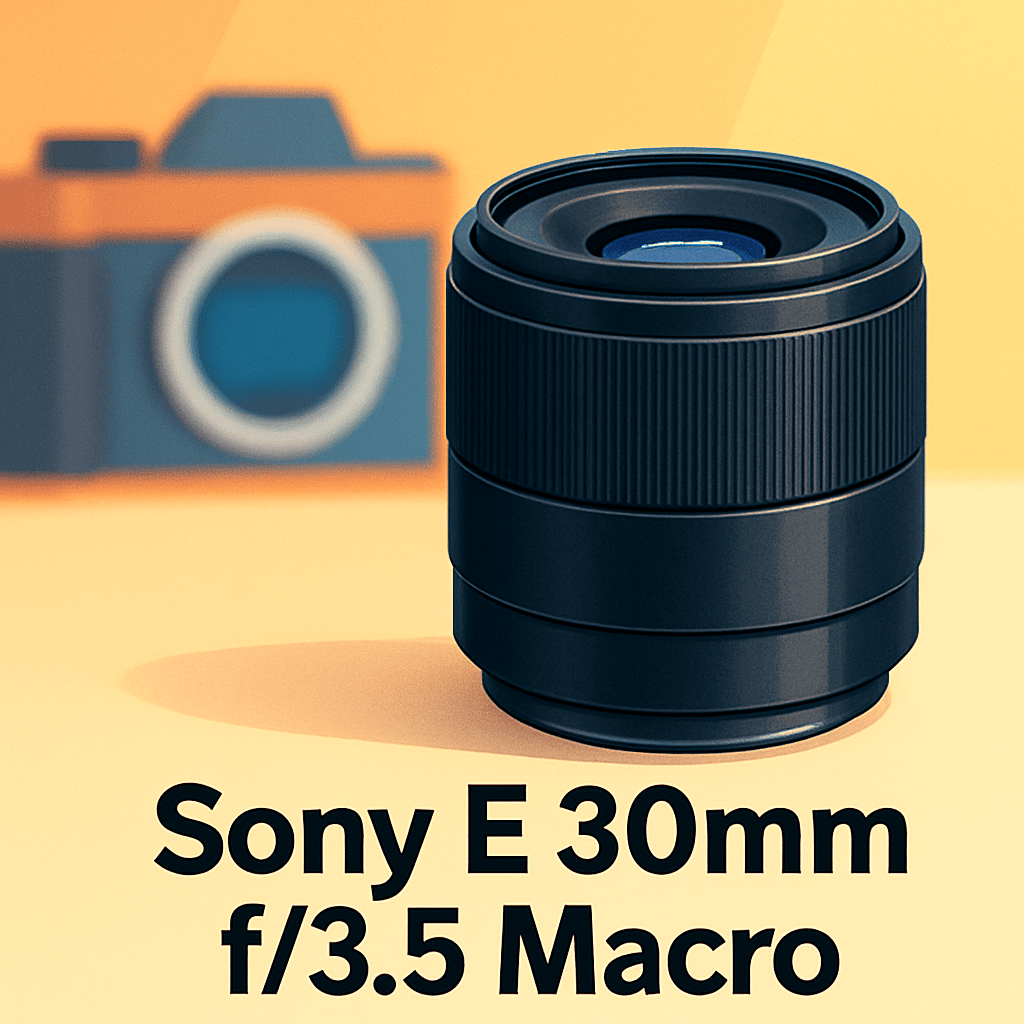
Want a pocketable lens that gets you true life-size close-ups without lugging heavy gear? The Sony E 30mm f/3.5 Macro aims to deliver compact 1:1 macro performance for APS-C shooters.
It’s ultra-light with a near‑normal field of view, great for tabletop, textures and casual macro work. Having field-tested it, I dug into handling, sharpness and autofocus in real shooting conditions.
I’ll cover build, handling, real-world macro usability, sharpness, autofocus, who it’s for, and key alternatives. Make sure to read the entire review as I show where this tiny macro excels and when a longer lens is smarter — keep reading.

Sony E 30mm f/3.5 Macro
Compact, lightweight close-up lens delivering crisp detail and tight close-focusing for insects, flowers, and tabletop subjects. Smooth focusing and sharp central performance make it perfect for portable, everyday close-up work.
Check PriceThe Numbers You Need
| Spec | Value |
|---|---|
| Focal Length | 30mm |
| Aperture | f/3.5 |
| Maximum Magnification | 1:1 |
| Lens Mount | Sony E |
| Format | APS-C |
| Filter Size | 49mm |
| Minimum Focus Distance | ~9.5cm |
| Elements/Groups | 6 elements in 4 groups |
| Optical Design | Internal focusing, aspherical elements |
| Weight | ~138g (typical) |
| Length | ~62mm mounted (typical) |
| Aperture Blades | 7 (rounded) |
| Autofocus | Built-in |
| Focus Hold Button | Yes |
| Lens Coating | Sony Anti-reflective |
How It’s Built
In my testing the Sony E 30mm f/3.5 Macro is delightfully small and light, and it sits comfortably on compact APS-C bodies. That means you can carry it everywhere and shoot handheld macro longer without your shoulder complaining. I loved how unobtrusive it is — you almost forget it’s on the camera until you need it.
I found the focus ring to be smooth and reasonably responsive, though the throw is a bit short for fine manual tweaks. The internal focusing is a big practical win — the barrel doesn’t creep out as you get close, so ring lights and small filters stay put and framing stays predictable. For real-world close work that simplicity makes life easier.
After using it for a while the build reads as lightweight plastic rather than heavy metal, but it never felt fragile in regular use. That balance keeps fatigue down during long tabletop sessions, but I do wish the build had a touch more heft and a slightly more damped focus feel.
The small filter thread makes adding a polarizer, close‑up filter, or a tiny LED ring straightforward and affordable. The focus‑hold button is genuinely useful for locking focus when recomposing, which is great for beginners learning macro framing and lighting.
In Your Hands
The Sony E 30mm f/3.5 Macro behaves like a short, near‑normal lens on an APS‑C body, which makes tiny subjects sit comfortably in context rather than being isolated on a narrow plane. At true life‑size magnification the working distance becomes very tight, forcing careful framing and creative lighting—expect to chase shadows and rely on small side lights or ring illuminators to avoid casting on your subject. Its internal focusing keeps the barrel and balance steady as you move in and out of close focus, which makes handling less fiddly than lenses that extend.
For grab‑and‑go handheld work this lens is surprisingly usable if you adopt a few habits: I often rock the camera to find the plane of sharpness, engage focus peaking for quick manual nudges, and fire a burst to capture a usable frame. For precision macro or stacking sessions a tripod still wins, but the lens’s compactness makes that tripod work less of a chore. The focus‑hold button is a handy practical touch for locking focus and recomposing during tricky setups.
Beyond extremes, it doubles as a friendly tabletop and texture lens—great for product detail, food closeups, and casual macro where context matters. That modest maximum aperture means subject separation won’t be as pronounced as with longer, faster macro optics, so background compression is more restrained. Autofocus is generally dependable but can hesitate at the closest distances, so switching to magnified manual focus for final tweaks gives the most reliable results.
The Good and Bad
- True 1:1 magnification
- Very compact and light (~138g, ~62mm length)
- Internal focusing (no extension during focusing)
- ~45mm effective field of view on APS-C for a natural perspective
- Very short minimum focus distance (~9.5 cm) leads to extremely tight working distances at 1:1
- f/3.5 maximum aperture offers less subject separation and light-gathering than faster macro lenses
Ideal Buyer
The Sony E 30mm f/3.5 Macro is a natural fit for APS‑C Sony E‑mount shooters who want a true 1:1 macro that actually fits in a pocket. It’s tiny at roughly 138 grams and barely over 60mm, so you can keep it on a compact body as a dedicated close‑up tool. If you want a budget‑ and space‑friendly way into real macro without hauling big glass, this lens is it.
Think product detail, food, jewelry, textures and casual nature shots where a ~45mm effective field of view gives a natural, near‑normal perspective. Internal focusing and the Focus Hold button make close framing more manageable, while a common 49mm thread makes small lights, diopters and filters inexpensive to integrate. Handheld enthusiasts and tabletop shooters will appreciate the balance between portability and true 1:1 capability.
This lens is less suited to photographers who need longer working distances for insects, skittish subjects, or studio lighting setups that require room to maneuver. It also won’t satisfy shooters who prioritize strong subject isolation, very fast low‑light performance, or native full‑frame coverage. If you need more reach or creamier bokeh, stepping up to 50–70mm macro options is the smarter trade.
Better Alternatives?
We’ve gone through what the Sony E 30mm f/3.5 Macro does best: a true 1:1 macro in a tiny, light package that’s easy to carry on an APS-C body. It’s great when you want a natural perspective and honest detail without hauling a big lens or tripod.
If you find the 30mm’s very short working distance or its f/3.5 limit holding you back, there are a few clear alternatives. Below I’ll point out options that give you more reach, more magnification, or a different shooting style, and I’ll tell you who I’d buy each one for based on real use.
Alternative 1:

Sony FE 50mm f/2.8 Macro
Standard-length close-focusing optic balances natural perspective with impressive subject separation for portraits and detailed work. High-contrast rendering and smooth bokeh make it ideal for product shots, close portraits, and studio.
Check PriceI’ve used the Sony FE 50mm f/2.8 Macro on both full-frame and APS-C bodies. Compared to the 30mm, the 50mm gives you more working distance and a bit more subject separation thanks to the longer focal length and the f/2.8 aperture. That makes it easier to light subjects and avoid casting shadows when you’re close, and it gives creamier backgrounds for product or close portrait shots.
What it does worse than the 30mm is simple: it’s bigger, heavier, and less pocketable. The 30mm beats it for being tiny and always-with-you. Also, while the 50mm is a solid all-around macro, you won’t get the ultra-close reach beyond 1:1 that some specialty macro users want.
Buyers who will like the 50mm are portrait and product shooters who want a true macro that also doubles as a nice short portrait lens, or anyone who wants a little extra working distance and better background separation. If you travel light all the time or need the absolute smallest setup, stick with the 30mm instead.
Alternative 2:

Laowa E 65mm f/2.8 2x Ultra Macro APO
Specialized ultra-close lens delivers double life-size magnification and exceptional micro-detail for scientific, jewelry, and close-up inspection. Apochromatic design offers outstanding color fidelity and edge-to-edge sharpness at extreme magnifications.
Check PriceThe Laowa 65mm 2x is a different beast. I’ve used it for jewelry and insect work where I needed more than 1:1—this lens gives 2:1, so you can capture tiny textures that the 30mm can’t resolve at the same framing. Colors and detail are very clean, and at high magnification the Laowa simply shows more micro-detail than the 30mm.
Where it’s worse is convenience: it’s manual-focus only and built for careful, tripod-based work. You’ll spend more time focusing, stopping down, or focus-stacking to get everything sharp. If you shoot handheld, run-and-gun macro, or want a point-and-shoot feel, the Sony 30mm is much easier to use.
This Laowa is for people who need extreme detail—jewelry shooters, scientific photographers, and anyone doing focus stacking or studio macro who doesn’t mind a slow, deliberate workflow. If you want fast AF and quick handheld close-ups, the 30mm is the better everyday choice.
Alternative 3:
Laowa E 65mm f/2.8 2x Ultra Macro APO
Precision manual-control optics enable fine focus and reliable stacking for high-magnification imaging. Robust build and low distortion ensure neutral tones and faithful detail reproduction, ideal for studio close-up capture.
Check PriceTo add a slightly different take from my time with the Laowa: this lens shines when you need precise control. The focus ring and manual feel let you nudge focus in tiny steps, which is perfect for stacking and for subjects where absolute sharpness matters. That level of control is something the autofocus Sony 30mm can’t match in critical studio work.
On the downside, the Laowa’s workflow demands more gear and patience—tripod, rail, and more time per shot. The Sony 30mm remains the pick for quick setups and handheld shooting. The Laowa also tends to be bulkier at similar working distances if you’re aiming for very high magnification.
Choose the Laowa here if you’re a serious close-up shooter who plans to do focus stacking, studio copy work, or scientific imaging and you value manual precision and max detail. If you want a light, everyday macro that’s easy to carry and quick to use, stick with the Sony 30mm.
What People Ask Most
What is the maximum magnification of the Sony E 30mm f/3.5 Macro?
Its maximum magnification is 1:1 (1.0×), so it can reproduce subjects at life size on the sensor.
Is the Sony E 30mm f/3.5 Macro compatible with full-frame Sony cameras?
It’s designed for APS-C E-mount bodies and will vignette on full-frame cameras unless you use crop/Super35 mode.
Does the Sony E 30mm f/3.5 Macro have image stabilization?
No — the lens has no optical stabilization (OSS), so use a stabilized camera body or a tripod for steady close-ups.
What is the minimum focusing distance of the Sony E 30mm f/3.5 Macro?
The minimum focusing distance is about 0.095 meters (9.5 cm) from the sensor, allowing very close 1:1 shooting.
Is the Sony E 30mm f/3.5 Macro sharp for macro and close-up photography?
Yes — it’s sharp in the center at close distances and produces excellent detail, though corners can soften and benefit from stopping down.
Is the Sony E 30mm f/3.5 Macro worth buying for Sony APS-C shooters?
Yes — it’s an affordable, compact true 1:1 macro that’s great for APS-C shooters who want high magnification and sharp close-ups without spending much.
Conclusion
The Sony E 30mm f/3.5 Macro is a compact surprise—lightweight, quietly competent and easy to carry, with true macro capability that makes everyday close-ups enjoyable rather than a chore. It feels designed for photographers who value portability and simple, dependable operation over headline-grabbing specs. In my experience it delivers crisp detail and a usable shooting workflow on small Sony bodies without demanding a dedicated kit bag.
That said, it’s not a cure-all. The very tight working distance and modest maximum aperture make lighting tricky and limit subject separation, and you’ll often find yourself switching to manual focus or careful technique for the most demanding close-ups. Those are practical trade-offs you accept for its pocketable size and approachable price, and they matter if you chase insects or need creamy, out-of-focus backgrounds.
Overall I recommend the Sony E 30mm f/3.5 Macro for APS-C shooters who want a carry-everywhere macro for tabletop, textures and everyday details. If you need more working distance or stronger subject isolation, look toward longer 50–70mm macro options. For its intended purpose this lens is a smart, economical choice that earns a place in a compact kit.
Sony E 30mm f/3.5 Macro
Compact, lightweight close-up lens delivering crisp detail and tight close-focusing for insects, flowers, and tabletop subjects. Smooth focusing and sharp central performance make it perfect for portable, everyday close-up work.
Check Price


0 Comments