
canon eos rebel t7 dslr review — want to know if this entry-level DSLR will actually lift your image quality and make shooting simpler?
As a working photographer I took this one into the field to see how it’s handling family portraits, travel shots, and everyday stills.
If you’re a beginner or casual shooter who wants optical viewfinder simplicity, RAW flexibility, good battery life and easy wireless sharing, it’s aimed at you.
It trades broader AF coverage, faster bursts, and only offers 1080p/30 video plus a fixed screen, in exchange for simple, stills-first shooting — we’ll unpack payoffs and limits, so keep reading.
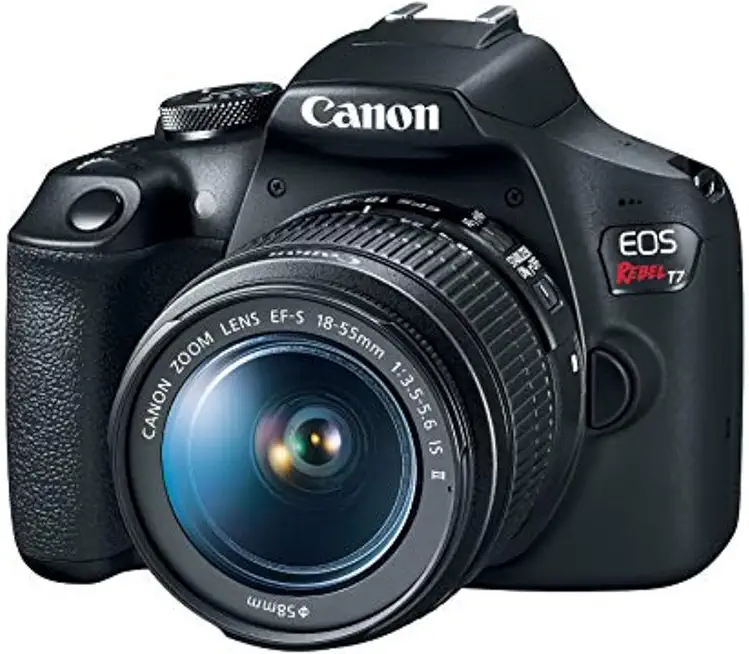
Canon EOS Rebel T7 DSLR Camera
Ideal for newcomers, this DSLR combines a 24MP APS-C sensor and reliable autofocus to deliver crisp photos and Full HD video. Intuitive controls, built-in Wi‑Fi, and solid battery life make learning effortless.
Check PriceThe Numbers You Need
| Spec | Value |
|---|---|
| Sensor | 24.1 MP APS-C CMOS |
| ISO Range | 100–6400 (expandable to 12800) |
| Autofocus | 9-point AF system |
| Viewfinder | Optical pentamirror, 95% coverage |
| LCD Screen | 3.0″ fixed, 920k dots |
| Continuous Shooting | 3 fps |
| Video | Full HD 1080p at 30 fps |
| Image Format | JPEG, RAW |
| Storage | SD/SDHC/SDXC card slot |
| Connectivity | Wi-Fi, NFC |
| Battery Life | Up to 500 shots (LP-E10) |
| Weight (body) | 475 g |
| Dimensions | 129 x 101 x 78 mm |
| Lens Mount | Canon EF/EF-S |
| Shutter Speed | 1/4000 to 30 sec |
How It’s Built
In my testing the Canon EOS Rebel T7 DSLR Camera feels like a classic, no-surprises entry-level DSLR you can rely on. The grip is comfortable even during long walks and the control layout is straightforward, so beginners won’t feel overwhelmed. That makes it easy to focus on learning composition and exposure instead of hunting through menus.
The optical viewfinder is a real plus outdoors because you can see your subject clearly in bright light. It does show a little less than what ends up in the final image, so I learned to leave a small margin when composing. The fixed LCD is fine for quick checks, but it gets awkward for low or high angle shots and almost useless for self-recording.
Buttons and dials are where you expect them, and switching shooting modes feels natural in the moment. I liked how accessible the Canon lens ecosystem is, which lets you grow your kit without replacing the body. In practical terms that means you can start simple and add more creative tools as you improve.
For travel the camera stayed compact in my bag and the battery carried me through casual days of shooting. One thing I really liked was the solid hand-feel for such a small body, and one thing that could be better is the lack of a tilting or articulating screen for vlogging and odd angles. Overall it’s a practical, beginner-friendly body that teaches DSLR basics well.
In Your Hands
The Canon EOS Rebel T7 feels predictably responsive for everyday shooting, with autofocus and shutter behavior that’s straightforward for beginners; its modest continuous rate suits family moments and casual street scenes but won’t keep up with fast action. The camera’s exposure range handles bright days and basic long exposures without fuss, and the optical viewfinder makes composing in sunlight easier than live view.
Battery life easily covers a day of casual photography, so short outings rarely require a spare pack. Built‑in Wi‑Fi and NFC make transferring images and using a phone as a remote simple — pair, preview in the app, and push shots to your device.
In real-world use the T7 is strongest for portraits, landscapes, travel and learning manual exposure, where its steady behavior rewards careful composition. It’s less ideal for sports or wildlife where broader AF coverage and faster bursts matter, and video is fine for short clips but the fixed screen limits low‑ or high‑angle shooting and vlogging.
A single memory card slot and uncomplicated file handling keep workflows simple, though there’s no redundancy for critical shoots. Shooting RAW alongside JPEG gives meaningful editing latitude for challenging light, while JPEGs remain convenient for quick sharing.
The Good and Bad
- 24.1 MP APS‑C sensor delivers solid detail for everyday stills
- Optical viewfinder experience with 95% coverage
- RAW capture alongside JPEG for editing flexibility
- EF/EF‑S mount: large, mature lens ecosystem
- 9-point AF with limited coverage; basic for moving subjects
- 3 fps burst restricts action and wildlife capture
Ideal Buyer
If you’re stepping from a phone to a proper DSLR, the Canon EOS Rebel T7 DSLR Camera is a tidy, affordable bridge. It excels for stills-first creators shooting family portraits, travel, landscapes and learning manual exposure, thanks to its 24.1MP sensor and RAW support. Wi‑Fi/NFC and access to Canon’s EF/EF‑S lens ecosystem make daily sharing and upgrades painless.
It is not the right tool for sports or wildlife shooters who need fast bursts and wide AF coverage. Video creators chasing 4K, high-frame-rate footage or a fully articulating screen will find the T7 limiting. Vloggers and solo content makers who rely on flexible angles and live-view autofocus will want a model with a vari-angle screen and better live-view AF.
Buy the T7 if you value the optical viewfinder experience, long battery life for day trips, and a straightforward DSLR layout that teaches fundamentals. Skip it if you prioritize advanced AF, fast continuous shooting, or creative video setups—those trade-offs define its real-world charm. Its compact 475 g body and up-to-500-shot battery make it a reliable companion on day-long outings and easy handling.
Better Alternatives?
In this canon eos rebel t7 dslr review we went through what makes the T7 a solid, stills-first camera: a 24MP sensor, a simple 9-point AF, basic 3 fps burst, and a fixed screen with an optical viewfinder. Those choices give you a straightforward shooting experience that’s great for portraits, travel in daylight, and learning the basics of exposure.
If you want something that changes one or two of those trade-offs — more battery life, a lighter carry, or a flip screen and better live-view AF — there are a few practical alternatives worth considering. Below I’ll walk through three cameras I’ve used and tell you how they shoot differently from the T7 and who will like each one.
Alternative 1:

Nikon D3500 DSLR Camera
Built for novices who demand quality, this compact DSLR features a 24MP sensor, long-lasting battery, and simple Guide Mode. Lightweight handling and sharp image output make it perfect for everyday shooting.
Check PriceThe Nikon D3500 beats the T7 in two real shooting areas: battery life and portability. On a long day of walking around a city or hiking, the D3500 runs much longer between charges and feels lighter in the hand, so you can shoot all day without fatigue. In good light the images look just as sharp and pleasing as the T7, and the camera’s simple controls make it easy to focus on composing shots instead of menus.
Where it falls short compared with the T7 is live-view and video convenience. The D3500’s live-view autofocus is very basic, and there’s no flipping screen or touchscreen, so it’s not great for vlogging or quick framing with the LCD. Also, some cheaper Nikon lenses need a motor (AF‑S/AF‑P) for autofocus on older bodies, so lens choice matters if you care about autofocus working out of the box.
Pick the D3500 if you want an ultra-light, all-day shooter that’s fuss-free for photos — travelers, families on day trips, or beginners who value long battery life over fancy live-view features. If you plan to vlog or need a modern live-view AF, the D3500 isn’t the best match.
Alternative 2:

Canon EOS 250D DSLR Camera
Compact and versatile, this lightweight DSLR packs a 24MP sensor, Dual Pixel autofocus, and a vari-angle touchscreen for creative framing. 4K capture and Bluetooth/Wi‑Fi connectivity simplify sharing and vlogging on the go.
Check PriceThe Canon EOS 250D (SL3) improves what the T7 struggles with in real shooting: live-view focus and a flip screen. Dual Pixel autofocus in live view is fast and reliable, so composing on the screen is much smoother and more useful for moving subjects or handheld video. The vari-angle touchscreen opens up low and high angle shots and makes self-recording far easier than the T7’s fixed LCD.
Compared to the T7 you get nicer live-view performance and more video-friendly tools, but there are trade-offs. The 250D’s battery can drain faster when you use live view a lot, and the 4K mode is cropped and limited, so for most video you’ll stick with 1080p just like on the T7. It also tends to cost more than the T7, so you’re paying for the added convenience and modern autofocus.
Choose the 250D if you want a Canon body that’s great for mixed use — photos plus occasional video or vlogging — and you want the comfort of Canon’s lenses and menus. It’s ideal for content creators who need a flip screen and solid live-view AF while staying compact.
Alternative 3:
Canon EOS 250D DSLR Camera
Perfect for travelers and content creators, this pocketable DSLR delivers crisp 24MP images, responsive live-view autofocus, and a flipping touch display for selfies. Quick connectivity and compact build make it a reliable companion.
Check PriceSeen as a travel and content camera, the 250D shines where the T7 is more traditional. Its small size and light weight make it easier to carry on trips, and the responsive live-view AF plus flipping touch display means you can get sharp shots quickly, even when shooting from odd angles or taking self-portraits. In real use it feels more modern and versatile than the T7 for everyday social content.
On the downside, if you prefer an optical viewfinder experience the T7 still wins — the viewfinder on the T7 is simple and direct for bright outdoor work, and its battery life is generally better when you mostly shoot through the viewfinder. The 250D’s strengths are about live view and convenience, not raw stills detail, which is similar between the two in normal light.
Go for the 250D if you travel a lot, shoot selfies or vlogs, or want a compact DSLR that’s easy to use on the move. If you’re a stills-first shooter who leans on the optical viewfinder and long battery life, the T7 may still be the better, simpler choice.
What People Ask Most
Is the Canon EOS Rebel T7 good for beginners?
Yes — it’s affordable, simple to use and great for learning DSLR basics, though its features are basic compared with newer entry-level models.
How is the image quality of the Canon EOS Rebel T7?
Very good in daylight thanks to a 24MP APS-C sensor, with usable RAW files; high-ISO noise becomes noticeable in low light compared with newer cameras.
What are the pros and cons of the Canon EOS Rebel T7?
Pros: good image quality for the price, easy to use, EF/EF‑S lens support and built-in Wi‑Fi/NFC; Cons: slow AF, no touchscreen or 4K video, limited continuous shooting and basic build.
How does the Canon EOS Rebel T7 compare to the Nikon D3500?
They’re similar in price and resolution, but the D3500 often has better battery life and slightly cleaner high‑ISO performance, while the T7 adds built‑in Wi‑Fi/NFC and easier smartphone pairing.
What lenses are compatible with the Canon EOS Rebel T7?
It accepts Canon EF and EF‑S lenses, plus compatible third‑party EF/EF‑S mount lenses from Sigma, Tamron and others.
Does the Canon EOS Rebel T7 have Wi‑Fi and NFC?
Yes — it has built‑in Wi‑Fi and NFC for quick pairing and image transfer, though the app transfer speeds and features are basic compared with newer models.
Conclusion
The Canon EOS Rebel T7 DSLR Camera is a stills-first DSLR built around a 24.1 MP APS‑C sensor with a simple AF, modest burst rates, basic 1080p video and a fixed LCD. It delivers an optical viewfinder experience and a very straightforward shooting workflow aimed at newcomers.
Where it shines is in delivering clean, detailed stills, RAW flexibility and access to Canon’s mature EF/EF‑S lens lineup without a steep learning curve. The physical grip, predictable controls and wireless sharing make day-to-day shooting enjoyable and reliable. Battery life and light weight keep it practical for travel and family use.
Its compromises are equally clear: limited AF coverage and a slow burst rate blunt its usefulness for fast action and tracking. Video capabilities and the non‑articulating screen restrict creative framing and vlogging. Single card slot and modest low‑light headroom are reminders this is an entry‑level tool.
As a purchase I recommend it confidently for beginners and everyday shooters who prioritize stills, simplicity and optical viewfinder handling. If you need stronger live‑view video or an articulating screen look to the Canon EOS Rebel SL3, if you want the lightest, longest‑lasting travel body consider the Nikon D3500, and if you need more AF points and enthusiast controls the Nikon D5600 is a better fit. For its price and purpose the T7 is a sensible, no‑frills step into DSLR photography.
Canon EOS Rebel T7 DSLR Camera
Ideal for newcomers, this DSLR combines a 24MP APS-C sensor and reliable autofocus to deliver crisp photos and Full HD video. Intuitive controls, built-in Wi‑Fi, and solid battery life make learning effortless.
Check Price


0 Comments