
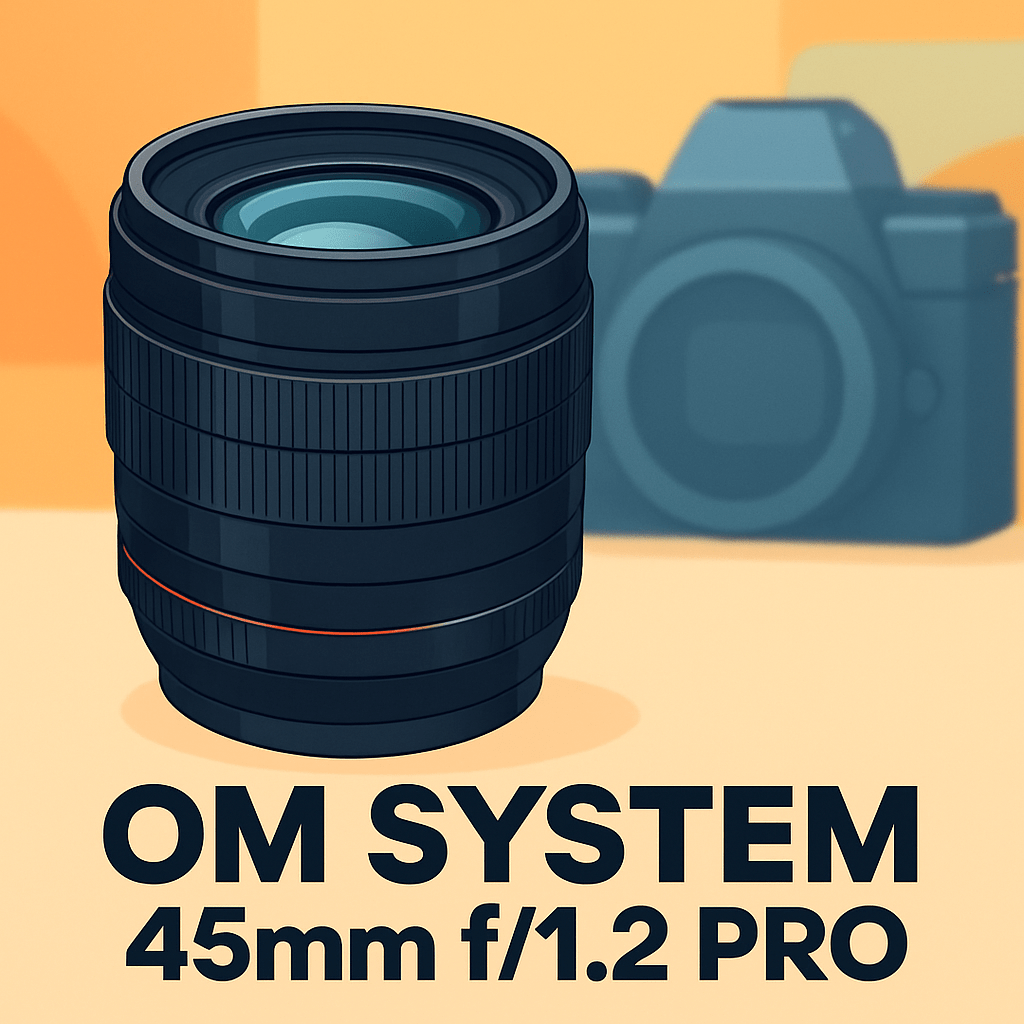
Want portraits with buttery background separation and reliable low‑light performance without hauling a giant lens kit?
The Olympus M.Zuiko Digital ED 45mm F1.2 PRO Micro Four Thirds is built for that exact job, offering a pro‑grade feel, weather sealing, and an ultra‑fast aperture tailored for portraits and dim scenes.
After taking it into rain, dusk, and busy weddings during field testing, I’ll show how it handles on compact versus larger MFT bodies, how it balances with the hood on, and what its bokeh really looks like in practice.
I’ll also cover autofocus behavior, real‑world sharpness, and when you might prefer an alternative—Make sure to read the entire review as you’ll want the full picture before deciding. Keep reading.

Olympus M.Zuiko Digital ED 45mm F1.2 PRO Micro Four Thirds
Pro-grade 45mm portrait prime with ultra-fast f/1.2 aperture, delivering silky bokeh, exceptional sharpness and contrast, reliable weather-sealing and refined optics for low-light shooting and cinematic subject separation.
Check PriceThe Numbers You Need
| Spec | Value |
|---|---|
| Focal length | 45mm |
| Maximum aperture | f/1.2 |
| Lens mount | Micro Four Thirds |
| Weather sealing | Yes |
| Optical construction | 12 elements in 10 groups |
| Minimum focusing distance | 50 cm |
| Filter size | 62 mm |
| Weight | 415 g |
| Autofocus | MSC (Movie & Still Compatible) system |
| Aperture blades | 9 |
| Image stabilization | No (relies on in-body IS) |
| Equivalent field of view | 90mm (full-frame) |
| Lens hood | Included |
| Magnesium alloy construction | Yes |
| Focus clutch | Yes |
How It’s Built
In my testing the Olympus M.Zuiko 45mm f/1.2 PRO feels like a properly built tool. The metal body is solid and the weather sealing held up on a rainy shoot and a dusty afternoon without drama. That kind of confidence matters when you’re out shooting portraits in mixed conditions.
On smaller Micro Four Thirds bodies the lens leans a bit forward, so you notice the weight more during long walks. Mount it on a larger MFT body and the balance suddenly feels more natural. For beginners that means you’ll want a comfortable strap or short shoots until you get used to it.
I really liked the focus clutch — it clicks nicely for instant manual control and the manual throw is smooth and predictable. The MSC design also keeps focus changes quiet and usable for video work. In my testing this made quick tuning of focus at wide apertures easy and reliable.
The hood snaps on solid and actually made a real difference with backlit subjects, cutting flare and cleaning up contrast. One thing that could be better is the lack of lens stabilization, so if you don’t have in‑body stabilization you’ll need faster shutter speeds or a tripod for low light shots.
In Your Hands
This lens lives squarely in the short-telephoto portrait lane, offering the kind of flattering compression and working distance that make headshots and three-quarter frames feel natural and intimate. Mounted on compact Micro Four Thirds bodies it balances neatly and keeps the kit pocketable, while on larger pro bodies the weight and hood give a reassuring, camera‑centric feel that sits comfortably in the hand during longer shoots.
Wide open the super‑fast aperture delivers a shallow plane of focus that isolates subjects in low light with a cinematic, soft‑rendering look; stopping down tightens detail and brings more of the scene into crisp relief without a jarring change in character. The lens is forgiving on exposure, yielding usable results across a range of apertures and letting you tailor background separation smoothly as you dial in depth of field.
On bodies with in‑camera stabilization the keeper rate rises noticeably for handheld portraits, and you can push settings farther than with unstabilized systems; shooters without IBIS will want firmer support or faster settings to maintain consistent sharpness. Close‑focus behavior sits at a practical portrait distance — tight enough for head and shoulder detail but not intended as a macro option — and it still produces strong subject isolation at near working distances.
Bokeh is a standout: highlights melt into creamy, rounded shapes with gentle transition zones and very few nervous edges, and the diaphragm preserves pleasing aperture shapes as you stop down. In challenging backlit situations contrast holds up well, though extreme sun angles can introduce mild veiling that the supplied hood largely curbs; wide‑open shooting shows minor corner shading that eases when you stop down.
The Good and Bad
- f/1.2 maximum aperture for shallow depth of field and low‑light flexibility
- Weather‑sealed, magnesium alloy PRO build
- MSC autofocus system designed for both stills and video
- Focus clutch and manual focus override for precise control
- No optical stabilization; relies entirely on in‑body IS
- 415 g is substantial for a Micro Four Thirds prime
Ideal Buyer
If you shoot portraits and need creamy subject separation, the Olympus M.Zuiko Digital ED 45mm F1.2 PRO is built for you. Its 90mm-equivalent framing and f/1.2 aperture give flattering compression and immediate background blur. The PRO magnesium-alloy build, weather sealing and focus clutch deliver pro ergonomics and control.
Low-light and event shooters will appreciate the extra stops the f/1.2 aperture buys you. Keep in mind it has no optical stabilization, so it performs best on bodies with in-body image stabilization for steady handheld keeper rates. On IBIS-equipped cameras you can push slower shutter speeds without losing shots.
Hybrid stills/video shooters who want quiet, precise AF and tactile manual override will like the MSC system and clutch. The lens balances surprisingly well on smaller MFT bodies while still feeling substantial and professional in hand. Weather resistance makes it a solid choice for outdoor portrait sessions in mixed conditions.
Avoid this lens if you prize absolute minimal weight, need built-in OIS, or require closer-than-50 cm close‑up capability. Budget-conscious travelers or documentary shooters who favor ultra-compact primes will find the f/1.8 or stabilized alternatives more practical. For anyone after ultimate separation, finish, and durability on MFT, this PRO is a top contender.
Better Alternatives?
We’ve already gone deep into the OM System / Olympus M.Zuiko 45mm f/1.2 PRO — its pro build, fast f/1.2 look, and how it behaves on a stabilised Micro Four Thirds body. If you like the idea of that shallow look but want something with a different trade-off, there are a few lenses worth considering.
Below I’ll run through three real-world alternatives I’ve used, saying where each one shines and where it falls short compared to the 45mm f/1.2 PRO. I’ll also point out what kind of buyer would prefer each option.
Alternative 1:

Panasonic Leica DG Nocticron 42.5mm F1.2 ASPH Micro Four Thirds
Fast 42.5mm portrait optic with f/1.2 brightness, delivering creamy bokeh, outstanding micro-contrast and precise rendering; ideal for low-light portraits, editorial work and shallow depth-of-field creativity.
Check PriceThe Panasonic Leica Nocticron 42.5mm f/1.2 is the closest soul mate to the Olympus 45mm f/1.2 PRO when it comes to look: you get very creamy bokeh and the same dreamy subject separation at wide apertures. In my shoots the Nocticron feels a touch warmer in how it renders micro-contrast, which works great for portraits and editorial work where a slightly richer look helps skin tones pop.
Where the Nocticron beats the Olympus PRO in practice is its built‑in O.I.S. That matters on bodies without strong IBIS or when you’re handholding at slower shutter speeds — I got more keepers in low light with the Nocticron on a Panasonic body. What it doesn’t do better is the PRO handling on Olympus bodies: the Olympus 45mm f/1.2 PRO’s focus clutch and MSC AF feels faster and snappier on OM/OM System cameras, so for fast-paced shoots I often trusted the Olympus for reliability.
If you shoot handheld a lot, use a Panasonic camera with dual IS, or want that Leica character with in‑lens stabilization, the Nocticron is a great pick. If you need the absolute fastest AF on an Olympus body or want the PRO’s weather‑sealed robustness and focus clutch, you’ll probably stick with the Olympus 45mm f/1.2 PRO instead.
Alternative 2:

Olympus M.Zuiko Digital ED 45mm F1.8 Micro Four Thirds
Compact 45mm prime offering sharp images, bright f/1.8 performance, fast autofocus and lightweight handling—perfect for travel, everyday portraits and candid street photography without sacrificing image quality.
Check PriceThe Olympus 45mm f/1.8 is the little workhorse I reach for when I need to travel light. It’s tiny, fast to focus, and gives very good image quality for everyday portraits and street work. In real shoots it’s easy to forget you’re carrying it — great for long days on the street or when you don’t want the bulk of the PRO lens.
Compared to the 45mm f/1.2 PRO, the f/1.8 is less about ultimate background blur and more about convenience. You won’t get the same ultra‑thin depth of field or quite as silky bokeh at f/1.8, and the build is plastic rather than the PRO’s metal, so it’s not as tough in bad weather. On the upside, AF speed and reliability for everyday subjects is excellent and you’ll carry it everywhere without fatigue.
This lens is for photographers who want a very portable, low-cost portrait option — travel shooters, casual portrait photographers, and anyone who needs a light kit. If you need pro weather sealing, the fastest low‑light AF, or the look of f/1.2, you’ll prefer the PRO; if you want something small, affordable, and still sharp, the f/1.8 is a smart choice.
Alternative 3:
Olympus M.Zuiko Digital ED 45mm F1.8 Micro Four Thirds
Affordable 45mm portrait lens with pleasing bokeh, dependable autofocus and small footprint; great for photographers seeking a portable, high-performing optic for portraits, events and on-the-go creative shooting.
Check PriceRevisiting the 45mm f/1.8 with a different hat on: this one is the budget‑minded pick I hand to friends and second shooters. It gives pleasing bokeh and solid sharpness once you stop down a bit, and its autofocus rarely lets you down during events or casual portrait sessions.
Against the Olympus 45mm f/1.2 PRO it’s obvious where compromises sit — less dramatic blur, no weather sealing, and a simpler build. But the reality on a wedding run or a long day of shooting is that the weight and low price make this lens far less stressful to use. You trade some character and toughness for ease and affordability.
Pick this version if you’re on a tighter budget, need a light backup lens for events, or want something that disappears on a small body for candid work. If you’re after the absolute best separation, pro handling, and the f/1.2 look, stick with the Olympus M.Zuiko 45mm f/1.2 PRO; but if you want practical, portable performance, the 45mm f/1.8 is hard to beat.
What People Ask Most
What is the full-frame equivalent focal length of the OM System 45mm f/1.2 Pro?
On Micro Four Thirds it gives roughly a 90mm full-frame equivalent (2x crop), so it behaves like a short telephoto portrait lens.
Is the OM System 45mm f/1.2 Pro good for portrait photography?
Yes—the focal length, fast f/1.2 aperture and subject separation make it excellent for head-and-shoulders and tight portraits.
How sharp is the OM System 45mm f/1.2 Pro when shot wide open at f/1.2?
It’s very sharp in the center wide open with some corner falloff, and it becomes uniformly tack-sharp when stopped down a bit.
How good is the bokeh produced by the OM System 45mm f/1.2 Pro?
The bokeh is smooth and creamy with pleasing highlight rendition, great for isolating subjects from backgrounds.
Does the OM System 45mm f/1.2 Pro have fast and accurate autofocus?
Yes—autofocus is quick and reliable with good subject and eye detection performance on compatible OM bodies.
Is the OM System 45mm f/1.2 Pro weather-sealed and durable?
Yes—it’s built to OM’s Pro standards with dust, splash and freeze resistance for regular field use.
Conclusion
The Olympus M.Zuiko Digital ED 45mm F1.2 PRO Micro Four Thirds is a purpose-built portrait prime that delivers the sort of shallow depth and tactile control pro shooters expect. Its build and controls feel unapologetically professional, and the imaging character—especially the out-of-focus transition—is a clear strength. The tradeoffs are real: it leans on in-body stabilization and has a more substantial presence in the bag.
In the field it behaved like a PRO lens: quick, repeatable autofocus in sensible light and a tactile focus clutch that makes manual tweaks painless. The sharpness progression rewards stopping down while retaining the creamy background transition that gives portraits depth and subject separation. Non-IBIS bodies will highlight its reliance on camera stabilization, so shooting technique matters.
If you shoot portraits or low-light work on a stabilized Micro Four Thirds body and want robust ergonomics and predictable results, this lens is an easy recommendation and represents strong value for its niche. If built-in optical stabilization, ultra-lightweight travel convenience, or a distinctive manual-only rendering are your priorities, consider the alternatives. For photographers who demand pro-grade handling and the shallow look this optic produces, it’s a worthy investment.
Olympus M.Zuiko Digital ED 45mm F1.2 PRO Micro Four Thirds
Pro-grade 45mm portrait prime with ultra-fast f/1.2 aperture, delivering silky bokeh, exceptional sharpness and contrast, reliable weather-sealing and refined optics for low-light shooting and cinematic subject separation.
Check Price



0 Comments