
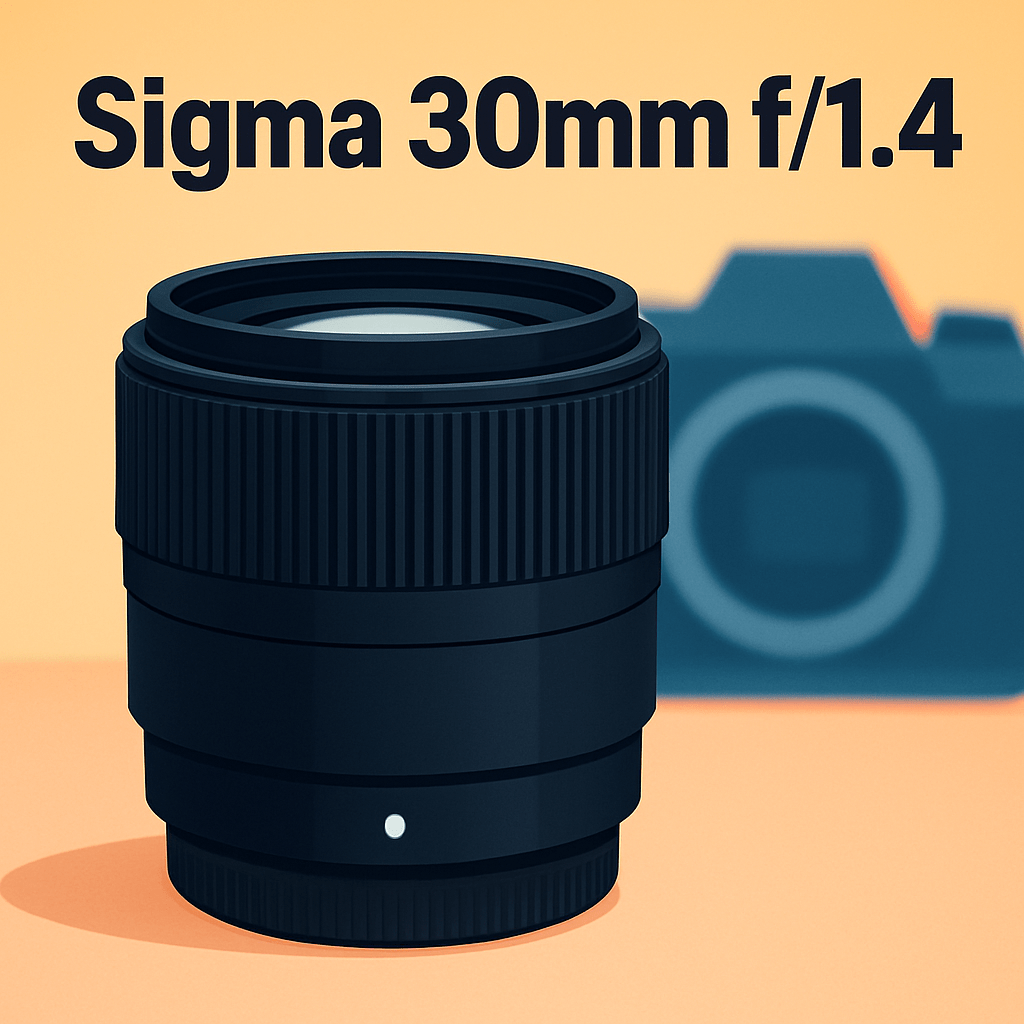
Want sharper images and creamier backgrounds from your Sony APS-C camera without lugging a giant lens? The Sigma 30mm f/1.4 DC DN Contemporary Sony E promises that sweet spot—natural perspective, big aperture, compact handling—and I put it through real-world shoots to find out.
If you shoot low-light scenes, portraits, street or travel, this lens is aimed at you; it’s built for subject separation and usable light. The payoff is obvious, though you’ll trade off built-in stabilization and instead rely on your camera’s IBIS or faster shutter speeds.
I’ll cover design and handling, autofocus behavior, sharpness across apertures, real-world shooting notes, pros and cons, and practical alternatives. Make sure to read the entire review as I break down when this lens is the right pick for your kit—keep reading.

Sigma 30mm f/1.4 DC DN Contemporary Sony E
Bright f/1.4 APS-C prime delivers exceptional sharpness, smooth bokeh and strong low-light performance. Compact, lightweight design and fast autofocus make it ideal for portraits, street scenes and storytelling.
Check PriceThe Numbers You Need
| Spec | Value |
|---|---|
| Focal length | 30mm |
| Maximum aperture | f/1.4 |
| Lens mount | Sony E-mount / Micro Four Thirds (depending on version) |
| Format compatibility | APS-C mirrorless cameras |
| Optical design | 9 elements in 8 groups |
| Angle of view | Approximately 50.7° (APS-C) |
| Minimum focusing distance | 0.30 m (11.8 in) |
| Maximum magnification ratio | 1:5.3 |
| Filter size | 52mm |
| Aperture blades | 9, rounded diaphragm for smooth bokeh |
| Autofocus | Stepping motor (STM) autofocus system |
| Dimensions (approx.) | 69 x 73 mm (diameter x length) |
| Weight | Approximately 265 g |
| Image stabilization | None (relies on camera body stabilization if available) |
| Coating | Super Multi-Layer Coating to reduce flare and ghosting |
How It’s Built
In my testing with the Sigma 30mm f/1.4 DC DN Contemporary Sony E I liked how well it balances on small Sony APS-C bodies. It feels light in the hand and stays steady when shooting one-handed. That makes it an easy lens to carry all day without tiring your wrist.
The focus ring is smooth and nicely damped, giving precise control when I switch to manual focus. Autofocus is driven quietly by a stepping motor, so it doesn’t distract during video. Beginners will find the controls simple and predictable right out of the box.
Build-wise the lens feels solid, with a sturdy mount and a well-made barrel that survived being tossed in my camera bag. One thing I really liked was the sense of quality despite the compact size. One thing that could be better is the lack of built-in stabilization, so you’ll rely on your camera’s IBIS or higher shutter speeds for steady shots.
The lens uses a common filter size, so ND and polarizing filters are easy to find and inexpensive. I also noticed the Super Multi-Layer Coating helped keep flare and ghosting under control in backlit scenes. In practice that means cleaner contrast and fewer surprises when shooting toward the sun.
In Your Hands
The Sigma 30mm f/1.4 DC DN Contemporary sits squarely in the “normal” pocket on APS-C bodies, giving a natural, eyes-level perspective that feels familiar and unobtrusive. Wide-open rendering delivers clear subject separation and a pleasing falloff that keeps faces and foreground subjects distinct from backgrounds.
Bokeh is one of the lens’s strengths — highlights round out smoothly and out-of-focus areas melt without harsh onion-ring edges, thanks to its rounded-blade diaphragm. That creamy backdrop works especially well for indoor portraits and environmental headshots where you want the subject to pop without the background becoming a distraction.
In low light the fast maximum aperture buys real-world headroom, letting you hold tighter shutter speeds or lower ISO than slower walkaround glass. Because the lens has no optical stabilization, handheld shooting depends on your camera’s stabilization or deliberately faster shutter speeds for tack-sharp results.
Close-focusing capability lets you make intimate food and product shots with convincing separation, though it isn’t a macro tool — detail is excellent for tighter framing but not true magnification. On the move it handles street and travel work well, balancing on small Sony APS-C bodies without feeling front-heavy.
Autofocus is quietly confident on Sony bodies, with smooth transitions and dependable face/eye detection for stills and video; you’ll notice only modest focus breathing in cine work. Backlit scenes are surprisingly well-controlled thanks to the coating, though you’ll see the usual wide-open vignetting and the small, usable quirks that come from a compact, fast prime.
The Good and Bad
- Fast f/1.4 aperture for low-light shooting and subject separation
- 9 rounded aperture blades for smooth bokeh
- Lightweight and compact for a fast prime (approx. 265 g; 69 x 73 mm)
- Super Multi-Layer Coating for flare and ghosting control
- No optical image stabilization
- APS-C only (not designed for full-frame coverage)
Ideal Buyer
For Sony APS-C mirrorless shooters who want a fast, natural-feeling normal lens, the Sigma 30mm f/1.4 DC DN Contemporary is a compact powerhouse. Its f/1.4 aperture gives real low‑light headroom and creamy subject separation that larger-aperture primes deliver without the bulk. If you prize a classic, fifty-ish perspective on a crop body, this lens speaks directly to that need.
It’s ideal for available-light portraits, street and travel work, and environmental shots where background rendering matters. The small footprint and 52mm filter thread make packing ND or polarizers painless, and the nine‑blade diaphragm helps deliver pleasing bokeh. Hybrid shooters will appreciate the quiet STM AF, but should accept the lack of optical stabilization or rely on camera IBIS or faster shutter speeds.
This lens suits photographers who value maximum subject separation and image character in a light, everyday package. It’s not the pick for those who need built‑in OSS or macro capability, but it excels for photographers willing to trade that convenience for f/1.4 speed and superior rendering. If you want a go‑to normal prime for low‑light, portraits and street without carrying a heavy setup, this is the lens to try.
Better Alternatives?
We’ve already gone through the Sigma 30mm f/1.4 and what it brings to Sony APS-C bodies: lots of light, shallow depth of field, nice bokeh and a compact, well-balanced feel. That lens is a great pick if you want f/1.4 speed and a natural “normal” field of view for portraits, street work and low‑light shooting.
If the Sigma doesn’t match your needs exactly, there are a few clear alternatives. Some give you similar wide aperture for the same look, some add stabilization or macro ability, and some trade a little blur for a much smaller, lighter package. Below are three lenses I’ve shot with that show those different choices in real-world use.
Alternative 1:

Viltrox 33mm f/1.4 XF Fujifilm X
Fast f/1.4 standard lens produces creamy background separation, crisp center detail and reliable autofocus. Affordable yet professional-feeling optic for portraits, everyday shooting and low-light creativity on APS-C bodies.
Check PriceI’ve used the Viltrox 33mm f/1.4 on Fuji bodies and it feels very close to the Sigma in what it delivers: big f/1.4 look, strong center sharpness and nice subject separation. Where it’s different is the field of view — 33mm is a touch tighter than the Sigma’s 30mm, so it frames a little closer without moving your feet.
Compared to the Sigma, the Viltrox often gives punchy contrast and very usable files straight from camera, and the build feels solid and a bit more metal. It doesn’t have optical stabilization either, so low‑light handheld shooting is the same trade‑off as the Sigma — rely on body IBIS or faster shutter speeds. I found corners a bit softer wide open than the Sigma’s center, but stopped down you get very pleasing results.
This is the lens I’d recommend to Fujifilm shooters who want that f/1.4 look without paying for a native Fuji top‑tier price. If you shoot on X bodies and want a professional feel, good autofocus and strong value, the Viltrox is a smart pick. If you need optical stabilization or you shoot on Sony E without an adapter, the Sigma (on Sony) or a Sony-native lens will be a better match.
Alternative 2:

Sony 35mm f/1.8 E
Versatile, lightweight prime balances sharpness and portability with quick autofocus and pleasing bokeh. Natural perspective suits street, travel and environmental portraits while performing well in challenging light.
Check PriceI use the Sony 35mm f/1.8 on Sony APS-C bodies when I want something very small and unobtrusive. In real shoots it’s noticeably lighter and more pocketable than the Sigma, and the built-in OSS (optical steady shot) really helps for handheld low‑light shots and video — something the Sigma lacks.
Where the Sony beats the Sigma is stability, size and AF integration. Its autofocus is quick and very reliable on Sony cameras, and the OSS lets you handhold at slower shutter speeds with less worry. What it can’t match is the Sigma’s f/1.4 look: you get less background blur and a bit less low‑light headroom, so the Sigma will give creamier bokeh and slightly better subject separation when that’s the goal.
Pick the Sony 35mm f/1.8 if you want a daily driver that disappears on the camera, if you shoot a lot of video or travel, or if you need stabilization without depending on body IBIS. If you prioritize maximum blur or the very shallow depth of field for portraits, the Sigma still has the edge.
Alternative 3:
Sony 35mm f/1.8 E
Compact standard focal length optimized for everyday use; delivers consistent contrast, accurate colors and dependable AF. Great for vloggers, documentary work and photographers seeking a discreet, high-quality walkaround lens.
Check PriceFor vloggers and documentary shooters I’ve often reached for the Sony 35mm f/1.8 because it gives consistent color and contrast and stays quiet and steady while you move. In real-world handheld shooting it feels more forgiving than the Sigma thanks to OSS and the smaller, lighter package that makes long days less tiring.
Compared with the Sigma 30mm f/1.4, the Sony is better when you need a discreet setup, reliable AF tracking, and image stabilization for mixed stills/video work. It’s worse when you’re after the shallowest depth of field or want that extra stop of light for very dim scenes — the Sigma’s f/1.4 gives a different look that the Sony can’t fully match.
If you’re a vlogger, run-and-gun documentarian, or a photographer who values a small, dependable walkaround lens, the Sony 35mm f/1.8 is a great alternative. If your main need is the brightest aperture and the softest background for portraits, stick with the Sigma or look for other f/1.4 options.
What People Ask Most
Is the Sigma 30mm f/1.4 worth buying?
Yes — it’s excellent value for an APS‑C fast prime, offering strong image quality and low‑light performance for the price.
Is the Sigma 30mm f/1.4 sharp?
Yes — very sharp in the center and becomes even better across the frame when you stop down a bit.
Is the Sigma 30mm f/1.4 a full-frame lens?
No — the common Sigma 30mm f/1.4 models (DC/DN) are made for APS‑C sensors, not full‑frame bodies.
Is the Sigma 30mm f/1.4 good for portraits?
Yes for environmental and waist‑up portraits thanks to its field of view on APS‑C, but it’s less ideal for tight headshots if you want strong background compression.
Is the Sigma 30mm f/1.4 good for low light photography?
Yes — f/1.4 gives you plenty of light and subject separation, though the lens doesn’t have image stabilization so you’ll rely on shutter speed or ISO.
What is the equivalent focal length of the Sigma 30mm f/1.4 on crop sensor cameras?
On most APS‑C bodies (1.5x crop) it’s roughly a 45mm equivalent, and about 48mm on Canon’s 1.6x crop bodies.
Conclusion
The Sigma 30mm f/1.4 DC DN Contemporary Sony E is a compact, fast normal prime that delivers the kind of low‑light freedom and subject separation many APS‑C shooters crave. Its wide aperture and rounded diaphragm produce a pleasing out‑of‑focus character while the modern STM autofocus keeps focus quiet and dependable. In hand it feels balanced and unobtrusive — a lens you can carry all day without compromise.
That said, the lens is not without clear trade‑offs. There’s no optical stabilization, so handheld low‑light video or ultra‑slow shutter work depends on your camera or technique. Stopping down improves micro‑contrast and edge acuity, and the coating helps keep contrast up under challenging light, but it’s not a one‑lens solution for every job.
Bottom line: if you shoot Sony APS‑C and want a compact, fast normal prime for portraits, street and available‑light work, this Sigma is an excellent, well‑rounded choice. If you need built‑in stabilization, macro capability or a smaller pocketable option, look elsewhere. For its balance of rendering, handling and real‑world performance, I’d recommend it as a go‑to creative tool for photographers who prioritize speed and image character.
Sigma 30mm f/1.4 DC DN Contemporary Sony E
Bright f/1.4 APS-C prime delivers exceptional sharpness, smooth bokeh and strong low-light performance. Compact, lightweight design and fast autofocus make it ideal for portraits, street scenes and storytelling.
Check Price


0 Comments