
What if you could capture pro-level photos and video without blowing your budget? This Ultimate Guide narrows the field to five cameras that consistently deliver the best bang for your buck—options that blend performance, useful features, and sensible pricing. Think of it as choosing gear that pays you back in better images, not just prettier marketing.
These selections are for anyone who wants serious value: first-time buyers stepping up from a phone, hobbyists refining their craft, and professionals who need a reliable, affordable second body. We weighed everyday usability as much as lab specs. The goal is to recommend models that remain adaptable as your skills and projects evolve.
Our short list was formed around a handful of practical criteria—sensor size, in-body stabilization, autofocus performance, video capability, lens ecosystem, and ergonomics. Each factor shapes day-to-day shooting, from low-light latitude to how comfortable a camera feels on a long assignment. Balancing those elements is the key to getting the most photographic return for your investment.
We evaluated value through the lens of real-world shooting, not buzzword features. The cameras that made the cut are reliable, flexible, and offer room to grow without forcing frequent upgrades. Ready to find the camera that stretches your budget without shrinking possibilities?
1. Olympus OM-D E-M1 Mark II Key Highlights

OM System OM-D E-M1 Mark II body
Rugged professional micro four‑thirds body delivering pro‑grade stabilization, fast autofocus and weather‑sealed durability for demanding photographers
Check PriceThe Olympus OM-D E-M1 Mark II is a Micro Four Thirds camera built for pros and serious enthusiasts. It holds strong used-market value, making it a smart buy if you want pro features without flagship pricing.
Its headline feature is an exceptional 5-axis IBIS that delivers sharp handheld shots and stabilized video without needing a gimbal. The body is weather-sealed and rugged, so it stands up well to travel and outdoor work.
For action shooters it’s compelling: you get very fast burst shooting — up to 60 fps with the electronic shutter — and a compact body with pro-grade controls that make tracking and timing easier. Autofocus is reliable for many action scenarios, though it’s not quite on par with the very latest full-frame and APS-C systems, especially for demanding video or extremely fast subjects.
Real-world users praise its battery life and a fully articulating touchscreen, which helps immensely for run-and-gun work and creative angles. Lens compatibility is broad across the Micro Four Thirds mount, so you can tap into a wide selection of Olympus and Panasonic Lumix glass without fuss.
Keep in mind the trade-offs: the 20MP Micro Four Thirds sensor won’t match larger sensors for dynamic range or high-ISO low-light performance. If you prioritize rugged, compact handling, excellent stabilization, and speed over ultimate low-light image quality, the E-M1 Mark II is a very practical and versatile tool.
- Exceptional 5-axis IBIS
- Up to 60 fps with electronic shutter
- Weather-sealed, durable build
- Compact body with pro-grade controls
- 20MP MFT sensor limits dynamic range/low-light
- AF trails latest full-frame/APS-C for video/fast action
2. Canon EOS R100 Key Highlights

Canon EOS R100 with RF-S 18-45mm STM kit
Beginner-friendly mirrorless kit offering intuitive controls, compact zoom lens and reliable image quality for everyday shooting and travel
Check PriceThe Canon EOS R100 is a no-nonsense entry-level mirrorless that shines where most beginners care most: stills, ergonomics, and price. Its 24MP APS-C sensor delivers respectable stills comparable to pricier Canon models, so you’ll get pleasing image quality straight out of camera without needing a deep learning curve.
Autofocus is a real strength here — Canon’s Dual Pixel AF provides reliable autofocus for stills, which means you can trust the camera to lock onto faces and subjects as you learn composition and timing. The body is compact and lightweight for everyday carry, and the straightforward interface with a comfortable grip makes it one of the easiest systems to shoot with for long periods.
If you’re upgrading from a smartphone or buying your first interchangeable-lens camera, the R100 is exactly the kind of tool that removes friction and helps you focus on making pictures. That said, it’s not aimed at advanced shooters: the build is basic plastic and the rear LCD is fixed, so it won’t suit heavy-duty travel or vlog-style shooting that needs a tilt screen.
Video shooters should be cautious — 4K video on the R100 is limited to 8-bit with a significant crop and lacks advanced video features, so it’s not the best choice if you plan to do serious hybrid work. For casual photographers, learners, and anyone wanting an affordable, reliable stepping-stone into mirrorless, the Canon EOS R100 is a very strong bang-for-buck option.
- Most affordable new mirrorless from a major brand
- 24MP APS-C sensor delivers respectable stills
- Dual Pixel AF provides reliable autofocus for stills
- Compact and lightweight for everyday carry
- Basic plastic body; lacks tilting touchscreen and other advanced features
- 4K video limited to 8-bit with a significant crop
3. Sony a6100 Key Highlights
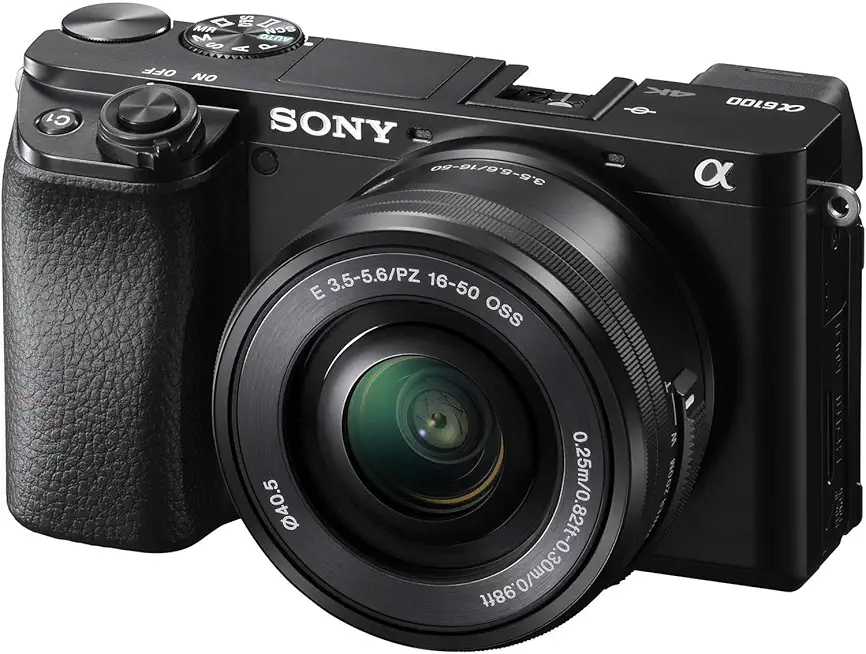
Sony Alpha A6100 with 16-50mm lens
Compact interchangeable-lens camera with lightning-fast autofocus, crisp image quality and a versatile 16–50mm zoom for vlogging and travel photography
Check PriceThe Sony a6100 is a compact APS-C mirrorless that punches above its weight for autofocus and video, making it a strong choice for content creators and hybrid shooters. Its 24MP APS-C sensor delivers notably good dynamic range and low-light performance for the class, so you get usable files in dim interiors and evening street scenes.
What really sells the a6100 is the AF system: Real-time Tracking and Eye AF work superbly for stills and video. As a photographer I rely on that eye detection for quick portraits and for keeping focus on moving subjects during run-and-gun shoots.
Video specs are solid — the camera is capable of 4K recording that will satisfy vloggers and creators who need clean, detailed footage. Do note there’s no in-body image stabilization, so handheld video can look shaky without stabilized lenses or a gimbal; many vloggers mention this limitation.
The body is compact and lightweight, which makes it ideal for travel and everyday carry. That small footprint, plus the broad Sony E-mount lens selection, means you can build a versatile kit without breaking the bank.
On the downside, the a6100 feels plasticky and isn’t weather-sealed, so it’s not the best choice for rough outdoor conditions or heavy rain. Still, for people moving up from smartphones or older DSLRs who prioritize autofocus, size, and video capability, the a6100 is mostly a very practical, value-packed option.
- Fast Real-time Tracking & Eye AF
- 24MP APS-C sensor — strong dynamic range
- Compact, lightweight body & wide E-mount lens selection
- Capable 4K video for vloggers/creators
- No in-body image stabilization (IBIS)
- Plasticky build; no weather sealing
4. Fujifilm X-T5 Key Highlights

Fujifilm X-T5 body
High-resolution APS-C body with refined film-simulation colors, tactile controls and powerful image processing for creatives and serious enthusiasts
Check PriceThe Fujifilm X-T5 is a mid-range APS-C mirrorless that blends classic, tactile controls with modern imaging chops. It’s built for photographers who want a hands-on experience and high-resolution stills without jumping to full-frame.
Image quality is the headline here thanks to the 40MP APS-C sensor. That resolution gives you excellent detail for landscapes and portraits, and Fuji’s color science means pleasing, film-like tones straight out of camera.
Handling is a major selling point. The tactile physical dials for shutter, ISO, and exposure make it intuitive to shoot manually and speed up workflow on the street or while traveling.
The body is compact and lightweight, so it won’t weigh you down on long walks or trips. And the strong X-mount lens ecosystem means you can find everything from affordable primes to high-performance glass as your needs evolve.
If you shoot a lot of video or need cutting-edge autofocus for fast action, be aware the X-T5’s video specs and autofocus trail some full-frame rivals. Battery life is moderate, so bring extra batteries for extended shoots or travel days.
Overall, the X-T5 is a great fit if you prioritize image quality, handling, and Fuji’s in-camera colors over the latest video features or the fastest AF performance. It’s ideal for enthusiasts, travel photographers, and anyone who values tactile controls and stunning JPEGs.
- 40MP APS-C sensor
- Tactile physical dials for shutter, ISO, and exposure
- Compact, lightweight body for travel and street photography
- Fuji Film Simulations for in-camera color profiles
- Video specs and autofocus trail some full-frame rivals
- Moderate battery life; extra batteries recommended
5. Panasonic Lumix S5 II Key Highlights

Panasonic Lumix S5II body
Compact full-frame hybrid body delivering advanced video features, in-body stabilization and professional-grade performance for filmmakers and photographers
Check PriceThe Panasonic Lumix S5 II is a full-frame hybrid that balances stills and video performance at a competitive price. As a working photographer I appreciate cameras that give punchy image quality without flagship bulk, and this one delivers that balance well.
At its heart is a 24MP full-frame sensor with strong dynamic range and low-light performance, so you get clean files and room to recover highlights and shadows. The body also sports advanced IBIS among the best in class, which makes handheld low-light shooting and run-and-gun video much more usable.
Video shooters will like the 6K video recording and the inclusion of phase-detect AF (first for Panasonic), which brings more confident subject tracking than previous Lumix bodies. Panasonic often prices the S5 II competitively, and it’s commonly bundled with high-quality prime lenses, boosting value for creators who need a capable kit straight away.
Controls are minimalist and intuitive, which shortens the learning curve when switching between stills and video workflows. Be aware the camera is larger and heavier than APS-C or Micro Four Thirds alternatives, and its autofocus still has some catching up to do versus Sony and Canon for fast action, so if you mostly shoot fast-paced sports you might feel the limits.
- 24MP full-frame sensor with strong dynamic range and low-light performance
- Advanced IBIS among the best in class
- 6K video recording and phase-detect AF (first for Panasonic)
- Good value often bundled with high-quality prime lenses
- Autofocus still catching up to Sony/Canon for fast action
- Larger and heavier than APS-C/Micro Four Thirds alternatives
Choosing the Right Camera

Choosing the right camera starts with one simple question: what will you actually shoot most of the time? Be honest—gear that’s perfect for wildlife will feel clumsy for travel, and a flashy video spec is wasted if you mostly shoot portraits. Prioritize the features that will be used every shoot.
Sensor size matters more than megapixels. Full-frame gives better low-light performance and shallower depth of field, but comes with bigger lenses and higher cost. APS-C and Micro Four Thirds offer excellent value, smaller bodies, and lighter, cheaper glass—great if you travel or carry your kit all day.
Match the camera’s strengths to your genre. For sports and wildlife, fast burst rates and reliable phase-detect AF are vital. Landscapes and studio work benefit from higher resolution and wide dynamic range. For street and travel shooting, compact bodies, weather sealing, and long battery life make your life easier.
Don’t ignore stabilization and autofocus quality. In-body image stabilization lets you shoot handheld in lower light and smooths video without a gimbal. For hybrid shooters, strong real-time AF and eye-detection simplify both stills and moving subjects, saving you time in post.
Think of lenses as the investment, not the camera body. A versatile, affordable lens lineup will pay dividends as your skills grow. Check availability of fast primes and useful zooms, along with used-market options—good glass keeps value and shapes your creative options more than camera specs.
Ergonomics determine whether you’ll enjoy using the camera. Physical dials, a comfortable grip, and intuitive menus speed up your workflow, especially under pressure. Try cameras in hand or rent one for a weekend before committing—comfort matters more than a spec sheet.
Finally, set a realistic budget that includes at least one good lens, spare batteries, and a decent bag. Buy used to stretch value when appropriate, and focus on the camera that makes you want to shoot more. The right choice is the one that keeps you creating.
Essential Budget Camera Accessories
Accessories are where a modest camera investment really starts to pay off. The right few items will solve real-world problems—low light, shaky hands, cramped storage—so you get better images without upgrading the body.
A tripod is the most transformative single accessory. It gives you sharp long exposures, cleaner landscapes, and precise composition for portraits. For travel, pick a compact but sturdy model; if you shoot long exposures or astrophotography, prioritize stability over weight.
Memory cards and spares are deceptively important. Carry at least two cards and a spare battery so you never cut a shoot short. For video or long bursts choose V30/U3 or faster cards to avoid dropped frames and write-speed bottlenecks.
Adding a small prime lens delivers more image quality than upgrading a body. A 50mm-equivalent f/1.8 is inexpensive, sharp, and perfect for portraits and low light. If you prefer street or landscapes, consider a 35mm or 28mm equivalent instead.
An external flash extends what you can do indoors and at events. Simple bounce techniques make shots look natural and flattering. If you want convenience, look for TTL-capable flashes; manual heads are cheaper and great for learning light control.
A protective, comfortable camera bag keeps you shooting longer and safer. Pick one that fits your usual kit with room for a couple of lenses and cards. Add a basic remote shutter release to cut shake for long exposures and group shots.
If budget is tight, prioritize batteries, cards, and a fast prime first, then add a tripod and flash. Buying used for tripods and lenses often gives the best value. Spend smart on accessories and your camera will feel like a much pricier system in everyday shooting.
What People Ask Most
What camera is best for beginners?
Choose a camera that is easy to use with a simple interface and reliable autofocus. Comfortable handling and an affordable lens ecosystem will make learning more enjoyable.
Which camera has the best image quality for everyday shooting?
Image quality depends on sensor size and good lenses rather than a single model. Prioritize cameras known for clean files, accurate color, and a lens selection that suits your subjects.
What mirrorless camera is the best overall?
There is no one best mirrorless camera for everyone; the right choice balances image quality, autofocus, video features, and ergonomics. Pick the system that fits your shooting priorities and budget.
Which camera is best for vlogging and content creation?
Look for a camera with stable autofocus, good in-camera stabilization, and useful video features like clean outputs and a mic input. Compact size and flip screens also help when recording yourself.
What camera performs best in low-light situations?
Cameras with larger sensors and effective stabilization generally handle low light better, especially when paired with fast lenses. Good high-ISO performance and noise control are key for usable results.
Which camera has the best autofocus for photos and video?
The best autofocus varies by brand and generation; aim for systems with reliable subject tracking and eye-detection. Test autofocus in the kind of shooting you do to ensure real-world performance.
What is the best all-around camera for travel and versatility?
An ideal travel camera balances compact size, weather resistance, solid image quality, and a versatile lens lineup. Long battery life and comfortable handling make it practical for extended outings.
Conclusion for Best Bang for Buck Cameras
These five cameras represent a practical cross-section of options that balance performance, features, and value for photographers ranging from beginners to working professionals.
Choose the body that best matches your priorities—sensor size, in-body stabilization, autofocus and video needs, lens ecosystem, and ergonomics will matter most depending on what and how you shoot.
Also consider used-market savings—for example, a well-maintained E-M1 Mark II can stretch your budget—and remember to set aside funds for essential accessories that keep your kit flexible in the field.
If you want to sharpen your decision-making and shooting skills, read more articles on the site for practical tips, hands-on comparisons, and workflow ideas that suit your level and budget.
Have a question or want to share your experience with one of these models? Leave a comment below and we usually reply within a few hours.





0 Comments