
Ready to spark a new kind of curiosity in your child — one that buzzes, hovers, and pulls them outdoors?
This ultimate guide to the 5 best mini drones for kids walks you through five kid-friendly picks, smart buying advice, safety pointers, and answers to common questions parents ask. We strip away the tech-speak so you can pick a fun, safe option without the guesswork.
If you’re a parent, grandparent, or caregiver shopping for a child’s first drone, this guide is for you. We focus on easy-to-fly, durable choices that match beginner hands and short attention spans. Expect clear guidance on what matters at different stages of learning to fly.
Mini drones are ideal for short bursts of play, backyard exploration, and creative projects. They spark problem-solving and hand-eye coordination while keeping the experience low-stress and affordable. Think of them as a gentle, hands-on introduction to flight and simple technology.
Inside, we compare each pick’s strengths and explain the practical trade-offs parents should weigh. We’ll help you balance safety, simplicity, and lasting play value so your child gets excited without the headaches. Read on to find a mini drone that fits your child’s age, energy, and your peace of mind.
1. DJI Tello Mini Drone

DJI Tello 720p Drone
Compact aerial camera delivers smooth HD video, easy controls, and beginner-friendly flight features for fun learning and creativity.
Check PriceAs a photographer who also enjoys teaching kids the basics of composition, the DJI Tello is a delightful little tool. It packs a 720p HD camera into an ultra-lightweight frame, so kids can safely experiment with framing and movement without worrying about heavy gear.
Control is via the DJI Tello smartphone app on iOS or Android, and the flight features are forgiving. Auto takeoff/landing and propeller guards make the learning curve gentle, so younger pilots can focus on capturing shots instead of panicking about crashes.
Real-world use shows it’s intuitive for children roughly 8–12 years old. It holds steady indoors and even outdoors in mild wind, which helps produce smoother video and easier practice sessions for budding aerial photographers.
Battery life is modest at about ~13 minutes per charge, so plan for short shooting windows or carry a spare battery. The lightweight frame and prop guards survive minor bumps, which is ideal for beginners still learning control and spatial awareness.
There are also educational perks: programmable features introduce basic coding concepts, turning playtime into a learning opportunity. That said, don’t expect professional-grade range or all-weather performance; it struggles in stronger wind and has a more limited range than pricier models.
- Easy, intuitive controls
- 720p HD camera
- Safety features (prop guards, auto takeoff/landing)
- Lightweight and durable for beginners
- Limited flight time (~13 min)
- Susceptible to wind; limited outdoor performance
2. Holy Stone HS210 Mini Drone
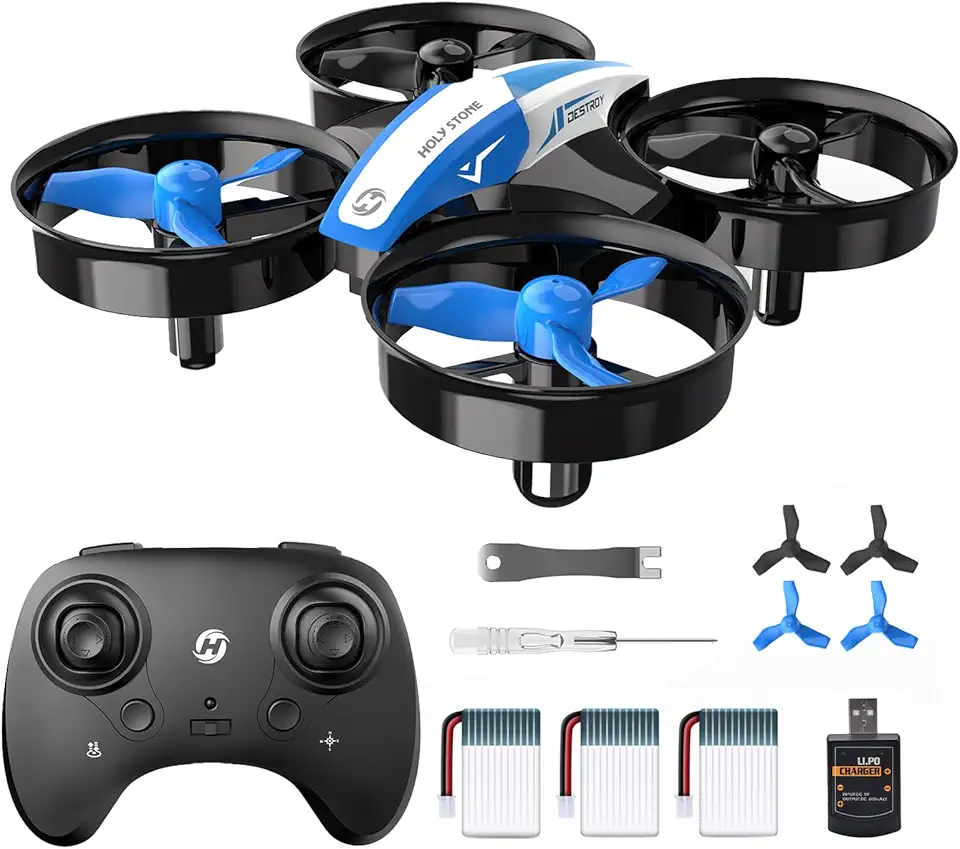
Holy Stone HS210 Mini Drone with 3 Batteries
Tiny, durable flyer with three included batteries for extended playtime, stable hovering, and kid-friendly controls.
Check PriceAs a photographer who often scouts tight indoor spaces, I appreciate a drone that’s compact, forgiving, and simple to fly — the Holy Stone HS210 fits that bill for kids aged 6 and up. It’s built for indoor play with protective propeller guards and a small footprint that won’t wreck your living room decor.
The controls are responsive and straightforward, with headless mode, three-speed levels, and one-key takeoff/landing so beginners can focus on flying, not orientation. It also does flips and rolls, which keeps playtime fun and encourages skill progression without needing advanced piloting knowledge.
Durability is a real selling point: the HS210 is tough and can withstand repeated crashes, so parents worry less about every bump or wall hit. That said, some users describe the build as a bit flimsy, so expect to replace parts after heavy use rather than rely on indestructible construction.
Flight time is short at about 7 minutes per battery, but most packages usually include three batteries, which lets kids swap in fresh juice and get roughly 21 minutes of total flying before you need to recharge. If long continuous flights are a priority, this isn’t the drone for you, but for short indoor sessions and practice, it’s very practical.
Overall, the Holy Stone HS210 is an excellent starter mini drone for young kids who need something durable, easy to learn on, and entertaining with stunt features. It’s especially well-suited to supervised indoor play and skill-building over longer, single-flight performance.
- Excellent crash durability
- Three-speed levels for progression
- Protective guards for safe indoor flying
- Simple one-button operation
- Short flight time (~7 min per battery)
- Build quality sometimes described as flimsy
3. Potensic A20 Mini Drone
Holy Stone HS210 Mini Drone with 3 Batteries
Pocket-sized quadcopter offers easy-to-use controls, propeller guards, and multiple batteries so kids can fly longer between charges.
Check PriceThe Potensic A20 Mini Drone is built specifically for very young beginners, with easy controls and kid-friendly safety features. It offers altitude hold, headless mode, one-key takeoff/landing, and three-speed levels, which makes initial learning straightforward for small hands.
In real-world use it shines indoors — smooth, stable flights suit kids roughly 6–10 years old. Altitude hold helps novices keep a steady hover, and the size plus prop guards make indoor play low-risk and forgiving of bumps and minor crashes.
From a user perspective it’s reliable for learning the basics; the multiple speed settings let a child progress as confidence grows. Be realistic about limits: the A20 is light and not built for outdoor use in wind, and run times are short — roughly 5–8 minutes per charge — so expect frequent battery swaps during play sessions.
If you want a safe, simple trainer to teach flight fundamentals and hand-eye coordination, the Potensic A20 is a smart, budget-friendly choice. If you need longer flight times or outdoor performance, you’ll want to look elsewhere.
- Simple controls with altitude hold for stable flight
- Safety propeller guards
- Multiple speed modes
- One-key takeoff/landing
- Very short flight time (~5–8 min)
- Unsuitable for outdoor use in wind
4. Snaptain H823H Mini Drone

Hermitshell Hard Case for UranHub / SNAPTAIN H823H and H823H Plus
Rugged protective carry case custom-molded to secure drone and accessories, featuring foam interior and durable zipper for travel.
Check PriceThe Snaptain H823H Mini Drone is a stunt-focused little quadcopter that kids love for its 360° flips and rolls. It also packs beginner-friendly features like altitude hold, headless mode, and one-key return, plus propeller guards for safer play.
Controls are approachable enough for children around ~8+ to pick up quickly. In my experience, the reliable stunt functions add immediate play value and encourage experimentation without overwhelming new pilots.
This model is primarily for indoor use but can handle mild outdoor conditions when the wind is calm. The frame is robust enough to survive hard landings, which reduces the stress for parents and keeps the learning curve fun rather than costly.
The trade-offs are predictable: battery life is short at ~5–7 minutes per charge, and the control range is limited compared with larger models. If you want longer sessions or farther flights, expect to swap batteries frequently or look elsewhere.
Overall, the Snaptain H823H is a great fit if your child is into aerial stunts and you need a durable, easy-to-fly indoor drone. It’s less suited for extended outdoor play or long recording sessions, but for short, high-energy flights and safe learning it’s mostly a win.
- Fun flips and stunts
- User-friendly controls and modes
- Safe flying with prop guards
- Compact size for indoor play
- Short flight duration (~5–7 min)
- Limited control range
5. Altair AA108 Mini Drone

Mini Kids Drone with Propeller Protection, Altitude Hold, 3D Flips
Safe beginner quadcopter with guarded propellers, altitude hold, and agile flip modes—perfect for youngsters learning to pilot with confidence.
Check PriceAs a photographer, I appreciate the Altair AA108 Mini Drone for what it is: a step-up craft for kids ready to move beyond the very basic models. It packs a 720p HD camera that produces decent images for entry-level aerial shots and simple video practice.
What makes it especially useful for learning is the GPS-assisted features — custom routes and return-home — which help prevent losing the drone and let a young pilot experiment with planned shots. One-touch takeoff/landing and headless mode keep the controls forgiving while the child learns framing and flight paths.
In practice this drone suits kids roughly 10 and up who have some hands-on experience or supervision. It’s suitable for outdoor use in calm weather and the build feels robust, so it stands up to beginner mistakes better than fragile toy copters.
On the downside, the flight time is limited to about ~10 minutes, so plan short shooting sessions or bring spare batteries. Also, it’s slightly heavier and larger than tiny indoor models, so it needs more open space to operate safely and comfortably.
If you want a camera-capable kid’s drone that teaches more advanced piloting—GPS navigation, route planning and reliable return features—this is a solid choice. For photography practice, the 720p quality is fine for learning composition and movement, though don’t expect professional-grade images.
- 720p HD camera
- GPS-assisted flight (custom routes, return-home)
- One-touch takeoff/landing and headless mode
- Robust build for beginners
- Flight time limited (~10 min)
- Larger/heavier; needs more open space
Choosing the Right Mini Drone for Kids
Choosing the right mini drone for a child is partly about features and partly about matching the toy to their temperament. As a photographer, I always look first at how forgiving the craft is in flight and how much creative opportunity it offers—simple controls and a stable hover will make learning fun, while a decent camera keeps curiosity alive.
For younger kids (roughly 6–10), favor drones with one-key takeoff/landing, headless or altitude-hold modes, and multiple speed settings. Older kids (11+) can handle models with camera controls, programmable flight paths, or GPS-assisted features that teach more advanced piloting and composition.
Durability matters. Lightweight frames with protective propeller guards survive the inevitable crashes, and replaceable parts—extra props and batteries—stretch the toy’s life. A modular battery system also makes it practical to keep flying through short practice sessions.
Expect short flight times from mini drones: many models give 5–15 minutes per charge. Buy at least one spare battery and plan shots in short bursts. Limited range (often around 100 m or less) is actually a safety benefit for beginners, keeping the drone within sight and easy control.
If photos or videos are important, look for true stabilization and at least 720p resolution. Mini drones rarely have full gimbals, so GPS, visual positioning, and stable hover are the next best things for cleaner, usable images. A steadier drone makes composition lessons easier and less frustrating for a child.
Think about where you’ll fly. Small, light drones are perfect indoors but struggle in wind; slightly larger, GPS-equipped models are better for calm outdoor use and are less likely to be lost. Always prioritize models with low-battery auto-return or emergency landing features.
Start slow: teach basic controls in an open room or backyard, show simple framing and movement for better photos, and supervise every flight. With a sensible match between age, features and your family’s flying environment, a mini drone becomes a safe, creative tool rather than a short-lived gadget.
Safety Features for Kid-Friendly Mini Drones
As a photographer I look at safety through two lenses: protecting people and preserving good footage. Propeller guards are non-negotiable for kids— they keep tiny fingers and hair away from spinning blades and also help protect the camera and gimbal from blunt impacts during those inevitable beginner crashes.
Auto-return and emergency landing features are lifesavers. If a battery drops or the signal cuts out, a drone that can safely descend or return-to-home will prevent a frantic search and reduce the chance of damage to both the craft and anything below it.
Low-battery and lost-signal protections are closely related but worth calling out separately. Teach your child to watch battery indicators and to land when the controller warns; drones that force a controlled descent on low power avoid sudden drops and ripped-up props.
GPS and basic obstacle sensing do more than keep the drone intact — they steady the aircraft for smoother video and cleaner photos. Visual positioning sensors help indoors where GPS is weak, giving a stable hover so a child can practice framing shots rather than fighting drift.
Lightweight construction makes a drone safer around the house, but also means wind can be a problem outdoors. Match the craft to the flying environment: indoors choose light, guarded models; outdoors prefer GPS-assist and slightly heavier builds for steadier footage.
Never underestimate supervision and simple rules. Set clear takeoff/landing zones, limit altitude and range until skills improve, and reinforce privacy and no-fly areas. Replaceable props and spare batteries are practical safety investments that keep learning sessions short and incident-free.
Safety features protect people, extend gear life, and make capturing good images easier. Prioritize drones with solid guards, return functions, and stabilization so your kid learns confidently — and you both come back with better photos.
What People Ask Most
What is the best mini drone for kids?
The best mini drone depends on the child’s age, skill level, and what you prioritize such as safety, durability, or a camera. Choose a model with easy controls and protective features for beginners. Consider one with replaceable parts to extend its usable life.
What age is appropriate for kids to fly a mini drone?
Appropriate age varies by model and the child’s coordination and attention span. Simpler drones with basic controls suit younger children, while older kids can handle cameras and programmable features. Always supervise younger pilots and match the drone to their abilities.
Are mini drones safe for children?
Mini drones can be safe when used with proper supervision and safety features like propeller guards and auto-landing functions. Teaching responsible use and following local rules reduces risks. Keep flights away from people, animals, and fragile property.
What features should I look for in a mini drone for kids?
Look for intuitive controls, one-key takeoff/landing, headless or beginner modes, and protective propeller guards. Durability and availability of replacement parts are important for long-term use. For older kids, camera or programmable options add educational value.
How do you teach a child to fly a mini drone?
Start in a safe, open indoor space or calm outdoor area and demonstrate basic controls before letting them try. Use beginner modes and slow speed settings while offering gentle guidance and praise. Emphasize safety rules and short practice sessions to build confidence.
How long do mini drones for kids typically fly?
Mini drones usually have limited flight time and are intended for short play sessions. Plan for brief flights and bring extra charged batteries if you want longer play. Treat flying as a series of short, supervised practice rounds.
Are mini drones good for beginners and children?
Yes, many mini drones are designed specifically for beginners with simplified controls and safety features. They are useful tools for learning basic piloting skills and encouraging creativity. Supervision and gradual progression help children get the most from their drone experience.
Conclusion for Best Mini Drones for Kids
This roundup highlights five kid-friendly mini drones, each with its own appeal—whether your child prefers stunts, a crash-resistant build, a basic camera, or GPS-assisted features—so you can match a toy to their interests and learning stage.
As you choose, prioritize age-appropriate controls, durability, and safety features like propeller guards and easy return functions, and plan for adult supervision during practice flights.
Remember there are trade-offs between play features and practical factors such as flight time, range, and indoor versus outdoor suitability, so picking the right balance will make flying more fun and less frustrating.
If you want to build your confidence and skills as you shop and practice, keep exploring our site for more buying tips, safety advice, and how-to guides aimed at parents and caregivers.
Have a question or want to share your child’s first-flight story? Leave a comment below and we usually reply within a few hours.


0 Comments