
What single piece of gear can turn a gorgeous image into an emotionally convincing scene—or leave it sounding flat and distant?
In 2026, choosing the best mic for filmmaking is a balance of formats, power options, budget constraints, and real-world reliability. From crowded city streets to quiet interiors, the right microphone captures performance, preserves intent, and channels emotion into every line.
This compact guide cuts through the jargon and focuses on five standout mics that filmmakers actually reach for when production stakes are high and setups must be quick. Rather than drowning you in specs, it weighs practical advantages like directionality, noise rejection, wireless freedom, battery life, and easy integration into camera workflows. You’ll get plain-language advice for choosing tools that match your shooting style, crew size, budget and post-production needs.
Whether you’re shooting a dialogue-heavy indie, a fast-paced documentary, or a solo vlog, this guide will help you prioritize what matters most: clarity, consistency, ease of use on set, and predictable files for post. We’ll also highlight common trade-offs—like portability versus broadcast-grade connectivity—and explain simple decisions that save time and headaches during production and post. Read on to find the best mic for filmmaking that fits your budget, elevates your sound from background noise to storytelling instrument, and makes on-set audio less of a gamble.
1. Sennheiser MKH 416 Shotgun Mic

Sennheiser MKH 416-P48U3 Short Shotgun Microphone
Broadcast-grade directional audio capture with exceptional off-axis rejection and low self-noise; rugged, weather-resistant for film, ENG, and location recording.
Check PriceAs a filmmaker who often records on location, the Sennheiser MKH 416 is one of those tools I reach for without thinking. It’s an industry‑standard shotgun built for professional outdoor film production and it consistently delivers.
The mic’s exceptional directionality lets you isolate dialogue and reject side and rear noise, which is crucial when you’re trying to capture clean takes in uncontrolled environments. I’ve seen it render what people call “Hollywood‑level clarity” on narrative and documentary shoots.
Build quality is another big plus — the MKH 416 is praised for reliability, longevity, and a rugged field construction that stands up to hard use. That makes it a favorite when weather and rough handling are part of the job.
There are some practical requirements to consider: the MKH 416 needs an XLR interface and phantom power, so it isn’t a plug‑and‑play option for casual users. It’s designed to be part of a higher‑end audio setup, so you’ll want compatible preamps, mixers, or recorders on set.
If you’re a serious indie filmmaker, sound recordist, or working on narrative/documentary projects, this mic is worth the investment for its focused capture and broadcast/cinematic-grade sound. If you need something instantly usable with cameras or mobile devices, expect a learning curve and extra gear.
- Exceptional directional capture
- Rugged, weather‑resistant construction
- Broadcast/cinematic‑grade sound quality
- Widely trusted in professional production
- Requires XLR and phantom power
- Higher setup learning curve
2. Rode VideoMic NTG Shotgun Mic

Rode VideoMic NTG Camera-Mount Shotgun Microphone
Compact camera-mounted directional audio solution with versatile gain control, rechargeable battery, and USB connectivity for videographers and content creators.
Check PriceThe Rode VideoMic NTG is a versatile shotgun that blends professional audio with plug-and-play ease. It offers USB-C and 3.5 mm outputs for cameras, computers, and smartphones, and its compact, lightweight, rechargeable design makes it ideal for vlogging, interviews, and run-and-gun shoots.
As a shooter who moves between run-and-gun sets and controlled interviews, I appreciate how the USB output lets me record cleanly without extra interfaces. Users call it a “Swiss Army knife” for adaptability and value, and many praise its clarity for the price and portability.
There are trade-offs to keep in mind. Some users report a slight noise floor in very quiet scenes, so if you regularly capture whisper-quiet dialogue in treated rooms you may hear the mic’s self-noise. Also, there’s no XLR connection, which limits integration into higher-end, phantom-powered rigs.
Overall, the VideoMic NTG is an excellent choice for solo filmmakers, content creators, and run-and-gun interviewers who need a compact, rechargeable shotgun that connects directly to cameras and mobile devices. If you need broadcast-level studio workflows with XLR or the absolute lowest noise floor, look elsewhere; otherwise this mic gives a lot of practical performance for its price.
- Dual USB-C and 3.5 mm outputs for multi-device compatibility
- Compact and portable with long-life rechargeable battery
- Clear, broadcast-quality directional audio
- Highly versatile — “Swiss Army knife” adaptability
- Slight self-noise in very quiet environments
- No XLR connection (limits high-end integration)
3. Shure MV7+ Podcast Mic

Shure MV7+ Dynamic Podcast Microphone USB-C/XLR
Hybrid USB/XLR vocal interface blending warm tone with clarity; intuitive touch controls and onboard processing ideal for podcasting and streaming.
Check PriceAs a photographer who often records behind-the-scenes narration and on-camera interviews, I find the Shure MV7+ Podcast Microphone to be a compelling hybrid tool. It’s a dynamic mic built for podcasting and voiceover but equally useful for filmmaking voice work, offering USB-C and XLR connectivity so you can plug straight into a computer or route into a mixer or field recorder.
The MV7+ ships with built-in digital effects including noise reduction and auto-gain, which makes capturing clean dialogue much easier when you don’t have a dedicated sound mixer. Users praise its auto-level and noise suppression for simplifying vocal takes, and the adjustable DSP plus the built-in headphone jack gives you reliable real-time monitoring on set.
Physically, the mic has a heavier build that’s praised for durability, and it includes strong pop-filtering and a cardioid pickup pattern that focuses on the speaker while rejecting off-axis noise. That makes it ideal for ADR, voiceover, commentary, and sit-down interview setups where consistent vocal quality matters more than stealth or mobility.
Keep in mind the trade-offs: the MV7+ is less portable and heavier than many on-camera or boom options, so it’s not the best choice for run-and-gun or boom-mounted dialogue capture. If your workflow centers on static recordings—studio dialogue, voiceovers, or podcast-style interviews on set—and you want plug-and-play simplicity with a path to pro XLR gear, this mic is a very practical and durable option.
- USB and XLR dual connectivity for flexible setups
- Integrated processing: auto-level and noise reduction
- Real-time headphone monitoring
- Strong pop-filtering and cardioid pickup suited to voice work
- Heavier and less portable for field use
- Better suited to static recording than boom/shotgun applications
4. DJI Mic 2 Wireless Lavalier System

DJI Mic 2 Wireless Lavalier Microphone (2 TX, 1 RX, Charging Case)
Dual-transmitter cordless clip-on kit delivering pristine transmitter-to-receiver transmission, easy pairing, long battery life, and portable charging for interviews and mobile creators.
Check PriceIf you shoot run-and-gun interviews, vlogs, or need reliable lavalier audio for narrative pickup, the DJI Mic 2 Wireless Lavalier System is a compact, practical choice. As a photographer who often doubles as a one-person filmmaker, I appreciate tools that reduce setup time without sacrificing sound quality.
The system offers true wireless freedom with up to 250 m transmission range, so you can move presenters around a location without losing signal. Users report easy setup and reliable wireless performance, which matters when you don’t have time to troubleshoot on set.
Sound quality is strong: DJI supports 24/32-bit audio and 32-bit float recording for cleaner, distortion-free capture across a wide dynamic range. That 32-bit float capability is a lifesaver for unpredictable on-location levels because it lets you recover clipped or low audio in post more easily.
Workflow-wise, the package includes dual transmitters so you can mic two people at once, and the touchscreen receiver plus Bluetooth direct-device recording makes monitoring and file transfer straightforward. Intelligent noise-cancellation and adaptive gain presets help tame background noise and simplify gain staging, which is helpful when you’re juggling camera, light, and sound.
There are a couple of caveats. Some users note that 32-bit files require extra post-production conversion, so you’ll need a compatible DAW or conversion step before editing. Also, while feature-rich, the kit is bulkier than the simplest lav solutions and doesn’t offer an XLR option for direct integration with high-end mixers.
- Up to 250 m transmission range
- Supports 24/32-bit audio and 32-bit float recording
- Dual transmitters for multi-talent recording
- Intuitive touchscreen receiver + Bluetooth recording
- 32-bit files require post conversion
- Bulkier than simple lavs; no XLR option
5. Audio-Technica AT8015 Shotgun Mic

Audio-Technica AT8015 Condenser Microphone
Studio-grade supercardioid small-diaphragm design for crisp instrument and dialogue capture; low distortion, wide dynamic range, ideal for location and studio.
Check PriceThe Audio-Technica AT8015 is a solid budget-to-mid-level shotgun I reach for when I’m shooting documentaries or low-budget indie work. It gives focused dialogue capture thanks to a long interference tube that rejects off-axis noise, which is exactly what you want on busy location shoots.
Power flexibility is a big plus in the field. It runs on battery or phantom power, so you can slap it on a DSLR or mirrorless camera for run-and-gun days or tie it into a mixer when you have a full audio kit.
In practice the mic delivers reliable directional accuracy on location, making it easy to isolate the subject even when you can’t control the environment completely. That said, a few users — and my own experience on very quiet interiors — show a moderate self-noise compared with premium shotguns, so I avoid it for ultra-quiet soundscapes where every whisper matters.
It also includes a switchable low-frequency roll-off, which helps tame wind and handling rumble without heavy post work. The build isn’t as tank-like as high-end models, so treat it with normal care on fast-paced sets and consider a proper shock mount and wind protection for outdoor shoots.
Overall, the AT8015 is a practical, portable choice when you need directional dialogue capture on a budget but still want professional features like dual power and low-cut filtering. If you need pristine, studio-level quiet or military-grade construction, look higher; otherwise this mic balances performance and value for indie filmmakers.
- Dual power options (battery or phantom) for flexible use
- Long interference tube for focused capture
- Switchable low-frequency roll-off to reduce wind/rumble
- Reliable directional accuracy on location
- Moderate self-noise audible in very quiet environments
- Build quality not as robust as high-end models
When To Use Lavalier Microphones
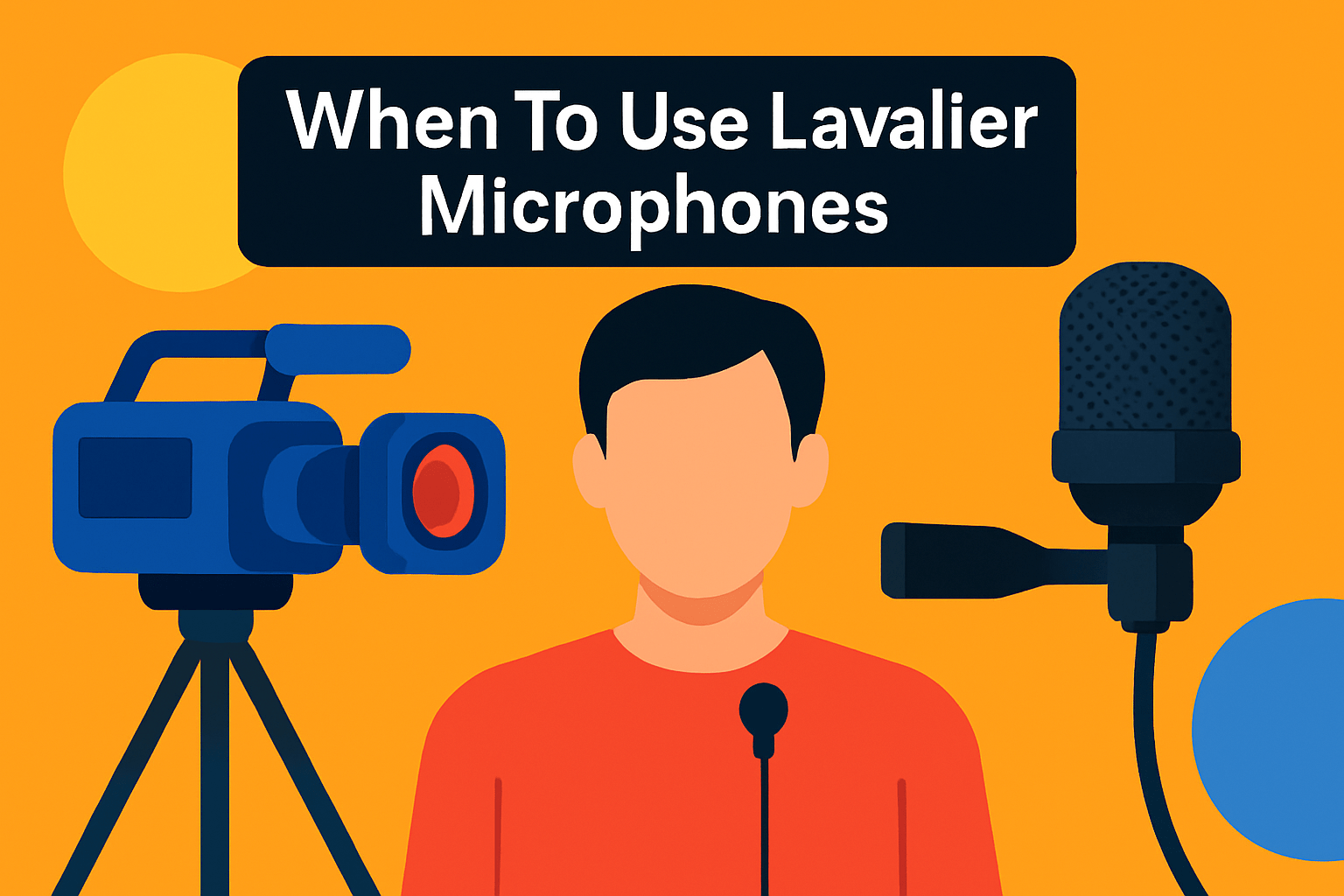
When I’m shooting interviews or any scene where dialogue needs to stay consistent through movement, I reach for a lavalier. Clip one to the subject and you get steady levels even when they’re pacing, walking, or turning away from a boom. For run-and-gun shoots or solo setups, lavs let you work without a boom operator and keep the camera frame clean.
Multiple speakers are another lav specialty. Giving each person their own mic saves you from chasing levels in post and makes editing far simpler. It also makes panel discussions, documentary vox pops, and on-the-street interviews much more manageable—especially with modern wireless kits that include dual transmitters.
Placement is critical. Aim for roughly 6–12 inches from the mouth and avoid clipping directly on noisy fabrics. I hide mics under collars, inside shirt seams, or attach them to a lapel with fabric tape to minimize rustle. Secure the cable so it can’t snag or rub; a taped loop near the mic goes a long way.
Wireless lavs give freedom but bring trade-offs. Batteries, interference, and file formats can complicate things—some systems produce 32-bit float files that need conversion in post. Wired lavs are simpler and more reliable, but obviously limit mobility. I always carry spare batteries and record a short clap or slate for sync and backup.
Remember the limits. Lavalier mics won’t replace a boom when you want natural room ambience or distant group capture. They’re also prone to handling and clothing noise. When I need both intimacy and atmosphere, I’ll mic actors with lavs and still run a boom for the room sound—then blend in post for the best of both worlds.
When To Use Shotgun Microphones
Shotgun microphones are the go-to when you need focused, cinematic dialogue and natural room sound. I reach for a shotgun on narrative shoots, indie dramas, and TV-style setups because their narrow pickup pattern isolates voices while still letting the scene breathe with ambient tone.
They shine on wide shots and group scenes where a single boom can cover multiple actors without cluttering the frame. Compared with lavaliers, shotguns capture a more realistic sense of space — you’ll get the room’s character and the actors’ interplay instead of the intimate, in-your-face sound a lav gives.
Outdoors, a shotgun is excellent — provided you protect it. Always use a blimp or deadcat and a quality shock mount; wind and handling noise will ruin an otherwise perfect take. Rugged, weather-resistant models help, but packaging and technique make the biggest difference.
Placement is critical: put the mic as close as you can without entering frame. That usually means an experienced boom operator aiming for roughly one to three feet from the actor’s mouth, angling to stay invisible while preserving clarity. Closer equals less room noise and easier post-production cleanup.
Be honest about limitations. Rapid actor movement and handheld chaos are shotgun weaknesses. For running-and-gun scenes or heavy movement I often combine a shotgun for ambient/dialogue and a lav for safety to ensure consistent levels across takes.
In controlled indoor environments, a shotgun will give rich, clear audio that edits together naturally. Use low-frequency roll-off sparingly to tame rumble, and back your setup with a good recorder and windscreens for reliable results.
In short: choose a shotgun when you want precise directionality, authentic room ambience, and a boom-based workflow. If you can afford the setup time and a skilled operator, the sonic payoff is worth it.
What People Ask Most
What is the best microphone for filmmaking?
There is no single best microphone; the right choice depends on your specific use case such as dialogue, mobility, and shooting environment. Consider factors like directionality, connectivity, and how the mic will be powered and mounted.
What mic do filmmakers use for recording dialogue?
Filmmakers commonly use highly directional mics for boom capture and lavaliers for close, on-person pickup depending on the scene. The choice balances sound quality, visibility, and actor movement.
Shotgun mic vs lavalier — which is better for filmmaking?
Shotguns excel at focused, off-camera dialogue capture and ambient room sound, while lavaliers are best for consistent close-up levels and scenes with movement. Pick based on whether you need directionality or unobtrusive, mobile mic placement.
Which microphone is best for DSLR or mirrorless filmmaking?
Compact and lightweight microphones that are compatible with camera inputs tend to work well with DSLR and mirrorless setups. Consider a short, directional mic or a versatile hybrid that balances portability with clear dialogue capture.
How do you mic actors on a film set?
Use a boom-mounted directional mic when you can and lavaliers when the mic needs to be hidden or the actor moves a lot. Coordinate with wardrobe and sound to prevent clothing noise and to keep levels consistent throughout a scene.
What microphone pickup pattern is best for filmmaking?
Cardioid and highly directional pickup patterns are commonly preferred for capturing dialogue because they focus on the subject and reject off-axis noise. Choose the pattern that best isolates the intended sound while fitting your shooting style.
Do filmmakers use condenser or dynamic microphones?
Filmmakers use both types depending on the situation: condensers are often chosen for their sensitivity and detail in controlled environments, while dynamics are favored for robustness and handling noisy or uncontrolled locations. The decision should reflect the recording environment and practical needs on set.
Conclusion For Best Mic For Filmmaking
This guide distilled the key considerations for choosing the right filmmaking microphone in 2026 so you can match gear to your creative needs quickly and confidently.
We covered five top microphones and their core strengths, from focused, broadcast‑grade directionality to portable, USB and wireless convenience, plus on‑board processing and budget‑minded options.
Let your project drive the choice—think shotgun versus lavalier, connectivity and power needs, portability, and the shooting environment when selecting a mic.
If you want to improve your audio and filmmaking skills, read more of our site’s articles for practical tips, setup advice, and real‑world workflow ideas.
Have a question or need gear recommendations for a specific shoot? Leave a comment below and we’ll usually reply within a few hours.


0 Comments