
Want your vlogs to sound as crisp and cinematic as they look on screen?
Great audio makes viewers linger, and the right shotgun microphone is often the single biggest upgrade you can make.
In this ultimate guide we compare five top shotgun microphones suited specifically for vlogging.
We examine how they handle voice clarity, background rejection, portability, and real-world ease of use.
Each option brings its own strengths and trade-offs.
Some are tailored for tight budgets and mobile creators, while others target interview setups, field journalism, or serious studio-quality capture.
Size, power source, directionality and wind performance all matter depending on where and how you shoot.
We focused on practical user needs rather than dense specs so you can pick gear that fits your workflow.
Whether you vlog from a noisy street, a cozy apartment, or a fast-moving set, this guide points you toward the best shotgun mic for vlogging within each use case.
Read on to find the right balance of price, portability and performance for your channel.
You’ll see which designs thrive on-camera and which deserve a proper boom or interface.
We also highlight real-world trade-offs so you don’t buy something that looks good on paper but fails in your recording scenario.
This is a practical guide for creators who want fewer retakes and clearer commentary.
If sound matters to your growth, the right shotgun mic can change how your audience perceives you.
1. Movo VXR10-PRO Overview

Movo VXR10-PRO External Video Microphone with Rycote Lyre Shock Mount
Compact on-camera mic delivering clear, directional audio and vibration-free performance for vlogs, interviews, and run-and-gun filmmaking.
Check PriceThe Movo VXR10-PRO is a lightweight, compact shotgun built for vloggers and mobile creators who need a dependable on‑camera mic. It’s portable and easy to carry, so it won’t bog down a small rig or smartphone setup.
Its supercardioid polar pattern gives crisper, more directional audio than built‑in device mics, and users report clear, directional pickup ideal for close‑to‑midrange vlogging. That tighter pickup helps isolate your voice in typical run‑and‑gun scenarios.
Power is simple and foolproof: the mic is battery‑free and runs via a 3.5mm TRS/TRRS connection to your phone or camera. That plug‑and‑play approach appeals to beginners and casual creators who don’t want to fuss with phantom power or rechargeable cells.
The VXR10‑PRO sports an aluminum body and ships with a shock mount to reduce handling noise. The metal build feels durable on a small rig, and the included shock mount really helps when you’re moving with the camera.
Be realistic about its limits: it needs external wind protection for outdoor shooting and isn’t designed for very noisy, professional‑level audio work. Still, as an upgrade over built‑in mics it’s a compact, practical choice for most vloggers looking for clearer directional sound without extra batteries or complexity.
- Compact, lightweight, easy to carry and mount
- No battery required
- Durable aluminum build + shock mount reduces handling noise
- Clear, professional directional audio for price/size
- Requires external wind protection outdoors
- Less suited to very noisy or professional‑level audio work
2. Audio-Technica AT8575R Overview

Audio-Technica AT85EP P-Mount Turntable Cartridge Elliptical Stylus
Smooth, warm analog playback with precise tracking and low distortion for vinyl enthusiasts and DJ setups.
Check PriceAs a photographer who often records interviews and behind‑the‑scenes commentary, I appreciate a shotgun mic that stays out of the frame but captures clear voice. The Audio‑Technica AT8575R fits that bill — compact at 7 in and very light at 2.8 oz, so it’s easy to mount on a boom or handhold for run‑and‑gun setups.
Technically it’s built with a line + gradient polar pattern and a frequency response of 35 Hz–18 kHz. There’s a fixed 12 dB/octave roll‑off below 120 Hz, which helps cut rumble from handling or HVAC noise without making voices sound thin.
In practice this mic shines on voice‑over, interviews, and indoor vlogging where clarity matters. Background voice rejection starts around a 60° angle, so off‑axis noise is reduced and speech stays forward and present in the mix.
It comes with a foam windscreen, which gives you basic wind protection for light outdoor use. For very windy locations you’ll want a larger windshield, but indoors or in controlled outdoor spots the included foam works well and keeps handling noise manageable.
Build and handling are straightforward — solid enough for handheld work or boom operation, and the form factor makes positioning easy when framing a shot matters. If you need extreme long‑distance pick‑up, this isn’t the ideal choice, but for close‑to‑midrange vlogging and interviews it’s a reliable, voice‑centric tool.
- Compact and easy to position.
- Excellent voice clarity and noise rejection.
- Low-frequency roll-off helps reduce rumble.
- Foam windscreen included.
- Additional accessories recommended for windy/outdoor use.
- Not optimized for very distant sound pickup.
3. SYNCO Mic-D2 Overview

SYNCO D2 XLR Shotgun Microphone
Long-range directional pickup with rugged build, ideal for film, ENG and broadcast applications capturing focused, high-fidelity dialogue.
Check PriceAs a working photographer who shoots run-and-gun interviews and on-camera vlogs, the SYNCO Mic‑D2 quickly became my go-to when I need semi‑professional sound without breaking the bank. It’s a hyper‑cardioid condenser shotgun mic that delivers surprisingly strong audio quality for the price. The mic’s design gives clean sound and useful side‑noise rejection, which makes dialogue sit naturally in the mix.
In practice it performs well at varying distances, so you can mount it on your camera for solo vlogs or place it on a boom for interviews and multi‑speaker voiceovers. It’s built sturdy and feels durable in the field, fitting camera mounts and boom poles easily. I’ve seen it compare favorably to pricier mics in blind tests, which speaks to its real‑world value.
There are tradeoffs to be aware of. The SYNCO Mic‑D2 has slightly less off‑axis rejection than premium models, so in extremely noisy environments a narrower, higher‑end shotgun will do better. It’s also occasionally wind sensitive outdoors, so plan on a windshield for reliable outdoor shoots. Despite that, for most vlogging scenarios—indoors, controlled outdoor settings, and interview setups—it’s a dependable, affordable choice.
If you’re a budget‑conscious creator who still wants professional-sounding audio, this mic is worth considering. It’s especially good if you need one mic to cover on‑camera work and boom‑mounted interviews without swapping gear. For the price, you get versatility and durability that will hold up across a variety of shoots.
- Strong audio quality for the price.
- Durable, reliable field construction.
- Versatile across distances and multi‑speaker scenarios.
- Affordable without major compromises.
- Slightly less off-axis rejection than premium models.
- Requires windshield for windy outdoor conditions.
4. Sony ECM-778 Overview

Sony ECM-XM1 Microphone
Lightweight, plug-and-play mic delivering clear voice capture and reduced background noise for interviews, streaming, and content creation.
Check PriceI lean on the Sony ECM-778 when I need broadcast-quality dialogue from a compact on‑camera package. It’s a compact short‑body shotgun (176 mm) that still delivers high‑end performance, so you get tight directionality without a long, awkward tube hanging off your rig.
What impresses me most is the linear frequency response tuned for voice at typical vlogging distances — it captures natural, full vocals without the artificial presence boost you sometimes get. Reviewers and users call out its outstanding sound quality and very low self‑noise / high signal‑to‑noise ratio, and I hear that clarity even in less‑ideal locations.
The ECM‑778 is built like a tool: rugged metal construction and a well‑balanced form factor make it comfortable mounted to a camera or on a short boom. For solo shoots and run‑and‑gun setups where audio matters, it feels like an investment mic — you’re paying for consistently clean, professional results rather than compromises.
That said, it’s not the best pick for casual creators on a shoestring. The price and overall complexity place it toward serious videographers and journalists, and it requires phantom power, so you need a compatible camera or interface to get the best out of it. If you can accommodate that, this mic will noticeably lift your vocal recordings.
- 176 mm compact short‑body — camera‑friendly
- Excellent linear frequency response & vocal clarity
- Very low self‑noise / high signal‑to‑noise ratio
- Rugged metal build, well‑balanced for mounting
- Higher price and complexity
- Requires phantom power (needs compatible camera/interface)
5. Rode NTG4+ Overview

RØDE NTG4+ Supercardioid Shotgun Microphone with Built-in Battery
Professional shotgun performance with onboard power and low-noise circuitry for extended field recording and seamless location shoots.
Check PriceThe Rode NTG4+ is a supercardioid shotgun that sits nicely between entry-level flexibility and prosumer features. It’s designed for vloggers and shooters who want on‑mic tone control without hauling extra gear.
Onboard you’ll find a -10 dB pad, a 75 Hz low‑cut, and a high‑frequency boost, which let you shape the sound in real time. Power comes from a USB‑C rechargeable lithium‑ion battery, so you can skip phantom power in many setups and charge quickly between shoots.
Physically it’s very light at 176 g and short at 278 mm, so it stays out of frame and is comfortable on booms or camera shoe mounts. The max SPL is 135 dB, which means it handles loud sources without distortion — handy if you film noisy environments or close, energetic talent.
In practice the NTG4+ is praised for its sound quality and ease of use. The rechargeable (non‑replaceable) battery simplifies setup but could affect long‑term serviceability. Also, while its directionality is strong, it’s sometimes less narrowly focused than premium shotguns, so I still recommend a windshield for outdoor work.
If you value onboard tone shaping, light weight, and rechargeable convenience, this mic is an excellent vlogging companion. It combines practical controls with a forgiving form factor for run‑and‑gun creators who want better-than-basic audio without complex rigs.
- Built-in rechargeable battery and USB‑C charging
- Real-time tone controls on the mic (-10 dB pad, 75 Hz low‑cut, HF boost)
- Lightweight and compact (176 g, 278 mm)
- High max SPL (135 dB) for loud sources
- Internal battery is not user‑replaceable
- Directionality sometimes less narrow than premium shotguns
Key Shotgun Microphone Features
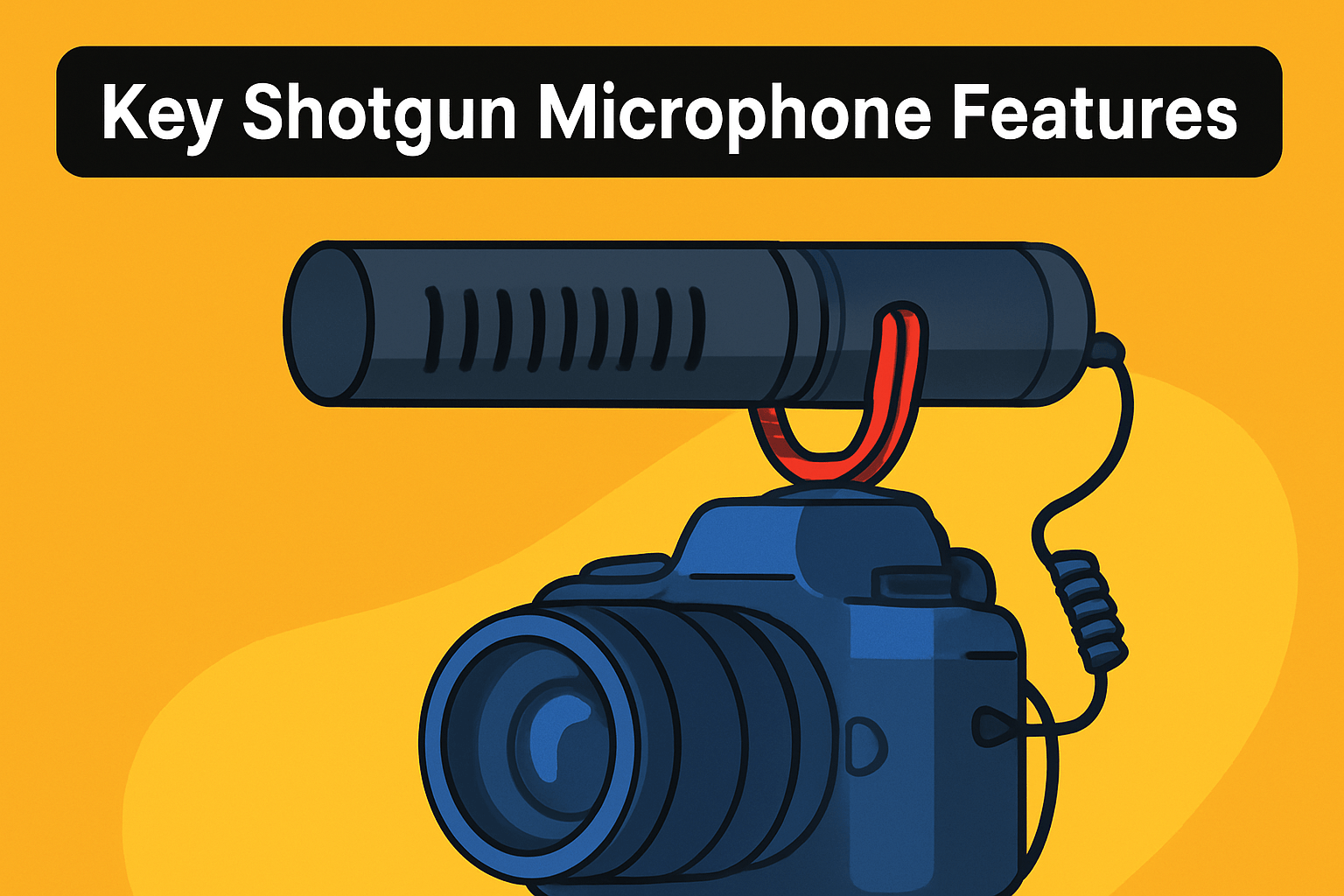
When you pick a shotgun mic, start with the polar pattern because it determines what the mic hears. Supercardioid or hyper‑cardioid patterns are usually best for vlogging because they focus on your voice and reject side noise, but they demand accurate pointing—miss the angle and you’ll lose clarity.
The interference‑tube design is the secret behind that tight off‑axis rejection. Those slots along the barrel create phase cancellation so background sounds fall away, which is handy on busy streets or echoey rooms. At the same time, think about size and weight: a short, light mic stays out of frame and won’t swing the camera balance, while a longer tube gives extra reach on a boom.
Power and connectivity are practical things that will make or break your workflow. Decide between battery, phantom power, or plug‑in options based on what you normally carry—cameras often need phantom, phones need TRS/TRRS adapters, and USB‑chargeable mics are great for run‑and‑gun days. Check your connectors before you buy so you don’t end up rummaging for adapters on set.
Mounting and wind protection matter more than most beginners expect. Use a proper shock mount to cut handling noise and get a furry windshield for outdoor work; foam is fine indoors, but wind kills clarity fast. Metal bodies and solid mounts also reduce unwanted vibrations and survive frequent travel.
Finally, favor ease of use. Onboard pads, low‑cut filters, and tone controls can save time in post, but remember that convenience sometimes trades off serviceability—rechargeable internal batteries are tidy, yet not always replaceable. My rule: pick a mic that fits your usual environment and test it in that environment before committing. You’ll hear the difference instantly.
Choosing a Shotgun Mic for Vlogging
Start by matching the mic to how you shoot. If you run-and-gun on crowded streets or parks, pick a tight super‑ or hyper‑cardioid shotgun that rejects side noise. In controlled indoor spaces you can afford a slightly wider pickup if it gives a fuller, more natural voice. Look for interference‑tube designs when off‑axis noise is an issue; they help keep background chatter out of your clips.
Think about typical subject distance and placement. Most vlogging setups live in the close‑to‑mid range — roughly two to three feet — so choose a mic voiced for that sweet spot. Mount it on the camera or a short boom a few inches above and angled down toward the mouth to minimize breath and plosives while staying out of frame.
Power and connectivity will make or break your workflow. Decide whether you want plug‑in power for phones, phantom power for pro mixers, or a battery/USB option for quick setups. Check connectors carefully: TRS vs TRRS for smartphones, or whether your camera supplies phantom power. Consider the long‑term tradeoffs of built‑in rechargeable batteries versus replaceable cells for serviceability.
Size, weight, and mounting matter more than you think. A lightweight, compact body keeps the camera balanced and reduces handling noise, while a proper shock mount is essential for handheld work. Outdoors, always plan for wind protection — foam for light breezes, a furry windshield for real wind. Metal housings last longer on the road and usually cut down on unwanted vibration noise.
Finally, balance convenience with sound quality. Lavalier mics give unbeatable proximity and SNR, but a good shotgun captures more natural dialogue and room tone. Before you commit, test the mic in your typical locations, monitor with headphones, and consider the accessories you’ll need. The right choice is the one that fits your environment, workflow, and how much time you want to spend on audio versus shooting.
What People Ask Most
What is the best shotgun microphone for vlogging?
There is no single best microphone for every vlogger; the right choice depends on budget, shooting environment, and workflow. Pick a model that matches your power and mounting needs while balancing size and directionality.
Do shotgun mics work well for vlogging?
Yes, shotgun microphones are effective at capturing directional dialogue and reducing surrounding noise when aimed correctly. They perform well on camera and on a boom but benefit from proper placement and wind protection outdoors.
Are shotgun microphones good for indoor vlogging?
Shotgun mics can provide clear, natural-sounding dialogue indoors, but room reflections and acoustics matter. Position the mic to avoid strong reflections and consider room treatment for best results.
Should I use a shotgun mic or a lavalier for vlogging?
Both are useful: lavaliers excel at consistent close-range pickup and freedom of movement, while shotguns capture more natural ambience and flexible placement. Choose based on your content, movement, and desired sound character.
Can you use a shotgun mic with a smartphone for vlogging?
Many shotgun mics can be used with smartphones if the connectors and power options are compatible or an appropriate adapter is used. Verify the mic’s connection and power requirements before relying on it for mobile setups.
Do shotgun mics require phantom power for vlogging?
Some shotgun microphones require phantom power while others use internal batteries or plug-in power. Check the specific mic’s power needs and ensure your camera or interface can supply the correct type of power.
How do you mount a shotgun mic on a camera for vlogging?
Use a compatible shoe mount or shock mount and position the mic slightly above and angled toward the subject to minimize handling noise and improve pickup. Secure cables and add a windshield when recording outdoors.
Conclusion: Best Shotgun Mic for Vlogging
This roundup aimed to make it easier to match a shotgun microphone to your vlogging needs by highlighting the strengths, trade-offs, and typical users for different options.
Rather than chasing a single “best” model, focus on the shooting environment, power and connector requirements, size and portability, and your budget to find the mic that fits your workflow.
Practical considerations like mounting, wind protection, and ease of use often matter more than raw specs, so prioritize the features that solve your everyday problems.
If you want to sharpen your recording and production skills, explore more articles on the site for hands‑on tips and comparisons that build on this guide.
Have questions about your setup or a specific use case? Leave a comment below — we usually reply within a few hours.




0 Comments