
Ever wondered why some interviews sound instantly professional while others feel flat and distant?
This guide compares five top lavalier mics for interviews and explains which one suits reporters, hosts, and creators.
No jargon, just clear recommendations so you spend less time guessing and more time recording great dialogue.
Microphone choice shapes everything from vocal presence to background noise and post-production workload.
Some lavaliers excel in busy, on-the-go environments; others shine in controlled studio or broadcast settings.
We’ll match each model to real-world roles and budgets, highlighting ease of use and audio reliability.
One key decision is wired versus wireless — a simple split with meaningful consequences.
Wired mics trade mobility for rock-solid connection and fewer technical surprises; wireless mics free subjects from cables but bring pairing, battery and range considerations.
Throughout the reviews we weigh those trade-offs in plain language so you can pick the right balance for interviews on location or in-studio.
You’ll also get practical tips on placement, concealment, and handling noisy environments to get clean, consistent levels.
By the end you’ll know which lavalier suits your workflow, camera, and post process without wading through specs you don’t need.
Let’s ditch the guesswork and find the mic that makes your next interview sound unmistakably professional.
1. Synco G2(A2) Max Wireless Lavalier Mic

SYNCO G2(A2) MAX Dual Wireless Lavalier Microphone System
Crystal-clear dual-channel wireless audio with reliable range, easy pairing, and long battery life for interviews, vlogging, and professional shoots.
Check PriceAs a working photographer who often records interviews on the move, the SYNCO G2(A2) Max stands out for practical reasons more than hype. It’s a wireless lavalier built specifically for interviews, with a single receiver that supports two transmitters — perfect for two-person conversations without extra kit.
One feature I trust is the 8GB onboard memory that records continuously as a backup during wireless transmission. In noisy locations its noise-cancellation and high sensitivity help pull dialogue forward, so you get usable audio even when the environment is busy.
Journalists praise this unit for its simplicity and sound quality, and I’ve found it reliably connects to DSLR and mirrorless cameras with minimal fuss. It’s small, lightweight, and unobtrusive on talent, which makes framing and wardrobe choices less stressful on set.
Where it isn’t perfect: there’s a bit of a learning curve to the menu and setup for some shooters, so budget time to get comfortable before a job. Also, battery life can be limited under continuous heavy use compared with higher-end rivals, so I carry spare power or rely on the onboard recording when I expect long takes.
Bottom line — if you’re a mobile interviewer or a journalist needing two-person wireless flexibility and a safety backup, the SYNCO G2(A2) Max is a very practical, mostly reliable choice that balances portability and professional features.
- Strong noise cancellation for clear audio
- 8GB onboard recording as a transmission backup
- Small, lightweight, unobtrusive
- Reliable connection and wide DSLR/mirrorless compatibility
- Setup/menu has a learning curve
- Limited battery life under heavy continuous use
2. Rode Wireless Pro Lavalier Kit

Rode Wireless PRO Microphone System with 2 Lavalier Mics and Charge Case
Pro-grade two-transmitter wireless kit delivering pristine sound, quick charging case, and seamless connectivity for creators and on-the-go professionals.
Check PriceAs a photographer who often records interviews and behind-the-scenes audio, the Rode Wireless Pro Lavalier Kit stands out for its clean, professional sound and practical design. It ships with two Rode Lavalier II mics and magnetic fastening transmitters that make on-camera or on-subject attachment quick and secure.
The kit’s headline tech is 32-bit floating point recording, which gives exceptional clarity and dynamic range and keeps dialogue distortion-free even when levels fluctuate. The receiver plays nicely with smartphones, recorders, and cameras, so I can plug straight into a mirrorless body or a phone rig without hunting adapters.
What I appreciate in real shoots is the redundancy: transmitters can record onboard, providing a safety copy if wireless transmission drops. That layered recording workflow is exactly what professionals need for live streaming, podcasts, and interviews where you can’t afford to lose the track.
Users praise the sound as rich and clear, and the flexible recording options let you choose the workflow that fits the shoot. Be aware this is a higher-end kit — the price is aimed at podcasters and videographers who want pro-level results — and the feature set benefits from some basic audio knowledge to get the most out of 32-bit float and multi-device connectivity.
- 32-bit float clarity and dynamic range
- Works with smartphone, DSLR, computer
- Redundant transmitter recording for safety
- Magnetic clips for quick attachment
- Higher price point
- Advanced features need audio know-how
3. Sony ECM-77B Lavalier Mic
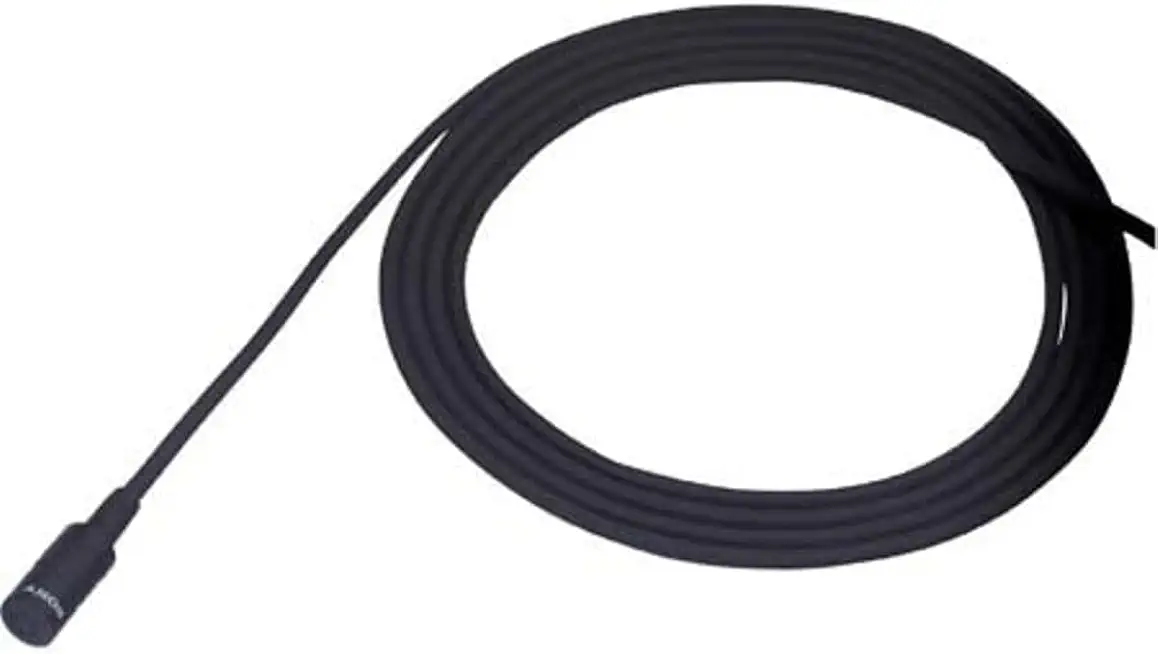
Sony ECM77BC/9X Lavalier Microphone
Discreet studio-quality clip-on microphone offering natural tonal balance, low noise, and dependable performance for broadcasts and presentations.
Check PriceThe Sony ECM-77B is a classic, professional wired lavalier favored in broadcast and film for its consistent performance and broad frequency response. It delivers a natural sound with strong lows, though some users report slightly bright highs that can stand out on certain voices.
As a photographer who often records interviews on set, I appreciate the ECM-77B’s durability and reliable wired connection. It’s the kind of mic you can trust for long shoots where you don’t want wireless dropouts or pairing issues to interrupt a take.
Placement is straightforward because the mic is relatively easy to position discreetly on clothing, so it won’t call attention during interviews or events. That discreet mounting helps maintain a consistent proximity to the mouth, which keeps levels even and reduces handling surprises.
If you work in controlled studio environments or run event shoots outdoors with predictable setups, this mic shines. Be prepared to do light EQ in post if a voice sounds a touch bright; that slight high-frequency emphasis is an easy fix and often worth trading for the mic’s reliability and clarity.
In short, the ECM-77B is an excellent choice for professional interviewers, filmmakers, and event videographers who prioritize dependable wired audio and a natural presentation of the voice. It’s less suited for subjects who need full mobility, but for sit-down or staged interviews it’s a go-to workhorse.
- Proven durability and performance
- Natural, clear sound for interviews
- Works well in studio and outdoor settings
- Easy to position discreetly on clothing
- Wired design limits movement
- May need EQ to tame bright highs
4. Shure SM93 Lavalier Mic

Shure WL93 Subminiature Lavalier Microphone with 4 ft Cable
Ultra-small omnidirectional capsule with flexible cable, delivering clear, unobtrusive pickup for theatre, film, and live speech applications.
Check PriceAs a photographer who often records interviews, I look for a lavalier that disappears visually but delivers clear voice detail. The Shure SM93 is a compact, low-profile lavalier with an 80 Hz–20 kHz frequency response and a built-in windscreen, so it captures natural speech without drawing attention.
In practice it shines on intelligibility. It’s popular with lecturers, presenters, and reporters for its clear vocal reproduction and low handling noise, and it effectively reduces clothing rustle and wind noise during shoots.
Because it includes a clip-on preamplifier, attaching it to a subject is quick and secure, which matters when you’re moving between setups or shooting run-and-gun interviews. It’s a strong choice for both indoor and outdoor interviews and talks where clear speech is the primary goal.
Keep in mind a couple of trade-offs. Some users report lower sensitivity for distant sound sources, so the mic works best close to the speaker’s mouth rather than across the room. Also, the SM93 requires a compatible wireless transmitter or recorder (sold separately), so it’s not a complete wireless kit out of the box.
If you need a discreet, durable lavalier that favors speech clarity and wind suppression, the SM93 is mostly a smart pick. For interviews where speakers remain close to mic placement and you can provide a transmitter/recorder, it will reliably deliver the kind of intelligible audio that makes editing and sync much easier.
- Excellent speech intelligibility; reduces low-frequency rumble
- Lightweight and easy to conceal
- Durable and reliable across scenarios
- Wind noise suppression for outdoor use
- Lower sensitivity for distant sound sources
- Requires compatible wireless transmitter/recorder (sold separately)
5. DJI Mic 2 Wireless Lavalier System

DJI Mic 2 Wireless Microphone System (2 TX + 1 RX + Charging Case)
Complete dual-transmitter wireless setup offering low-latency transmission, extended range, and portable charging for seamless mobile recording.
Check PriceThe DJI Mic 2 Wireless Lavalier System is a polished, no-nonsense wireless kit that suits solo videographers and small production teams who need great vocal audio without a lot of fiddling. It ships with two transmitters and an OLED touchscreen receiver, so pairing, level checks, and gain presets are simple — useful when you’ve only got one chance to capture an interview.
Each transmitter includes 8GB of onboard storage, which acts as a safety net if you lose wireless signal or need an isolated track later. The system also offers an impressive wireless range of up to 250 m, giving you freedom to move or to stage dialogue across a larger set without running cables.
Where DJI stands out for interviews is its intelligent adaptive noise cancellation. In busy locations I’ve used it on, the noise isolation adapts to the environment and keeps the subject’s voice clear without sounding overly processed. Built‑in gain presets and USB charging make day‑long shoots and quick turnarounds easier.
There are a couple of practical caveats. The system records in a 32‑bit float file format that often needs conversion during post, so you’ll want a workflow that handles that. And while it’s fantastic for location work and run‑and‑gun interviews, it’s not the ideal choice for fixed studio setups where you rarely move and prefer traditional studio mics.
- Crisp, natural vocal reproduction with little setup
- Intelligent adaptive noise cancelling
- 8GB onboard storage on each transmitter; strong battery life with USB charging
- Up to 250 m wireless range
- 32‑bit float files require conversion in post
- Not optimal for fixed studio users
Choosing a Lavalier Mic for Interviews
When I pick a lavalier for an interview I start with the shoot itself: where we’re going to be, how much movement there will be, and how visible I can let the mic be. In a controlled studio I lean toward wired options for their rock-steady reliability and natural sound. On location, where subjects walk, sit, or cross streets, wireless systems that offer dual transmitters and solid range win every time.
Think about the polar pattern next. Omnidirectional lavs are forgiving when a subject turns their head and usually sound more natural at close range. If you’re working next to traffic or a busy café, a more directional lav or a system with strong noise rejection will keep dialogue intelligible without resorting to heavy EQ later.
Placement is as important as the mic choice. Clip the mic at the upper chest or collarbone, hidden under a lapel when possible, and keep it a consistent distance from the mouth. Little tricks like tucking the cable under a shirt, adding a tiny bit of tape where the clip contacts fabric, or using an extra foam windscreen do more for reducing rustle and wind than most people expect.
Always plan for redundancy. Onboard recording or dual-track capture is a lifesaver when RF hiccups or camera levels clip. I monitor with headphones during rehearsals and do a short walk-and-speak test so I can hear handling noise, clothing interference, and how the mic behaves if the subject turns or leans.
Finally, match accessories and connectivity to your workflow. Color-matched clips, rugged cables, and the right adapters for phones or recorders are small details that save time on set. Battery life, charging options, and ease of operation are worth paying for—nothing ruins a good interview faster than scrambling for a spare battery or a convoluted menu when the subject is ready to speak.
Lavalier vs Shotgun vs Handheld Mics
Picking between a lavalier, shotgun, or handheld comes down to three things I always ask before a shoot: how noisy the location is, how much freedom of movement you need, and how many people are speaking. Each mic has a sweet spot — and once you match that to your setup, the audio problems you’ll fight in post drop dramatically.
Lavaliers are my go-to for sit-down interviews and multi-person panels because they sit close to the mouth and give consistent levels without getting in the shot. They’re unobtrusive and let subjects keep natural eye-lines, but watch clothing rustle and wind; a good clip, foam windscreen, and careful routing of the cable make a huge difference. Wireless lavs add mobility, wired ones still win for ultra-reliable studio work.
Shotguns shine when you need to reject background noise from a distance — think chaotic outdoor scenes or documentary pickup where boom placement is possible. They isolate sound well but demand a boom operator and precise positioning, and they’ll be visible or awkward on tight shoots. If the subject moves a lot, maintaining that sweet spot can be a headache.
Handheld mics are simple and familiar for street interviews and live events; the interviewer controls distance and dynamics in real time. They’re intuitive and robust, but expect handling noise and a more “on-camera” look that can feel intrusive in intimate formats.
My practical workflow is to pair mics when uncertainty or noise is likely: a lavalier for consistent close sound, a shotgun as environmental backup, or a handheld when you need direct interaction. Redundancy—like onboard recording on the transmitter or a secondary recorder—saves shoots when wireless hiccups or wind strikes.
Ultimately, match the mic to the environment. If you’re indoors and want natural, invisible audio, choose a lav. For noisy outdoors, reach for a shotgun. For fast, interactive interviews, take a handheld—and always monitor with headphones and test placements before you roll.
What People Ask Most
What is the best lavalier mic for interviews?
There is no single best option; the right choice depends on your recording environment, mobility needs, and desired sound quality. Match a mic’s features to your workflow and prioritize clarity and ease of use.
How do you choose a lavalier mic for interviews?
Consider the interview setting, whether you need mobility or redundancy, the microphone’s directional characteristics, and physical design and accessories. Also factor in ease of use and how the mic integrates with your recording gear.
Are lavalier mics good for interviews?
Yes, they provide consistent, close-up audio and are discreet on camera, making them well suited to many interview formats. They can be prone to clothing rustle and require careful placement to sound their best.
Wired vs wireless lavalier mics: which is better for interviews?
Wireless is ideal for mobility and multi-person setups, while wired mics tend to be more reliable in controlled environments. Choose based on how much movement you need and how important signal stability is for the shoot.
How do you place a lavalier mic on a person for an interview?
Clip the mic to clothing near the chest or collar so it stays at a consistent distance from the mouth and faces outward. Secure cables and test for rustle or rubbing before recording to avoid handling noise.
How do you hide a lavalier mic during an interview?
Tuck the mic under clothing, into a lapel, or behind a button, and secure it with tape or a discreet clip to minimize visibility. Take care not to muffle the capsule or create additional clothing noise.
Can you use a lavalier mic with a smartphone for interviews?
Yes, many lavaliers work with smartphones when paired with the appropriate adapter or a compatible wireless receiver. Verify compatibility and perform a quick test recording to ensure levels and connection are correct.
Conclusion on Best Interview Lavalier Mics
These five lavalier options—SYNCO G2(A2) Max, Rode Wireless Pro, Sony ECM-77B, Shure SM93, and DJI Mic 2—cover interview needs from mobile, multi-person setups to studio and solo-creator workflows.
SYNCO and DJI lean toward mobile, dual-transmitter wireless convenience and onboard backups, Rode focuses on high-dynamic-range recording and redundancy, Sony offers wired robustness and natural tone, and Shure prioritizes speech clarity and wind suppression.
Let the interview environment, how much mobility you need, and the level of audio polish you want guide your choice rather than searching for a single “best” mic.
If you want to sharpen your interview technique and capture better audio, read more of our site’s articles for practical tips, comparisons, and setup advice to improve your skills.
Have questions or a setup to share—leave a comment below and we usually reply within a few hours.




0 Comments