
Want your next music video to look cinematic without hiring a lighting crew or blowing your budget?
This guide cuts through the hype to spotlight five lights that actually make a difference on set.
Think punchy colors, flattering skin tones, and dramatic rim light without fuss.
We test each light in real-world shoots, note strengths and trade-offs, and include quick setup tips you can use tonight.
Expect concise, practical advice rather than long spec lists.
This guide is for music video creators who want practical, camera-friendly lighting choices.
Whether you film in a rehearsal room, a small studio, or on-location with a tight crew, these picks are chosen for real workflows.
You’ll read honest notes on color fidelity, portability, noise, and ease of use under camera.
The goal is to help you balance creative control with practical concerns like speed, setup space, and continuity.
I’ll also break down simple three-point setups, softening techniques, and ways to shape background light for mood.
These tips are fast to implement and work whether you’re lighting a solo performer or a full band.
By the end you’ll know which light fits your budget, your camera, and your visual style.
Small choices in light quality and placement can transform a clip from amateur to iconic.

SmallRig RC 220B Pro 220W COB Bi-Color Video Light 2700–6500K CRI95+ Bowens Mount
1. Rotolight AEOS 2 Pro

Rotolight AEOS 2 Pro RGBWW LED Light with HSS Flash
Ultra-portable, color-accurate on-camera lighting with high-speed sync capability and cinematic full-spectrum effects for photographers and videographers.
Check PriceThe Rotolight AEOS 2 Pro is a versatile, portable LED panel built with filmmakers in mind. It’s rugged enough for location work yet refined for studio use.
Color accuracy is a standout — think millions of colors and cinematic presets used by industry professionals. That level of control makes it simple to dial in skin tones and stylized looks without relying on heavy color correction later.
Rotolight boosted output by 25% over previous models, which is meaningful on smaller shoots. In practice that improved brightness often reduces the need for extra units or heavy grip setups.
The touchscreen controls are intuitive and let you tweak color, presets, and output fast on set. Once you learn the interface you can move quickly between setups, saving time during tight music video shoots.
Because it’s both portable and rugged, the AEOS 2 Pro is ideal for artists who shoot on location or bounce between studio and live environments. It’s a solid choice if you value color fidelity and need a single light that can perform many roles.
That said, it’s positioned toward pros and serious enthusiasts. The price can be a hurdle for beginners, and those cinematic presets and expanded controls have a learning curve before you get truly fast with them.
- Exceptional color fidelity and control
- Portable, rugged design for location work
- Intuitive touchscreen for quick adjustments
- 25% brightness boost — fewer units needed
- Considered costly for beginners
- Presets and controls may take time to master
2. Nanlite Forza 60C

Nanlite Forza 60C LED Video Light 88W 1800–20000K
Compact, powerful bi-color fixture offering extreme color temperature range, precise control, and flicker-free output for run-and-gun shoots and studio setups.
Check PriceAs a compact spotlight LED, the Nanlite Forza 60C punches well above its weight for music-video work. Its RGBLAC color technology delivers vivid, usable color that makes creative gels and gels-in-post less necessary.
In practice I’ve found the Forza 60C gives accurate and creative color effects while remaining easy to position on location. It runs cool and virtually silent, which is a huge benefit when you’re shooting live audio or need minimal kit noise.
The unit’s output is impressive for its size, so you can get strong highlights and controlled rim light without breaking your back hauling large fixtures. Built-in lighting effects expand your on-set options, letting you dial in looks quickly for performance shots and transitions.
That said, it’s not a bargain-basement option. The Forza 60C is relatively expensive for lower-budget projects, and some of its advanced features lean more toward cinematic work than very simple, straightforward music videos.
If you’re a solo shooter or a small crew seeking portable, powerful, and color-creative light that won’t introduce heat or noise, the Forza 60C is a smart choice. If you’re on a tight budget or only need plain white-key lighting, its strengths may be more than you require.
- High color accuracy with vibrant RGBLAC
- Wide built-in lighting effects for creative work
- Low heat output and quiet operation for sound-sensitive shoots
- Powerful output for its size
- Expensive for lower-budget projects
- Advanced features may be better suited to cinematic than simple music videos
3. SmallRig RC 350D COB LED Video Light
SmallRig RC 220B Pro 220W COB Bi-Color Video Light 2700–6500K CRI95+ Bowens Mount
Professional-grade, high-output COB lamp delivering smooth bicolor tones, exceptional CRI for true-to-life skin tones, and Bowens compatibility for modifiers.
Check PriceThe SmallRig RC 350D is a professional-grade COB LED built to serve as a strong key light for studio and video production. As a working photographer, I value lights that give dependable, punchy output and this unit is designed exactly for that role.
In practice it’s been praised for being a powerful key light for interviews and music videos. The built-in fans are quiet enough to prevent audio interference, which matters a lot when you’re shooting on-set with live sound.
Beyond sheer output, the RC 350D offers multiple creative lighting effects that help shape mood without adding gels or extra fixtures. The housing and controls feel durable, so it stands up to regular use in studio and location work.
There are a couple of trade-offs to keep in mind. A number of users reported app control connectivity issues, so don’t rely solely on wireless control for critical shoots. Also, it leans toward the pricier side, so it’s a better investment for larger or professional setups than for casual hobbyists.
- Strong key light output for larger/professional setups
- Quiet operation and durable build
- Multiple creative lighting effects
- Designed for studio/video production
- App control connectivity issues reported by some users
- Pricey for casual or beginner users
4. Lume Cube Panel Pro 2.0

Lume Cube Panel Pro 2.0 RGB Camera Light with Camera Mount and Diffuser
Versatile panel offering vibrant RGB control, soft diffusion, and quick mounting—perfect for vlogging, interviews, and creative lighting effects.
Check PriceAs a working photographer who shoots music videos on location, I reach for lights that balance color accuracy, portability, and battery life — the Lume Cube Panel Pro 2.0 hits that sweet spot. It’s a budget-friendly, compact RGB panel that’s easy to carry between rehearsal rooms and small sets without feeling like a compromise.
The panel boasts high CRI (96) LEDs, which means skin tones and practicals render faithfully on camera — a real win when you want natural-looking close-ups and consistent color across takes. Bluetooth app control lets you dial in hue and intensity remotely, speeding setups when you’re wrangling talent and gear.
Build-wise it’s lightweight yet durable, so it survives travel and tight grip-and-go shoots. Battery runtime is solid for half-day shoots, and the built-in power bank capability is genuinely useful for remote locations where outlets aren’t an option — I’ve used it to top up small devices between takes.
Keep expectations realistic about output: this is a moderate-output panel best suited to small setups, on-camera fills, or mood washes rather than lighting a large stage or studio alone. Also note the LCD’s blue lettering can be hard to read in bright outdoor conditions, so plan controls via the app or shade the display when you’re outside.
Overall, if you need a portable, color-accurate RGB panel with great battery features for indie music videos and location work, the Lume Cube Panel Pro 2.0 is a practical, affordable choice.
- High CRI (96) for accurate color
- Bluetooth app control for remote adjustments
- Portable, lightweight, durable build
- Good battery runtime + power bank capability
- LCD blue lettering hard to read outdoors
- Moderate output—better for small setups than large studios
5. Neewer LED Panel 2-Pack Lighting Kit

Neewer 13
Complete dual-panel kit with adjustable bi-color output, high CRI accuracy, sturdy stands, and long-lasting batteries for reliable on-location lighting.
Check PriceThe Neewer LED Panel 2-Pack is an affordable two-panel kit built for small studios and practice rooms, offering adjustable brightness and color temperature controls to shape mood quickly. As a working photographer I appreciate gear that gives immediate control without fuss, and these panels do exactly that for entry-level music shoots.
In real-world terms they’re great at transforming a home or rehearsal space — they brighten drum kits and soften harsh stage shadows so your performers look more three-dimensional on camera. Use one panel as a key and the other as a soft fill and you’ll see how much cleaner skin tones and instrument details read on video.
Setup is straightforward: the kit is portable, and the included tripods and diffusers make it fast to rig in cramped rooms or practice spaces. That portability means you can move quickly between setups during rehearsals or low-budget music-video shoots without calling for a crew.
The light quality leans soft and flattering thanks to the diffusers, which reduces reflections on glossy instruments and limits unflattering shadows on faces. The brightness and color temperature controls let you dial warmth or coolness to match practicals or to push a specific vibe without adding gels.
Know the limits: output is modest, so these panels won’t be enough alone for very large stages or wide outdoor scenes; you’ll want more powerful fixtures or additional units in those cases. Build quality is clearly budget-oriented, so treat stands and mounts gently or consider backups for heavy use — but for indie artists, content creators, and rehearsal-room videos, this kit punches above its price.
- Adjustable brightness & color temperature
- Includes tripods and diffusers
- Soft, diffused light that reduces reflections
- Compact and portable for quick setups
- Limited output for large/outdoor scenes
- Budget build quality; not ideal for heavy professional use
How To Set Up Music Video Lights
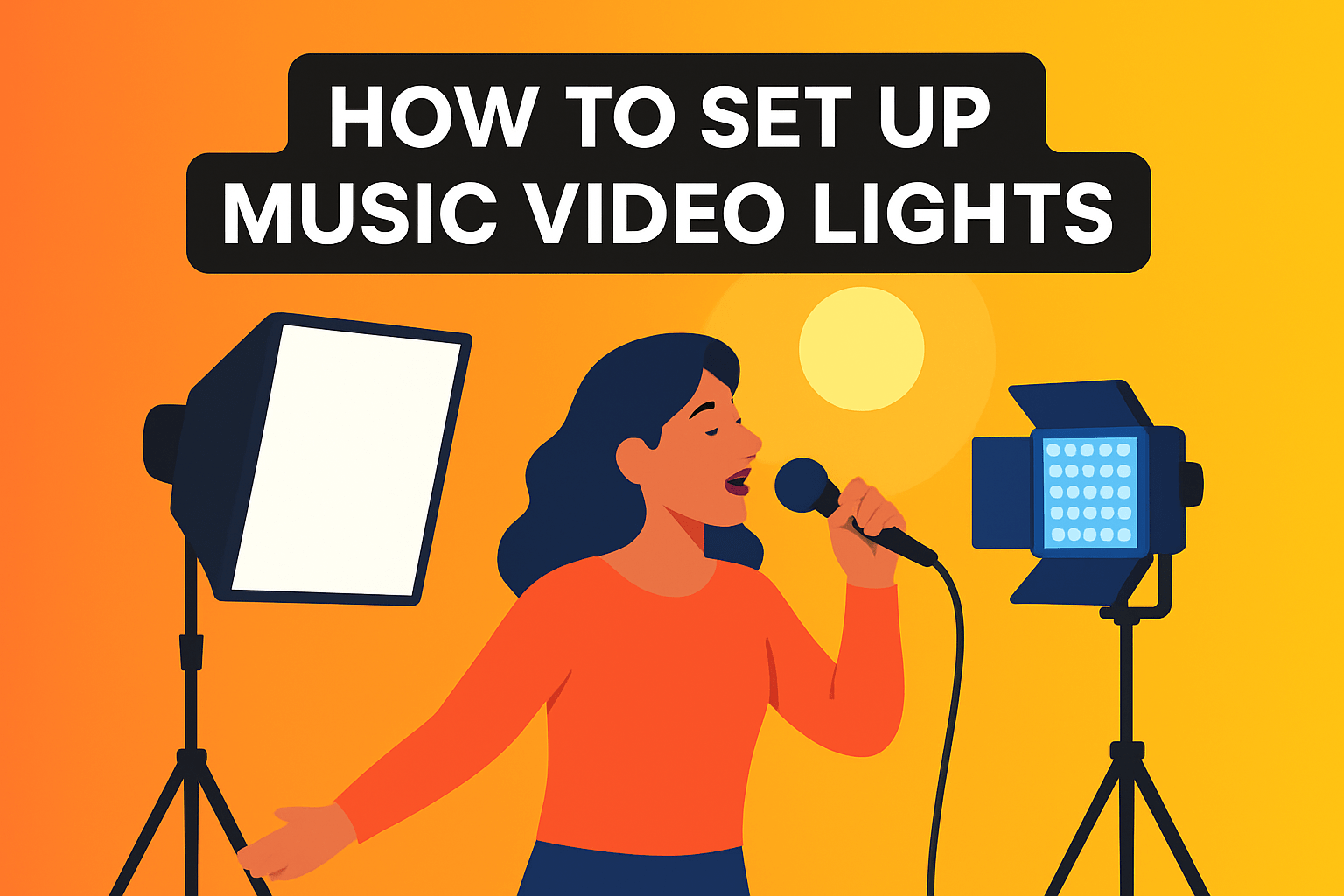
Start by thinking in layers rather than fixtures: a strong key to sculpt the face, a softer fill to keep shape, and a rim to pop the subject off the background. I usually place the key about 45° to one side and slightly above eye level; that angle defines cheekbones and catchlights. Keep the fill on the opposite side at roughly half the key’s power (about a 1:2 ratio) so shadows remain readable but not flattened.
The rim or back light should sit behind the subject, aimed to create a thin edge of light on shoulders and hair. Place it a little higher than the subject so the falloff looks natural and you avoid spilling into the lens. Use barn doors, flags, or grids to shape that light—tightening it gives drama, opening it softens separation.
Camera placement matters. Put the camera roughly perpendicular to the line between key and fill to preserve depth and avoid a flat, evenly lit look. If you want more drama, move the camera closer to the key and slightly lower; for a softer, pop-art feel, back away and widen the frame so background lights read more.
Backgrounds are not an afterthought. Use LED tubes or practicals as color accents and position them so they peek into the frame. Adding a little haze will make those beams sing and give the scene cinematic depth; just be careful with how much you use around lenses to avoid flaring unwantedly.
Decide your visual style before tweaking lights. For moody videos, lower the fill and increase contrast, favoring stronger backlight and shadow. For bright, energetic pop, soften the fill, introduce colorful washes on the background, and keep the key cleaner. Small moves—shifting a light a few inches or dialing power down by 10–20%—often do more than a big rehang, so test, watch, and trust your eyes.
Softening Light With Softboxes
Softboxes are one of the simplest tools to transform a harsh LED into flattering, cinematic light. The front diffusion spreads the beam and lowers contrast, which means skin looks smooth without losing texture. That softer falloff makes them ideal for keys and fills when you want a natural, filmic look.
Placement matters more than fancy gear. Put your softbox roughly 45° to the subject and a little above eye level to mimic window light and create pleasing catchlights. For a three-dimensional face, keep the key a stop or two brighter than the fill, and use the softbox height to sculpt cheekbones and jawlines.
Size is your softness control. Larger softboxes wrapped close to the subject give broad, even light that flatters full-body shots and groups, while smaller boxes or grids give tighter control for close-ups and moodier contrast. Moving the softbox closer increases softness but also increases falloff, so watch how the background drops off and adjust distance accordingly.
Don’t forget modifiers for precision. A grid will tame spill and keep the soft, even quality while directing it where you need it. Stripboxes are excellent for rim and edge light because they produce a slim, controllable strip of soft light that separates performers from the background.
Simple reflectors are underrated partners; bounce softened light back into shadow areas to retain depth without adding another powered fixture. If you need color or texture, gel the softbox or add a diffusion panel in front of an LED tube for similar results—softboxes just give the most consistent, predictable output.
On set, I aim for workable, repeatable setups: speedring adapters for panels, collapsible softboxes for location work, and a couple of reflector options in the kit. That lets you shape mood quickly—soft and dreamy, or soft but contrasty—without sacrificing control or skin tone fidelity.
What People Ask Most
What lighting is best for filming music videos?
It depends on the desired style, but versatile LED fixtures with good color control and dimming are commonly preferred for music videos. Portable, quiet lights with reliable color fidelity make both studio and location shoots easier to manage.
What are the best lighting setups for music videos?
Start with a foundational three-point approach—key, fill, and back—to shape the subject, then adapt with colored background or practicals to establish mood. Use modifiers like softboxes and flags to control softness and spill for more polished results.
How do you light a music video for a cinematic look?
Create contrast with a controlled key and rim light while using a softer fill to preserve depth, and shape highlights with barn doors or flags for drama. Subtle haze and thoughtfully placed background lights can add separation and atmosphere.
What lights do professional music video productions use?
Professionals often mix high-quality LED panels, spot fixtures, and practicals chosen for color accuracy and reliability. Specific choices vary by budget and creative needs, with setups tailored to the shoot’s aesthetic and logistical demands.
Should music videos use LED or tungsten lighting?
LEDs are popular for their efficiency, color control, and low heat, while tungsten may be chosen for a warmer, classic quality; selection should follow the look you want and practical needs on set. Many productions combine types or use gels to achieve the intended palette.
What color temperature is best for music videos?
There is no single best color temperature; cooler tones often suit modern or pop styles while warmer tones support intimate or vintage looks. Choose a consistent palette that reinforces the song’s mood and match fixtures accordingly.
How many lights do you need to light a music video?
The number varies with the scene and style, but most effective setups begin with key, fill, and back lights and add background or practicals as required. Prioritize light quality and placement rather than simply increasing the number of fixtures.
Conclusion For Best Music Video Lights
These five lights cover a broad range of needs—from compact RGB spotlights and portable, color-accurate panels to powerful COB key lights and budget-friendly two-panel kits—so you can match a fixture to the size, mood, and mobility of your music-video projects.
Think of the guide as a decision map: choose for color control and portability when shooting on location, for output and quiet operation when you need a strong key, or for value and ease-of-use in small studio setups.
Nothing replaces hands-on testing, so try simple three-point setups and experiment with softening and background treatments to see which combinations support your visual style.
If you enjoyed this guide and want to keep improving your lighting and craft, read more articles on the site to expand techniques, gear knowledge, and creative approaches.
Have questions or want feedback on a setup you’re planning? Leave a comment below and we usually reply within a few hours.

0 Comments