
Which adhesive will keep your photos flat, secure, and true to color for years—without warping, staining, or peeling at the edges?
It sounds simple, but paper types, print finishes, and glue chemistry can undo a beloved photo in a few seasons. This guide exists to remove the guesswork and help you choose the best glue for photos on paper, whatever your project.
You’ll get side‑by‑side looks at Art Glitter Glue, Beacon Fabri‑Tac, a 3M spray adhesive, trusty Elmer’s school glue, and several double‑sided tape runners. Each option fills a different slot: from pin‑point precision to fast, even coverage and mess‑free mounting. I’ll flag which work best on glossy prints, heavyweight papers, and albums so you can match glue to task.
We’ll break down real‑world use cases, list practical pros and cons, and explain key archival considerations like acid‑free formulas and reversibility. You’ll also find step‑by‑step application tips to avoid common pitfalls such as wrinkling, shine, bleed‑through, and trapped bubbles. Short hands‑on tests and user feedback will show which adhesives hold up over time without compromising paper or image quality.
Whether you’re framing a gallery print, finishing a scrapbook, or mounting classroom photos, the right adhesive changes the outcome. No matter your skill level, this guide will help you pick a photo‑safe, non‑yellowing solution that fits your budget and needs. Flip the page and make your next glue decision with confidence.
1. Art Glitter Glue for Photos

Art Glitter Glue Designer 2 oz ultra fine metal tip
Precision adhesive dispenses ultra-fine lines for secure glitter placement and intricate detailing on crafts.
Check PriceArt Glitter Glue is a go-to when I need pinpoint adhesion for photos on paper. It excels at precision work like photo corners and delicate paper‑craft elements, making it ideal for scrapbooks, journals, and detailed layouts where you can’t afford wrinkling.
The adhesive dries clear and bonds very strongly; in practice, repositioning becomes almost impossible after a few seconds, so plan placement carefully. Users praise its strong hold and clear drying — and despite the name, it contains no glitter, which surprised a few crafters the first time.
I often decant a little into a fine‑tip applicator for even more precise application, which turns this into a superb tool for tiny tabs and edges. The bottle also lasts a long time with steady use, so while the upfront cost can be a bit higher than common craft glues, it’s efficient over many projects.
If you need a reliable, non‑wrinkling bond that looks clean and lasts, Art Glitter Glue is a solid choice. Just be mindful of the very quick setting time — once it grabs, it holds. For photographers mounting prints in albums or creating layered paper projects, its durability and clear finish are huge pluses.
- Very strong, durable bond
- Dries clear without residue
- Precise application possible (decant/dilute)
- Long‑lasting bottle with steady use
- Very quick setting — minimal reposition time
- Slightly more expensive than common craft glues
2. Beacon Fabri-Tac (3-in-1)
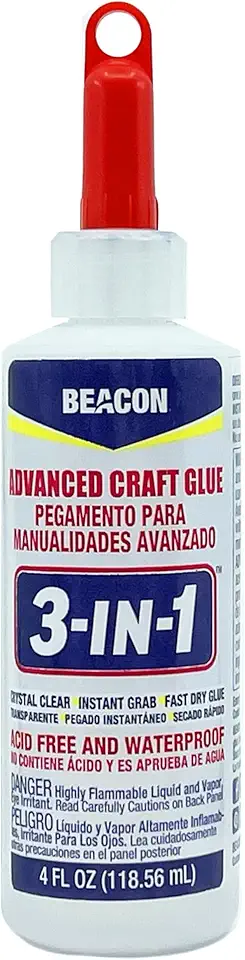
Beacon 3-in-1 Advanced Craft Glue 4 oz
Versatile formula bonds, seals, and repairs a variety of materials with durable, long-lasting hold.
Check PriceAs a photographer who mounts prints into handmade books and mixed‑media pieces, I reach for Beacon Fabri‑Tac (Beacon 3‑in‑1) when I need a reliable, fast finish that won’t wrinkle heavier papers. It’s a versatile, quick‑drying adhesive popular among scrapbookers and crafters for good reason: it forms a permanent, strong bond yet allows a brief reposition window so you can nudge things into place.
One of the things I appreciate is that it dries clear, so my photos retain their clean look without cloudy residue. It handles heavier papers without warping, making it a solid choice for mounting prints onto card stocks, fine art papers, or layered layouts where stiffness could otherwise buckle an image.
User feedback mirrors my experience: many pros praise its strength and fast, clear drying. In practice that means fewer clamps and less wait time between layers. It also doubles as a multipurpose craft glue, so it’s handy when your shoot day turns into a scrapbooking afternoon—buttons, ribbons, and lightweight trims stick well.
Be mindful of application technique, though. If you over‑apply, Fabri‑Tac can become stringy or tacky, which complicates neat edges and can look messy on light papers. Some users report a slight chemical odor during use, so I recommend a quick test on a scrap and working in a ventilated area if that concerns you.
- Strong permanent hold with some reposition time
- Dries crystal clear
- Works well for heavier papers without wrinkling
- Multipurpose for other crafting materials
- Can be stringy/tacky if applied thickly
- Slight chemical odor reported by some users
3. 3M Spray Adhesive (3M Super 77)

3M Super 77 Multipurpose Spray Adhesive 16.75 oz
Fast-drying aerosol adhesive creates an instant, strong bond for fabrics, foam, paper, and lightweight panels.
Check PriceAs a photographer who mounts multiple prints, I reach for 3M Super 77 when I need fast, even coverage across larger paper surfaces. It’s designed for large‑scale photo mounting and collages, so it covers broad areas quickly and smoothly.
The adhesive is highly rated for holding power and permanence, so your layered photos stay put over time. Applied thinly, it does not cause wrinkling or warping, which is crucial when you’re working with glossy or delicate paper.
It’s excellent for creating multi‑photo collages and complex layouts that demand a uniform bond across the whole piece. The spray format makes layering straightforward and helps build multidimensional projects without lumps or ridges.
One practical trade‑off is control: the spray pattern can be harder to manage than a tape runner or liquid glue. That means you’ll want to mask off edges and practice on scrap paper to avoid overspray and uneven coverage.
Because it’s a solvent‑based spray, use it in a well‑ventilated space; ventilation is specifically noted as a requirement. Take standard studio precautions—cover work surfaces and keep prints flat until fully set.
For photographers mounting large prints, presentation boards, or multiple images at once, 3M Super 77 is a strong, time‑saving choice. It’s less useful for tiny, highly detailed gluing tasks, but for scale and permanence it performs very well.
- Fast, even application
- Strong permanent bond on paper with photos
- No warping or wrinkling if applied thinly
- Good for layering and multidimensional projects
- Spraying can be messy or over‑applied without care
- Requires ventilation due to solvent fumes
4. Elmer’s School Glue (Liquid White)

Washable No-Run School Glue
Kid-safe, washable formula dries clear, resists drips, perfect for classroom projects and daily crafting.
Check PriceElmer’s School Glue is the classic white, non‑toxic, acid‑free school glue favored for basic crafts and easy cleanup. As a photographer, I find it useful when I need a gentle, forgiving bond for low‑stress projects rather than archival mounting.
It has a thicker consistency, so you must be careful with the amount you apply. The thicker formula can cause wrinkling or paper buckling if it’s over‑applied, which matters when working with thin papers or lightweight photos.
Users value it for safety and simplicity; it dries fairly clear and is very easy to clean up while still wet. Because the adhesion is relatively mild, it’s not recommended for permanent photo mounting or heavy papers where long‑term hold is required.
Elmer’s is ideal for casual craft projects, kids’ scrapbooking, and situations where a temporary or light bond is acceptable. The outline notes that long‑term preservation is less certain, so avoid it for framed prints or archival albums you want to last decades.
In short, treat this glue as a handy, safe, and accessible option for low‑risk photo applications. For anything needing permanence or museum‑level stability, consider alternatives; but for quick layouts, demonstrations, or children’s projects it’s often perfectly adequate.
- Non‑toxic and widely available
- Easy to apply and clean up
- Dries fairly clear
- Good for temporary or light adhesion
- Weaker hold; not ideal for archival projects
- Can cause paper warping or shine if overused
5. Double-Sided Tape and Glue Runners

Scrapbook Double-Sided Tape Roller 4-pack 0.3in x 26ft
Compact tape applicator delivers consistent, mess-free adhesive strips for photos, scrapbooks, and paper crafts.
Check PriceAs a photographer who mounts prints in albums and on cards, I reach for double-sided tape or a glue tape runner when I need a clean, fast finish. Tape runners dispense thin strips of pressure-sensitive, acid-free, photo-safe adhesive, which makes them reliable for photo work.
The bond forms instantly and there’s no wet glue to cause wrinkling or moisture damage. Because they bond quickly without wrinkling or moisture risks, they’re ideal for quick photo mounting with minimal mess.
I appreciate how precise tape runners are for layered paper crafts and scrapbooking; the application is fast, clean, and precise so you can align images exactly where you want them. There’s no drying time and the instant grip gives immediate strong adhesion, which is handy when assembling cards or multi-layer layouts.
Be aware they’re less forgiving if you need to reposition a print—limited repositioning after application is the norm. Also, some runners are disposable or have limited refill options, and disposable runners create extra waste; some users dislike refillless models.
In short, if you want a no-mess, photo-safe option that won’t wrinkle prints and gives immediate hold, double-sided tape/glue runners are an excellent choice. They shine in speed and precision, but plan carefully before sticking because adjustment options are limited.
- Fast, clean, precise application
- Acid‑free and safe for photos over time
- Does not wrinkle or warp paper
- No drying time; immediate strong adhesion
- Limited repositioning after application
- Disposable runners create extra waste; some users dislike refillless models
How to Choose Photo Adhesives
As a photographer, the first question I ask is where the photo will live. Prints destined for a gallery wall need a different adhesive than snaps for a scrapbook or a client album.
Pressure‑sensitive options like double‑sided tape or tape runners are the quickest and cleanest choice. They give instant grab, work well for layered paper work, and many photo‑safe versions are acid‑free; just be mindful that high‑tack varieties are effectively permanent while low‑tack allow tiny shifts during placement.
Heat‑activated adhesives deliver museum‑grade permanence, but they come with caveats. You need a mounting press or iron and some technique, so they’re great for archival prints but overkill for casual projects.
Spray adhesives are my go‑to for large boards and collages because they give even coverage. Use a photo‑safe, non‑yellowing formula and low‑VOC sprays where possible, spray thinly to avoid buckling, and work in a ventilated area; practice on scraps until you control the pattern.
Gummed or water‑activated tapes are the smart choice when reversibility matters. They’re reversible with water, which conservators love, though they’re slower to apply and require a wetting tool.
Always check for acid‑free and lignin‑free labeling — that’s the baseline for long‑term stability. Also test on the same paper finish before committing; glossy, coated, and fine‑art surfaces bond differently and can react to moisture or solvents.
In practical terms, use a brayer or squeegee to apply even pressure without crushing the print, avoid over‑application that causes wrinkles, and do a small trial if you’re unsure. Match the adhesive to the job: quick tape for albums, spray for big pieces, heat for archival mounting, and gummed tape when you may need to remove the photo later.
Why Acid-Free Glue Matters for Photos
Photographs are more chemically vulnerable than most people realize. Standard craft glues and tapes can contain acids that slowly migrate into the paper and image layers. Over time this causes yellowing, brittleness and image loss.
Acid-free and lignin-free adhesives are formulated to avoid those reactions. They resist yellowing and help maintain tonal fidelity and paper strength. That is why conservators, galleries and professional printers use them.
If you’re mounting prints for clients or making family albums, pair acid-free glue with acid-free backing boards and mats. It’s a small extra cost now for decades of stability. I always make this a non-negotiable step in my workflow.
Not every project needs museum permanence, but decide up front whether the bond must be removable. For archival albums, exhibition prints and client work choose materials labeled ‘photo-safe’ and ‘acid-free.’ For casual crafts you can be economical, but check the label regardless.
Read product specs and ask suppliers when labels are vague. Testing on a scrap of the same paper won’t show decades of change, but it will reveal immediate discoloration or warping. Immediate reactions often predict long-term trouble.
Even acid-free glues can cause problems if you flood an area. Apply adhesives sparingly and evenly to avoid seepage, shine or wrinkling. Use a brayer or bone folder to settle the piece and remove air pockets for a flat result.
If future removal is likely, prefer reversible methods like gummed tape or removable pressure-sensitive adhesives. Permanent archival bonds are fine for display, but they should be explicitly labeled acid-free. In short, longevity is about materials and technique, not just the name on the bottle.
For heirlooms, gallery work and client prints, spend a bit more on tested, labeled acid-free adhesives and proper supports. That choice preserves color, paper integrity and the value of the work for generations.
What People Ask Most
What is the best glue to use for mounting photos on paper?
Choose an adhesive based on the job: precision work benefits from pressure‑sensitive tapes, large areas from spray adhesives, and archival needs from acid‑free or heat‑activated options. Match the adhesive to the paper surface and permanence you want, and always test on a scrap first.
Can you use a glue stick to attach photos to paper?
Glue sticks can work for casual projects if they are labeled photo‑safe and acid‑free, but they generally provide a lighter bond. They are best for temporary or low‑stress applications rather than long‑term mounting.
Is Mod Podge safe to use on printed photos?
Mod Podge and similar decoupage products can alter surface sheen and may not be formulated for archival photo work. If you consider using one, test on a spare print and prefer products labeled safe for photographs and non‑yellowing.
How do you glue photos to paper without causing wrinkles or bubbles?
Apply adhesive sparingly and evenly, and use firm, even pressure with a brayer or squeegee to smooth the photo onto the backing. Work from the center outward and test your method on scrap materials before committing to the final piece.
What adhesive will not damage or discolor photographs?
Look for adhesives that are explicitly labeled acid‑free, lignin‑free, and non‑yellowing to minimize long‑term chemical damage. For removability, choose reversible options such as gummed tape or removable pressure‑sensitive adhesives.
Can double‑sided tape be used to stick photos to paper?
Yes, double‑sided tape is a clean, precise option that bonds instantly without moisture and typically avoids wrinkling. Ensure the tape is photo‑safe and understand that most tapes offer limited repositioning once applied.
Is spray adhesive suitable for attaching photos to paper?
Spray adhesive works well for large prints and even coverage when a photo‑safe, non‑yellowing formula is used and applied sparingly. Use good ventilation and practice on scraps to control spray pattern and prevent over‑application.
Conclusion for Best Photo Glue on Paper
Choosing the right adhesive comes down to your project: pick a precise, strong adhesive for delicate or detailed work, a spray for even coverage on large pieces, gentle school‑grade formulas for casual or kid‑friendly projects, and pressure‑sensitive tape for fast, clean mounting with no moisture.
Prioritize archival needs by matching permanence and reversibility to the end use—framing and long‑term display call for more permanent, stable options while albums or portfolios may benefit from removable choices.
Always test your chosen adhesive on scrap material first, and check labels for “acid‑free,” “photo‑safe,” and “non‑yellowing” to protect prints over time.
If you want to sharpen your mounting and preservation skills further, take a look around our site for more practical guides and tips that build on this overview.
Have questions or a project to describe? Leave a comment below—we usually reply within a few hours and are happy to help.



0 Comments