
Ever wondered which adhesive will keep your favorite images pristine for years without warping, yellowing, or regret? Choosing the right glue can mean the difference between a cherished heirloom and a ruined print.
This guide breaks down five top photo‑safe adhesives — covering permanent bonds, archival options, peel‑and‑stick solutions, and photo corners that avoid contact with the image. I’ll walk you through what each type is best for and why.
You’ll learn practical uses, the key pros and cons, and which adhesives suit hobbyists, scrapbookers, professional framers, or archival caretakers. We also cover safe application techniques so your prints stay flat and unmarked.
Expect clear, photographer‑friendly advice on matching permanence, appearance, and long‑term preservation needs to your project. No gimmicks. Just straightforward guidance based on real‑world use.
Whether you’re compiling a family album, prepping gallery prints, or crafting mixed‑media pieces, this primer will save you time and mistakes. Read on to choose the best adhesive for your photos with confidence.
I’ll also flag common mistakes to avoid, like household tapes that yellow or over‑wet glues that warp prints. Small steps make big differences, and with the right technique your albums will look professional and last for generations.
Ready to find the perfect match for your project? Let’s get started and protect your photos the right way.
1. Scotch Photo Mount Adhesive by 3M

Scotch Photo Mount Adhesive 10.3 oz (6094)
Professional-strength bonding formula for securing prints and enlargements; drip-resistant, fast-setting, and durable for clean, long-lasting bonds.
Check PriceAs a working photographer I reach for Scotch Photo Mount Adhesive when I need a clean, professional finish. It’s a clear, professional‑grade mounting adhesive made for photos, art prints, maps, and illustrations.
In practice it’s excellent for scrapbooking and mounting prints. The bond is very strong and permanent, and it mounts quickly without wrinkles or damage.
Users consistently praise that it dries clear and does not stain photos, which matters when you’re preserving color and detail. It’s also straightforward to use for most mounting tasks, so scrapbookers, professional photographers, and artists mounting prints will find it useful.
That said, remember it’s permanent. If you like to reposition images while composing a layout, this isn’t the product for that workflow. Application can be a bit fiddly — it’s easy to get excess adhesive if you’re not careful — so take your time and practice on scrap material first.
For anyone who needs a strong, clear, long‑lasting mount on a variety of surfaces, this product does the job very well. If you need removability or are uncomfortable with precise application, consider a repositionable or corner solution instead.
- Very strong, clear, professional-quality bond.
- Quick drying without wrinkling or staining.
- Easy application for scrapbooking and art mounting.
- Permanent bond on various surfaces.
- Permanent — cannot be repositioned.
- Tricky to apply precisely; risk of excess adhesive oozing.
2. UHU Stic Glue Stick
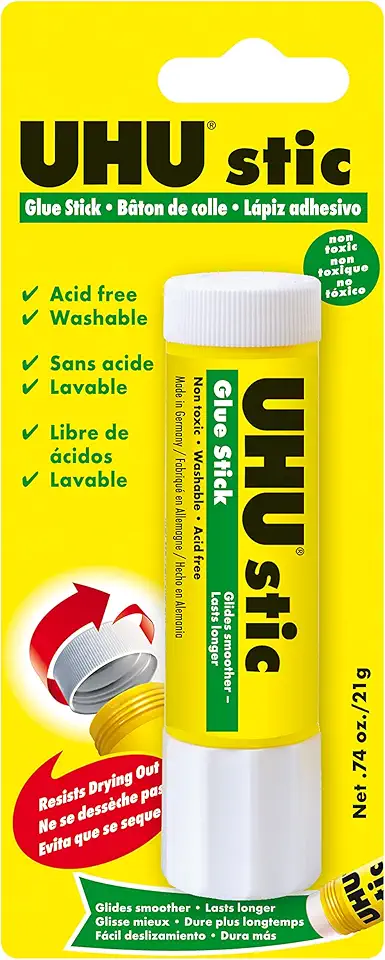
UHU stic Glue Stick 21 g (screw cap)
Convenient twist-cap solid applicator for mess-free paper bonding; quick-drying, non-toxic, ideal for crafts, school projects, everyday fixes.
Check PriceAs a photographer who assembles albums and collages, I reach for the UHU Stic Glue Stick when I need a clean, archival-safe finish without fuss. It’s an acid-free glue stick designed for scrapbooking, collage, and photo mounting, so it won’t introduce harmful acids that yellow prints over time.
Application is pleasantly simple: the glue goes on with minimal moisture, which reduces the risk of wrinkles and bubbles that kill a photo’s look. It dries quickly and invisibly, so you won’t get cloudy patches or clumps across a glossy print. Compared with cheap sticks, users praise its smoother, more refined feel and the fact that it doubles as a light sealer for edges.
That said, very thin images can still show slight wrinkling if you’re heavy-handed. In those cases I recommend a gentle press and, if needed, a quick ironing/smoothing step (low heat, protective tissue) to flatten the paper. Also keep in mind the stick format isn’t as precise as a liquid adhesive for fine edge work—so for tiny trims or border work you may need a micro applicator or thin tape instead.
Overall, UHU Stic is an excellent go-to for hobbyists, scrapbookers, and collage artists who want a mess-free, archival option that looks professional without specialized tools. It’s not for every precision job, but for everyday photo mounting it’s reliable and forgiving.
- Minimal moisture application reduces wrinkles/bubbles.
- Acid-free and archival-safe.
- Dries quickly and clear with no clumps.
- Multipurpose glue and sealer.
- May require ironing/smoothing for very thin papers.
- Glue stick format is less precise around edges than liquid adhesives.
3. Lineco Neutral pH PVA Adhesive

Lineco Neutral pH PVA Adhesive 1 qt (archival acid-free)
Archival-grade conservation formula that provides flexible, long-lasting bonds safe for books, frames, and delicate papers.
Check PriceLineco Neutral pH PVA Adhesive is an archival‑quality choice I reach for when mounting prints that need museum‑grade longevity. It’s a neutral pH PVA formulated specifically for photo mounting and framing, so it’s safe for pigment and resin‑coated photo papers.
Professional framers and printers commonly use it, and for good reason: when applied correctly it creates a strong, durable bond without damaging photos. For an even coating and a smooth, wrinkle‑free finish I always use a foam roller — it makes a big difference in the final result.
Be warned: this is not a grab‑and‑go product. The adhesive requires a practiced hand to avoid air bubbles and achieve a clean finish, so plan for a careful application and some trial pieces if you’re learning the technique.
It’s also not instant — drying time and patience are part of the process, which is worth it if your priority is long‑term preservation. If you’re mounting archival prints for clients, gallery display, or personal archives, Lineco’s PVA gives the permanence and archival safety you want.
In short, choose Lineco Neutral pH PVA if you need archival, museum‑quality mounting and are comfortable taking the time to apply it properly. If you prefer quick, repositionable solutions or have no experience with foam rollers, this may feel fiddly at first but will reward careful use with a professional, long‑lasting result.
- Neutral pH — safe for pigment/resin‑coated papers
- Strong, durable bond without damaging photos
- Even application with foam roller for wrinkle‑free mounting
- Suitable for long‑term preservation
- Complex application — needs care to avoid bubbles
- Not instant — requires drying time and patience
4. Herma Photo Stickers

Herma 1071 Photo Stickers Pack of 1000
Clear, removable adhesive tabs for residue-free attachment of prints and mementos; low-tack and perfect for albums, scrapbooks, and displays.
Check PriceHerma Photo Stickers are double-sided, solvent-free photo adhesive stickers designed specifically for photo mounting. The sheets use small 12 mm × 17 mm stickers, which makes them adaptable to lots of mounting situations.
In practice they offer a true peel‑and‑stick, mess‑free mounting method that speeds up album assembly and casual projects. Because there’s no liquid involved, you avoid drips, drying time, and the wrinkling that wet glues can cause.
Feedback from users highlights that these stickers work well for quick permanent mounting and are safe on photos — a basic requirement for anyone putting prints into an album. That said, peeling and applying the tiny tabs can be fiddly for some, so expect a bit of extra care when you’re handling small prints.
As a photographer, I’d reach for Herma Photo Stickers when I want a clean, fast solution for personal albums, event handouts, or simple scrapbook pages. They’re ideal for casual scrapbookers and photo‑album creators who want fast, mess‑free mounting rather than repositionable solutions.
The permanent hold gives confidence that prints will stay put, but it also means you can’t reposition once stuck. The compact 12×17 mm format is versatile — good for corners, backs, or small images — and the solvent‑free composition reduces risk to image surfaces.
- Solvent-free and safe for photos.
- Mess-free peel-and-stick convenience.
- Small size suitable for varied applications.
- Strong, permanent hold.
- Permanent—no repositioning after sticking.
- Can be fiddly to peel and apply accurately.
5. Pioneer Photo PCR-1 Clear Photo Corners

Pioneer PCR-1 Photo Corners Self-Adhesive 250 pack
Pre-taped mounts for gentle, damage-free placement of prints in albums; archival-safe, easy to apply and reposition.
Check PricePioneer Photo PCR-1 Clear Photo Corners are self-adhesive, clear corners made from archival-quality, acid‑ and lignin‑free materials. I turn to these when I want a clean, non-invasive way to mount prints without touching the image surface.
The corners come in a dispenser box for easy use and are designed for non‑permanent mounting, which makes them ideal for work that may need to be changed later. In practice they sit almost invisible on the paper, giving a neat, professional finish that keeps the adhesive off your photo.
These corners are pressure‑sensitive and repositionable before a firm press, so you can tweak placement as you go — a real help when lining up a series of prints. Because they are acid-, lignin-, and PVC‑emission free, they’re suitable for valuable or vintage photos where long‑term preservation matters.
There are a couple of practical limits to bear in mind. They can be fiddly to apply at first, particularly if you’re used to peel‑and‑stick tapes, and they only secure the corners — not the whole back of the photo — so they won’t replace full‑surface mounting for heavy or permanently framed pieces. That said, if you want a removable, archival-safe method that preserves the image and looks discreet, these corners are an excellent choice.
- Acid-, lignin-, and PVC‑emission free for archival safety.
- Clear and nearly invisible on photos.
- Allows non‑permanent mounting; prevents adhesive contact with photo.
- Pressure‑sensitive and repositionable before firm press.
- Can be fiddly to apply for beginners.
- Only suitable for corner mounting, not full‑surface adhesion.
How to Glue Photos in Albums
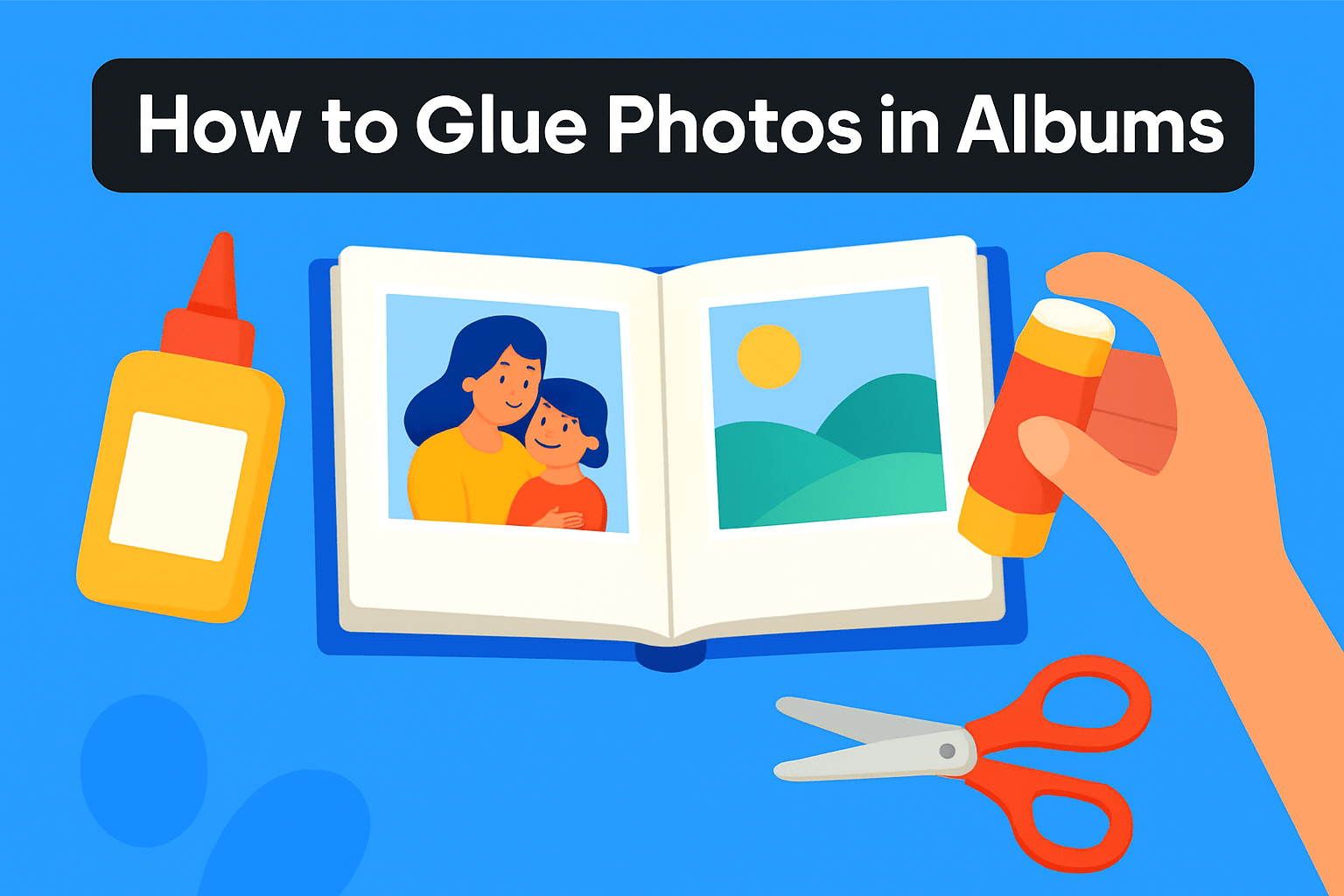
Gluing photos into an album is easy, but small choices affect their longevity. Always choose archival-safe, acid- and lignin-free adhesives and handle prints by the edges to avoid fingerprinting.
Select the adhesive form to match permanence and paper weight. Photo corners are safest for removability and vintage prints, peel-and-stick photo labels or archival double-sided tape are quick and tidy for scrapbooks, and neutral-pH PVA gives museum-quality permanence when applied carefully.
Corners are the least invasive option. For standard prints I slide them into the top two corners so the photo can be lifted out later. For thicker prints like Polaroids, use opposing corners (top-left and bottom-right) to lock the image without touching the emulsion.
When you use stickers or double-sided tape, plan and mark placement before you peel. Align with a ruler, stick from one edge across to avoid trapping air, then burnish the join with a bone folder or clean cloth for a flat, invisible finish.
Glue sticks and liquid adhesives demand restraint. Acid-free glue sticks work well on thin papers—apply lightly and smooth; some very thin prints benefit from a gentle ironing under protective paper. For PVA, work with a foam roller and a thin, even coat, roll outward to push out bubbles and weight the album flat while it dries.
If you want removability, hinge the print with acid-free hinging tape or tissue at the back edge for a reversible attachment. Never use household tapes such as masking, duct, or office tape—they will yellow and harm prints. When in doubt, test on a scrap or use corners; a little patience now preserves your photos for years to come.
Photo Adhesive Types
As a photographer I treat adhesive choice like choosing the right paper or frame. The wrong glue can warp, yellow or ruin a print, so think permanence, archival safety and paper thickness before you pick.
Pressure-sensitive adhesives (PSA) are the stick-on, no-drying-time options—tapes, dots and peel-and-stick stickers. They come in low, medium and high tack; photo-safe PSAs usually use low/medium tack and are acid- and lignin-free. Use them for quick albums and scrapbooks, but know they are usually permanent after pressure.
Water-activated (gummed) adhesives are revived with moisture and are often reversible and archival-safe. Conservators choose them when future removal matters, because they can be cleaned away. They take patience and a light touch to avoid over-wetting or cockling thin papers.
Glue sticks and liquid PVA are studio workhorses. Acid-free glue sticks dry clear, add little moisture and are excellent for lightweight prints and collages, though very thin paper may need smoothing. Neutral pH PVA gives a strong, long-term bond for framing, but needs even application and drying time—rollers help get a smooth finish.
Photo corners secure an image without adhesive touching the emulsion, so they’re ideal for valuable or vintage prints. Clear archival corners are nearly invisible and let you remove or reposition images easily once you’ve practiced the placement.
Spray adhesives deliver an even full-surface bond and keep prints flat, which is why pros use them for mounting on foamboard and mats. Many sprays are solvent-based, so work outdoors or in a ventilated area and always test on a scrap first.
Avoid hot glue and cyanoacrylate on photos; they can yellow, stiffen or chemically damage prints. Likewise skip household tapes like masking or duct tape—these will cause problems over the years.
Match the adhesive to the job: corners or archival stickers for albums, glue sticks for casual projects, and neutral PVA or a tested spray for professional framing. Whatever you choose, use acid- and lignin-free products, test on a leftover print, and apply sparingly—gentle mounting preserves your work best.
What People Ask Most
What is the best adhesive for mounting photos permanently?
A clear, professional-grade permanent mounting adhesive or a permanent double-sided photo-safe tape is usually best for a lasting bond. Choose a product that dries clear and lays flat to avoid wrinkles or staining.
Which adhesives are archival and safe for photos?
Look for adhesives that are acid- and lignin-free and labeled neutral pH or archival. Archival-rated PVA adhesives, glue sticks, and pressure-sensitive tapes or photo corners are common safe options.
Are glue sticks like UHU Stic safe for photo albums?
Acid-free glue sticks designed for photos are generally considered safe and archival and they reduce moisture compared with some liquid glues. Very thin papers may still need smoothing after application to prevent slight wrinkling.
How can I avoid wrinkles and bubbles when mounting photos?
Use minimal-moisture or pressure-sensitive adhesives and apply adhesive evenly, smoothing from the center outward or using a roller for even contact. Avoid over-applying wet glues and press firmly to remove trapped air.
What are the pros and cons of photo corners versus full-surface adhesives?
Photo corners hold images without adhesive touching the image and allow removal or repositioning, but they can be fiddly and only support corner mounting. Full-surface adhesives provide a seamless, strong bond but are typically permanent and require careful application to avoid damage.
Can I reposition photos after using photo stickers or double-sided tape?
Most photo stickers and double-sided tapes are pressure-sensitive and tend to be permanent with limited repositionability, though some allow brief adjustment before firm pressure is applied. Choose products labeled repositionable if you need to move images later.
Which adhesive is best for professional framing or museum-quality mounting?
Neutral pH archival adhesives or reversible water-activated options are preferred for long-term preservation in professional or museum settings. These methods are usually applied with proper tools to ensure an even, bubble-free finish.
Conclusion for Best Photo Adhesives
Whether you want a permanent bond, a removable solution, or museum‑grade archival care, the adhesives covered give you practical choices for mounting, preserving, and displaying photos.
The main takeaway is simple: match your adhesive to the level of permanence you need, the archival requirements of your prints, and how precise or easy you want the application to be.
When in doubt, test on a scrap or inconspicuous area and practice your application to avoid wrinkles, bubbles, or misalignment.
To continue improving your mounting and preservation skills, explore more articles on our site for practical tips, comparisons, and step‑by‑step guidance.
Please leave a comment with your questions or experiences — we usually reply within a few hours and are happy to help you choose the right approach.



0 Comments