
Want to know how to build a camera obscura and see the world projected upside down on a wall?
This easy guide walks you through every step, from a simple shoebox pinhole to a full-room conversion.
You will get clear material lists and design choices like pinhole vs lens and box vs room, plus a quick cost and time comparison.
The heart of the article is a detailed step-by-step box build with a printable template, a pinhole-size table, photos, and a troubleshooting checklist.
We also cover room conversion, photographing the projection, creative variations, and essential safety tips for teachers and makers.
Materials & design choices (pinhole vs. lens; box vs. room)
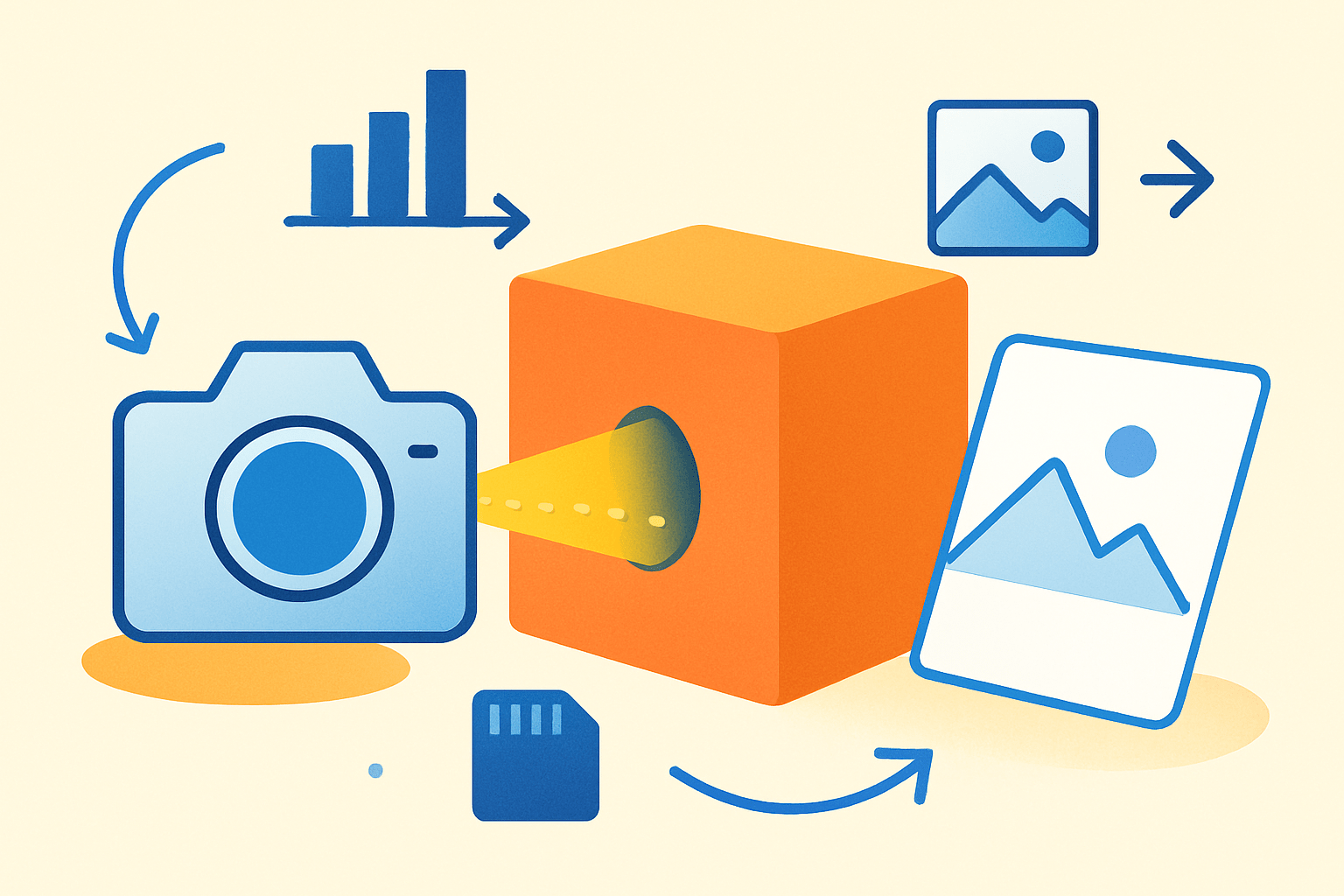
The classic camera obscura can be a tiny box or an entire room. The principle is the same, and the choice decides scale, cost, and effort.
You can build a small box with a pinhole, a box with a lens, or convert a room. A pinhole is simplest, while a lens gives a brighter, sharper image.
For a box build you need a cardboard box, tracing paper or vellum for the screen, aluminium foil or thin metal for the pinhole, and matte black paint. Add duct or masking tape, a craft knife, a ruler, a needle, glue, and optional parts like a magnifying glass, brass shim or washers, and a tripod screw adapter.
For a room build you need blackout material for windows, a sturdy mount for the aperture, and a white wall or large translucent screen. You can use a pinhole plate or a lens in the mount.
Design choices matter. Focal length is the distance from the aperture to the screen and it sets image size, focus, and brightness. Small shoebox builds are cheap and fast, while a room conversion is inexpensive but needs planning and careful sealing when you decide how to build a camera obscura for groups.
Step-by-step: Build a simple box camera obscura (this answers “how to build a camera obscura”)
Here is the clearest path on how to build a camera obscura at home. We will make a shoebox projector you can finish in about an hour.
Materials checklist for one box: one cardboard box about 20–30 cm long, tracing paper or vellum for a screen about 5–10 cm square, and a 3 × 3 cm patch of aluminium foil. Add matte black paint or black paper, duct or masking tape, craft knife, ruler, needle or pin, glue, and a pencil.
Optional parts include a small magnifying glass or surplus lens of 30–50 mm diameter, a piece of brass shim or a thin metal washer for a crisp pinhole, and a tripod screw adapter to mount the box. These let you upgrade brightness, sharpness, and stability later.
If you want a second reference, you can also make your own following a similar layout. Seeing another build helps you plan your cuts and tape lines.
Step 1, prepare the box. Choose an orientation where the aperture goes on a short end and the screen sits on the opposite long side, then paint the inside matte black to kill reflections.
Let the paint dry completely before closing the box again. If you do not paint, line the interior with black paper and overlap edges to stop light leaks.
Step 2, make the screen. Cut a neat rectangular window on the inside face where you will view, then tape tracing paper or vellum from the inside so it is tight and smooth.
Build a removable frame for the screen using a folded cardboard sleeve. This lets you slide the screen slightly to adjust focus without cutting the box again.
Here is a simple printable template idea. Use a box 25 cm long, cut a 7 × 7 cm centered screen on one end, and leave a 2 cm border for strength.
Step 3, create the aperture. Cut a small square hole at the center of the opposite side and tape a foil patch over it, then use a fine needle to make one smooth pinhole.
Twist the needle gently and polish any burrs with very fine sandpaper or the needle tip. A clean, round hole is key for a crisp projection.
As an alternative, mount a small magnifying glass in a cardboard ring and seat it in the hole. A lens makes the image brighter, and you can slide the lens or screen to focus.
Step 4, seal the box. Tape all seams inside and out, pay special attention to corners, and use black tape on edges where light can seep in.
Add a small viewing hole on the lid if you plan to look inside and not at the translucent screen. You can make a simple eyepiece with a rolled cardboard tube.
Step 5, test and focus. Point the pinhole toward a bright outdoor scene, let your eyes adapt to darkness, and watch an inverted image appear on the screen.
To focus, move the screen slightly closer or farther from the aperture, or try a different pinhole size. With a lens, slide the lens or screen until details snap into clarity.
Assembly tips matter. Cut straight edges using a ruler, keep foil tight with no wrinkles, and avoid glossy surfaces that cause ghost reflections inside.
Make the screen removable so you can experiment with distances. Add small pencil marks where the screen is sharp for different subjects, so you can repeat positions later.
Materials alternatives are easy. You can punch a pinhole in a soda can strip, use brass shim for cleaner edges, or try thin washers with drilled holes for repeatable sizes.
This little box shows the whole idea behind how to build a camera obscura. Once you see the first live projection, you will want to tweak and improve it.
Convert a room into a camera obscura (when and how to do a room-sized projection)
Choose a room with a sunny view and a flat wall opposite the window. A bare white wall or a large white screen gives the best results.
Block every source of light using blackout cloth, cardboard, or thick curtains, and tape all seams until the room is near-dark. Leave one controlled opening for the aperture mount.
Build a rigid mount at the window for a pinhole plate or lens, and ensure it is light-tight around the edges. If you use a lens, design a sliding holder so you can focus on the far wall.
Placing the wall farther from the aperture gives a larger image but it will be dimmer. The projection will be inverted and reversed, which matches many historic examples.
Think safety and stability when adding heavy blackout materials and glass lenses. Avoid aiming focused sunlight at curtains or wood, and never observe the sun directly.
Focus, aperture sizing and troubleshooting
Brightness and sharpness trade off in a pinhole. A smaller hole is sharper but dimmer, and a larger hole is brighter but softer.
A good guide for pinhole size is d ≈ 1.9 × sqrt(f × λ), where f is the distance from aperture to screen in millimeters, and λ is about 0.00055 mm. This balances diffraction and blur.
Here are quick examples that act like a pocket table. For f = 50 mm, use about 0.32 mm; for f = 100 mm, use about 0.45 mm; for f = 200 mm, use about 0.63 mm; for f = 500 mm, use about 1.0 mm.
Quick troubleshooting helps you move fast. If the image is too dim, make the pinhole slightly larger, use a lens, or aim at a brighter scene.
If the image is blurry, try a smaller hole or slide the screen until details sharpen, and fix light leaks and shiny interior spots. If you see ghost images, look for extra holes or repaint matte black.
An upside-down view is normal. You can add a front-surface mirror or prism to flip it, but it is not needed for learning how to build a camera obscura.
To measure focus changes, mark screen positions with pencil lines and note subject distance. Make a few pinholes on separate metal disks and record which looks best.
Capture, creative variations and essential safety tips
Photographing the projection is easy with a phone or camera on a tripod. Lock exposure or use manual mode, lower exposure compensation, and focus on the screen texture.
Placing the phone flat against the tracing paper reduces glare and boosts contrast. Photographing the wall in a room build shows scale and ambience, but you will need slower shutter speeds.
Explore creative variations once your box works. Try a two-box design that slides to focus, swap pinholes with different diameters like f-stops, or add a simple interchangeable lens mount.
Use it as an art installation or a classroom lab. Time-lapse a street scene to capture moving shadows, or project a live portrait session for a magical, living mural.
Plan visuals that explain both what and why. Shoot a materials layout, step-by-step assembly photos, a close-up of the pinhole, and a comparison photo showing focus changes with two screen distances, and add captions that teach.
Always put safety first. Never look at the sun through a pinhole or lens, do not focus sunlight on flammable materials, and be careful with knives, hot glue, and unattended lenses in bright light.
What People Ask Most
What is a camera obscura?
A camera obscura is a dark box or room that projects an upside-down image of the outside through a small hole or lens. It’s a simple way to see how light makes pictures without any electricity.
Why should I learn how to build a camera obscura?
Building one teaches basic optics and gives a hands-on art project that is cheap and educational. It’s great for classrooms, kids, or anyone curious about how cameras work.
Can I use a camera obscura for drawing or art?
Yes, artists use the projected image as a guide for tracing, composition, and studying light. The projection makes it easier to capture proportions and perspective by hand.
Is it hard to build a camera obscura at home?
No, basic versions only need a dark space, a small hole, and a screen to project on, so beginners can make one with everyday materials. More advanced builds just improve image quality a bit at a time.
What are common mistakes when trying to build a camera obscura?
Typical mistakes are not making the space fully dark, having light leaks, or placing the hole or screen in the wrong spot. Fixing these small issues usually makes the image much clearer.
How do I safely test a camera obscura without hurting my eyes?
Never look directly through the hole at the sun; always view the image on the projection surface inside the box or room. Use shaded openings and avoid pointing the device at intense light sources.
How big should my camera obscura be for a clear image?
Size affects brightness and image size, but both small boxes and larger rooms work for beginners depending on the projected image you want. Start simple, then adjust the space and screen distance to improve clarity.
Final Thoughts on Building a Camera Obscura
Whether you used the shoebox template or a larger setup, even a simple 270 mm box shows how basic materials make elegant optical magic — the core benefit is a hands-on way to see photography’s fundamentals in real time. It’s an inexpensive, tactile lesson in light, focus and composition that doubles as a creative display. Teachers, hobbyists, curious students and photographers will all get the most from this kind of project.
One realistic caution: don’t aim lenses or focused sunlight at flammable surfaces or look through a lens directly at the sun. If your opening question was whether a shoebox or a room can really become a working projector, this guide answered it with step-by-step builds, focus advice and troubleshooting so you can repeat and refine the results safely.
With a little patience and the simple adjustments shown here, you’ll be rewarded with crisp, moving images and new ways to teach or create. Keep experimenting — every tweak teaches you something new about light and seeing.




0 Comments