
Which single lens can transform your Sony APS-C camera into the only glass you need for a weekend of travel, portraits, or vlogging? With so many options, picking the right glass can feel paralyzing. This compact guide cuts through the hype and points to five lenses that actually work in the real world.
You’ll get a clear roundup of five lens types for Sony APS-C, with plain notes on when to use each. We focus on what shooters actually reach for: wide angles, primes, and travel zooms.
The scope covers ultra-wide options for sweeping vistas and vlogs, standard primes for flattering portraits, and versatile zooms for everyday and travel use. If you shoot video or street photography, there’s advice on autofocus behavior and handling.
The other big consideration is stabilization: match your lens choices to whether your body has IBIS or whether you’ll rely on lenses with OSS. Bodies with IBIS let you favor smaller, unstabilized optics; cameras without IBIS will benefit from optically stabilized glass. We’ll explain the trade-offs so you can balance portability and image quality.
By the end you’ll be armed with real-world picks tailored to travel, portraits, landscape and video, plus simple rules for matching glass to your kit. Ready to simplify your bag and shoot more confidently? Let’s dive in.
1. Sony E 16-55mm f/2.8 G

Sony SEL1655G 16-55mm F2.8 G APS-C Lens
Professional-grade standard zoom with constant bright aperture, razor-sharp optics and fast autofocus for versatile everyday shooting and cinematic results.
Check PriceThe Sony E 16-55mm f/2.8 G is my go-to all-purpose zoom for Sony APS-C bodies. It’s widely regarded as the best standard zoom for a6700, a6600 and a6500 shooters who want pro-level results without switching lenses constantly.
The constant f/2.8 aperture really changes the game. You get sharper, more vibrant images and creamy bokeh compared with older f/4 zooms, which is great for portraits, street work and low-light shooting.
It’s also compact and lightweight for what it delivers, so it’s easy to carry on travel days and for everyday use. Autofocus is fast and reliable, which makes it practical for both stills and run-and-gun situations.
There are a couple of practical caveats to keep in mind. The lens has no optical image stabilization, so it performs best on bodies with IBIS; I wouldn’t recommend it as the primary walk-around lens for cameras without in-body stabilization.
Users consistently praise its sharpness and color rendition, and its versatility makes it a real workhorse in my kit. However, it tends to be on the expensive side, and some shooters notice barrel distortion at the 16mm wide end that may require correction in post.
If you want a single zoom that covers everyday focal lengths with pro image quality and pleasing bokeh, this is an excellent choice—provided your camera has IBIS or you’re comfortable stabilizing at faster shutter speeds.
- Excellent sharpness with bright constant f/2.8 aperture
- Compact, lightweight design
- Fast, accurate autofocus
- Produces beautiful bokeh
- No optical image stabilization
- Noticeable barrel distortion at 16mm wide end
2. Tamron 17-70mm f/2.8 Di III-A VC RXD

Tamron 17-70mm F2.8 Di III-A VC RXD Sony E APS-C Lens
All-in-one zoom combining stabilized, fast-aperture performance with close focusing and smooth AF—ideal for travel, run-and-gun videography, and low-light shooting.
Check PriceThe Tamron 17-70mm f/2.8 Di III‑A VC RXD is one of my go-to travel zooms for Sony APS-C bodies because it covers a very useful 17–70mm range (~25.5–105mm full-frame equivalent). That range gives you wide-to-short-tele reach without swapping lenses, which is ideal for travel, street work and run‑and‑gun shoots.
Autofocus is very quiet and fast, so it handles both stills and video without calling attention to itself. Tamron’s BBAR coating also helps keep flare and chromatic aberration in check, so contrast and color stay punchy even in strong backlight.
Another big plus is the built‑in optical stabilization (VC), which matters if you’re using bodies without IBIS. On cameras like the a6600 the lens feels well‑balanced and comfortable for handheld shooting throughout the focal range.
Yes, it’s larger than a typical prime, but that’s the trade for a constant f/2.8 zoom and the flexibility it delivers. In practice you get excellent sharpness and contrast for an all‑around zoom, though, like most zooms, it’s slightly less sharp at the extreme wide and telephoto ends compared to dedicated primes.
If you want one lens that covers everyday, travel and casual portrait work while giving you low‑light performance and stabilization on non‑IBIS bodies, this Tamron is a very practical choice. It’s a balanced, versatile option for photographers who value flexibility without sacrificing too much image quality.
- Effective optical image stabilization
- Excellent sharpness and contrast
- Quiet, fast autofocus
- BBAR coating minimizes flare and chromatic aberration
- Larger and heavier than prime lenses
- Less sharp at extreme wide or telephoto ends compared to primes
3. Sigma 30mm f/1.4 DC DN Contemporary

Sigma 30mm F1.4 Contemporary DC DN Sony E Lens
Bright prime delivering dreamy background separation, outstanding sharpness and low-light speed—perfect for portraits, street photography and creative video.
Check PriceThe Sigma 30mm f/1.4 DC DN Contemporary is a highly recommended walk-around prime for Sony APS-C shooters. Its very fast f/1.4 aperture makes it a go-to for low-light work and for achieving a shallow depth of field when you want subject separation.
Image quality is a strong suit: the lens delivers outstanding sharpness when focused precisely and produces a smooth, pleasing bokeh that flatters portraits and close-ups. That combination makes it perfect for portraits, travel, documentary, and everyday photography where both image quality and background separation matter.
Build and handling are impressive for the price point — a premium metal construction that remains portable thanks to a weight of just 265 g. Autofocus is reasonably quick and generally quiet for stills, but it can produce a noticeable clunk/noise that may be distracting during video work.
If you prioritize ultimate autofocus speed and whisper-quiet operation for run-and-gun video, be aware the AF is slightly slower than some native Sony lenses. For photographers who value image quality, low-light capability, and a compact, well-built prime, this Sigma is an excellent and mostly forgiving choice.
- Large f/1.4 aperture for low light and bokeh
- Outstanding sharpness when focused precisely
- Premium metal build yet lightweight (265 g)
- Great for portraits, travel and everyday use
- Noticeable autofocus clunk/noise
- Autofocus slightly slower than native Sony lenses
4. Sony E 15mm f/1.4 G

Sony 15mm F1.4 G E APS-C Lens
Ultra-wide, fast-aperture optic for dramatic landscapes, astrophotography and immersive vlogging with exceptional edge-to-edge clarity and controlled distortion.
Check PriceThe Sony E 15mm f/1.4 G is a superb wide-angle prime for APS-C shooters who want a fast, sharp lens in a compact package. With a full-frame equivalent of ~22.5mm it gives a wide, natural field of view that’s ideal for environmental portraits, street scenes and vlog framing.
Optically it’s very sharp and handles low light well thanks to the f/1.4 aperture, so you can keep ISO down and still isolate subjects with pleasing background separation. I found its rendering clean and contrasty, which helps images pop straight out of camera.
For video shooters it’s especially appealing because it exhibits minimal focus breathing, so composition stays consistent when pulling focus. The manual focus ring is smooth and the dedicated aperture ring makes quick adjustments intuitive when shooting run-and-gun or recording handheld clips.
Physically the lens is extremely lightweight and compact, so it balances beautifully on small APS-C bodies and disappears in a sling bag during long walks. That portability makes it a favorite for vloggers and street photographers who need a high-quality, carry-all solution.
One practical caveat: there’s no optical image stabilization, so pairing this lens with a body that has in-body stabilization is recommended for steady handheld shots. Also, while many users appreciate the build and performance, some consider it relatively expensive for an APS-C prime.
- Very sharp with excellent low-light performance
- Minimal focus breathing — great for video
- Lightweight and compact
- Smooth manual focus ring and dedicated aperture ring
- No optical image stabilization
- Relatively high price for an APS-C prime
5. Sony E 11mm f/1.8
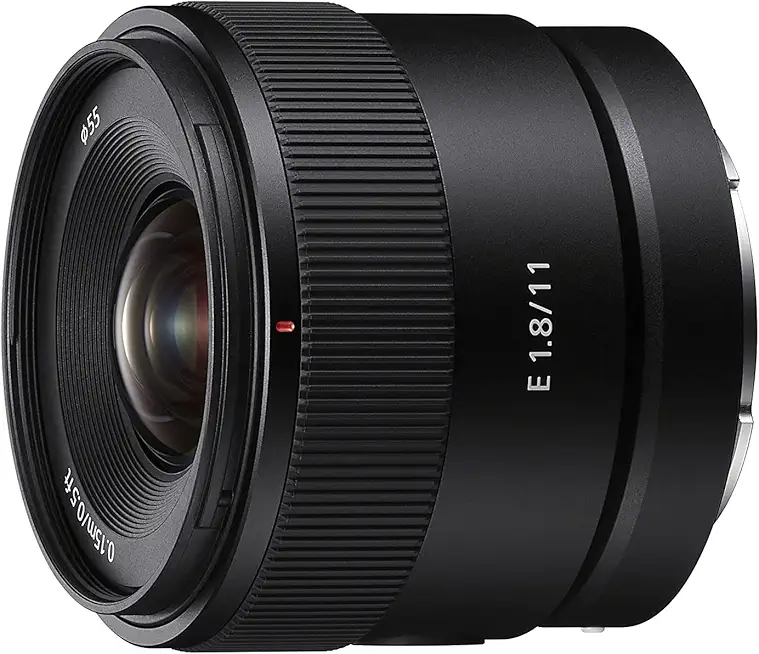
Sony 11mm F1.8 E APS-C Lens
Extreme ultra-wide lens offering expansive perspectives, bright low-light capability and creative distortion control for architecture, interiors and cinematic wide shots.
Check PriceThe Sony E 11mm f/1.8 is the go-to ultra-wide prime if you need a truly expansive field of view on an APS-C body. At 11mm it delivers creative, wider-than-typical perspectives that are ideal for vlogging, real estate interiors, and dramatic landscapes.
What makes this lens stand out is its bright f/1.8 aperture — unusual for an ultra-wide — which genuinely helps in low-light situations and even allows a bit of background separation when you want subject emphasis. Users consistently praise its sharpness and color accuracy, so images feel crisp and vibrant straight out of camera.
It’s also compact and lightweight, which makes it a solid choice for travel and handheld shooting where mobility matters. Autofocus is reported to be fast and quiet, so it’s comfortable for run-and-gun video or quick photo work without distracting focus noise.
No lens is perfect: expect some minor barrel distortion — typical for extreme ultra-wides — so plan for small corrections in post for architectural work. Also, the lens lacks built-in stabilization, so if you frequently handhold in very low light you’ll want a stabilized body or faster shutter technique.
- Ultra-wide 11mm focal length
- Bright f/1.8 for low light
- Compact and lightweight
- Fast, quiet autofocus
- Minor barrel distortion
- No built-in stabilization
Choosing the Right Sony APS-C Lens
Choosing the right lens comes down to matching focal length and aperture to your shooting habits. Think of lenses as tools: pick the one that solves the problems you face on the street, on a trip, or in dim light.
Wide-angle glass below 24mm is for landscapes, architecture and interiors; compact options like the Sony E PZ 10–20mm f/4 G or the Sony 11mm f/1.8 excel for vlogging and dramatic perspectives. Standard 24–50mm is the everyday sweet spot — the Sigma 30mm f/1.4 is a brilliant walk-around prime. For portraits and reach, anything above 50mm does the heavy lifting; an 18–135mm gives useful tele reach in a compact package.
Aperture affects low-light performance and background separation. Fast primes such as f/1.4 let you work in tough light and sculpt the scene, while a constant f/2.8 zoom like the Sony 16–55mm balances speed with framing flexibility.
Primes reward you with compact size and optical character, while zooms buy versatility. If you want a single do-it-all lens choose a 17–70mm or the 16–55mm f/2.8; if you crave subject isolation add a 30mm or a 56mm prime.
Autofocus on modern E-mount glass is generally quick, but stabilization matters. On bodies without IBIS — older a6000-series models or the ZV-E10 — favor lenses with VC or OSS; Tamron’s 17–70mm includes VC and many Sony zooms offer OSS.
Portability is one of APS-C’s strengths: lenses are smaller and easier to carry all day. Third-party makers often hit a sweet spot between weight, cost and image quality, while Sony’s premium G glass usually gives cleaner rendering with less distortion and corner softness.
For a practical kit carry a stabilized travel zoom like the Tamron 17–70mm or 18–135mm, and add a fast prime such as the Sigma 30mm or a 56mm for portraits and low-light work. For video, consider power-zoom or OSS options like the Sony 18–105mm, and choose the lens that solves your most common shooting problems.
Understanding the APS-C Crop Factor
Think of the APS‑C crop factor as a simple field‑of‑view translator. Sony APS‑C sensors use a 1.5× crop, so a 50mm lens on your camera “looks” like a 75mm on full‑frame (50 × 1.5 = 75). That math helps you picture what you’ll actually frame out in the real world.
The focal length written on the lens never changes, only the portion of the image circle the sensor captures. Practically that means full‑frame (FE) lenses give you extra effective reach on APS‑C bodies, while native APS‑C lenses stay compact and optimized for the smaller sensor.
If you shoot wide, the crop factor matters most. To get true ultra‑wide views you need very short focal lengths — an 11mm APS‑C prime is roughly a 16.5mm equivalent, and a 15mm acts like about 22.5mm. That’s why ultra‑wide APS‑C lenses are so short and special‑purpose.
For portraits the crop can be an advantage. A 56mm prime behaves like an ~84mm lens, which is a classic head‑and‑shoulders focal length. Keep in mind, though, APS‑C sensors tend to produce more depth of field at the same aperture and framing than full‑frame, so getting creamy background separation often means using very fast primes or stepping back for longer focal lengths.
When choosing glass, multiply focal lengths by 1.5 in your head and think in terms of field of view rather than the printed number. Want compact travel kit? APS‑C lenses give size and weight savings. Need reach or plan to upgrade to full‑frame later? FE glass gives flexibility but adds bulk.
Bottom line: use the crop factor as a planning tool. Match the effective focal length to the scenes and looks you want, and pick lenses that deliver that field of view without surprises when you’re out shooting.
What People Ask Most
What are the best lenses for Sony APS-C cameras?
The top picks include the Sony 16–55mm f/2.8 G, Tamron 17–70mm f/2.8, Sigma 30mm f/1.4, Sony 15mm f/1.4, and Sony 11mm f/1.8. Each excels in different uses like travel, portraits, wide-angle work, and everyday shooting. Choose based on your shooting style and whether your body has in-body stabilization.
Which Sony lenses are best for portraits on APS-C bodies?
Medium-telephoto primes such as the Sigma 56mm f/1.4 or Sony 50mm f/1.8 OSS are commonly recommended for flattering portrait compression and subject separation. Fast primes with wide apertures are generally preferred for smoother backgrounds. Consider a lens that balances sharpness with comfortable working distance.
What is the best wide-angle lens for Sony APS-C?
The Sony 15mm f/1.4 is widely praised as a premium wide-angle APS-C prime with excellent sharpness and video-friendly behavior. For even wider perspectives, the Sony 11mm f/1.8 offers an ultra-wide field of view that’s great for vlogging and creative landscapes. Pick based on how much width you need and how important low-light performance is.
What is the best prime lens for Sony APS-C?
The Sigma 30mm f/1.4 is a highly recommended all-around prime known for its low-light capability and sharpness. Primes generally deliver superior image quality and wider apertures compared with zooms. They are especially useful for portraits, street work, and everyday shooting.
What is the best zoom lens for Sony APS-C?
The Sony 16–55mm f/2.8 G is often cited as the best all-purpose zoom for APS-C due to its image quality and constant aperture. For travel and general versatility, the Tamron 17–70mm f/2.8 is a compelling alternative with built-in stabilization. Choose a zoom that matches your preferred focal range and whether your camera needs optical stabilization.
Are full-frame Sony lenses compatible with APS-C cameras?
Yes, full-frame FE lenses mount and work on Sony APS-C bodies since they share the same E-mount. On APS-C cameras they use a cropped portion of the lens’s image circle and tend to be larger and heavier than APS-C-specific lenses. FE lenses can be useful if you want the option to use them on full-frame bodies later.
What lenses are best for landscape photography on Sony APS-C?
Wide-angle primes and compact wide zooms are ideal for landscapes because they capture broader scenes and often deliver good corner sharpness. Lenses such as ultra-wide primes or quality wide zooms give the perspective and image quality that landscape work benefits from. Consider weight and portability if you plan to hike or travel with your gear.
Conclusion for Best Sony APS-C Lenses
This guide distills five top APS-C lens choices into practical, real-world uses so you can quickly match focal length and aperture choices to travel, portrait, vlogging, landscape, or everyday shooting.
Key trade-offs to keep in mind are stabilization (body IBIS vs lens OSS), the benefits of fast apertures for low light and background separation, and the portability versus image-quality balance that best fits your workflow.
Rather than chasing specs, prioritize lenses that complement your camera’s stabilization, your preferred genres, and how much weight you want to carry day to day.
If you want to sharpen your decision-making and shooting skills, read more articles on the site for deeper comparisons, tips, and real-world advice tailored to APS-C systems.
Have questions or need tailored recommendations? Leave a comment below — we usually reply within a few hours.



0 Comments