
Which zoom lens will unlock the full creative potential of your Sony A7IV and elevate both stills and video? This guide compares five standout zoom lenses and concentrates on what matters most to A7IV shooters: optical sharpness and autofocus reliability.
Sharpness is the foundation of image fidelity, defining how much texture and fine detail survive processing and display. We’ll look at how lenses render contrast, edge detail, and microsharpness in real-world shooting rather than just on-paper numbers.
Autofocus behavior is the difference between a keeper and a throwaway frame, particularly when you work in mixed photo‑video workflows or rapid-change environments. Quiet, accurate, and predictive AF helps with smooth pulls during recording and cleaner tracking when subjects move fast.
This piece is aimed at hybrid shooters, landscape and architecture photographers, lightweight travelers, and video creators who demand dependable performance. If you need breadth of zoom, edge-to-edge clarity, or film-friendly focus control, the right choice can change how you shoot day-to-day.
Beyond resolution and AF, we factor handling, size and weight, stabilization behavior, and the practical trade-offs between aperture and portability. These are the variables that influence whether a lens becomes a go-to on your A7IV or merely an occasional option.
I’ve distilled hands-on impressions and user feedback into practical recommendations meant to help you match a zoom to your workflow and budget. Read on to find the five zooms that deliver the best balance of clarity, focus performance, and everyday usability for the Sony A7IV.
1. Sony FE 24-70mm f/2.8 GM II

Sony FE 24-70mm F2.8 GM II
Professional-grade standard zoom delivering fast aperture, exceptional sharpness and creamy bokeh for portraits, events, and studio work.
Check PriceIf you want a true do-everything lens for the Sony A7IV, the Sony FE 24-70mm f/2.8 GM II is a hard lens to beat. As a hybrid shooter myself, I appreciate how it covers the most-used focal lengths with a constant f/2.8 aperture that performs well for both stills and video.
Optically it’s excellent — edge-to-edge sharpness across the entire 24–70mm range, even wide open, means you don’t have to stop down to get usable corners. Portraits pop nicely thanks to the lens’s excellent bokeh and subject separation, while event work benefits from that resolving power.
Handling is noticeably improved over the previous version: it’s lighter and more comfortable for long sessions and travel, so you’ll actually use it more. The build is robust and weather-sealed, which gives peace of mind for outdoor and run-and-gun assignments.
Autofocus is fast, quiet and reliable — it tracks moving subjects well and holds up even in low light, which is exactly what you need for events and reportage. Video shooters will love the de-click aperture ring for smooth exposure changes without audible clicks.
The trade-offs are minor but real: there can be some distortion at the wide end, which architects and landscape shooters should watch for. And yes, the lens sits at a higher price point, but for many hybrid pros the performance and build justify the cost.
- Outstanding sharpness 24–70mm, even wide open
- Fast, accurate autofocus that tracks moving subjects well
- Compact and lightweight for an f/2.8 zoom
- Excellent bokeh and subject separation for portraits
- Minor distortion at the wide end
- Higher price point
2. Sony FE 16-35mm f/2.8 GM II

Sony FE 16-35mm F2.8 GM II
Ultra-wide zoom with bright optics and edge-to-edge clarity tailored for landscapes, architecture, and immersive environmental portraits.
Check PriceThe Sony FE 16-35mm f/2.8 GM II is my go-to ultra-wide when I need punchy landscapes, clean architecture lines, or immersive event coverage. Its constant f/2.8 aperture gives real low-light headroom and lets you isolate subjects with a shallow depth of field even at wide angles.
Optically it delivers exceptional sharpness and image quality across the zoom range, so you get crisp corners on the A7IV’s 33MP sensor without chasing apertures. In the field that means cleaner files, less correction work, and more usable pixels for large prints or heavy cropping.
Autofocus is quick and silent, which matters for both fast-moving scenes and run-and-gun video. The zoom and control rings are smooth and well-damped, making exposure/zoom adjustments feel deliberate and video-friendly.
Build quality is reassuringly solid with weather sealing, so I’m happy to take it into coastal, dusty, or damp environments without second thoughts. It also balances nicely on the A7IV and plays well on gimbals, so handheld and stabilized shooting both feel natural.
The trade-offs are straightforward: it’s slightly heavier than the f/4 alternative and sits at a higher price point. For many shooters that added weight and cost are worth the f/2.8 performance, but if absolute weight or budget is your primary concern you’ll want to consider that.
If you shoot landscapes, architecture, events, or hybrid photo/video work and prioritize image quality plus low-light capability, this lens is an excellent fit. It’s a professional-grade tool that rewards careful use.
- Exceptional sharpness and image quality across the zoom range.
- Fast, reliable autofocus in challenging lighting.
- Durable build with weather sealing.
- Smooth controls ideal for video.
- Heavier than the f/4 alternative.
- Higher price than f/4 option.
3. Sigma 24-70mm f/2.8 DG DN II Art

Sigma 24-70mm F2.8 DG DN II Art Sony E-mount
High-resolution standard zoom offering fast, consistent aperture, refined rendering, and robust build for demanding professional workflows.
Check PriceI’ve spent many days with the Sigma 24-70mm f/2.8 DG DN II Art on a full-frame mirrorless body, and it’s one of those lenses that surprises you for the money. Optically it delivers excellent sharpness and pleasing color rendition across the zoom range, with generally minimal chromatic aberration in normal scenes. Because it’s lighter than many pro-grade 24–70s, it’s comfortable for travel and long shoots.
Autofocus is quick and reliable in real-world use, and I noticed very little focus breathing — a real plus for run-and-gun video work. The lens also gives you practical video controls: an aperture ring with a de-click switch and two customizable function buttons that make exposure and function changes smooth and repeatable. That combination makes it a solid pick for hybrid shooters who move between stills and video.
Build quality tilts toward a more plastic feel compared with higher-priced alternatives, so it won’t feel as rugged in heavy professional use. Still, the optics feel on par with much more expensive options, so you’re getting a lot of image performance for the price. For travel, weddings, and everyday use where weight and image quality matter more than a boutique build, this lens is mostly a win.
If you want a sharp, color-accurate 24–70 that won’t weigh you down and includes video-friendly controls, put this Sigma on your shortlist. Be mindful that the finish isn’t the most premium and in very high-contrast scenes you may see some chromatic quirks, but for most shooters those are tolerable trade-offs.
- Excellent image quality and sharpness across the zoom range.
- Lightweight and compact.
- Fast, reliable autofocus with minimal focus breathing.
- Customizable function buttons.
- Build quality feels less premium.
- Minor chromatic aberration in high-contrast scenes.
4. Sony FE 24-105mm f/4 G OSS
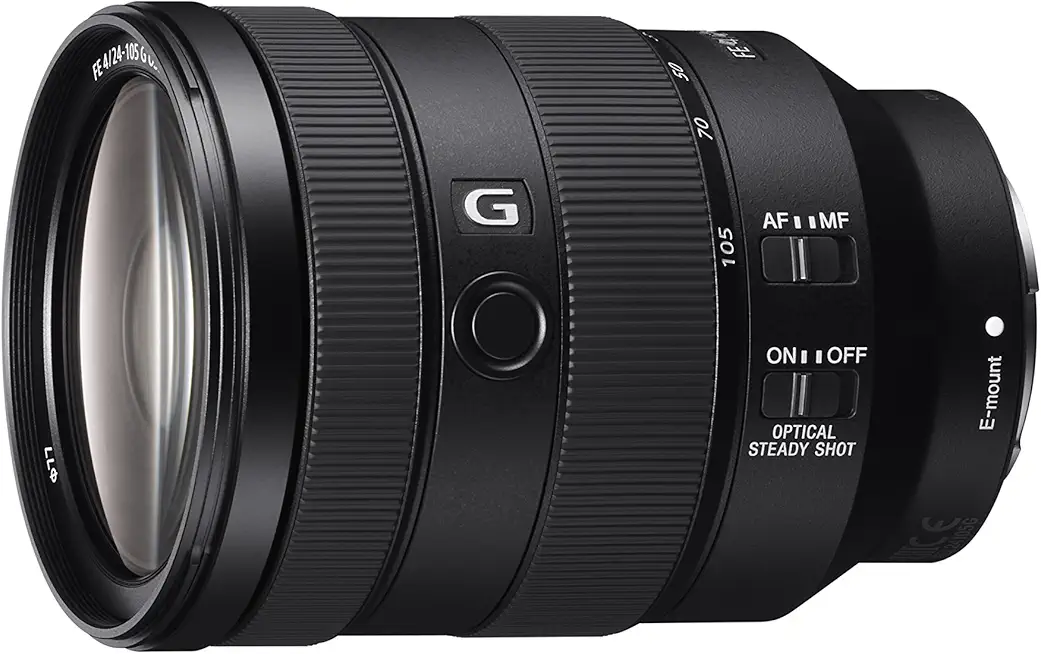
Sony FE 24-105mm F4 G OSS
Versatile all-purpose zoom with steady optical stabilization and constant aperture—ideal for travel, photojournalism, and everyday shooting.
Check PriceThe Sony FE 24-105mm f/4 G OSS is a genuinely useful, do-it-all zoom that I reach for on trips and events when I want to travel light without losing flexibility. Its wide 24–105mm range covers most shooting scenarios so you’re not constantly swapping glass, and the lens stays relatively compact and lightweight for what it delivers.
Optical image stabilization (OSS) is one of its standout practical features — it lets you hold the camera steady for handheld low-light shots more often than not. The constant f/4 aperture does mean it won’t match faster f/2.8 zooms in extreme low light, but OSS helps compensate and keeps usable shutter speeds without pushing ISO too high.
Autofocus is fast and quiet, which I appreciate when switching between stills and video; it feels reliable in real-world conditions and won’t call attention in quiet environments. Paired with the lens’s balanced size, this makes it a comfortable choice for long event days or travel shoots where mobility matters.
All told, this is a mostly positive, pragmatic lens: versatile, stabilized, and easy to carry. If you shoot a lot in very low light or need absolute edge-to-edge optical perfection, be aware of the aperture limitation and minor wide-end distortion — both manageable, but worth considering depending on your workflow.
- Versatile 24–105mm range for many subjects.
- Built-in stabilization for handheld shooting.
- Compact and lightweight.
- Quiet, reliable autofocus for stills and video.
- f/4 aperture not as bright as f/2.8 (limitation in very low light).
- Minor distortion reported at the wide end.
5. Tamron 17-28mm f/2.8 Di III RXD

Tamron 17-28mm F2.8 Di III RXD Sony E-mount
Compact, lightweight wide-angle designed for fast low-light performance and smooth focusing—perfect for landscapes, interiors, and vlogging.
Check PriceThe Tamron 17-28mm f/2.8 Di III RXD is a budget-friendly ultra-wide zoom that delivers professional-grade image quality. It’s aimed at travel and landscape shooters who want excellent optics without a heavy kit.
In real-world use this lens is repeatedly praised for its sharpness and color rendition across the zoom range. You’ll notice minimal distortion and very little chromatic aberration, which keeps files clean and easy to work with in post.
The build is compact and lightweight, making it a pleasure to carry on long walks or extended shoots. It sits well on the Sony A7IV and feels balanced, so handheld sessions stay comfortable all day.
Autofocus is fast and quiet, so the lens locks on reliably for stills and remains discreet during video capture. Its low-light performance is strong for an f/2.8 ultra-wide, helping with interiors, dusk scenes, and handheld shooting.
Where it compromises is in professional convenience: the Tamron lacks some switches and extra controls found on higher-end lenses. If your workflow depends on direct physical switches or extra features, that’s an important trade-off to consider.
Despite that, the optics are the headline—pro-level sharpness and color at a very attractive price. If you prioritize image quality, low weight, and value for money over pro-level control layouts, this lens is a smart choice for the A7IV.
I regularly recommend it for photographers who want a true ultra-wide perspective without the bulk or cost of flagship glass. Just be mindful of the small feature trade-offs if you need every convenience a pro lens offers.
- Excellent image quality and sharpness across the zoom range
- Compact and lightweight
- Fast, reliable autofocus with good low-light ability
- Affordable relative to quality offered
- Missing some switches/features found on higher-end models
- Zoom range slightly shorter than some ultra-wide alternatives
Sharpness and Resolving Power
The Sony A7IV’s 33‑megapixel sensor rewards lenses that actually resolve fine detail. Resolving power — a lens’s ability to separate fine lines (measured in lp/mm) — decides whether that extra resolution becomes usable detail or just larger files.
Zooms usually hit their optical sweet spot around f/5.6–f/8, where center and edge sharpness balance best. Stop down past f/11 and diffraction begins to soften micro‑contrast, wasting some of the sensor’s advantage. In practice you’ll often get sharper results by closing the aperture a stop or two from wide open rather than pushing to tiny f‑stops.
Corner performance changes with focal length and design, so a lens that’s razor‑sharp in the center can still lag at the edges. Premium zooms are engineered for better corner‑to‑corner performance, but many modern third‑party lenses are surprisingly capable. Run test frames across the range to find each lens’s true sweet spots before you rely on it for critical work.
Shooting technique matters as much as optics. For handheld work aim for shutter speeds around 1/250s or faster to avoid motion blur, and keep ISO ideally under 800 so noise doesn’t mask fine detail. When possible, use a tripod or stabilization to allow slower speeds without sacrificing resolving power.
Focus precision is equally important — use a small AF point or magnified live view for critical stills, and consider back‑button focus for consistency. For static scenes, focus stacking at the lens’s sharpest aperture can deliver the highest perceived resolution.
Shoot RAW, apply modest lens‑profile corrections and gentle sharpening in post, and avoid heavy noise reduction that erases micro‑detail. Correcting chromatic aberration and distortion on a 33MP file often yields a bigger jump in usable sharpness than chasing tenths of an f‑stop.
Autofocus Performance Considerations
The A7IV’s AF system is a major reason photographers pick this camera. It offers 759 phase-detection points and AI-driven tracking for stills and video. But the camera can only do so much on its own; if your lens can’t keep up, AF speed and accuracy suffer, especially in low light or with moving subjects.
Lens motor design and native integration largely determine real-world AF behavior. Sony’s G Master and G lines typically combine fast motors with full compatibility that lets the body drive focus smoothly. Third-party and budget zooms vary widely; many are excellent, but some show slower response or less reliable tracking.
Quiet, smooth focus drives matter when you shoot both stills and video. Noisy or jerky AF can ruin a clip even if still images look fine. Aim for lenses with consistently silent, precise AF for clean tracking and smooth focus pulls.
Built-in OSS helps autofocus stability, particularly at long focal lengths and in dim light. With the A7IV’s native ISO range of 100–51,200, stabilization often makes the difference between locked focus and hunting. On handheld shoots and gimbal work, OSS paired with a responsive motor gives far more reliable continuous tracking.
Some zooms exhibit focus breathing or periodic hunting during continuous AF, which shows up most in video. The A7IV’s AF system can compensate to a degree, but it can’t fully correct poor lens mechanics. If you do a lot of action or run-and-gun video, prioritize zooms engineered to minimize breathing and hunting.
My practical rule as a working photographer is simple: prioritize fast, quiet, and fully compatible AF when selecting a zoom for the A7IV. Always test lenses with real subjects in the light and motion situations you’ll shoot to confirm tracking and eye-detection performance. That quick, real-world check tells you whether the camera and lens will work together when it matters most.
What People Ask Most
What are the best zoom lenses for the Sony A7 IV?
The best zoom depends on your shooting needs: a fast standard mid‑range, an ultra‑wide, a value 24–70 alternative, and an all‑in‑one travel zoom are common top choices. Prioritize sharpness, autofocus behavior, stabilization, and weight when choosing.
Which zoom lens is best for portraits on the Sony A7 IV?
A fast standard zoom that delivers strong sharpness and pleasing bokeh is ideal for portraits. Lenses known for subject separation and reliable autofocus tend to perform best for headshots and environmental portraits.
Which zoom lens is best for wildlife and sports on the Sony A7 IV?
For wildlife and sports you generally want greater reach and fast, accurate tracking from the lens. Many shooters opt for longer telephoto zooms for serious action work, while shorter-range zooms offer versatility for mixed shooting.
Which zoom lenses are best for video and vlogging with the Sony A7 IV?
Video‑friendly zooms combine quiet, precise autofocus, smooth controls, and features like de‑click aperture or built‑in stabilization. Lenses that balance well on gimbals and minimize focus breathing make handheld and run‑and‑gun video easier.
Is the Sony 24-70mm f/2.8 a good zoom choice for the A7 IV?
Yes, it is widely praised for edge‑to‑edge sharpness, fast quiet autofocus, and hybrid photo/video use. Be aware it comes at a premium price and can show some wide‑end distortion in architectural shots.
Are third-party zoom lenses compatible and reliable for the Sony A7 IV?
Third‑party zooms are generally compatible and can offer excellent value and strong optical performance. Expect occasional trade‑offs in build feel or feature set compared with native high‑end lenses, and verify real‑world autofocus behavior where possible.
What is the best all-in-one travel zoom lens for the Sony A7 IV?
An all‑in‑one travel zoom that covers a broad focal range with built‑in stabilization is often the most convenient choice for travel. These lenses reduce the need to swap glass, though aperture brightness can be a trade‑off compared with faster zooms.
Conclusion for Best Sony A7 IV Zooms
In short, this comparison highlights distinct zoom options that suit different A7IV users—from versatile hybrids and ultra-wide shooters to travel-friendly all‑rounders and value-focused alternatives.
When choosing, prioritize optical sharpness, autofocus behavior and compatibility, stabilization, aperture needs, handling/weight and your budget so the lens matches your shooting priorities.
Keep in mind that technique, support (tripod/OSS) and sensible exposure choices often matter as much as the glass itself when it comes to extracting detail and keeping images sharp.
If you want to improve your skills and make smarter gear choices, read more on our site to deepen your understanding of lenses, AF behavior and practical shooting tips.
Have a question or want to share your experience with the A7IV and zoom lenses? Leave a comment below — we usually reply within a few hours.


0 Comments