
Want to see inside an engine, pipe, or wall cavity without dismantling anything? A borescope and your Android phone can do that in minutes. No extra monitor required.
This guide focuses on the best borescopes that pair smoothly with Android devices. It highlights models that balance image clarity, cable reach, and ease of use. We looked for tools that deliver reliable performance and simple, real-world setups.
You’ll get concise model summaries and straightforward connection and setup tips. The guide explains how to get a stable link and reliable live video on your phone. Tips are written for Android users at all experience levels.
We cover the practical benefits of pairing a borescope with your phone. Think portability, instant sharing, and straightforward documentation. We flag common pitfalls to avoid during inspections.
Whether you’re a mechanic, plumber, or a weekend DIYer, this guide helps. It focuses on usability in tight spaces and typical troubleshooting scenarios. Real user feedback and common use cases shape our recommendations.
No jargon, no fluff—just clear advice to help you choose and use the right borescope. Read on for five top picks and practical tips to inspect more efficiently with your Android phone. By the end you’ll know which features matter most for your needs.

1920P Endoscope Camera 16.4ft semi-rigid single-lens 8 LED for Android/iOS

NIDAGE 5.5mm Wireless WiFi Endoscope HD waterproof 4.92ft for Android/iOS
1. Depstech 5.0 MP USB-C Endoscope Camera

DEPSTECH Dual-lens 1080P Wireless Endoscope 0.31
Wireless dual-camera inspection probe with 1080p clarity, 0.31-inch miniature lens, IP67 waterproofing and 16.5ft cable for Android/iOS
Check PriceAs a photographer who often shoots tight, detailed subjects, I appreciate the Depstech 5.0 MP USB-C Endoscope Camera for its ability to render sharp close-ups when you need to inspect small, intricate areas. The 5.0 MP sensor delivers surprisingly clear detail for engine bays, HVAC ducts, and wall cavities, so you can actually make out fine features rather than guessing what you’re seeing.
Connection is dead simple — a reliable USB-C plug-and-play link with modern Android phones means you spend less time fiddling with setup and more time shooting. The cable is flexible enough to bend around corners, making it practical for automotive and home inspections where access is limited.
Lighting is generally good for indoor work; the LED lights are bright enough for most inspections and reveal textures and defects clearly. Be aware, though, that in very deep or poorly lit cavities the illumination can be uneven, which may require repositioning the head or supplementary lighting to fully eliminate shadows.
Overall, this Depstech model is a solid choice if you want clear, real-time imaging on an Android device with minimal setup — especially useful for mechanics, HVAC techs, and home inspectors. If you frequently probe extremely tight, complex spaces or very deep dark cavities, plan for a little extra patience with cable positioning and lighting.
- Reliable plug-and-play USB-C connection
- 5.0 MP sensor for clear, detailed close-up views
- Flexible cable useful for tight spaces (bends around corners)
- Bright LED lights sufficient for most indoor work
- Cable can be stiff and hard to maneuver in very tight/complex spaces
- LED illumination may be uneven in very dark or deep areas
2. Depstech Dual Lens Industrial Endoscope

DEPSTECH Dual-lens 1080P Endoscope with 4.3
Portable handheld scope with integrated 4.3-inch LCD, 1080p imaging, 7.9mm tip, IP67 waterproof, 16.5ft cable and 32GB storage
Check PriceAs a photographer who often needs to visualize hard-to-reach spaces, the Depstech Dual Lens Industrial Endoscope feels like a practical field tool rather than a toy. Its dual-lens design gives you both forward and side views, which is invaluable when composing shots inside spark plug holes or down drain pipes where a single viewpoint simply can’t show the full scene.
The 16.5-foot semi-rigid cable is the real workhorse here — it reaches deep into engine bays and long plumbing runs, and the semi-rigid build helps the probe keep a line through bends. That reach makes it excellent for documenting faults or capturing reference images, though the cable’s bulk can be awkward when you need very fine, delicate positioning in cramped areas.
Being wireless, the unit lets you stream to a smartphone for easy framing, sharing, and saving images without lugging an external monitor. Be aware that the Wi‑Fi connection shows noticeable lag when you move the camera; that lag can make precise composition and steady framing more difficult, especially for quick adjustments.
The included hook, mirror, and magnet are small but thoughtful extras for retrieval and angled inspections — handy when you want to both inspect and extract debris or capture a reflective angle for better context. The app works for most tasks, but users report bugs and occasional freezes, and setup can require disconnecting from your home Wi‑Fi to get things running smoothly.
- Dual forward and side viewing lenses
- 16.5‑foot semi‑rigid cable for deep reaches
- Wireless smartphone connection for easy sharing
- Hook, mirror, and magnet accessories included
- Noticeable wireless lag during movement
- App can freeze; setup may be cumbersome
3. T Takmly USB OTG Android Endoscope
1920P Endoscope Camera 16.4ft semi-rigid single-lens 8 LED for Android/iOS
High-resolution inspection camera (1920p) with semi-rigid 16.4ft cable, single-lens, 8 bright LEDs, compatible with Android/iOS
Check PriceAs a photographer who often shoots tight, detailed subjects, I appreciate the T Takmly USB Endoscope’s compact, lightweight design — it’s easy to slip into a tool bag and push into tight spaces like electronics housings or pipe bends. It’s genuinely handy for quick diagnostic shots of small mechanical parts where maneuverability matters more than ultra‑fine resolution.
The endoscope uses a reliable USB connection that doesn’t drop out, so you get a steady live feed to your Android device via OTG. That stability makes framing and capturing the exact view you need straightforward, especially when you’re working hands‑on and can’t fuss with wireless pairing or lag.
Its 2 MP sensor provides decent close‑up image quality but is lower resolution than some models, so expect clean, useful images at close range but limited cropping room. If you need to inspect very fine details from a distance, this isn’t the tool for pixel‑peeking — it’s built for practical inspection photography, not high‑magnification forensic work.
The flexible cable is easy to maneuver through awkward routes, which helps when you’re angling for the right composition inside a cavity. However, that flexibility comes with a tradeoff: the cable can be flimsy and may not hold its shape in more complex spaces, so you’ll sometimes need a second hand or an improvised brace to steady the camera.
Lighting is generally good — the LEDs are bright enough for most indoor inspections — but like many small borescopes the illumination can be uneven in very deep or pitch‑black areas. For controlled results, adjust the LED brightness and approach slowly to prevent blown highlights or underexposed corners.
- Compact, lightweight and portable for tight-space work
- Stable USB connection for real-time use
- Flexible cable easy to maneuver
- Bright LEDs suitable for most indoor inspections
- 2 MP sensor limits ability to see fine details at a distance
- Cable may be too flimsy to hold shape in complex spaces
4. BlueFire Semi-Rigid Flexible Wireless Endoscope

BlueFire 2MP Wireless WiFi Endoscope semi-rigid IP67 33ft for Android/iOS
2MP wireless Wi-Fi inspection camera with semi-rigid 33ft cable, IP67 waterproofing and extended reach for Android/iOS devices
Check PriceAs a photographer who often shoots in tight, contested spaces, I appreciate the BlueFire Semi-Rigid Flexible Wireless Endoscope for its practical balance of reach and image quality. Its 1080p camera delivers clear HD images that make identifying details in pipes, HVAC ducts, and wall cavities straightforward.
The semi-rigid cable is a standout for me because it holds shape in complex spaces and lets you steer the camera where you need it without constant re-positioning. That stability saves time and reduces the need for repeated passes when documenting damage or routing inspections.
Being wireless over Wi‑Fi is convenient for sharing images and video directly to an Android device during a job. However, expect noticeable lag and occasionally jerky motion when moving the camera quickly, which can hinder very precise inspections.
Low-light performance is a trade-off: daytime or well-lit interiors look sharp, but video can appear grainy in darker cavities despite the HD resolution. The app is generally functional, yet some users report bugs and a setup that may require disconnecting from home Wi‑Fi to connect reliably.
Practically speaking, this endoscope is mostly a good choice if you want a portable, shape-holding cable and high-definition captures for documentation or client photos. It’s less ideal when you need flawless, instant live control or perfect night/dark-cavity video quality.
- Semi-rigid cable that holds shape
- 1080p camera for high-definition images
- Wireless Wi‑Fi connection for easy sharing
- Includes hook, mirror, magnet accessories
- Wireless lag causes jerky movement
- Video can be grainy in low-light conditions
5. Kzyee Mini Wireless Endoscope
NIDAGE 5.5mm Wireless WiFi Endoscope HD waterproof 4.92ft for Android/iOS
Compact 5.5mm waterproof Wi-Fi inspection camera offering HD imaging and a 4.92ft semi-rigid cable for Android/iOS connectivity
Check PriceAs a photographer who often needs to document small, hard-to-reach details, the Kzyee Mini Wireless Endoscope is a handy little tool. It’s designed for tight spaces like small mechanical parts, electronics, and wall cavities, where a full-sized camera can’t go.
The unit is compact and lightweight, so it’s easy to carry in a bag and maneuver with one hand while you steady the phone with the other. That portability makes it great for field checks and quick inspection shots where speed matters more than studio-grade stability.
Image-wise the 1080p camera delivers clear, high-definition images when there’s adequate light, allowing you to capture useful detail for documentation or troubleshooting. However, in low light the video can become grainy, so expect to do some noise cleanup if you plan to publish or zoom in heavily on shots.
Connectivity is wireless via Wi‑Fi, which is convenient for sharing images and moving without a tether. Do note there is noticeable lag when moving the camera, which can make precise framing and live adjustments feel jerky—so it’s better suited to slower, steady inspections than fast scanning.
The app is generally functional and gets the job done, but it can be buggy; setup may require disconnecting from your home Wi‑Fi to connect the borescope. The package includes a hook, mirror, and magnet, which are genuinely useful for retrievals and angled views during inspections.
Overall, if you need a portable, easy-to-share inspection camera for occasional use on electronics or in wall cavities, the Kzyee is a solid choice. If you require smooth, real-time maneuvering or low-light perfection, be aware of its limits.
- Compact, lightweight and portable for tight-space inspections
- Wireless connection convenient for sharing images/videos
- 1080p camera for clear, high-definition images
- Useful accessories included for retrieval/inspection
- Wireless lag can cause jerky movement
- Video quality can be grainy in low-light conditions
How to Use a Borescope on Android
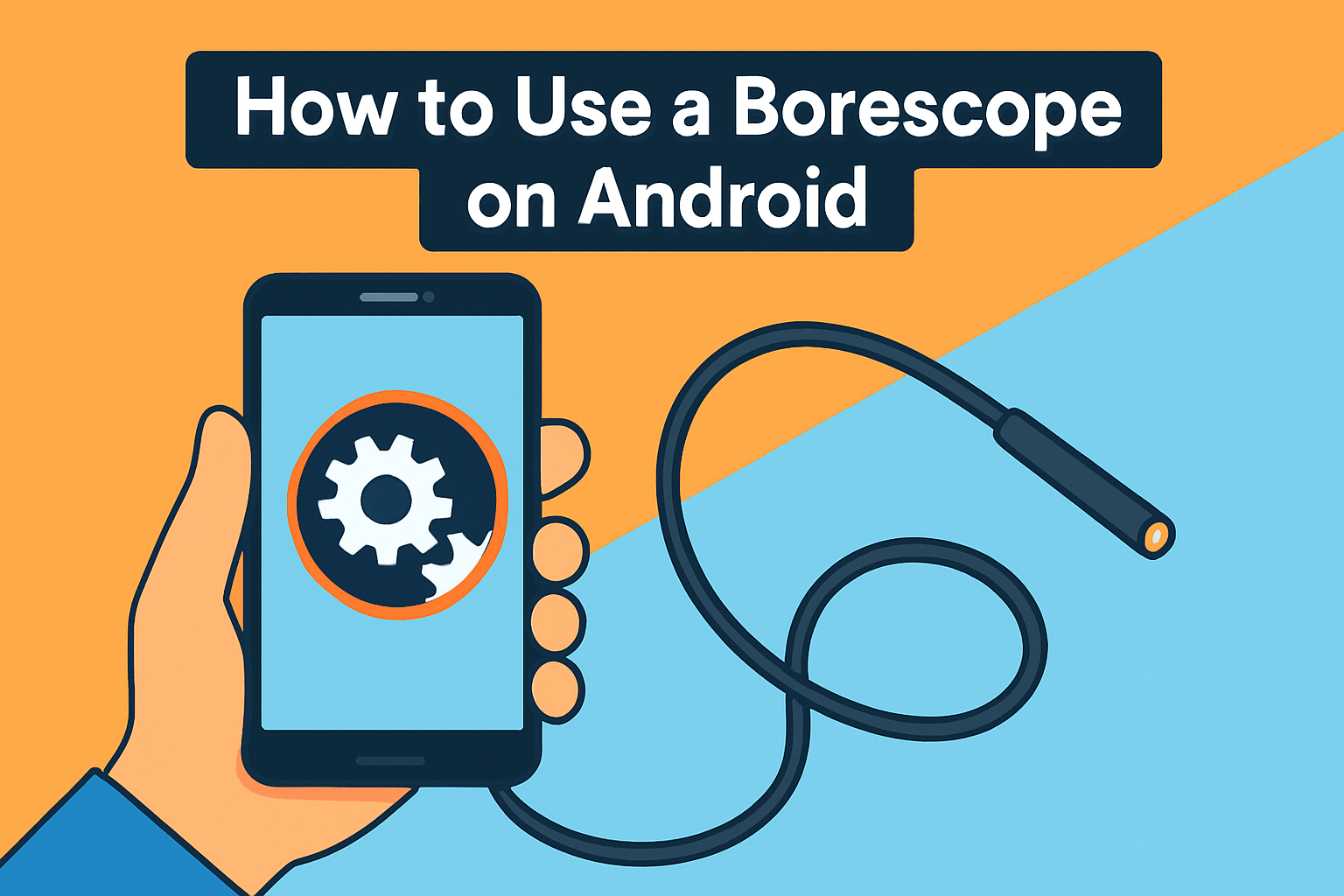
Think of a borescope as a tiny, flexible lens you plug into your Android phone. Connection type matters: USB‑C or micro‑USB with OTG gives plug‑and‑play reliability and minimal lag, while Wi‑Fi lets you roam but can introduce delay and interference. Before you buy, verify OTG support with a checker app or your phone’s specs so you don’t get stuck at setup.
Install a trusted camera app from Google Play—CameraFi, USB Camera, OTG View, Finder Borescope, Smart Endoscope or the maker’s app (for example Depstech‑View). For USB models you’ll usually plug in, grant the app permission, and see the live feed immediately. For wireless scopes enable the probe’s hotspot, connect your phone to that network, then launch the app; avoid sideloaded APKs unless you have no other choice.
Lighting and exposure are where photography instincts pay off. Use the probe’s LED dial to tame glare on shiny surfaces and bring up light in deep cavities, and lock AE/AF or set manual exposure when the app allows so the camera stops hunting. Set white balance to keep colors believable, avoid digital zoom, and capture high‑res stills as your primary record—video is great for context, but photos are often clearer for inspection details.
Move the probe slowly and let semi‑rigid cables hold a line; jerky motion magnifies lag on wireless units. Use the included mirror, hook or magnet for angled views and retrievals, and mount your phone in a clamp or small tripod to keep the display steady. For Wi‑Fi scopes, temporarily disable your home Wi‑Fi to prevent dropouts; if you need real‑time precision, opt for USB.
If the feed doesn’t appear, check connections, restart the app, and confirm OTG is enabled. Keep the camera head clean and dry, carry a power bank if you expect long sessions, and don’t hesitate to try the manufacturer’s app or an alternative camera app—software swaps often fix compatibility quirks.
Benefits of Using a Borescope on Android
A borescope paired with an Android phone dramatically expands how I document tight spaces. The live, high-res display makes focusing and framing intuitive on a familiar touchscreen. It also helps me assess texture, corrosion, and tiny failures without disassembly.
Using the phone as a monitor removes the need for a bulky separate display and speeds the workflow. Pinch-to-zoom, tap-to-capture, and instant playback let you share a diagnostic photo before you leave the job.
Choice of cable changes field performance—flexible cables bend into electronics, semi-rigid shafts hold shape in drains and engine bays. To a photographer it feels like threading a macro lens into a scene you otherwise couldn’t reach.
Many Android borescopes include adjustable LEDs, waterproof heads, and app tools like video recording and measurement overlays. Those features turn a quick peek into verifiable documentation. Combined with simple app controls, these make measurement and reporting straightforward.
Lighting and angle matter more than resolution when you want usable detail; dial LEDs down to avoid blown-out reflections and tilt the head to reveal depth. Capture a few angles and short clips instead of a single still for a fuller record.
Using your Android is cost-effective—no dedicated viewer, and your phone provides storage, editing, and sharing. USB connections usually give a steadier, lag-free feed while wireless models buy mobility when you need it.
Save, tag, and back up images on your phone, then send selective clips to clients or colleagues in seconds. Properly cataloged before-and-after images simplify reporting and reduce repeated trips. A clear naming convention and timestamps save hours when you revisit projects.
A practical tip: confirm OTG support and test your preferred app before you head into the field. Bring a power bank and a few accessories like a magnet or mirror, and your Android borescope becomes an indispensable inspection camera.
What People Ask Most
What is the best borescope for Android?
The best borescope depends on your intended use and the phone you have. Choose a model designed for Android and match features like connection type, cable flexibility, and image clarity to your needs.
How do I connect a borescope to an Android phone?
For USB models plug the borescope into the phone and allow the camera app to access the device. For wireless models connect your phone to the borescope’s Wi‑Fi network and open the compatible app to view the feed.
What apps work with Android borescopes?
Several camera and endoscope apps are commonly used and available on the Google Play Store, including manufacturer apps. Use apps from the Play Store and avoid third‑party APKs unless absolutely necessary.
Are USB borescopes compatible with Android devices?
Many USB borescopes are compatible if your phone supports USB OTG or the appropriate connector. USB connections are often more reliable for real‑time video and typically power the device from the phone.
Can I use a wireless borescope with an Android tablet?
Yes, wireless borescopes can be used with Android tablets by connecting to the borescope’s Wi‑Fi and launching the app. Be aware that wireless setups can introduce lag and may require managing your tablet’s Wi‑Fi connections during setup.
How do I record and save video from a borescope on Android?
Use a compatible camera or endoscope app that offers video recording and grant it permission to save files. Record through the app and save the files directly to your device for easy sharing and documentation.
What camera resolution and features should I look for in a borescope for Android?
Look for a device that provides clear images and has useful features like adjustable LED lighting, a cable that suits your inspection needs, and reliable app support. Prioritize compatibility with your phone and practical features such as accessory tools and stable connectivity.
Conclusion for Best Borescope for Android
We’ve compared a range of Android‑compatible borescopes and walked through connection options, practical pros and cons, and real‑world trade‑offs like resolution, cable type, and app stability to help you choose the right tool for your needs.
When deciding, match the scope’s reach and flexibility to the job, weigh USB plug‑and‑play reliability against wireless convenience, and prioritize app compatibility and user feedback to avoid surprises during inspections.
Before you buy, verify OTG support on your phone, test the companion app where possible, and consider return policies or warranties so you can trial a unit in the field without risk.
Used with a smartphone, a borescope can make inspections faster, more portable, and easier to document, whether you’re working on vehicles, plumbing, HVAC, or electronics.
If you want to sharpen your inspection and troubleshooting skills, explore more of our practical guides and reviews on the site to learn tips, workflows, and best practices for mobile borescope use.
Please leave a comment with your questions or experiences below — we usually reply within a few hours and are happy to help you pick the right setup.


0 Comments