
Which flash will finally unlock your Nikon Z5’s low-light mojo? Whether you’re shooting portraits, weddings, or travel, the right speedlight changes everything.
In this guide we compare five standout flashes compatible with the Z5: a flagship pro model, a mid-range workhorse, a third-party premium option, an affordable TTL unit designed for Z cameras, and a compact budget mini. Each occupies a different sweet spot for power, features, and price.
We’ll walk you through each flash’s real-world strengths and trade-offs. Expect clear notes on compatibility with the Z system, high-speed (FP/HSS) behavior, and wireless options. I’ll highlight when native Nikon integration matters and when radio-based third-party systems win on value.
By the end you’ll know which unit suits long event days, fast-paced portraits, or carry-everywhere travel. There are smart compromises between raw power, reliability, and portability. Read on to find the best flash for your Nikon Z5 and your shooting style.
We tested lights for battery life, recycle speed, bounce and diffusion, and radio vs optical control. Real shoots reveal quirks that spec sheets often hide.
This guide balances hands-on results with practical buying advice for hobbyists and pros alike. Whether you want seamless Z-series integration or the best value from a radio-driven system, you’ll find paths here. Let’s get started.
1. Nikon SB-5000 Flagship Speedlight

Nikon SB-5000 AF Speedlight
Professional radio-controlled flash delivering fast recycle, powerful output, advanced TTL, high-speed sync and durable cooling for reliable performance in demanding shoots.
Check PriceThe Nikon SB-5000 is Nikon’s flagship speedlight aimed at professional and advanced users who need reliable, powerful lighting. It offers radio-controlled Advanced Wireless Lighting (AWL) for flexible off‑camera setups.
Power is solid for a hot‑shoe flash with a Guide Number of 34.5 m (ISO 100, 35mm). The head also has extensive tilt and rotation for easy bounce and shaping of light.
Where the SB‑5000 really shines is durability during long jobs. Internal cooling supports over 100 full‑power consecutive flashes, which keeps output stable and prevents overheating on long event or wedding days.
Integration with Nikon bodies is smooth thanks to full Nikon Z‑series i‑TTL support. That means reliable metering and consistent TTL behavior when you need quick exposure decisions in changing conditions.
In the field this makes the SB‑5000 ideal for event, wedding, and studio photographers who want a workhorse flash. The radio control also reduces line‑of‑sight limits compared with optical systems, which is a huge practical advantage for complex off‑camera setups.
There are tradeoffs to consider. It is the most expensive Nikon speedlight, so price can be a real barrier for beginners or hobbyists. Also, to use the full radio feature set you need compatible commander units or cameras, so budget for extras if you plan advanced wireless setups.
Overall, choose the SB‑5000 if you prioritize power, thermal reliability, and native Nikon integration for demanding shoots. If budget or simplicity is your top concern, it may be overkill.
- Built‑in radio control (AWL)
- Internal cooling prevents overheating
- Strong output — Guide Number 34.5 m (ISO 100, 35mm)
- Full Nikon Z‑series i‑TTL compatibility
- Most expensive Nikon speedlight
- Requires compatible commander units or cameras for full radio function
2. Nikon SB-700 Versatile Speedlight

Nikon SB-700 AF Speedlight
Compact, versatile on-camera unit offering consistent TTL exposure, flexible bounce, tilt/swivel head and dependable performance for event and portrait photography.
Check PriceThe Nikon SB-700 is a mid‑priced, versatile speedlight aimed at enthusiasts and semi‑professionals who want reliable on‑camera and simple off‑camera lighting. It delivers a Guide Number of 28 m (ISO 100, 35mm), which is plenty for portraits, events, and outdoor fill‑flash at moderate distances. The tilt and swivel head makes bounce work easy and effective for flattering light.
In real shoots the SB‑700 feels solid and intuitive. The controls are straightforward and the clear LCD keeps menu navigation painless during a busy wedding or event. Power comes from AA batteries and you can expect roughly ≈2.5 s recycle time on NiMH cells, which is adequate for most portrait and event pacing.
One of the SB‑700’s strengths is native Nikon CLS support — it can act as optical commander or remote slave in Nikon’s system. Optical wireless works well for straightforward multi‑flash setups, but remember it requires line‑of‑sight for reliable firing. If your work demands radio‑based off‑camera TTL or long‑range triggering, this unit doesn’t have built‑in radio control.
All told, the SB‑700 is a practical, cost‑conscious choice for photographers who value a balanced mix of power, ease of use, and bounce versatility. It’s a great upgrade from basic on‑camera strobes and a dependable main or master unit in optical CLS setups — just be mindful of its AA battery design and the optical wireless limitations.
- Guide Number 28 m (ISO 100, 35mm)
- Supports Nikon CLS (commander/slave optical)
- User‑friendly controls with clear LCD
- Tilt/swivel head for flexible bounce
- No built‑in radio wireless — optical only
- Uses AA batteries; ≈2.5s recycle on NiMH
3. Godox V1 TTL Round-Head For Nikon Z

GODOX V1N Round Head TTL Flash for Nikon 2.4G HSS
Circular-head TTL strobe with 2.4G radio, fast HSS, long battery life and soft, natural light ideal for portraits and on-location creativity.
Check PriceI use the Godox V1 on many portrait and wedding shoots because that round head really changes the quality of light. The circular flash creates softer falloff and natural-looking catchlights that flatter skin tones and cut down on harsh specular highlights.
It’s a TTL unit with high-speed sync, so exposure is reliable even when I’m working fast outdoors or mixing ambient light. The built-in 2.4 GHz radio system makes off-camera triggering straightforward with Godox triggers, so I can throw the V1 on a stand and control it without fuss.
The Li‑ion battery is a practical game-changer — fast recycle times and extended shooting mean fewer interruptions during critical moments. Users and I have found its sustained output and battery endurance to be excellent for long events, often rivaling much pricier options.
Build and ergonomics are solid for a third‑party unit, though you can feel it’s not quite the same premium fit-and-finish as top-brand flagships. Also note the menu layout and UI are Godox-centric; Nikon shooters may need a short learning curve to set everything the way they want.
Bottom line: if you want a flattering, natural light quality, reliable TTL/HSS performance, and radio control without breaking the bank, the Godox V1 is a very strong choice. It’s especially appealing for portrait and wedding photographers who prioritize light quality and battery endurance over brand-name polish.
- Round head — soft light & pleasing catchlights
- TTL + HSS support
- Li‑ion battery — fast recycle & long life
- Integrated 2.4 GHz radio wireless
- Build quality less premium than flagships
- Menus/UI less intuitive for Nikon users
4. Viltrox Spark Z3 TTL For Nikon Z

Viltrox Spark Z3-N TTL Flash for Nikon
Compact TTL unit delivering reliable exposures, HSS support, quick recycle and versatile bounce/swivel options for efficient event and portrait shooting.
Check PriceThe Viltrox Spark Z3 TTL is a sensible, camera‑matching flash built with Nikon Z users in mind. It offers TTL and HSS compatibility so you can work confidently in mixed light and fast‑shutter situations.
In practice I’ve found it best suited to beginner and intermediate shooters who want reliable, on‑camera lighting for portraits and events. The unit delivers solid TTL accuracy so your exposures are often usable straight out of the camera.
Viltrox kept the interface simple, which speeds up workflow when you’re moving between handheld and on‑stand setups. Integration with Nikon Z5 menus and controls is reported to be good, and users note reliable wireless triggering with Z cameras.
Performance feels balanced rather than extreme: recycle times are decent and output is consistent, which matters more in the real world than peak GN numbers. It’s also an affordable option, so you get TTL/HSS functionality without a big investment.
If you need a lightweight, easy‑to‑use TTL flash for portraits, events, or as a dependable on‑camera unit, the Spark Z3 is a very good choice. Keep in mind it’s not aimed at high‑power studio replacement use, and long‑term durability isn’t as proven as some established brands. For many photographers, though, the Spark Z3 hits the right mix of features, usability, and price.
- Affordable with competent TTL and HSS support
- Simple operation for entry‑level users
- Good recycle time and consistent output
- Compatible and well‑integrated with Nikon Z5 menus/controls
- Less powerful output than premium models
- Build quality/longevity less proven vs established brands
5. Zeniko ZF08 Mini Flash Budget Option
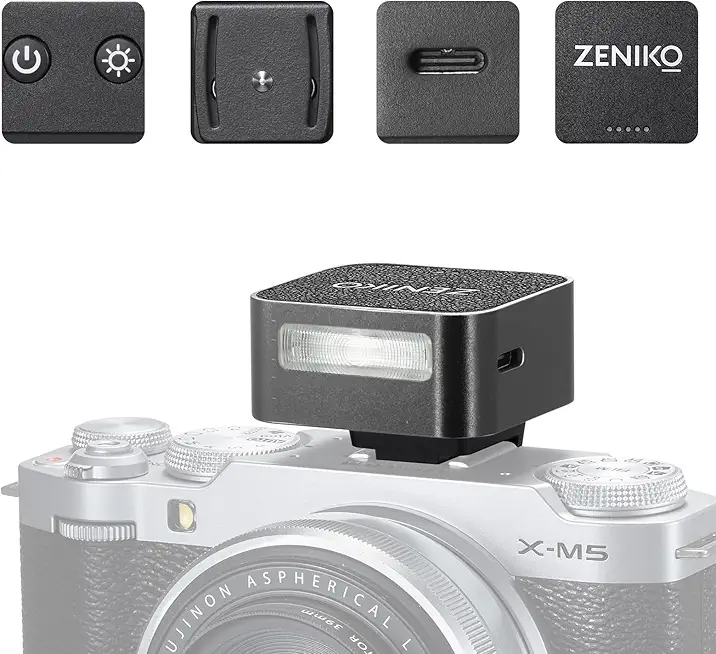
Zeniko ZF08 Mini Flash Speedlite for Canon/Fuji/Sony/Nikon/Panasonic/Olympus/Pentax
Ultra-compact universal speedlite offering broad brand compatibility, lightweight portability, bounce-capable head and reliable fill light for travel and everyday photography.
Check PriceThe Zeniko ZF08 Mini is a compact, budget‑friendly speedlight that works with the Nikon Z5. As a working photographer I appreciate how small and lightweight it is for grab‑and‑go shoots and travel.
It’s best used for indoor portraits, casual events, and creative lighting experiments where you’re close to your subject. The flash’s power is sufficient for small rooms and close range, but it’s limited for large bounce lighting or outdoor fill.
Controls are refreshingly simple, making setup quick even for beginners. The unit offers adjustable power from full to 1/16th with visible recycle indicators, so you can see when it’s ready and dial in exposure without fiddling through menus.
At lower power settings the ZF08 delivers fast recycle times, which is handy for walk‑around portrait work or kids’ parties. Its affordability and compact size are obvious pluses, though you should expect some shadowing and minor light spill near lens edges in tighter setups.
If you need an easy, portable on‑camera flash for everyday use, this is a solid budget pick. It’s not a replacement for a powerful bounce head or a radio‑controlled system, but it’s great for beginners, travel shooters, and anyone who prioritizes size and simplicity over raw output.
Keep in mind there’s no wireless support; it’s hot‑shoe on‑camera use only, so plan your setups accordingly.
- Extremely compact and lightweight
- Adjustable power from full to 1/16th with visible recycle indicators
- Fast recycle at lower power settings
- Simple interface for beginners
- Limited flash power
- No wireless support; hot‑shoe on‑camera use only
Third-Party Flash Compatibility Issues
Third‑party flashes can be a great way to get powerful, affordable light, but they demand a little more planning with the Z5. Nikon uses a proprietary flash protocol, so many non‑Nikon units won’t appear in the camera’s flash control menu and won’t behave like a native Speedlight. You’ll often need to set mode, power and zoom directly on the flash head.
One key limitation is wireless control. The Z5 doesn’t have a full optical commander built into the body, and third‑party flashes generally can’t act as masters in Nikon’s CLS system. If you want off‑camera TTL/HSS without a Nikon master, use a radio system like Godox or Yongnuo — a transmitter on the camera and receivers on the flashes will give reliable TTL and HSS over 2.4 GHz.
Firmware mismatch is a real-world headache. Nikon firmware updates have, at times, changed communication details and broken compatibility with third‑party units. Always test a new camera or flash firmware weeks before a paid job, and keep spare triggers or a Nikon speedlight as a fallback.
In practice, I treat third‑party systems like a professional kit: update transmitter and flash firmware together, label channels/groups, and carry a small cheat sheet for manual conversion tables. On critical shoots I pre‑set manual powers for key lights so I can ditch TTL if it hiccups.
High‑speed sync works with many third‑party systems when used through compatible radio triggers, but expect reduced range and output. For outdoor portraits or when you need wide apertures, plan for closer placement or higher ISO to compensate for FP/HSS power loss.
If you want seamless, out‑of‑the‑box integration and camera menu control, stick with Nikon speedlights. If you need flexibility and budget savings, a well‑configured radio third‑party system (Godox being the most proven) will serve you well — just test thoroughly and bring backups.
High-Speed Sync (FP) Support
High‑Speed Sync (FP) lets you use flash at shutter speeds faster than the Z5’s normal sync (the Z5 sits around 1/200s). It’s the trick you reach for when you want a wide aperture in bright light or need to freeze fast action while still using fill flash.
The Z5 will support FP with compatible Nikon speedlights — think SB‑5000, SB‑700, SB‑600, SB‑500, SB‑300, SB‑400 and SB‑R200. On Nikon units FP is turned on in the flash menu, and the camera typically switches into FP mode automatically when it detects a compatible flash and you push past the sync limit.
For third‑party lights you usually need a radio transmitter/receiver to get FP working reliably. Systems like Godox (with XPro transmitters) or Yongnuo’s YN‑E3‑RT can provide TTL and HSS/FP off‑camera, but expect occasional quirks and watch for firmware updates that affect compatibility.
Be practical about what FP costs: it eats effective power and range, so your flash will reach less far and batteries drain faster. Compensate by placing lights closer, increasing ISO slightly, or using Li‑ion packs for faster recycle. For wide‑open outdoor portraits an ND filter can be an alternative if you want to keep full flash output at lower shutter speeds.
In the field I test FP setups before the shoot and bring spare batteries. Use FP when you need subject separation or to freeze movement with fill light; for long‑range or critical power needs, native Nikon speedlights tend to be the most consistent choice.
What People Ask Most
What is the best flash for Nikon Z5?
There is no single best flash for every user; the right choice depends on priorities like native camera integration, wireless control, power, and budget. Choose a Nikon speedlight for the smoothest integration or a radio‑based third‑party system for cost and flexibility.
Is the Nikon SB-5000 compatible with the Nikon Z5?
Yes, the SB-5000 is compatible with the Z5 and supports the camera’s advanced flash features. It works well for users who need reliable power and full integration.
Can I use third-party speedlights with the Nikon Z5?
Yes, third‑party speedlights can be used with the Z5 but they may have limited integration with the camera’s flash menus and features. Many photographers use radio transmitters or native third‑party radio systems to get reliable off‑camera TTL and HSS functionality.
Does the Nikon Z5 support TTL flash?
Yes, the Z5 supports TTL flash with compatible speedlights and radio systems that implement the camera’s TTL protocol. Functionality may vary depending on whether the flash is a native Nikon unit or a third‑party model using external triggers.
How do I set up an external flash on the Nikon Z5?
Mount the flash on the hot shoe or connect it via a compatible radio transmitter, then set the flash mode to TTL or manual on the unit. Confirm communication with the camera and make small test adjustments to flash power and position for the desired look.
Does the Nikon Z5 support wireless off-camera flash?
The Z5 can use wireless off‑camera flash but it does not have a built‑in optical commander mode, so you will need a compatible master speedlight or radio trigger system. Radio-based systems are a reliable option for off‑camera TTL and high‑speed sync.
What flash settings work best for portrait photography with the Nikon Z5?
Use TTL for quick, adaptive exposure or manual power for consistent results once you find a look you like. Soften the light by bouncing or using modifiers and balance flash with ambient exposure for a natural portrait effect.
Conclusion For Best Nikon Z5 Flash
This guide pulls together practical comparisons so you can match a flash to your Nikon Z5 workflow — weighing native integration, wireless options, FP/HSS support, power versus portability, and budget.
Whether you prioritize full Nikon compatibility, robust radio systems from third parties, or a tiny budget-friendly unit, the right choice comes down to how and where you shoot rather than a single “best” model.
Use the decision points we highlighted to test candidates in your own setup — try bounce, off‑camera triggering, and high‑speed scenarios to confirm real‑world fit before committing.
If you want to sharpen your lighting and flash technique, explore more of the site’s practical guides and gear explanations to build confidence and speed in your workflow.
Have questions about a specific setup or experience to share? Leave a comment below — we usually reply within a few hours and are happy to help troubleshoot or recommend next steps.




0 Comments