

What if one lens could change the way your camera tells a story? This guide distills a curated set of category picks—prime, wide‑angle, all‑in‑one zoom, telephoto, and macro—into practical recommendations for artists who shoot with any camera system. Whether you favor a shallow prime for portraits, a cavernous wide‑angle for landscapes, an all‑in‑one zoom for run‑and‑gun creativity, a telephoto for compressed perspective, or a macro for micro textures, each category is chosen to match artistic use and optical priorities like sharpness, bokeh, distortion control, and flare.
I’ll walk you through the real tradeoffs photographers face: peak sharpness versus edge consistency, blazing autofocus versus manual precision, the value of stabilization for handheld or macro work, and build quality versus packability. You’ll learn practical buying criteria—what matters for sharpness, AF, stabilization, build and weight, and mount compatibility—as well as which compromises make sense for portraiture, environmental art, studio setups, and fieldwork. Plus, expect hands‑on tips for pairing lenses with mirrorless and DSLR bodies, when to prefer native mounts, and how to balance optical priorities with real‑world handling so your camera and glass feel like an extension of your creative intent.
Best Prime Lens SIGMA 85mm F1.4

Sigma 85mm F1.4 DG DN (Sony E)
Creamy bokeh and razor-sharp portrait performance; fast wide aperture for low-light shooting and exquisite subject separation.
Check PriceI’ve used the SIGMA 85mm F1.4 DG DN on Sony E bodies for portraits, editorial work and small-studio shoots and it consistently delivers a look that’s hard to beat for art photography. The combination of 85mm focal length and a wide f/1.4 aperture gives you immediate subject separation and a creamy bokeh that flatters skin and textures without distracting edges.
Sharpness is remarkable — the center is exceptional wide open and the corners are surprisingly strong for an f/1.4 design, so you get usable detail across the frame even when you’re composing tightly. Chromatic aberration and flare are well controlled, which means less time in post and more reliable results when shooting into window light or subdued backlight.
Autofocus driven by HSM (silent, fast) is reliable on Sony bodies, including eye/face detection; I’ve tracked moving subjects and locked onto eyes with confidence in real-world shoots. The lens is weather sealed, so it stays in play during damp outdoor sessions without worrying about moisture or dust.
There are practical tradeoffs: it’s heavier than typical primes at ~625g, so expect some wrist fatigue during long handheld days. Also there is no optical stabilization, so slower shutter speeds demand a steady hand, higher ISO, or a tripod for tack-sharp results.
Close-focusing isn’t the lens’s strength — minimum focus is ~85cm with max magnification ~0.12x — so it’s not a substitute for a short‑work‑distance portrait macro, but it’s perfect for headshots and three-quarter compositions. The 82mm filter thread is convenient for filters and creative gels.
- Outstanding image quality for portraits and fine art
- Reliable, quick autofocus suitable for dynamic shooting
- Robust build with dust and moisture sealing
- Excellent subject isolation with very shallow DOF
- Heavier than typical primes in this range
- No optical stabilization (requires steady hand/tripod at slow shutter speeds)
Best Wide-Angle Lens SIGMA 14-24mm F2.8

Sigma 14-24mm F2.8 DG DN Art (Sony E)
Ultra-wide zoom delivering edge-to-edge sharpness, constant bright aperture for dramatic landscapes, architecture, and low-light or night-sky photography.
Check PriceI’ve been shooting the Sigma 213965 14-24mm F2.8 DG DN Art on Sony E bodies in all kinds of light and the first thing you notice is the build — it feels solid and weather sealed, yet manageable in the field despite the weight (~795g). The constant f/2.8 aperture gives real control in low light and lets you hold a consistent exposure and depth of field as you reframe between 14–24mm.
Autofocus is impressive in real use: the HSM with stepping motor (fast/quiet) locks quickly even on moving subjects and feels reliable for run-and-gun landscape or environmental portrait work. I’ve used it handheld at dusk and the AF kept up with changing scenes without hunting.
Optically the lens delivers what the spec sheet promises — excellent edge-to-edge sharpness and low distortion across the frame, with consistent color and contrast that reduces time in post. Flare control is good too; wide-open at f/2.8 you still get usable corner detail and clean micro-contrast, which matters for architectural lines and expansive skies.
Practicalities matter: there’s no front filter ring so you’ll work with rear gel filters or a specialized filter holder when you need grads or NDs. Minimum focus is about ~28cm so you can get creative close foregrounds for dramatic wide-angle compositions, though magnification remains low.
Downsides in daily shooting are clear — no stabilization means a tripod for long exposures and the lens is larger than prime wide‑angles, so carry choices matter. Still, if you want an ultra-wide that rivals primes optically on a Sony E mount, this Sigma is hard to beat for landscapes and environmental art.
- Versatile ultra‑wide zoom for landscape and environmental art
- High‑quality optics rival many primes
- Fast, accurate AF for dynamic scenes
- Weather sealed for rugged outdoor use
- No front filter ring limits use of screw‑on filters
- Larger and heavier than prime wide‑angles
Best All-in-One Zoom SIGMA 17-70mm F2.8-4

Sigma 17-70mm F2.8-4 Contemporary DC Macro OS HSM (Sony)
Versatile standard zoom with close-focusing macro capabilities, optical stabilization, and compact design for everyday shooting and travel.
Check PriceOn Sony APS‑C bodies the Sigma 17‑70mm F2.8‑4 Contemporary feels like a do‑everything lens that actually delivers. The 17–70mm range (≈25–105mm equiv) covers wide environmental shots to short portrait reach without swapping glass.
Optically the center sharpness is impressive for a zoom in this class, especially around f/4–f/8, which is where I shoot it most. Corners are fine at shorter focal lengths but start to soften toward 70mm, so I avoid pixel-peeping crops at the long end.
The f/2.8–4 aperture is useful: f/2.8 at the wide end gives usable subject separation and low‑light headroom on Sony bodies. At the tele end the slower f/4 limit means you’ll rely on the ~4‑stop Optical Stabilizer or higher ISO indoors.
The built‑in OS (~4 stops) is a real-world benefit for handheld low‑light and for handheld closeups at the 1:2 macro range. Speaking of macro, the 22cm minimum focus and 1:2 (0.5x) magnification are surprisingly capable for texture work and small still‑life setups.
Autofocus driven by HSM is quick and quiet on my Sony mirrorless via a reliable adapter; subject tracking held up in everyday shooting. The lens is also reasonably compact at ~525g, making it an easy walkaround companion.
Build is good for casual fieldwork: partial dust/splash resistance gives confidence in mixed weather but don’t expect pro sealing. Filter thread is 72mm, so you can add filters without hassle.
In short, it’s a versatile, well‑rounded lens for artists who need flexibility and solid center sharpness, plus useful macro chops. If you prioritize corner resolution at 70mm or extreme low‑light teleperformance, you’ll feel the limits.
- Highly versatile focal range for varied artistic composition
- Fast aperture in wide–mid range useful in many lighting conditions
- Stabilization supports handheld creative shooting (~4 stops)
- Compact and lightweight relative to similar all‑in‑one zooms (~525g)
- Corner softness at longest focal lengths
- Slower aperture at telephoto end reduces low‑light ability
Best Telephoto Lens Canon RF 70-200mm F2.8
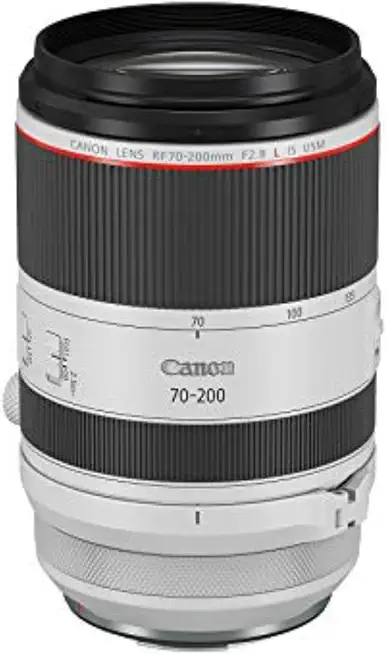
Canon RF 70-200mm F2.8L IS USM
Professional telephoto delivering consistent bright aperture, rock-solid image stabilization, fast autofocus, and rugged weather-sealed construction for sports, events, and portraits.
Check PriceShooting with the Canon RF 70-200mm f/2.8L IS USM feels like bringing a small studio into the field. On my R-series bodies the lens renders subjects with consistent sharpness wide-open and a pleasingly smooth bokeh that helps isolate details without harsh edges.
The f/2.8 constant aperture gives reliable exposure and subject separation across the zoom range, and the ~5 stops of IS makes handheld telephoto work genuinely practical in low light. I’ve pulled off tight portraits and compressed landscapes at 200mm with surprising stability given the lens’ size.
Autofocus via the ring USM is fast and silent, which really helps for candid portraiture and quiet art installations where disturbance matters. Subject and eye detection on modern Canon bodies feel confident—focus locks quickly and stays put even when recomposing.
Build quality is professional; the weather sealing held up through wind and light drizzle during a long outdoor shoot. The weight (~1070g) and size demand respect—expect to use a strap or monopod for extended sessions to avoid fatigue.
Working distance and reproduction are practical but not macro—minimum focus is 70cm with a max magnification of 0.23x, so close-ups have good detail but won’t replace a dedicated macro. The 77mm filter thread is convenient for polarizers and ND filters when shooting landscapes or long exposures.
Optically the lens controls CA and flare well, with low distortion across the range, which saves time in post and preserves fine tonal gradations for art prints. If you need fast, reliable telephoto performance with professional handling, this is a lens I’d recommend testing in person.
- Professional build and weather sealing for demanding use
- Powerful IS for sharp handheld telephoto shots (~5 stops)
- Excellent for perspective compression in art photography
- Fast AF with strong subject/eye detection performance (Ring USM)
- Heavy and relatively large, limiting portability (~1070g)
- Size and weight can be tiring for long handheld use
Best Macro Lens Nikon 105mm F2.8

Nikon AF-S VR Micro-NIKKOR 105mm F2.8G IF-ED
True macro performance with 1:1 reproduction, vibration reduction, exceptional sharpness, and flattering telephoto reach for close-up detail and portraits.
Check PriceMounting the Nikon AF-S VR Micro-NIKKOR 105mm F2.8G IF-ED on a Nikon F body feels balanced and purposeful. At 105mm and f/2.8 it gives a comfortable working distance and true macro capability — 31cm / 1:1 (true macro) — so you can capture texture and detail without disturbing the subject.
Optically it delivers what the specs promise: high resolution and contrast at macro distances with excellent edge-to-edge sharpness. Chromatic aberration and distortion are minimal, and the background falloff is rendered with very smooth bokeh that isolates subjects beautifully.
The VR (~3–4 stops) is genuinely useful for handheld close-up work; it buys you slower shutter speeds and fewer ruined frames when you’re shooting live subjects. That said, at high magnifications I still reach for a tripod or focus stacking for ultimate micro-detail and repeatable framing.
Autofocus via the Silent Wave Motor (SWM) is quick and quiet, which matters when working with insects or skittish plants. The lens is native to Nikon F DSLRs and works reliably on Z bodies via the FTZ adapter, though the adapter does add slight bulk.
At ~600g the lens is compact and comfortable for extended field sessions, and the 62mm filter thread makes using polarizers or diffusers straightforward. Weather sealing gives confidence in outdoor shoots and mixed conditions.
Limitations are few but practical: the fixed f/2.8 aperture is narrow compared with some modern optics, so low-light macro hand‑holding without VR can be challenging. The design dates to the Early 2010s, but the performance keeps it highly relevant.
- True 1:1 macro magnification for fine detail capture
- Compact and comfortable for extended use
- VR (~3–4 stops) enables handheld macro shooting
- Fast, silent autofocus suitable for elusive subjects (SWM)
- Requires adapter for Nikon Z mirrorless, adding slight bulk
- Narrow aperture limits low-light macro hand-holding without stabilization
Lens Pairing And Buying Tips
Start by writing down what you shoot most with this camera. Portraits, landscapes, tabletop still life and tiny macro work all demand different focal lengths and apertures. That list becomes your buying map; prioritize the lenses that cover your core projects first, then add specialty glass as budget allows.
Optical performance matters, but so does real-world behavior. Look for lenses that deliver consistent sharpness across apertures you actually use. Don’t chase the single best lab score—choose glass that gives predictable results at the working distances and apertures you prefer.
Autofocus is more than speed. You want accuracy and quiet operation for art work. Test AF in low light and on contrasted edges. If your camera supports custom AF personalities, learn to tune settings for single-subject still life differently than for moving subjects.
Stabilization strategy should match your shooting style. If your camera has in-body stabilization use that to your advantage and treat lens IS as additive. When handholding at slow shutter speeds, combine both when available. For macro and long-exposure creative work, a solid tripod and a remote release remain indispensable.
Aperture choice is artistic control. Wide apertures give creamy subject separation but can hide compositional mistakes. For critically sharp detail, stop down into the lens’s “sweet spot” by one or two stops. For intimate, painterly images, embrace the narrow plane of focus but brace for increased variability in hit rate.
Think about size and weight like a workflow decision. Heavy pro glass produces great results, but it also changes how and where you shoot. If you travel light, prioritize compact lenses with good coatings and mechanical build. If you work in a studio, heft is less of a concern.
Mount and adaptability are practical choices. Prefer native-mount glass for the smoothest AF and exposure behavior. If you must adapt, verify that autofocus, aperture control and stabilization work reliably on your camera body before committing. Test adapters with your actual shooting scenarios.
Filters and front-element access matter for landscapes and long exposures. Determine whether the lenses you choose accept screw-on filters or require rear gels. Carry polarizers and ND filters sized to your most-used lens to avoid constant re-buying and to speed setup in the field.
Buy smart: rent before you buy when possible. If purchasing used, inspect for fungus, oil on the aperture blades and smooth mechanical operation. Bring the camera body and test focus across a range of apertures and distances to check for decentering or AF inconsistencies.
Refine technique to get the most from your gear. Use back-button focus for precise control, bracket focus for shallow-DOF work, and focus stacking for macro or ultra-detailed still life. When handheld, maintain shutter speeds at least equal to the effective focal length and employ IS when available.
Maintain lenses like tools. Keep front/rear elements clean, change caps and hoods in the bag, and store in a dry place to prevent fungus. Make a quick checklist for shoots—camera, lenses, filters, tripod, remote, batteries—and run it before leaving. Small habits protect image quality and save time during the shoot.
Frequently Asked Questions
What are the best lenses for portrait art photography?
Primes like the SIGMA 85mm F1.4 DG DN Art are excellent for portraits due to exceptional image quality, creamy bokeh, and strong subject isolation. Telephoto options such as the Canon RF 70‑200mm f/2.8L IS USM offer pleasing compression and smooth background rendering for a different portrait look.
How do prime and zoom lenses compare for art photography?
Primes generally emphasize optical quality, wider apertures, and stronger subject separation, making them great for controlled portrait and fine art work. Zooms provide focal flexibility and convenience for varied compositions, so the choice depends on whether you prioritize ultimate image quality or versatility.
How can I use a macro lens for fine art photography?
True 1:1 macro lenses are ideal for capturing extreme detail and texture, letting you create intimate, abstract compositions from small subjects. Use stabilization and the lens’s working distance to manage handheld or delicate-subject shooting, and combine sharp macro detail with shallow depth of field for a fine‑art look.
Should I choose native mount lenses or use adapters?
Choosing native mount lenses is usually the safest option for reliable autofocus and full performance. Adapters are useful when necessary, but only if AF and optical performance remain dependable with your camera system.
How important is optical stabilization for art photography?
Stabilization is valuable for handheld low‑light and macro work because it helps keep images sharp when a tripod isn’t practical. When you can use a tripod or shoot with fast apertures and short shutter speeds, stabilization becomes less critical.
How do I pick focal length and aperture for my artistic goals?
Select focal length based on whether you want subject isolation or environmental context, as longer lenses compress and isolate while wider angles include more surroundings. Choose aperture to control depth of field and bokeh, balancing aesthetic intent with sharpness and available light.
Conclusion And Final Recommendations
This guide condensed the practical strengths of primes, wide‑angle lenses, all‑in‑one zooms, telephoto glass and macro optics so you can match each category to common artistic goals like subject isolation, environmental storytelling, versatility, perspective compression, and fine‑detail capture.
When choosing, prioritize core criteria—optical performance, autofocus behavior, stabilization, build quality, weight and mount compatibility—because those factors determine real‑world results more than spec sheets alone.
Match your final choice to the subjects, shooting conditions and workflow you use most often; favor a native‑mount option for the cleanest performance and only rely on adapters when AF and image quality remain reliable for your needs.
If you want to keep improving your craft, explore more of the practical buying tips and field‑tested technique pieces on the site to build confidence with new glass.
Enjoy your new lens and the creative possibilities it brings—there’s nothing like that first roll of frames to inspire new ideas.
Have a question or want advice on a specific setup? Leave a comment below and we usually reply within a few hours.




0 Comments