
What if you could carry studio-grade light in your camera bag?
Which portable strobe gives you the best mix of power, runtime, and portability?
This roundup examines five portable strobes covering budget to professional needs.
We tested for real-world use rather than just specs.
Each selection balances cost against real shooting demands.
Our focus was on battery life, recycle time, user feedback, and practical pros and cons.
These factors decide whether a light thrives on location.
We weigh specs against what actually matters on set.
We paid attention to ergonomics, wireless reliability, and how quick swaps and spare batteries affect workflow.
We also watched for color consistency and modeling lamp usefulness in the field.
Hands-on ergonomics often trump theoretical power numbers.
Expect hands-on insights and candid notes from photographers who used these units in portraits, events, and outdoor sessions.
No marketing fluff—just what matters when you are under time pressure and changing light.
Expect candid pros and cons to help decide quickly.
Want a strobe that travels well and lasts through a shoot?
This guide will narrow the choices.
Read on for clear, practical recommendations and trade-offs to match your shooting needs.
1. Neewer Q4 Outdoor Strobe Light

Neewer Q4 400Ws TTL battery monolight Bowens mount
Portable, high-output studio strobe with rapid recycling and consistent color for on-location portrait and event photography.
Check PriceAs a location shooter I reach for lights that won’t weigh me down, and the Neewer Q4 is an obvious choice for quick outdoor sessions. It’s compact and surprisingly light at around 4.4 lb with the battery, so it cuts fatigue during multi-location work and fits easily in a day bag.
The Q4’s strengths are practical: it supports TTL, Manual and Multi modes and is compatible with Canon E-TTL II, Nikon i-TTL and Sony TTL — great when you switch camera bodies or work with other shooters. The replaceable 2800mAh lithium battery delivers roughly 400 full-power flashes and can be swapped on the go, which keeps long sessions moving without hunting for AC power.
Light quality and control are usable: flash duration ranges from 1/209s to 1/10,989s and color temperature sits around 5600 ± 200 K, so colors stay consistent across shots. The built-in 2.4G Q wireless system is convenient for simple setups and quick group control when you don’t need long-range triggering.
There are a couple of practical caveats. The Q4’s rectangular, award-winning shape is distinctive but takes some handling adjustment, and the buttons feel basic compared with more premium units. Also, if you rely on long-range or multi-group wireless triggering for complex setups, the Q4’s wireless range is noted as less robust than some competitors.
- Replaceable 2800mAh battery — ~400 full-power flashes
- Lightweight (~4.4 lb with battery)
- Cross-brand TTL (Canon E-TTL II, Nikon i-TTL, Sony TTL)
- Award-winning, compact design
- Basic control interface/buttons
- Wireless trigger range less robust than some competitors
2. Neewer Q300 300Ws Outdoor Strobe Light

Neewer Q300 300Ws battery monolight with wireless trigger
Compact, portable strobe delivering reliable power with integrated wireless control for seamless remote firing outdoors and on shoots.
Check PriceThe Neewer Q300 300Ws Outdoor Strobe Light delivers a surprising amount of power for its class, offering 300Ws with power adjustable from 1/64 to full. It’s the sort of headroom that makes outdoor portrait and event work straightforward, even in bright conditions. The 13W modeling lamp at 3050K produces 5010 lux at 0.5m, which helps with framing and focus before you fire the main light.
Battery life is a standout feature. The built-in 7800mAh battery yields roughly 1000 full-power flashes, and the unit includes robust battery management for extended sessions. For location work that can be a real workflow win — fewer battery swaps and less downtime.
Physically the Q300 weighs around 4.85 lbs and uses a Bowens mount, so you have wide compatibility with softboxes, reflectors, and other modifiers. It’s well balanced and the adjustable handle helps when you need to tweak angles quickly on a stand or hand-hold the unit for short periods.
Recycle times span roughly 0.4 to 2.5 seconds depending on power, which is adequate for most portraits and event moments. Built-in heat and overvoltage protection add reliability during long shoots or when you push the unit hard. Many photographers report a stable, consistent output, which is important for keeping color and exposure predictable.
If you prioritize a portable strobe with solid output, long battery life, and modifier flexibility, the Q300 is a strong candidate. If you need ultra-light travel kit or lightning-fast burst shooting at full power, be aware of its size and recycle limits. Overall it’s a practical, powerful tool for on-location photographers who value reliability and light quality.
- 300Ws output, power from 1/64 to full
- 7800mAh battery — ~1000 full-power flashes
- 13W modeling lamp, 5010 lux at 0.5m
- Standard Bowens mount for modifiers
- Larger and heavier than some portable strobes
- Recycle can be slow at high power
3. Godox AD600Pro Witstro Portable Flash

Godox AD600Pro II 600Ws TTL battery monolight Bowens mount
High-performance off-camera strobe offering professional power, quick recycling, and accurate color for demanding studio and location work.
Check PriceThe Godox AD600Pro Witstro is a workhorse that strikes a smart balance between studio-level power and on-location portability. It delivers 600Ws of output and supports TTL, Manual, and HSS, so you can push light hard or let the camera help dial exposure. The unit’s bright modeling lamp and excellent color consistency make it straightforward to see how your modifiers will render the light.
Battery life is practical for location work. You get roughly 480 full‑power flashes from its swappable pack, so swapping batteries is an easy way to keep a shoot rolling. Recycling is impressively fast — about 0.01 to 0.9 seconds depending on power — which helps when you’re capturing movement or running through quick sequences.
The built-in Wireless X system is reliable and long‑range, with multi‑group support that makes complex setups simple to manage. The body feels robust and professional, so it stands up to frequent travel and heavier use. There’s a small learning curve to mastering all the features, but the UI is generally well designed once you spend a little time with it.
In short, the AD600Pro is an excellent choice if you need substantial power without lugging a full studio pack. It’s especially good for portrait, event, and location work where consistent color, fast recycle, and dependable wireless control matter. Beginners might find the feature set abundant, but for most working photographers this unit represents very strong value for its capabilities.
- 600Ws power with TTL and HSS
- Fast recycle times (≈ 0.01–0.9 s)
- Reliable long-range Wireless X system
- Professional build quality
- Heavier than lower-power compact units (≈ 6.6 lbs)
- Many features may overwhelm beginners
4. Profoto B10X Portable Strobe

Profoto B10X
Ultra-compact, daylight-balanced strobe designed for studio-quality lighting in a portable, rugged package with intuitive controls.
Check PriceI’ve used the Profoto B10X on location shoots where I needed clean, flattering light without lugging a full generator kit. Its roughly 250Ws output gives you enough punch for portraits and small group work while staying pleasantly compact.
The unit supports TTL and HSS, so it slots into a fast-paced mixed lighting workflow with ease. The modeling lamp is bright and adjustable, and the B10X delivers excellent light quality and color rendering that makes skin tones sing.
Battery performance is solid for on-location days — expect about 450 full-power flashes per charge with quick recycling between shots. In practice that means a day of moderate shooting without hunting for sockets, though heavy high-power work will chew through charges faster.
Controls are intuitive, which is a small but meaningful time-saver when you’re juggling modifiers and assistants. The wireless system is reliable for most setups, but note it has a shorter effective range through walls compared to systems like Godox.
Build quality and the smooth, consistent output are where the B10X shines; portraits look polished straight out of camera. It does trade the absolute highest max brightness for portability, so if you need peak power for huge modifiers or very bright sun, it’s a slight limitation.
Users also flag the price premium, but many justify it for firmware upgrades and the long-term support Profoto provides. If you value color fidelity, simple operation, and a compact footprint, the B10X is hard to beat.
- Exceptional light quality and color rendering
- User-friendly controls and bright modeling lamp
- Compact and easy to carry
- Reliable battery — about 450 full-power flashes
- Higher cost/premium price
- Wireless range shorter through walls vs Godox
5. LimoStudio 200W Strobe Monolight
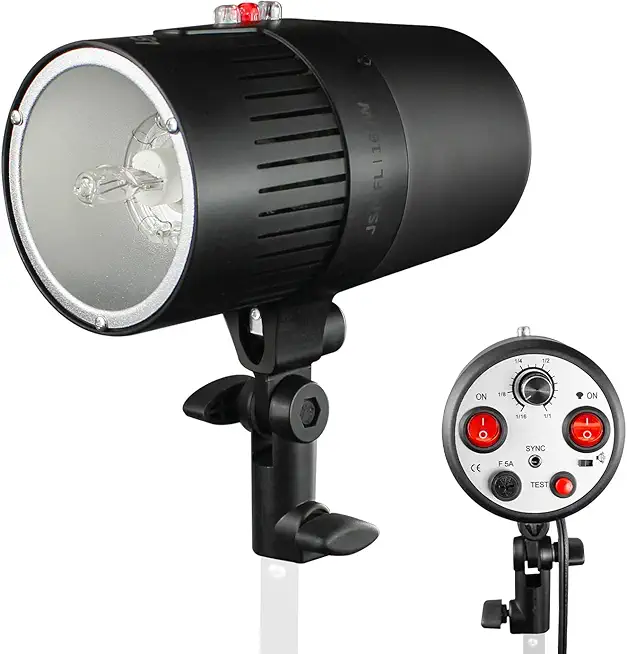
LimoStudio 160W monolight AGG1756
Affordable continuous and flash lighting solution ideal for beginners, offering steady output and easy setup for home studios.
Check PriceThe LimoStudio 200W Strobe Monolight is a straightforward 200W unit built for budget-conscious photographers and beginners. Its adjustable power and recycle time of roughly 0.2 to 1.5 seconds give you usable performance for portraits, product shots, and small studio work. LEDs indicate power levels, and a test button makes quick pre-shot checks simple.
In practice the light is very easy to set up and operate, which is great when you’re teaching clients or running quick sessions. The adjustable shooting angle helps shape the light without swapping modifiers mid-shoot, so you can dial in main or fill roles fast. For indoor and tabletop work the 200W output is typically sufficient and the lightweight design makes it easy to reposition between setups.
Where it falls short is in field durability and raw punch. The body is plastic, so it doesn’t inspire the same confidence as metal-bodied prosumer units when moved around constantly. And at 200W it won’t overpower bright daylight or fill large groups, so you’ll want something stronger for outdoor or high-demand scenarios.
If you need an affordable, portable strobe to learn with or to run small portrait and product sessions, this is a solid option. It’s not meant to replace professional outdoor packs, but for the money you get usable control, quick recycling, and a tool that helps you learn lighting fundamentals without breaking the bank.
- Great value for beginners
- Simple controls with LED power indicators
- Adjustable angle and quick ~0.2–1.5s recycle
- Lightweight and portable
- Limited 200W power for large/outdoor shoots
- Plastic body feels less durable
Battery Life Considerations for Portable Strobes
Battery life is one of the first things I check before any location shoot. Without reliable power, even great strobes become a liability.
You’ll find wide variation in real use. Compact heads often deliver ~200–400 full‑power flashes, mid‑range units sit around ~400–750, and big‑battery models can reach ~1,000 or more; for reference, the Neewer Q4 is about ~400, Q300 ~1,000, Godox AD600Pro ~480 and Profoto B10X ~450, while older B1/B1X examples top out near ~325.
Keep in mind that those numbers assume full‑power pops. Run strobes at lower settings and you can easily reach thousands of flashes from a single charge. Conversely, frequent full‑power bursts will eat through capacity fast.
Most portable strobes use lithium‑ion packs and recharge in roughly 1–3 hours. That makes recharge planning important when you’ve got gaps between sessions or limited access to power.
Swappable batteries and a clear battery indicator are worth their weight in gold. I always carry at least one spare swappable pack and prefer units that accept external battery options for long days.
Also remember modeling lamps and heavy wireless use draw power and can slow recycle times. Test your setup at the actual power levels and modes you’ll shoot in so you know how many usable flashes and how much recycle performance to expect.
Match battery capacity to your shooting style. For quick location portraits a single battery may be fine; for multi‑hour events or weddings plan on one or two spares and factor weight into your gear list.
Finally, build simple routines: charge between breaks, turn off modeling lights and wireless when idle, and swap batteries proactively rather than waiting for a warning light. Small habits like these keep shoots moving and reduce stress on busy days.
Recycling Time Considerations for Portable Strobes
Recycle time is the pace-setter on a shoot. It’s the gap between one flash and the next, and in practice it decides whether you catch a split-second expression or wait for the light to catch up.
Across modern portable strobes you’ll see big differences. Typical recycle times run roughly from 0.01 to 1.8 seconds; for example, the Westcott FJ800 sits around 0.01–1.8s while the FJ400 II manages about 0.01–0.9s.
Don’t expect the fastest numbers at full power. Recycle time increases as you crank up output, and a tired or low battery will lengthen that pause too.
Modeling lamps can also steal juice. On some units leaving the modeling light full-on will slow recycling, so switch it off between setups or dim it during burst work.
My routine is simple: test the strobe at the power levels I actually plan to use. Fire a handful of consecutive frames, watch the ready indicator, and note how the pace feels when I’m framing a series of shots under real conditions.
Match the recycle spec to your shooting style. If you do sports, fashion or fast-paced events, prioritize shorter recycle times; for deliberate portraits or tabletop work, a slower recycle at higher output is often perfectly acceptable.
Finally, plan redundancy. Carry a spare battery or a second unit when a fast turnaround matters—changing batteries or swapping to a backup strobe is usually faster than fighting a slow recycle when the moment appears.
What People Ask Most
What are the best portable strobe lights for photography?
There is no single best option because needs vary by shooting style and budget. Choose a model that balances power, portability, battery life, and build quality for the work you do most.
How do I choose a portable strobe for on-location shooting?
Focus on battery performance, recycle speed, weight, and ease of use for outdoor work. Prioritize features that reduce downtime and fatigue during long sessions.
What features should I look for in a portable strobe light?
Look for flexible power control, reliable wireless triggering, good modeling light, and compatibility with common modifiers. Swappable batteries and clear battery indicators are also helpful for location work.
How do portable strobe lights compare to speedlights and continuous lights?
Portable strobes generally offer greater sustained output and faster brief bursts than continuous lights, while speedlights trade power for compact size. Match the tool to your needs for portability, light quality, and shooting speed.
Can portable strobes be used with softboxes, umbrellas, and other modifiers?
Yes, most portable strobes accept common modifier mounts and work well with softboxes, umbrellas, and grids. Always check the mount type and try the modifier setup before a critical shoot to ensure fit and light shaping.
How do you power and manage battery life for portable strobe lights?
Use swappable batteries or carry spares, monitor charge indicators, and reduce modeling light use to conserve power. Plan battery capacity around your session length and have backups for longer shoots.
What is recycling time and why does it matter for portable strobe performance?
Recycling time is how long a strobe takes to be ready for the next flash, and it affects how quickly you can shoot in succession. Faster recycling is important for action, events, and any fast-paced work where you need consecutive exposures.
Conclusion for Best Portable Strobe Lights
Choosing the right portable strobe comes down to balancing battery life and recycle time with the length of your session, shooting style, and subject, and the models covered here span outdoor-ready, budget-friendly, and professional options to suit those needs.
Before a shoot, assess your power and portability needs, bring spare or swappable batteries, test strobes at the power levels you use most, and plan a simple contingency for fast-paced work.
To keep improving your lighting and gear decisions, read more articles on our site for practical tips, comparisons, and workflow ideas that help you refine technique and confidence on location.
Have questions or want to share your experience with these units? Leave a comment below — we usually reply within a few hours.


0 Comments