
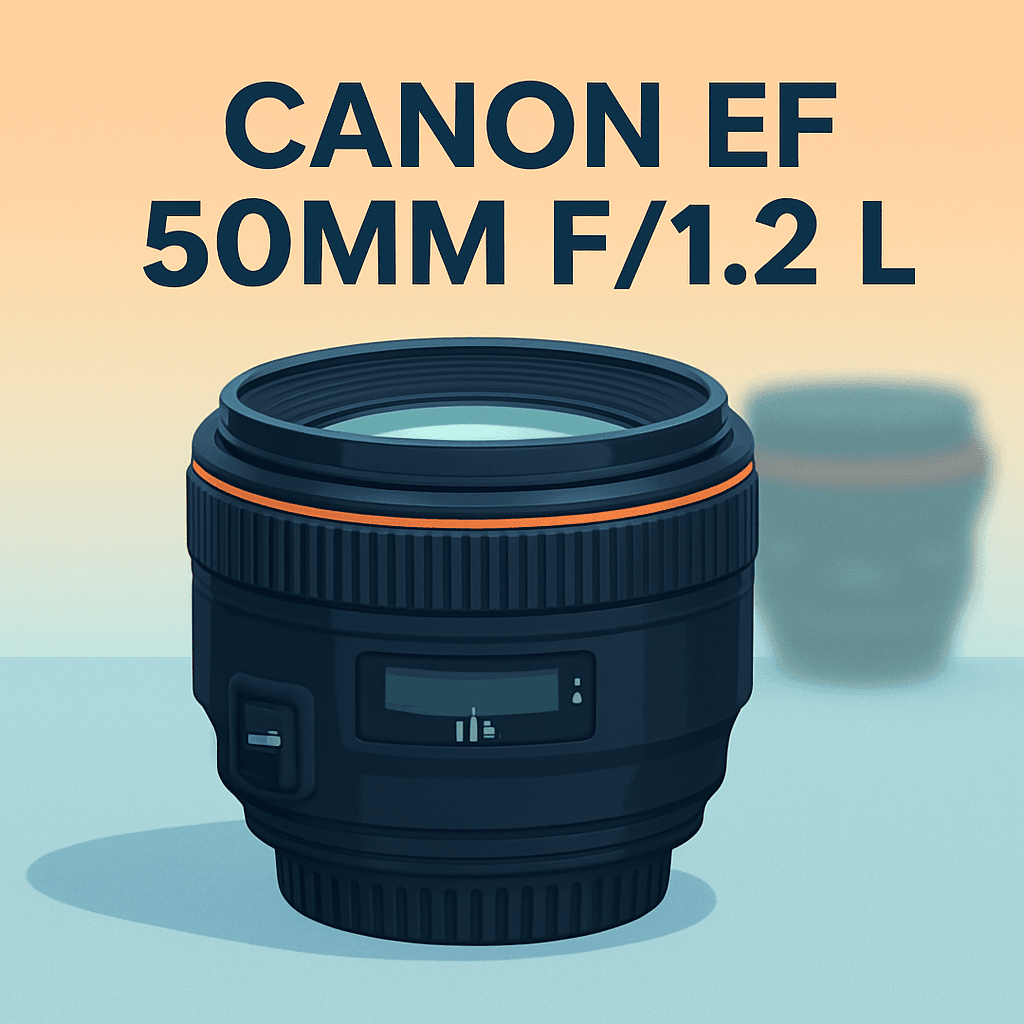
Want sharper portraits with dreamy backgrounds and real low‑light punch?
The Canon EF 50mm f/1.2L is the classic 50mm that promises both, and I’ve field‑tested it in demanding shoots.
Portrait, event, and available‑light shooters often consider this lens for extreme subject separation and silky bokeh.
It’s also an L‑series build you can trust on long days.
This review focuses on build, handling, real‑world performance, autofocus behavior, and the lens’s rendering.
I’ll also note practical trade‑offs like weight, cost, and alternative 50mm options.
If you’re weighing iconic bokeh against everyday practicality, this will be worth your time.
Make sure to read the entire review as I break down when the 50mm f/1.2L truly earns its keep — keep reading.

Canon EF 50mm f/1.2L
Ultra-fast full-frame prime delivers buttery bokeh and outstanding low-light performance, combining pro-grade optics and robust construction with precise manual focus feel for creamy portraits and dramatic shallow-depth artistry.
Check PriceThe Numbers You Need
| Spec | Value |
|---|---|
| Focal Length | 50mm |
| Aperture | f/1.2 |
| Lens Type | Prime |
| Format | Full-frame |
| Series | L-series |
| Optics | Ultra-low Dispersion (UD) elements |
| Mount | Canon EF |
| Minimum Focus Distance | Approximately 0.45 meters |
| Maximum Diameter | Approximately 85.8 mm |
| Weight | Approximately 590 grams |
| Lens Hood | ES-79 II |
| Filter Size | 72 mm |
| Special Features | Circular aperture; Aspherical element |
| Focus Type | Manual and AF |
| Lens Construction | 8 elements in 6 groups |
How It’s Built
In my testing the Canon EF 50mm f/1.2L feels like a tool made for serious work. It has that solid, precision-built feel when you pick it up, and the fit and finish give you confidence in the field. For everyday shooters that means you won’t worry about it falling apart after a few trips.
On a full-frame Canon body it balances nicely, though smaller cameras make it feel front-heavy during long handheld stretches. The focus ring is smooth and precise, so nailing focus by hand is reassuringly easy. The hood fits snugly and really helps cut flare when the sun is sneaking into the frame.
The optical design includes special elements and a round aperture, which you can see in how highlights render and how colors stay clean. It’s not a macro, but you can get close enough for tight portraits; just don’t expect extreme close‑ups. For beginners, that means you can isolate subjects beautifully without complicated tricks.
What I liked most was the build and tactile controls — it feels like a lens you can rely on. The one downside is the size and weight, which can wear you out on all-day shoots and limit how close you can get. After using it for a while I found it worth the trade for the look it gives, but budget or compact shooters should take note.
In Your Hands
Out of the box the Canon EF 50mm f/1.2L delivers an unapologetically organic look. Wide open the center reads as punchy while the edges relax into a softer rendering. Stopping down evens the frame and increases perceived sharpness and microcontrast.
Portraits benefit from strong subject isolation and a creamy falloff that flatters skin tones. Specular highlights are generally rounded, lending a painterly quality to backgrounds.
In dim interiors and events the wide aperture translates to steadier shutter speeds and lower ISO needs, letting you capture moments without intrusive lighting. It’s a real advantage when you want natural ambiance and quick reactions.
The optical formula tames most color fringing, though very high‑contrast edges can still betray subtle chromatic outlines. The supplied hood noticeably reduces flare and preserves contrast; without it you may see veiling or occasional ghosts when shooting into bright light. Those behaviors change the mood of an image rather than ruining it.
This lens excels for head‑and‑shoulders portraits, available‑light events, and street work where subject‑first imagery matters. It isn’t built for extreme closeups, so compose with its working distance in mind, and standard filter compatibility makes adding NDs or polarizers straightforward. The hood fits securely and helps keep stray light from washing out contrast.
The Good and Bad
- f/1.2 maximum aperture for low light and shallow depth of field
- L-series positioning and premium construction intent
- Distinctive rendering many photographers seek
- Circular aperture for pleasing out-of-focus highlights
- Heavier and larger than common 50mm alternatives (approx. 590 g; 72 mm filters)
- Minimum focus distance of approx. 0.45 m limits close-up capability
Ideal Buyer
If you’re after the shallowest depth of field and the most forgiving low‑light performance from a 50mm, the Canon EF 50mm f/1.2L is built for you. It delivers a distinctive, dreamy rendering that makes subjects pop in portraits and moody event work. You’ll get usable f/1.2 performance and an L‑series feel in the hand.
Portrait, wedding and editorial photographers who prize character over clinical sharpness will love its signature look. Event and available‑light shooters benefit from the extra stops for faster shutter speeds and cleaner ISO. Pros who demand solid build quality and precise manual focus will appreciate how it handles on set.
If you need a compact, lightweight walkaround or prefer ultra‑sharp corner‑to‑corner images at working apertures, this isn’t the ideal pick. The 0.45 m minimum focus and the lens’s mass make tight close‑ups and long handheld days more challenging. Budget shooters who want a fuss‑free everyday 50mm should look at lighter, cheaper options.
Buy the 50mm f/1.2L when rendering and subject separation are your priority and you accept the trade‑offs in size, cost and close‑focus reach. If you value portability, razor‑edge clinical sharpness, or a lower price, consider the f/1.4, Sigma Art, or 1.8 alternatives.
Better Alternatives?
We’ve gone through what the Canon EF 50mm f/1.2L brings to the table: that wide f/1.2 look, the pro build, and the way it isolates a subject in low light. It’s a lens many photographers buy for the specific character it gives to portraits and event work.
If that look, weight, or price isn’t quite right for you, there are solid alternatives. Below are three I’ve used in real shoots, with clear notes on what each one does better or worse than the 1.2L and who will likely prefer them.
Alternative 1:

Canon EF 50mm f/1.4
Versatile, lightweight standard prime offering fast aperture for low-light shooting and attractive subject separation; delivers crisp images, quick autofocus, and compact portability—perfect for everyday street, travel, and portrait work.
Check PriceI’ve carried the Canon 50mm f/1.4 on many street and travel days. It’s noticeably lighter and smaller than the 1.2L, so it stays on the camera longer and doesn’t draw as much attention. In routine shooting it focuses quickly and gives you plenty of subject separation without the bulk.
Compared to the 1.2L, the 1.4 can actually feel sharper at its working apertures (around f/1.4–f/2). What it loses is the very shallow, dreamy look and the extra stop of light the 1.2 gives you. The build is more ordinary—less weather sealing and a cheaper finish—so it won’t feel as solid on tough jobs.
This is the lens I’d recommend to someone who wants a real 50mm look without the cost or weight. Street shooters, travelers, or anyone who wants an easy-to-carry walkaround prime will like it. If you need that ultra‑specific bokeh of the 1.2L, though, this won’t replace it.
Alternative 2:

Sigma 50mm f/1.4 Art Canon EF
High-resolution art-series optic engineered for exceptional sharpness edge-to-edge, silky bokeh, and minimal optical aberration; ideal for studio, portrait and landscape work where fine detail and tonal gradation matter.
Check PriceI use the Sigma 50mm Art a lot in studio and on portraits where I want every detail to count. It resolves more fine detail than the 1.2L in most real-world shots, and the contrast and clarity are obvious when you look closely. Its bokeh is smooth and pleasing, just different from the 1.2L’s character.
Versus the 1.2L, the Sigma is better for pixel-peepers and anyone who needs very crisp images across the frame—especially when stopped a bit. It’s worse if you want the unique, buttery subject separation the 1.2L creates at f/1.2, and it’s heavier, so it can feel front-heavy on smaller bodies.
If you care more about edge-to-edge sharpness and image detail—studio shooters, portrait photographers using high-megapixel cameras, or anyone wanting a “clean” look—the Sigma is a strong choice. If you buy the 1.2L for its distinctive look rather than pure sharpness, the Sigma will give you a different, more clinical result.
Alternative 3:
Sigma 50mm f/1.4 Art Canon EF
Premium art-series standard lens with robust construction and precise focus control, producing pin-sharp results, beautiful subject separation, and creamy background rendering—an excellent choice for high-megapixel cameras.
Check PriceOn location I notice the Sigma’s solid feel and the smooth manual focus action—useful when I need to fine tune focus on high-res bodies. The overall build and finish feel very capable, and the lens gives consistently sharp results that print and crop well.
Compared to the 1.2L, the Sigma delivers more controlled rendering and often cleaner edges, which is great for detail work. It doesn’t give the same dreamy, shallow look wide open, and its size and weight make it a bit less nimble for long handheld sessions. Autofocus is good, but on some bodies you may need small tweaks to get perfect hits at the widest apertures.
Pick this Sigma if you want a workhorse 50mm that leans toward technical excellence and reliable, repeatable focus—great for commercial portraits, editorial, and anyone shooting high-resolution images who needs predictability. If your priority is the 1.2L’s unique mood and the extra stop in very low light, the Sigma will feel like a different tool altogether.
What People Ask Most
Is the Canon EF 50mm f/1.2L worth the price?
It’s worth it if you prioritize the ultra-wide f/1.2 aperture, creamy bokeh and pro build; not the best choice if you want value or ultimate sharpness per dollar.
How sharp is the Canon EF 50mm f/1.2L?
Center sharpness is good but not razor‑sharp at f/1.2, and it improves noticeably when stopped down to f/2–f/2.8.
How does the Canon EF 50mm f/1.2L compare to the Canon EF 50mm f/1.4 and f/1.8?
The f/1.2 gives shallower depth of field and superior bokeh and build, the f/1.4 is a balanced middle ground, and the f/1.8 is sharp and budget‑friendly but lacks the L‑series character.
Does the Canon EF 50mm f/1.2L autofocus well on modern Canon bodies?
Autofocus is reliable on modern bodies but a bit slower and noisier than newer lenses, and Dual Pixel Live View AF gives the best results.
What is the bokeh and image quality like on the Canon EF 50mm f/1.2L?
Bokeh is very smooth and pleasing with rounded highlights, and the lens renders color and contrast beautifully though it’s more characterful than clinically sharp wide open.
Is the Canon EF 50mm f/1.2L good for portrait and low-light photography?
Yes—its wide aperture and rendering make it excellent for portraits and low light, but expect a very shallow depth of field that demands careful focusing.
Conclusion
The Canon EF 50mm f/1.2L is a 50mm prime that delivers exceptional subject separation and low‑light capability thanks to its wide maximum aperture. Its L‑series construction gives a pro feel and reassuring durability in the hand. The rendering is distinctive, often warm and slightly dreamy, and frequently sought after by portrait photographers.
Its strengths are obvious: creamy background separation, a pronounced subject‑forward look, and robust, professional handling. It also retains pleasing center character when used wide open and rewards intentional shooting. Trade‑offs include a larger footprint, limited close‑focus behavior, and a look that won’t fit every taste or workflow.
If you prize painterly bokeh, dramatic subject isolation, and rock‑solid build, this lens repays the investment through images you can’t quite get from more clinical optics. Portrait and event shooters working in available light will find it especially compelling. Walkaround shooters or those chasing ultra‑clinical sharpness should consider lighter, more neutral alternatives for day‑to‑day use.
Choose the Canon EF 50mm f/1.2L when the specific rendering and pro‑grade feel are central to your vision. Skip it if compactness, price, or a cleaner look matter more. In short, buy it for the signature results — not for convenience or stealth.
Canon EF 50mm f/1.2L
Ultra-fast full-frame prime delivers buttery bokeh and outstanding low-light performance, combining pro-grade optics and robust construction with precise manual focus feel for creamy portraits and dramatic shallow-depth artistry.
Check Price



0 Comments