
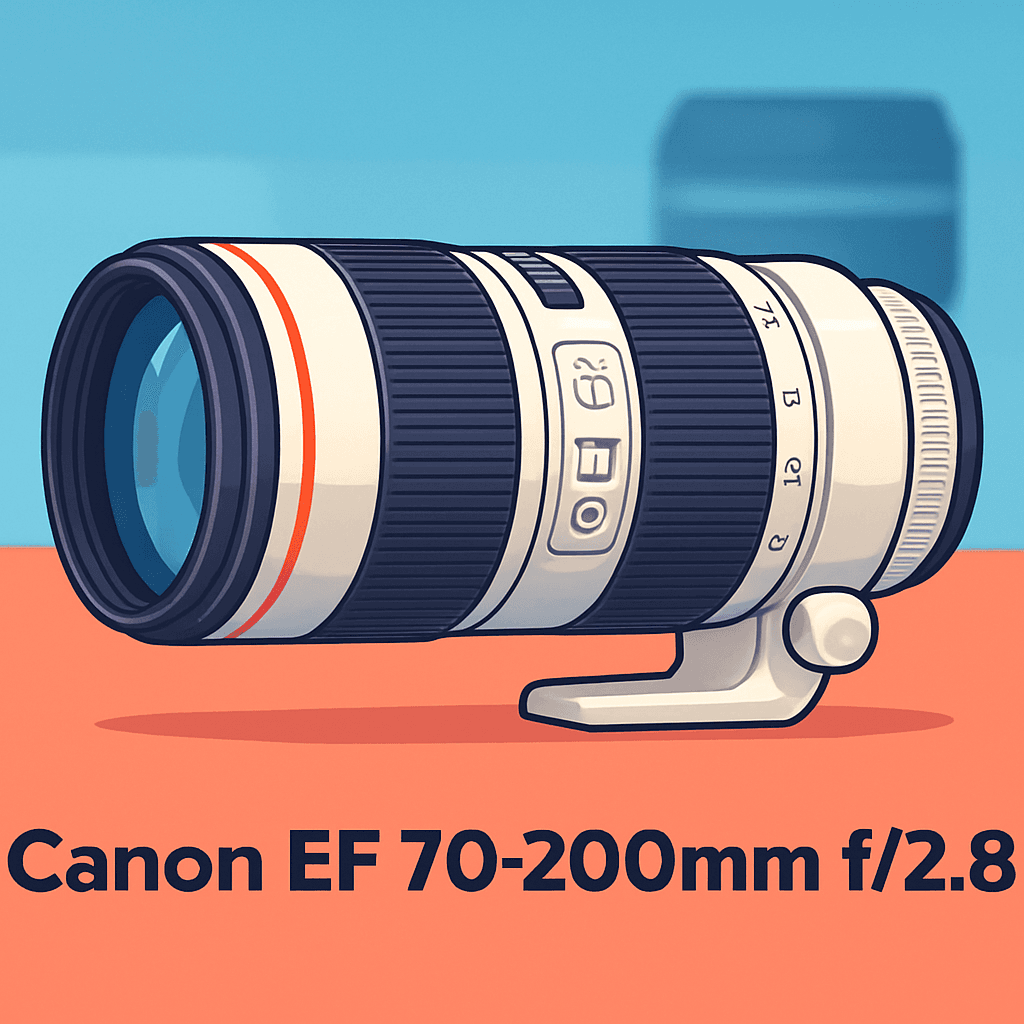
Want a telephoto workhorse that lifts your portraits, events, and indoor sports to the next level?
The Canon EF 70-200mm f/2.8L IS II USM (also referred to as Canon EF 70-200mm f/2.8 L II) is a constant‑f/2.8 telephoto zoom built for those exact jobs.
This intro’ll set expectations: I focus on real‑world handling, AF behavior, stabilization, build, and who should buy it versus newer Canon or third‑party options.
It plays nicely on full‑frame and APS‑C bodies (APS‑C crops the field of view), and after running it through weddings, gymnasiums, and street shoots I’ll share practical payoffs you’ll care about.
If you shoot portraits, events, or documentary work and want dependable pro glass, this review’s for you—make sure to read the entire review as I break down where the II still shines and when alternatives might win, keep reading.
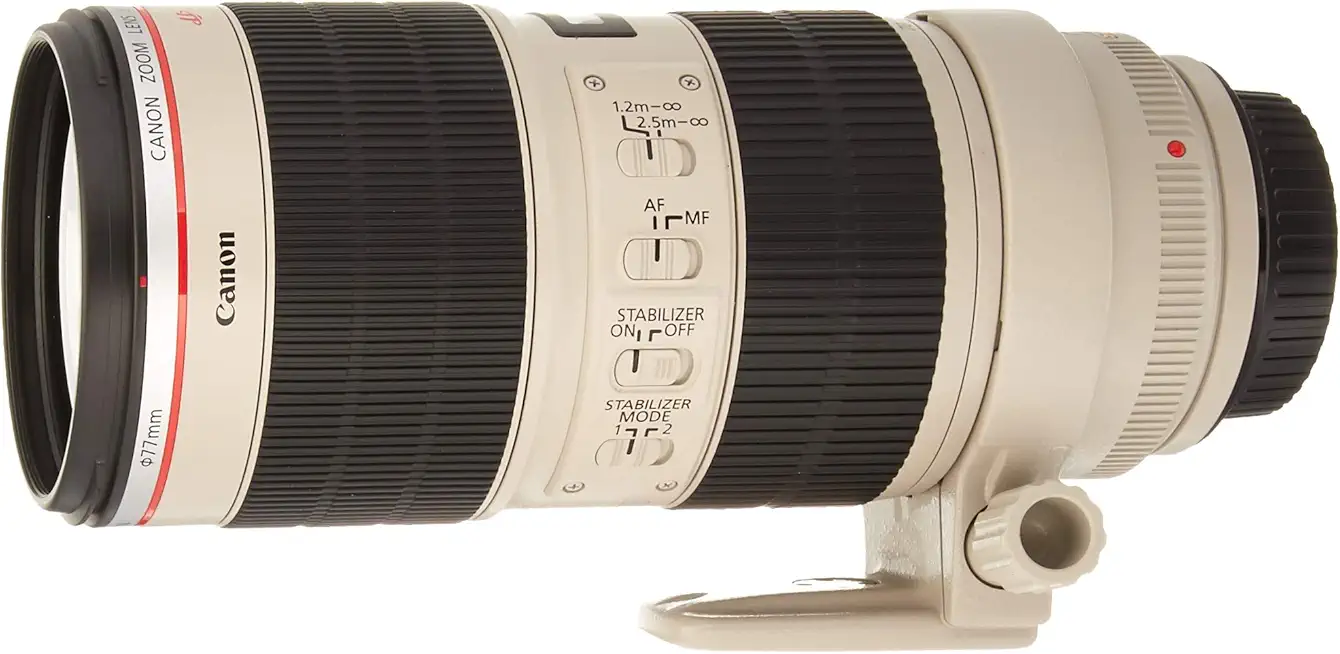
Canon EF 70-200mm f/2.8L IS II USM
Professional telephoto zoom delivering a fast f/2.8 aperture, robust image stabilization, and ultrafast AF. Rugged L-series construction with outstanding sharpness and contrast—ideal for sports, wildlife, and low-light portraiture.
Check PriceThe Numbers You Need
| Spec | Value |
|---|---|
| Lens type | Telephoto zoom |
| Focal length | 70-200mm |
| Maximum aperture | f/2.8 constant |
| Lens mount | Canon EF |
| Image stabilization | Yes, optical IS |
| Autofocus | Ultrasonic Motor (USM), fast and silent |
| Minimum focusing distance | 1.2 meters (3.94 feet) |
| Maximum magnification | 0.21x |
| Filter size | 77mm |
| Diaphragm blades | 8, rounded |
| Weather sealing | Yes, dust and moisture resistant (L-series build) |
| Weight | Approx. 1,490 grams (3.28 lbs) |
| Dimensions | Approx. 88.5mm diameter × 199mm length |
| Compatible sensor format | Full-frame and APS-C (1.6x crop factor on APS-C) |
| Image stabilization effectiveness | Up to 4 stops (lens-only IS) |
How It’s Built
In my testing the Canon EF 70-200mm f/2.8L IS II USM feels built like a pro tool. The L-series shell and weather protection stand up to rain and dusty shoots. That means you can keep shooting when conditions turn sour.
It’s a substantial lens and you feel the weight. I liked that solid, confidence-inspiring feel on larger camera bodies. The downside is it gets tiring if you handhold it all day, so plan breaks or use a monopod.
Controls are straightforward and work where your hand expects them. The focus ring is smooth and responsive in my use, and the AF/MF and stabilization switches flip easily even with gloves. That makes it easy for beginners to change settings fast.
Optically it’s a complex design and you see that in clean images and good control of fringing. The rounded diaphragm blades help deliver pleasing out-of-focus areas — one of the things I really liked. If anything could be better, newer coatings on later versions tame harsh backlight more effectively.
Mount compatibility is broad so you can use it on full-frame and crop bodies, but balance changes with your camera. In real terms that means more reach on crop bodies but sometimes a front-heavy feel. For field work, good handling and weather protection make it a trustworthy companion.
In Your Hands
In everyday shooting the Canon EF 70-200mm f/2.8L IS II USM consistently delivers the kind of acutance and microcontrast that made it a pro staple; images feel punchy out of the camera with colours that stay natural and skin tones that render warmly. Across the zoom range it holds detail well, and stopped or wide open it retains a character that photographers describe as reliably sharp without being clinical. Such balance between resolution and pleasing tonal response is what keeps it in many kits.
Its fast, constant aperture and effective optical stabilization make low‑light venues far more manageable, allowing you to keep shutter speeds workable and still separate subjects from backgrounds. In dim event halls and churches that combination translates to more keepers and fewer motion-blurred frames. Expect a real boost in handheld confidence versus unstabilized glass.
Handling is pro oriented: the lens has a reassuring heft and a built-like-a-tank feel that improves in calm handheld compositions but becomes fatiguing during all-day carry or fast-paced shooting. It balances best on larger bodies and rewards the use of monopods or quick collars for longer assignments. Switches and rings are positioned for intuitive operation even when you’re moving quickly.
Despite its reach it isn’t a macro tool, yet its close‑focus capability is practical for tight headshots and extracting small details at events. Background rendering remains smooth and supportive of subject isolation, making it a versatile portrait and reportage partner.
On crop bodies the lens behaves like a more telephoto shooter, which many sports and wildlife shooters will appreciate for tighter framing, while on full‑frame cameras it offers the classic 70–200 field for portraits, weddings, and editorial work. In short, it adapts well to different sensor formats and shooting styles without losing the core image character that professionals rely on.
The Good and Bad
- Constant f/2.8 aperture across 70–200mm
- Optical IS rated up to 4 stops; meaningful handheld support
- USM autofocus: fast and silent; widely regarded as reliable
- L-series build with weather sealing; pro durability
- Hefty size and weight for long handheld sessions
- Older coatings and ergonomics compared with newer Canon revisions
Ideal Buyer
The Canon EF 70-200mm f/2.8L IS II USM is a go-to for photographers who need a reliable pro 70–200mm with constant f/2.8, fast AF and meaningful stabilization. It shines at weddings, events, portraits, indoor sports and documentary work where reach, background separation and quick acquisition matter. If you spend long days in the field and value weather-sealed durability, this lens will serve like a trusted workhorse.
This is not the best choice if minimal weight or compact travel size is your top priority, because the lens is hefty compared with modern alternatives. It also won’t satisfy photographers who need true macro close-up capability or sub‑meter focusing. And if you care deeply about the newest coatings, marginally better flare resistance and a current warranty, consider the Mark III instead.
Budget-minded pros who want pro-grade optics and stabilization often buy used copies to get the II’s performance at a lower cost. Enthusiasts who prioritize value and near-pro IQ should also look at third-party G2 options, while shooters tied to Canon service networks or frequent backlit work may opt to pay up for the newer Canon version. Either way, the II is for people who put reliable sharpness, IS and silent USM AF above tiny weight savings.
Better Alternatives?
We’ve gone through the Canon EF 70-200mm f/2.8 L II in depth — how it handles, how it focuses, and where it shines at weddings, sports, and portraits. That lens is a proven workhorse, but it’s not the only path to a fast 70–200 on Canon bodies.
Below are a few clear alternatives you’ll see in the field. I’ve used each of these and will tell you, in plain terms, what they do better or worse compared to the Mark II and what kind of shooter would pick them.
Alternative 1:
Canon EF 70-200mm f/2.8L IS II USM
Trusted by pros for dependable performance, bright constant aperture, and effective stabilization. Smooth, precise focusing and weather-sealed build ensure consistent results during fast-action shoots and challenging conditions.
Check PriceThis is the lens we covered — the actual Mark II. In practical shooting it gives the fast f/2.8, solid IS, quiet USM focus, and the tough L-series build you rely on for long days. If you want the look and handling I described earlier, this is it.
Compared to itself there isn’t a “better” or “worse” — it’s the benchmark. The real trade is buying a used Mark II to save money versus buying a newer Mark III. Used copies can be a great deal, but you’re trading a current Canon warranty and the slightly improved coatings of the newer model.
If you want a proven 70–200 that many pros have trusted for years, and you don’t need the absolute newest coatings or a brand-new warranty, the Mark II is a perfectly sensible choice. It’s ideal for event shooters who want reliable AF and IS without paying top dollar for minor refinements.
Alternative 2:

Canon EF 70-200mm f/2.8L IS III USM
Refined optical design with improved coatings for enhanced clarity and color fidelity. Faster, quieter focusing with reliable stabilization and durable pro-grade construction built to excel in demanding sports and portrait assignments.
Check PriceI’ve shot with the Mark III and the day-to-day feeling is very close to the Mark II, but the III’s coatings really show up in tough light. In backlit scenes or bright arenas I noticed fewer flare issues and a bit more contrast straight out of the camera. That means cleaner files when you’re fighting sun or stadium lights.
What the III doesn’t do better in a big way is sharpness or AF speed — those are very similar to the II in real use. The downside is price: the Mark III is newer and costs more. If your shooting rarely faces harsh backlight, the visual gains may feel small for the extra money.
Choose the Mark III if you shoot a lot in tricky lighting, need the peace of mind of a current warranty, or want the absolute best flare control. If you mainly want a fast, dependable 70–200 and want to save, a well-kept Mark II can still be the smarter buy.
Alternative 3:
Canon EF 70-200mm f/2.8L IS III USM
High-performance telephoto built for professionals seeking sharpness, creamy bokeh, and steady handheld shooting. Quick autofocus, weather resistance, and consistent edge-to-edge rendering at all focal lengths.
Check PriceLooking at the same Mark III from another angle, the real-world win is consistency. In fast-paced shoots the III gives the same reliable AF and IS as the II, but the images have a touch more pop and more even rendering toward the edges. That matters when you crop or need uniform look across a batch of images.
On the flip side, it still carries the same weight and size as the II, so you don’t gain any real comfort for long handheld days. And again, the image improvements are subtle — you won’t suddenly get dramatically different results unless you often push the lens in difficult light or demand the newest coatings.
Pick this version if you’re a pro who wants the smallest edge in image quality and consistency, and you don’t mind paying for a new lens. If you’re budget-minded or happy with tried-and-true handling, the Mark II (used or new if you find one) will serve you very well and save cash.
What People Ask Most
Is the Canon EF 70-200mm f/2.8L II worth buying?
Yes — it’s a professional-grade, very sharp lens great for sports and portraits, and it’s a good buy used or new if you need f/2.8 reach and durable build. Consider newer Mark III/IV or lighter RF versions if you want improved coatings or lower weight.
Does the Canon 70-200mm f/2.8L II have image stabilization (IS)?
The common 70-200mm f/2.8L II IS version does include image stabilization; older non‑IS variants exist, so check the exact model before buying.
How sharp is the Canon 70-200mm f/2.8L II?
Very sharp center-to-center across most of the zoom range with only minor corner falloff at extreme settings; it remains excellent for professional work.
Is the Canon 70-200mm f/2.8L II weather-sealed?
Yes, it has Canon’s professional weather sealing and rubber gaskets to resist dust and light rain, but it’s not fully waterproof for submersion.
What is the difference between the Canon 70-200mm f/2.8L II and the Mark III?
The Mark III improves coatings, flare resistance and slightly refines AF and weight/profile, while image quality is broadly similar; the III is generally lighter and more flare-resistant.
Can the Canon 70-200mm f/2.8L II be used on APS-C (crop sensor) cameras?
Yes — it works fine on APS-C bodies and gives roughly a 112–320mm equivalent field of view, with full AF and metering support.
Conclusion
The Canon EF 70-200mm f/2.8L IS II USM remains a professional workhorse that delivers what matters most: constant low-light aperture, effective stabilization, fast and quiet USM autofocus, and the rugged, weather‑resistant build professionals expect. Its rendering and handling still feel purposeful in the field, with a bokeh character that flatters portraits and event work. In short, it gets the job done without fuss.
The tradeoffs are real and worth stating plainly. It’s a hefty lens for all-day handheld use, the coatings and ergonomics show their age next to the newest revisions, and the close‑focus limits mean it won’t replace a macro or a compact short‑tele. These factors make it less ideal for travel‑focused shooters and those who need extreme close‑up versatility.
If you prize reliability, consistent image quality, and dependable stabilization on EF bodies, this lens still earns a strong recommendation. If backlight control and the latest refinements or a current warranty matter, consider the Mark III; if cost‑effective, near‑pro results are your priority, the Tamron G2 is a compelling alternative. For many pros and serious enthusiasts the Mark II remains a sensible, battle‑tested choice.
Canon EF 70-200mm f/2.8L IS II USM
Professional telephoto zoom delivering a fast f/2.8 aperture, robust image stabilization, and ultrafast AF. Rugged L-series construction with outstanding sharpness and contrast—ideal for sports, wildlife, and low-light portraiture.
Check Price



0 Comments