
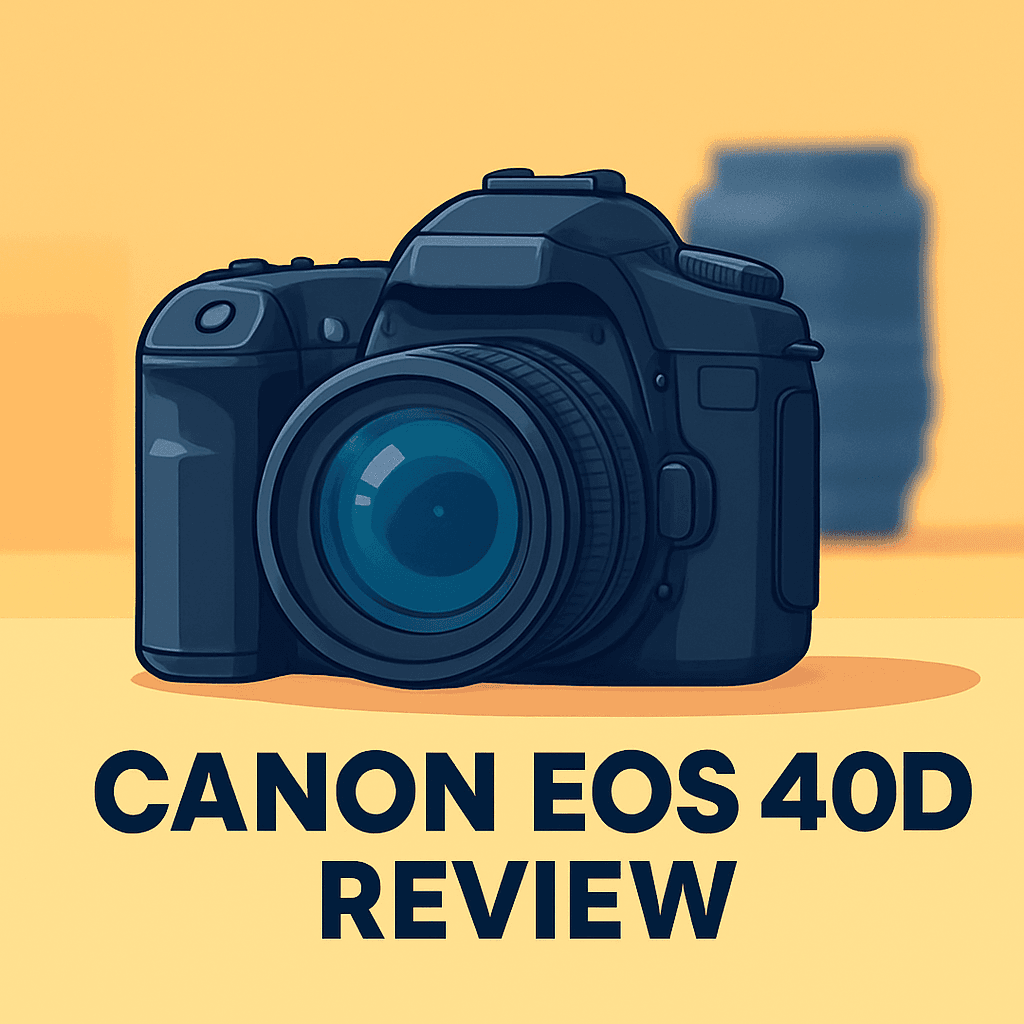
Want sharper stills and a faster shooting feel without modern video distractions?
It’s a stills‑first APS‑C DSLR built around direct controls and an optical viewfinder. After field‑testing it, I saw how that simplicity benefits EF/EF‑S users and budget buyers.
I’ll cover handling, reliability, autofocus, and image quality from real shoots. Make sure to read the entire review as I reveal whether this classic stills tool is worth it—keep reading.
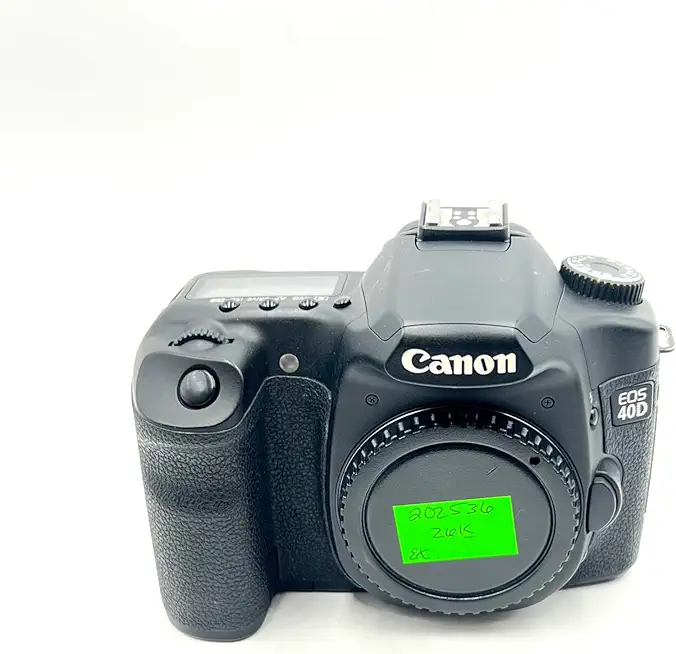
Canon EOS 40D Camera
A rugged, enthusiast-level DSLR delivering fast continuous capture, dependable autofocus and durable construction for demanding shoots. Ideal for learning creative controls while producing sharp, reliable images in varied conditions.
Check PriceThe Numbers You Need
| Spec | Value |
|---|---|
| Sensor | 10.1 MP APS-C |
| Continuous Shooting | 6.5 fps |
| ISO Range | 100–1600 (expandable to 3200) |
| Autofocus | 9-point AF |
| Lens Mount | Canon EF / EF-S |
| Image Stabilization | None (lens-based) |
| Video Recording | No |
| Viewfinder | Optical |
| LCD Screen | 3.0″ TFT |
| Shutter Speed | 1/8000s to 30s |
| Flash | Built-in |
| Weather Sealing | Partial |
| Burst Mode | Yes |
| Metering Modes | Evaluative, Center-weighted, Spot |
| Storage | CompactFlash I/II cards |
How It’s Built
In my testing the Canon EOS 40D felt like a familiar old friend in the hand. The optical viewfinder and rear LCD make framing and reviewing shots simple and immediate. That straightforward feel means you can focus on shooting, not fiddling with menus.
The buttons and dials are tactile and placed where your fingers expect them. I found I could change core settings without taking my eye off the finder. For beginners that direct control is a huge confidence booster.
The body has some weather protection, but I treated it cautiously in truly wet conditions. After using it in light drizzle I avoided heavy downpours and kept a towel handy. That means you can shoot outdoors comfortably, just don’t assume it’s fully waterproof.
The built-in flash is handy for quick fill, and the hot shoe makes adding a proper speedlight easy. In the field I popped on an external flash for portraits and liked the instant upgrade in light control. It’s a small but useful touch.
One thing I really liked was the solid, user-focused layout that made day-to-day shooting pleasurable. One thing that could be better is the storage workflow—CompactFlash cards work fine, but you’ll want a reliable card reader on hand for fast transfers.
In Your Hands
In hand the Canon EOS 40D feels like a camera built for decisive moments; its rapid continuous shooting and broad shutter range let you chase quick sequences and freeze bright-day action without fuss. Bursts are useful for sports and candid storytelling, and the shutter’s top-end speed plus long-exposure capability give flexibility across lighting conditions. Pair it with fast lenses for lowest-light situations.
ISO headroom is respectable for an older-sensor design, but best results come from conservative settings, good glass, or adding fill light when necessary. The metering options are straightforward—evaluative for general scenes, center-weighted for portraits, and spot for tricky backlit subjects—and in practice they respond predictably, though you’ll want to watch highlights in high-contrast situations. Shooting through the optical viewfinder is immediate and battery-friendly, making long days less fatiguing.
Out in the field the 40D starts promptly, buttons have a satisfying tactile feel, and its handling encourages a focused, single-task workflow. The buffer behaves consistently: it carries you through short bursts and then clears once you give it a breath, and CompactFlash-based storage has proven reliable on shoots. Menus are dated but logical, with only minor quirks once you memorize the layout.
Remember this is a stills-first tool with no video capability, so plan mixed-media jobs accordingly. In practical use it’s a durable, straightforward workhorse that rewards strong technique and quality lenses more than bells and whistles.
The Good and Bad
- 6.5 fps burst for its class
- 1/8000s max shutter for fast-action and bright-light control
- Optical viewfinder shooting experience
- EF/EF-S lens compatibility
- No video recording
- 9-point AF is limited by modern standards
Ideal Buyer
The Canon EOS 40D is for photographers who put stills above everything else and relish the optical viewfinder ritual. Its tactile dials and direct controls reward shooters who prefer fast, deliberate handling over menu gymnastics. If you miss the satisfying mechanical feel of a classic DSLR, this body scratches that itch.
Owners of EF/EF-S glass get the most from the 40D as an affordable workhorse or reliable backup. Wedding second-shooters, newspaper shooters on a budget, and hobbyists expanding a Canon kit can step in without changing lenses. Partial weather sealing and rugged ergonomics mean it endures long days in the field.
Shoots that favor technique—fast primes, disciplined ISO control, and careful composition—benefit from the 6.5 fps burst and 1/8000s shutter for action and bright-light work. Street, travel, and sports hobbyists can exploit those strengths while accepting a 10.1MP ceiling. You’ll lean on good glass and exposure rather than modern high-ISO rescue.
This isn’t the camera for filmmakers, high-ISO hunters, or anyone needing modern AF tracking and heavy cropping room. But if you want a straightforward stills tool, a dependable second body, or a budget gateway into Canon glass, the 40D still makes practical sense. It rewards patience, solid lenses, and hands-on shooting.
Better Alternatives?
We’ve talked about what the Canon EOS 40D does well and where it shows its age. For many shooters today it still makes sense as a simple, reliable stills body — but there are clear reasons to consider newer options if you want better low-light performance, faster and denser autofocus, or video features.
Below are three practical alternatives I’ve used in the field. I’ll point out what each one brings to the table compared with the 40D, what it can’t do as well, and what kind of photographer will get the most from it.
Alternative 1:

Canon EOS 90D Camera
High-resolution APS-C imaging with swift burst performance and 4K video capability, balancing detail and speed for wildlife, sports and portrait work. Responsive autofocus and advanced controls empower creative exploration.
Check PriceI’ve used the Canon EOS 90D on weddings and in the field with my EF lenses, and the first thing you notice is how much more detail you get compared to the 40D. Where the 40D’s 10 MP files feel tight for cropping, the 90D’s higher-res files let you crop more and still keep sharp images. The 90D also nails autofocus in live view and has faster burst shooting, so tracking moving subjects is easier in real shoots.
Compared with the 40D, the 90D is better for low light, focus tracking, and mixed photo/video work. It gives you an articulating screen and modern menus that make some tasks faster. The trade-offs are real: files are bigger so you’ll do more editing time and need more storage, and the camera’s many features make it less of the simple, focused tool the 40D is. I’ve also found the grip and layout feel a bit busier if you liked the 40D’s straightforward controls.
If you already own Canon EF/EF-S glass and want a clear upgrade without switching systems, the 90D is the pick. It’s great for portrait shooters who want more detail, wildlife or sports shooters who need better autofocus, and hybrid shooters who want video sometimes. If you want a basic, no-frills stills camera, the 40D will still be simpler to use.
Alternative 2:

Nikon D500 Camera
Pro-grade crop-sensor powerhouse built for action: rapid continuous shooting, industry-leading autofocus and rugged weather-sealed body make it perfect for sports and wildlife photographers demanding speed and accuracy.
Check PriceThe Nikon D500 is a camera I’ve leaned on for fast-action shoots, and in real use it outpaces the 40D at subject tracking and buffer handling. If you’re shooting long sequences of sport or wildlife the D500 keeps firing longer and finds subjects more reliably. The body is beefy and weather-sealed, so I’ve used it in tough outdoor conditions where the 40D would make me more cautious.
Where the D500 shines over the 40D is raw speed and reliability on moving subjects, plus better high-ISO performance in dim light. The downside is system change: moving to Nikon means swapping lenses or buying adapters, and the D500 as a package can be more costly and heavier. I’ve also noticed that for simple portrait work the 40D’s more direct handling can feel less fussy than the D500’s many options.
Pick the D500 if you shoot a lot of action or wildlife and need a camera that locks on and keeps going in bad weather. If you’re happy with Canon glass and want to stay in that ecosystem, the D500 makes less sense unless you’re willing to move systems for the AF and ruggedness gains.
Alternative 3:

Nikon D7500 Camera
Lightweight, high-performance DSLR that combines sensitive low-light imaging with 4K video, responsive autofocus and flexible controls. Great for travel and enthusiast photographers seeking compact versatility and image quality.
Check PriceI’ve carried the Nikon D7500 on trips where I needed a lighter but capable body, and compared to the 40D it feels more modern and easier to get usable shots in low light. The D7500’s autofocus is more reliable across a range of scenes, and I often got better results without swapping to a very fast prime. Its 4K video also means I could capture motion when needed, something the 40D simply can’t do.
The D7500 is better than the 40D for travel, low-light versatility, and overall image quality in everyday shooting. On the flip side, it isn’t as rugged as the D500 and doesn’t give the pure, simple DSLR feel of the 40D some shooters like. Also, switching to Nikon means considering lens choices and adapting if you have Canon glass; that’s a practical cost many forget until they start shooting.
If you want a step up from the 40D but still want a fairly small, friendly DSLR for travel and general photography, the D7500 is a solid middle ground. It’s ideal for enthusiasts who want better high-ISO shots and some video ability without jumping to a big pro body or changing systems entirely for the sake of one feature.
What People Ask Most
Is the Canon EOS 40D still worth buying?
Yes — it’s a solid, well-built DSLR for learning or budget shooting with good autofocus and image quality for its age, but newer cameras offer better high-ISO performance, video, and features.
How many megapixels does the Canon EOS 40D have?
The 40D has 10.1 megapixels, which is fine for prints and web use but lower than most modern cameras.
Is the Canon EOS 40D a full-frame camera?
No, it uses an APS-C sensor with a 1.6x crop factor rather than full-frame.
What lenses are compatible with the Canon EOS 40D?
It accepts Canon EF and EF-S lenses; EF-S lenses are designed for APS-C bodies, while full-frame EF lenses also work but with the crop factor.
How does the Canon EOS 40D compare to the Canon EOS 50D?
The 50D is a modest upgrade with a higher-resolution 15 MP sensor and slightly better noise handling and LCD, but both share similar bodies and autofocus systems.
Is the Canon EOS 40D good for beginners?
Yes, it’s a durable, straightforward camera for learning manual controls and fundamentals, though it lacks modern conveniences like live view, touchscreen, and advanced video.
Conclusion
The Canon EOS 40D Camera still feels like a photographer’s tool rather than a gadget, delivering a focused, no-nonsense shooting experience that rewards technique and good glass. Its handling, viewfinder clarity, and reliable build make it an enjoyable companion in the field, even if it wears its age on its sleeve.
Where it shines is in straightforward stills work: tactile controls, a pleasing optical viewfinder, compatibility with Canon EF/EF‑S lenses, and a snappy, confident burst capability that helps you catch decisive moments. In practice it feels durable and dependable, which is a real advantage for someone after a workhorse body or a budget backup.
The tradeoffs are real and should steer your choice. Autofocus coverage is compact by modern standards, resolution and high‑ISO latitude are modest, there’s no video, and the legacy CF card workflow adds friction to contemporary studios and travel setups. These limits aren’t fatal, just defining.
Bottom line: pick the Canon EOS 40D Camera if you want a simple, reliable stills machine, already own compatible glass, and can live with classic DSLR constraints. If you need modern AF tracking, higher resolution, in‑body stabilization, or video, plan to look at newer bodies instead.
Canon EOS 40D Camera
A rugged, enthusiast-level DSLR delivering fast continuous capture, dependable autofocus and durable construction for demanding shoots. Ideal for learning creative controls while producing sharp, reliable images in varied conditions.
Check Price

0 Comments