
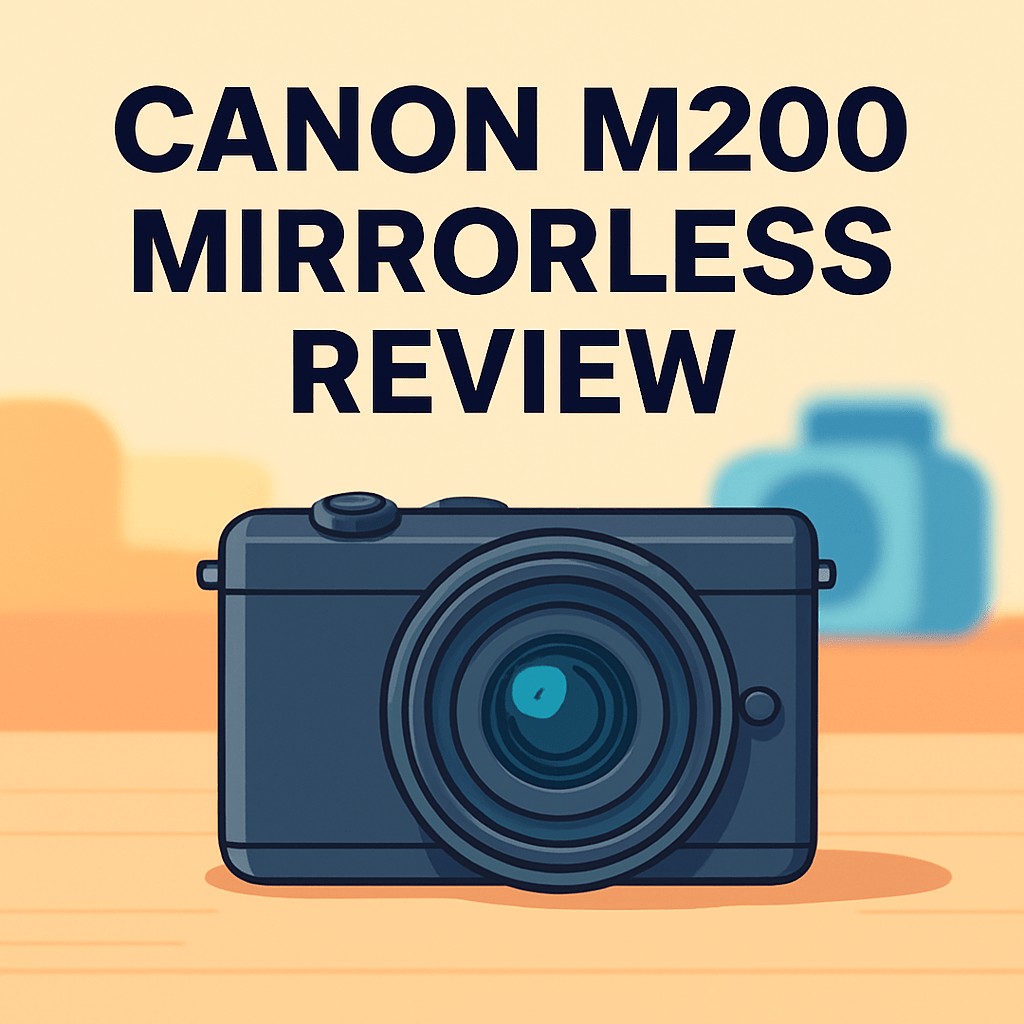
Want better photos without lugging around a bulky kit? It’s a common goal, and the Canon EOS M200 Camera promises a tiny, friendly package that might deliver just that.
Having spent time with it in the field, I’ll walk you through what it really gives you: pocketable handling, a responsive touchscreen, confident autofocus, and basic 4K for casual video — all with real-world payoffs for travel and family shots.
It isn’t perfect — there are tradeoffs like no viewfinder, no mic input, and modest battery life — so I’ll show who’ll benefit most and where compromises matter. Make sure to read the entire review as I break it down for different shooters — keep reading.

Canon EOS M200 Camera
Compact, lightweight mirrorless designed for beginners and travelers—delivers sharp APS-C image quality, easy touchscreen controls and Bluetooth/Wi‑Fi connectivity for simple sharing and quick vlogging on the go.
Check PriceThe Numbers You Need
| Spec | Value |
|---|---|
| Sensor | 24.1 MP APS-C CMOS |
| Autofocus | Dual Pixel CMOS AF |
| Continuous shooting | Up to 6.1 fps |
| ISO range | 100–25600 (expandable to 51200) |
| Shutter speeds | 1/4000s–30s |
| Video | 4K/24p, 1080p/60p |
| LCD | 3.0″ tilt-type touchscreen |
| Viewfinder | None |
| Built-in flash | Yes |
| Wi-Fi/Bluetooth | Yes |
| Weight | Approx. 299g (body only, with battery and card) |
| Battery life | Approx. 315 shots per charge |
| Microphone input | No |
| Ports | micro-HDMI, micro-USB |
| Storage | SD/SDHC/SDXC (UHS-I) |
How It’s Built
In my testing the Canon EOS M200 immediately stood out as a true grab-and-go camera. It’s compact and light, so I actually carried it on runs and day trips without feeling weighed down. For anyone moving up from a phone, that small size makes shooting more often, which is a big win.
The tilt touchscreen is where this camera shines for me. Touch AF, quick menus, and composing from low or high angles felt natural and fast during street and family shoots. I really liked how intuitive the screen made one-handed shooting for beginners.
What I missed was a viewfinder. Shooting in bright sun or when I wanted to steady the camera at my eye felt less comfortable without one. There’s a built-in flash for quick fill light, which saved a few evening shots, but it’s no substitute for better low-light tools.
Wireless pairing with my phone was painless, and remote shooting made selfies and group shots easy. The ports feel a bit dated and the card slot is basic, so expect some waiting after long bursts or video clips during a busy day.
Hand-feel is pleasant but not chunky; it’s easy to hold with small lenses but larger glass gets a bit front-heavy. The tilt hinge can feel slightly loose at extreme angles and the menus sometimes take a beat to respond, but overall it’s simple and friendly for beginners.
In Your Hands
Out in the field the M200 feels eager rather than ferocious — it will happily keep up with kids, pets and the occasional burst of street action without a hiccup. The buffer handles short runs of frames smoothly, and single-shot responsiveness is reliable, though continuous tracking can show the occasional missed beat in very chaotic scenes. For everyday use it never feels sluggish; for pro sports or long action sequences it’s clear this body wasn’t built to chase high-octane drama.
Exposure-wise the camera is forgiving and flexible: it nails daytime action and lets you experiment with slower shutter work for intentional motion blur, while higher sensitivity settings are usable but progressively softer. Fine detail and color hold up well through a moderate range, then noise and loss of micro-contrast become noticeable as light dwindles. For real-world shoots I treat the upper range as a last-resort tool rather than a first choice.
Battery life is solid for a half- to full-day of casual shooting, but I always pack a spare for travel or event days to avoid compromises. Video-wise the body delivers a cinematic feel in high-res capture and a smoother look in standard-definition modes, yet the lack of a mic input means you’ll want an external recorder or a reliable companion mic solution for better sound. The tilting touchscreen is a genuine asset for self-shooting, though composing without an eye-level finder asks for a steadier stance or a small tripod.
Wireless pairing for quick transfers and remote control is painless and genuinely speeds up my workflow when I’m sharing frames between shoots. In extended video runs the camera can warm up, but I rarely saw thermal limits intrude on short projects; autofocus is confident for stills and standard-definition video but can be a touch less assertive in high-resolution movie mode. Touch-to-focus is intuitive and makes framing fast, a welcome design choice for photographers who shoot on the move.
The Good and Bad
- 24.1 MP APS-C sensor with DIGIC 8 for solid stills quality
- Dual Pixel CMOS AF for confident focusing
- 4K/24p and 1080/60p video options
- Very compact and lightweight (approx. 299g)
- No electronic viewfinder — harder to compose in bright sun and less stable at eye-level
- No microphone input — limits on-camera audio options for video
Ideal Buyer
Travelers, families and smartphone upgraders will love the Canon EOS M200 Camera for what it strips away: complexity. Its pocketable APS‑C body, 24.1MP sensor and responsive Dual Pixel AF deliver a real step up in image quality without a steep learning curve. The tilt touchscreen makes composing and sharing easy on the go, and built‑in Wi‑Fi speeds simple transfers.
If you make photos and videos as a hobby—birthday parties, street snaps, quick vlogs—the M200 is a tidy, light hybrid that covers 1080/60p and occasional 4K/24p. Expect clean stills and dependable autofocus (thanks to Dual Pixel AF) for people and pets, whether you’re using the kit zoom or a small prime. Battery life and the single UHS‑I slot mean bringing a spare and keeping expectations modest for long shoots.
Skip it if you need pro features like an EVF for bright‑sun composition, a mic jack for serious audio or higher‑frame‑rate 4K. Photographers building a larger lens ecosystem or shooting extended events will quickly outgrow the M200’s modest endurance and media speeds. For casual users who prize size, simplicity and Canon color, though, it’s a smart, friendly choice.
Better Alternatives?
We’ve gone through the Canon M200 and what makes it a great little camera for travel, family shots and simple video. It’s small, light and easy to use, but we also saw its limits — no viewfinder, no mic jack and modest battery life — so it’s worth looking at a few close alternatives if those things matter to you.
Below I’ll walk through three cameras I’ve used in real shoots that solve some of the M200’s weak points in different ways. I’ll tell you what each one does better and where it still falls short compared to the M200, and who I think should pick each one.
Alternative 1:

Canon EOS M50 Mark II Camera
Designed for creators and livestreamers, this versatile camera offers responsive autofocus, flip-out touchscreen for selfies, improved video features and seamless wireless streaming for polished social content and vertical videos.
Check PriceI’ve shot events and street work with the Canon EOS M50 Mark II and the first thing you notice vs the M200 is the EVF and the better grip. The viewfinder makes bright-day shooting and steady framing much easier, and the larger handhold means you can shoot longer without cramping. For video it adds a mic jack and nicer livestreaming tools, so audio and live content are easier to manage than on the M200.
Where it doesn’t beat the M200 is in raw simplicity and size — the M50 Mark II is a touch bigger and feels less pocketable. Image quality is very similar in everyday shooting, and 4K video still has practical limits (cropping and reduced AF in 4K so you’ll notice it if you do lots of 4K). Battery life and low-light shooting are close to the M200, so don’t expect a major gain there.
If you want Canon colors and handling but miss an EVF and a real mic input, the M50 Mark II is the natural step up. It’s the pick for someone who shoots outdoors often, needs steadier eye-level framing, or wants better on-camera audio for YouTube or livestreams without leaving the Canon mirrorless family.
Alternative 2:

Sony ZV-E10 Camera
A vlogger-focused interchangeable-lens camera that combines fast autofocus, crisp APS-C image quality and a flip-out screen with a directional mic input—ideal for fluent handheld filming and quick content creation.
Check PriceOn the ZV-E10 I noticed autofocus that stays locked on moving faces and animals in a way the M200 sometimes struggles with. For run-and-gun video the ZV-E10 lets me walk and film without losing focus, and 4K uses the full width of the lens so framing feels more natural for vlogs and travel clips. The flip-out screen and mic input make quick solo setups a lot smoother than the M200.
That said, the ZV-E10 doesn’t give you an EVF either, so if you love eye-level shooting you won’t get that advantage over the M200. The menus and settings can feel deeper and there’s a small learning curve if you’re coming from the very simple Canon interface. Also, like the M200, it has no in-body stabilization — you’ll rely on lenses or a gimbal for steady handheld 4K shots.
Pick the ZV-E10 if you are a creator who needs sharp, reliable autofocus and plans to build a lens kit over time. It’s great for vloggers, travel shooters and people who want cleaner, worry-free focus while moving. If you’re coming from a smartphone and want better video and subject tracking, this one will feel like a big step forward.
Alternative 3:
Sony ZV-E10 Camera
Compact content-creation powerhouse with excellent subject tracking, clean HDMI output and customizable controls; pairs with a wide range of lenses to elevate interviews, tutorials and high-quality live streams.
Check PriceI’ve used the ZV-E10 for interviews and live streams, and the clean HDMI output plus easy audio hookups made it far simpler than the M200 for that work. The camera’s subject tracking and customizable buttons let me keep a consistent look across clips, and switching lenses opens up creative options I didn’t have with the M200’s tiny kit lens in low light or for close-up work.
Where it falls short versus the M200 is in sheer simplicity and size — if your priority is the smallest, lightest setup you can grab for a family day, the M200 still beats the ZV-E10. Also, without a viewfinder you lose that stable, eye-level shooting mode, and battery life under heavy streaming or long takes will push you to carry extras.
This version of the ZV-E10 is ideal for small studios, teachers, streamers and interviewers who want a compact camera that can feed a clean HDMI signal and take better lenses. If you need a camera that’s ready for more serious video work and external audio gear, it’s a much better fit than the M200.
What People Ask Most
Is the Canon EOS M200 a good camera for beginners?
Yes — it’s compact, easy to use, and produces great photos straight from the camera, though it lacks a viewfinder and some manual controls.
Does the Canon M200 have reliable autofocus for photos and video?
Autofocus is very reliable for stills and 1080p video thanks to Canon’s Dual Pixel AF, but 4K uses slower contrast AF and is less dependable.
Can the Canon M200 shoot 4K video and how good is its video performance?
It can record 4K at 24p, but with a significant crop and limited autofocus, so 1080p is usually a better choice for smooth, usable video.
How does the Canon M200 compare to the Canon M50?
The M50 is more feature-packed (EVF, mic input, better handling) for enthusiasts, while the M200 is smaller, simpler, and often cheaper for casual shooters.
What lenses are compatible with the Canon M200 and which should I buy?
It uses Canon EF-M lenses natively (popular choices are the 15–45mm kit and the 22mm pancake); you can also use EF/EF-S lenses with an adapter and add a fast prime for low-light and portraits.
Is the Canon M200 worth buying in 2026 given its battery life and features?
Only if you find it cheap or want a very small, simple camera — battery life and missing modern features make newer models better value for most buyers in 2026.
Conclusion
The Canon EOS M200 Camera is a pocketable APS-C mirrorless that delivers pleasing stills and confident autofocus in a fuss-free package. Its touchscreen-first interface makes getting usable images quick and painless, and the small body is a real traveler’s advantage. For anyone stepping up from a phone, it’s one of the simplest ways to get noticeably better results without a steep learning curve.
But there are clear compromises that shape who this camera is meant for. No electronic viewfinder, no mic input, modest battery life and 4K capped at 24p limit its appeal for serious video work and bright-sun shooting. If you need pro-level audio, longer runtimes or eye-level stability, this isn’t the right tool.
Bottom line: the Canon EOS M200 Camera is a smart, affordable choice for beginners, travelers, and casual hybrid shooters who prioritize size and simplicity over pro features. Those who want an EVF, a bigger lens roadmap, or stronger video options should look to the alternatives. For lightweight, reliable everyday photography it earns a firm recommendation; for ambitious creators, step up to a more capable model.
Canon EOS M200 Camera
Compact, lightweight mirrorless designed for beginners and travelers—delivers sharp APS-C image quality, easy touchscreen controls and Bluetooth/Wi‑Fi connectivity for simple sharing and quick vlogging on the go.
Check Price

0 Comments