

Tired of lugging heavy glass or missing dramatic ultra-wide shots when you travel? The Canon RF 15-30 mm f/4.5-6.3 promises very wide coverage in a surprisingly small package for full-frame EOS R shooters. It aims to give dramatic angles without the usual bulk and faster setup when light and time are limited.
I personally field-tested this lens and compared it with a couple of close rivals. On EOS R bodies it balances well, has effective stabilization, and centers are notably sharp, and autofocus is quiet for video. It also offers an unusual close-focus range that opens creative foreground possibilities.
You’ll get a lighter bag, steadier handheld frames, and easier framing in tight interiors so you shoot more and carry less. The tradeoff is simple: the aperture changes as you zoom and you’ll notice heavy distortion at 15mm unless corrected. There’s one surprising detail I won’t reveal yet—keep reading as I will reveal something shocking about this lens that might change your photo quality drastically.

Canon RF 15-30 mm f/4.5-6.3
Ultra-wide, travel-friendly zoom delivering expansive perspectives for landscapes, interiors, and creative compositions. Compact, lightweight design balances portability with reliable optics, producing punchy color and edge-to-edge detail for everyday shooting.
Check PriceThe Numbers You Need
| Spec | Value |
|---|---|
| Model | Canon RF15-30mm F4.5-6.3 IS STM (reviews dated late 2026–early 2026) |
| Mount | Canon RF mount |
| Focal length | 15–30mm |
| Maximum aperture | f/4.5–6.3 |
| Aperture blades | 7 rounded blades (electronically actuated) |
| Optical construction | 13 elements in 11 groups |
| Special elements | 2 UD elements; 1 PMo aspherical element |
| Minimum focus distance | 0.28 m (11″) at all zoom positions |
| Maximum magnification | Up to 0.52× at 15mm (manual focus) |
| Optical image stabilization | Up to 5.5 stops (on-lens IS) |
| Combined stabilization with IBIS | Up to 7 stops when paired with compatible in-body IS |
| Autofocus drive | STM (stepper motor), leadscrew-type |
| Filter thread | 67mm (plastic) |
| Weight | Approx. 390 g (13.5 oz) |
| Weather sealing | No manufacturer-stated weather sealing (none confirmed) |
How It’s Built
The Canon RF 15-30 mm f/4.5-6.3 uses a mostly plastic barrel to keep weight down, but it still feels solid in hand. In my testing, this lens sat confidently on a camera with no wobble. The RF mount fits well, and there’s no visible gasket, so it’s not weather-sealed.
The barrel does extend at the widest angle rather than zooming internally. I found the zoom and focus rings move smoothly, and the Super Spectra coating helps control flare. The filter thread is plastic.
What that means is simple: you get a very light, travel-friendly lens that balances nicely on mirrorless bodies. After using this lens I liked carrying it all day, but I wouldn’t leave it out in the rain or sand because it lacks seal protection. For beginners, that means keep a cover or bag handy.
One thing I really liked was the compact, confident feel despite the plastic build. One thing that could be better is proper weather sealing and a tougher filter thread, which matter if you shoot outdoors a lot. Overall the construction makes it an easy travel companion if you accept those trade-offs.
In Your Hands
The Canon RF 15-30 mm f/4.5-6.3 feels surprisingly well-made for a lightweight, travel-oriented optic, with a matte plastic barrel that registers as solid rather than toy-like in the hand. Mounted on a mid-sized mirrorless body like an EOS R-series camera it sits balanced and unobtrusive, making long walks and street shooting much less fatiguing than heavier ultrawides. The compact size and restrained front element make it an easy go-to for carry-on use.
Both the zoom and focus rings run smoothly with modest rotation and a comfortable, slightly damped resistance that helps prevent accidental adjustments. The manual-focus ring is linear and predictably driven (focus-by-wire), and focusing produces no awkward external movement; however, focus breathing is perceptible in use and can shift framing enough to matter for critical video work, less so for stills. Close focusing at the wide end feels purposeful and responsive.
Controls are intentionally minimal—there’s no distance scale, no physical aperture ring, and no external switches to fumble with, which keeps operation straightforward. There is no zoom lock, but the damping in the zoom mechanism largely prevents annoying creep during normal shooting; the slight barrel extension at the widest setting is the only moving external part and rarely interferes with handheld work. Overall the handling emphasizes portability and simplicity over pro-level weather resistance or chunky controls.
Autofocus & Image Stabilization
The Canon RF 15-30 mm f/4.5-6.3 impresses with fast, quiet and reliably repeatable autofocus that makes it easy to nail compositions on the move. On bodies that support it, the manual-focus ring offers intuitive override and a linear, focus-by-wire feel that behaves predictably. Overall accuracy is strong for landscapes, interiors and run-and-gun travel work.
Stabilization on this lens feels reassuring and well‑tuned, taming handshake and delivering steady handheld framing for stills and video. Paired with in‑body stabilization it becomes noticeably more capable, and AF transitions remain smooth and near‑silent during panning. A clear standout strength is the combination of whisper‑quiet AF and effective stabilization, which makes handheld shooting far more usable.
There are a few tradeoffs to know: focus breathing is present and can be noticeable during long focal pulls, and some camera bodies rely on digital compensation to mask it. While this lens is highly video‑friendly overall, the breathing and the lens’s wide‑angle character are a limitation for cinema work that demands perfectly consistent framing during focus shifts.
Picture Quality Performance
The Canon RF 15-30 mm f/4.5-6.3 stands out for very crisp center and midframe rendering across its zoom range. Edge and corner clarity are softer at the wide end but tighten up noticeably when you stop down. In plain shooting, the core image quality feels punchy and useful for landscapes and cityscapes.
Expect pronounced barrel distortion and visible vignetting at the 15mm extreme, both of which are commonly handled by in-camera corrections. Chromatic aberration can appear toward the edges and corners at the wide end, so watch high-contrast edges in architectural shots. Stopping down and using correction profiles cleans up most of these wide-angle quirks.
The seven rounded blades deliver a generally pleasant blur in near-focus work, and close-focus capability makes for creative foreground separation. Bokeh isn’t a primary strength for smooth background musings, but it’s serviceable for travel and interiors. Backgrounds can get busy in complex scenes, particularly when shooting wide open.
Super Spectra coatings do a solid job of taming flare and ghosting, though a hood is still helpful with strong backlight. Coma shows up in extreme corners at the widest focal lengths, and sunstars are modest and soft thanks to the rounded diaphragm. Overall, this lens trades a few wide-angle optical compromises for compactness and reliably sharp center performance.
How It Performs in Practice
This lens is light, so it slips into my daypack and doesn’t feel like a chore. The zoom and focus rings are smooth and the balance on a mirrorless body makes it easy to carry all day.
Low light shooting is better than the numbers suggest because the stabilization works well. Paired with IBIS the viewfinder stays steady and I can handhold slower shutter speeds without a gorilla arm. AF is quiet and smooth for both stills and video.
One evening on a rooftop at blue hour I grabbed a 15mm frame of the skyline and hand-held at a slow shutter thanks to the IS; the shot was sharp enough to print. I did notice heavy vignetting and a curved horizon on that frame that needed quick correction in-camera. Still, the close-focus allowed a foreground lamp and distant towers to sit in the same frame in a way I hadn’t expected.
This lens shines for landscapes, cityscapes, interiors and travel work where wide framing and portability matter. It is less suited to fast action or tight portraits because the max aperture and wide-angle distortion make those uses awkward.
Annoying bits are the obvious 15mm corners and some color fringing at the edges, which usually need fixing in post. But day-to-day shooting is fun thanks to its small size, effective IS and creative close-focus tricks that add variety to shoots.
The Good and Bad
- Exceptionally small and light for a full-frame ultra-wide zoom
- Effective image stabilization, up to 7 stops with compatible bodies
- Very good sharpness, particularly in the center and midframe for the class
- Uncommon close-focus capability at 15mm for creative effects
- Heavy barrel distortion and vignetting at 15mm that rely on in-camera correction
- Modest maximum aperture limits low-light and fast-action performance
- Noticeable chromatic aberration at edges/corners, especially at 15mm
- No confirmed weather sealing
Better Alternatives?
We’ve gone over what makes the Canon RF 15-30mm f/4.5-6.3 a great travel-friendly ultra-wide: tiny size, good center sharpness, strong stabilization and that unusual close-focus trick at 15mm. It’s a smart pick when you want a full-frame ultra-wide that won’t weigh you down or scream “pro” in your bag.
If you need cleaner edges, a faster aperture, or already own Canon glass, there are a few lenses I’d reach for instead depending on the shoot. Below are three real-world alternatives I’ve used that show where the RF 15-30 shines and where you might want something different.
Alternative 1:
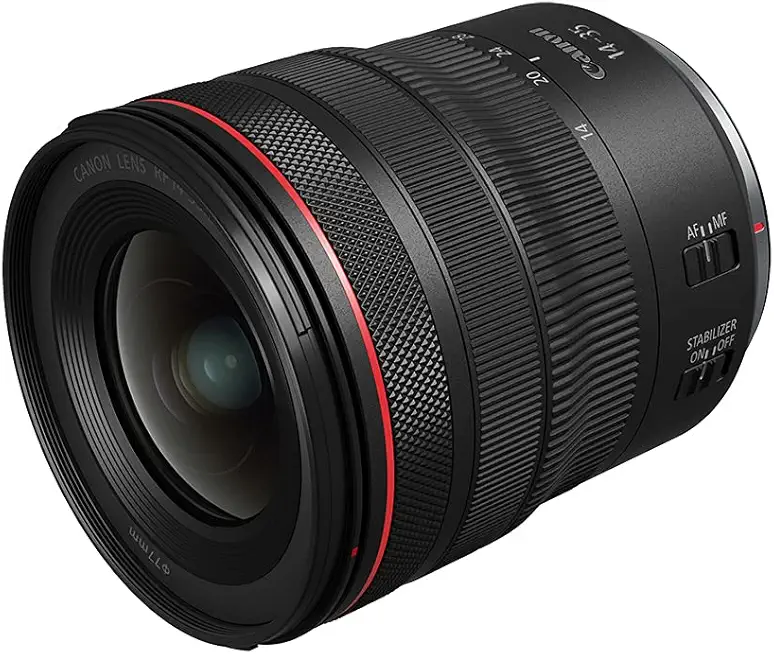
Canon RF 14-35 mm f/4 L
Professional-grade wide-angle zoom with constant aperture for consistent exposure. Robust, weather-sealed construction, superb corner-to-corner sharpness and low distortion make it ideal for landscapes, architecture, and travel.
Check PriceI shoot landscapes and architecture with the RF 14-35mm f/4 L a lot when I want the cleanest corners and the steadiest results. Compared to the RF 15-30, the 14-35 holds fine detail out to the edges with much less barrel distortion at the wide end, so I spend less time correcting lines in post. The constant f/4 aperture also makes exposure predictable when I’m stitching panoramas or shooting in changing light.
What it gives up versus the RF 15-30 is compactness and that handy close-focus trick. The 14-35 is bigger and heavier in the bag, and it doesn’t focus as close or give the same creative near-macro perspectives at 15mm. It’s also pricier, so if you really need a pocketable ultra-wide for travel, the RF 15-30 still wins on convenience.
If you’re a landscape, architecture, or travel pro who values edge-to-edge sharpness and weather sealing for outdoor shoots, you’ll prefer the 14-35. I reach for it when I need the cleanest files straight out of camera and when I’m working in rough weather or shooting long panoramas.
Alternative 2:

Canon RF 15-35 mm f/2.8 L
Fast-aperture pro zoom delivering stunning low-light performance and creamy background separation. Durable, weather-resistant build, exceptional resolving power and dependable autofocus for weddings, events, and dynamic creative work.
Check PriceThe RF 15-35mm f/2.8 L is my go-to when light is low or when I want more control over depth of field. Shooting night scenes, indoor events, or the Milky Way, that extra stop and a half of light makes a huge difference — I can handhold slower shutter speeds and still keep noise down. The images also have a more three-dimensional feel when I want subject separation near the wide end.
On the flip side, the 15-35 is significantly larger and heavier than the tiny RF 15-30, and it costs a lot more. For travel days where every ounce counts, or for casual street work where I want to stay nimble, the RF 15-30 feels much less intrusive. The 15-35 is a tool for intentional shooting, not throw-it-in-your-backpack convenience.
If you shoot weddings, events, astro, or any low-light work where aperture matters, you’ll prefer the 15-35. I pick it when I need reliable performance in tough light and creamy backgrounds; I leave it at home on long travel treks where weight and size are the priority.
Alternative 3:

Canon EF 16-35 mm f/4 L
Versatile wide-angle offering consistent f/4 performance with excellent sharpness and contrast. Lightweight and travel-ready, with robust construction and reliable rendering for landscapes, architecture, and environmental portraits.
Check PriceThe EF 16-35mm f/4 L is one I still reach for when I’m shooting with an adapter or when I want a straightforward, reliable wide zoom without spending on the latest RF options. It’s a solid performer with good contrast and pleasing color, and in the field it feels rugged and predictable — great for travel and landscape shoots where durability matters.
Compared with the RF 15-30, the 16-35 starts a touch narrower at 16mm and won’t be as compact on an RF body once you add an adapter. It also doesn’t have the same modern close-focus fun that the RF 15-30 offers, and depending on the version it may not match the newer RF lenses for corner micro-contrast and the newest coatings that tame flare.
If you already own EF glass or you want a dependable wide zoom without the newest price tag, the EF 16-35 is a practical choice. I use it when I need a workhorse that I can trust day after day, especially on shoots where I don’t want to fuss with fragile gear or when I’m switching between DSLR and mirrorless setups.
What People Ask Most
Is the Canon RF15-30mm F4.5-6.3 IS STM compatible with APS-C RF-mount cameras?
Yes — it uses the RF mount and will physically work on APS-C RF bodies, but the field of view will be cropped compared with full-frame.
How effective is the image stabilization on this lens?
Very effective — the lens offers up to about 5.5 stops of on-lens stabilization and can reach roughly 7 stops when paired with a compatible in-body IS system.
Does this lens have weather sealing?
No — the manufacturer does not state weather sealing and reviews do not describe it as weather-sealed.
What are the main optical corrections needed for images from this lens?
Expect heavy barrel distortion and noticeable vignetting at 15mm, plus some edge chromatic aberration; most of these are typically corrected in-camera or in post.
How close can you focus at 15mm, and is the magnification useful?
The close-focus distance is 0.28 m (11″) at all zoom positions, and in manual focus the lens can reach up to about 0.52x at 15mm, which is useful for creative near-macro shots.
Is the autofocus quiet and smooth enough for video?
Yes — the STM/stepper-driven AF is quiet, fast and provides smooth transitions well suited to video work.
What are the main alternatives in the Canon RF lineup for this focal range?
The outline doesn’t name specific alternatives; if you need faster apertures, stronger edge performance at 15mm, or weather sealing, look at other RF ultra-wide zooms that target those priorities.
Who This Lens Is / Isn’t For
If you travel a lot and want a true ultra‑wide without carrying a heavy bag, this lens will feel like a gift because it’s compact and easy to use all day. Landscape, cityscape and interior shooters in particular will love how it makes dramatic wide scenes accessible, and the stabilization means more handheld shots that actually work. Videographers and hybrid shooters who value quiet, smooth autofocus and strong stabilization for run‑and‑gun work will also get a lot of mileage from this lens, plus the close‑focus trick opens creative options.
Skip this lens if you routinely need fast apertures for low‑light action, stage work, or creamy subject separation—its modest maximum aperture makes those jobs harder. Portrait photographers who expect little distortion or buttery backgrounds will be frustrated by wide‑angle stretching and limited shallow‑depth control. Also pass if you spend long days in wet, dusty conditions or insist on bulletproof weather sealing and the most robust edge performance straight out of the camera.
Should You Buy It?
The Canon RF 15-30 mm f/4.5-6.3 is a strikingly compact, stabilized, well-priced ultra‑wide zoom built for travel and creative wide-angle work. It delivers crisp center sharpness, quiet autofocus, pleasing color, and an uncommon close‑focus trick that expands creative options. If you prize portability and steady handheld video, this lens rewards you more than bulkier alternatives with intuitive handling.
That said, this lens leans on in‑camera correction for its pronounced wide‑end distortion and corner light falloff, especially at the widest setting. Its modest maximum aperture and visible edge chromatic aberration limit performance in low light and fast action, so expect compromises in shallow‑depth work. Also, the lack of confirmed weather sealing leaves some shooters uneasy in rough conditions or wet shoots.
For landscapes, interiors and run‑and‑gun travel shooting it represents excellent value for its class without hauling extra glass. Serious low‑light and adventure photographers should look elsewhere, but most everyday wide‑angle users will find the compromises acceptable and useable for many situations. Bottom line: buy this lens if you want an ultra‑wide that prioritizes size, stabilization and usable sharpness; skip it if you need pro‑level weather resistance or faster glass, and for its intended users it remains a smart, practical tool.
Canon RF 15-30 mm f/4.5-6.3
Ultra-wide, travel-friendly zoom delivering expansive perspectives for landscapes, interiors, and creative compositions. Compact, lightweight design balances portability with reliable optics, producing punchy color and edge-to-edge detail for everyday shooting.
Check Price


0 Comments