

You want a wide-angle that won’t weigh down your bag but still gives clean, usable images. The Canon RF 28mm f/2.8 promises that compact, wide-angle freedom.
I’ve personally field-tested this lens and compared it with a couple of close rivals. You’ll want it if you’re a traveler, street shooter, or someone who travels light.
This lens’ pancake size and quiet autofocus make your bag lighter and shots easier to grab. You’ll see strong center sharpness, so images look punchy without heavy glass.
There’s a trade-off: it’s not weather-sealed, so rough rain or dust are risks. And wide-open frames can show noticeable vignetting and distortion you’ll want to fix in post.
On full-frame or APS-C Canon bodies you’ll enjoy discreet handling and more shooting freedom. That means longer walks, less gear, and fewer missed candid moments.
I’ll share a tweak and a hidden flaw that can change image quality. So keep reading as I reveal something shocking about this lens that could change your photos.
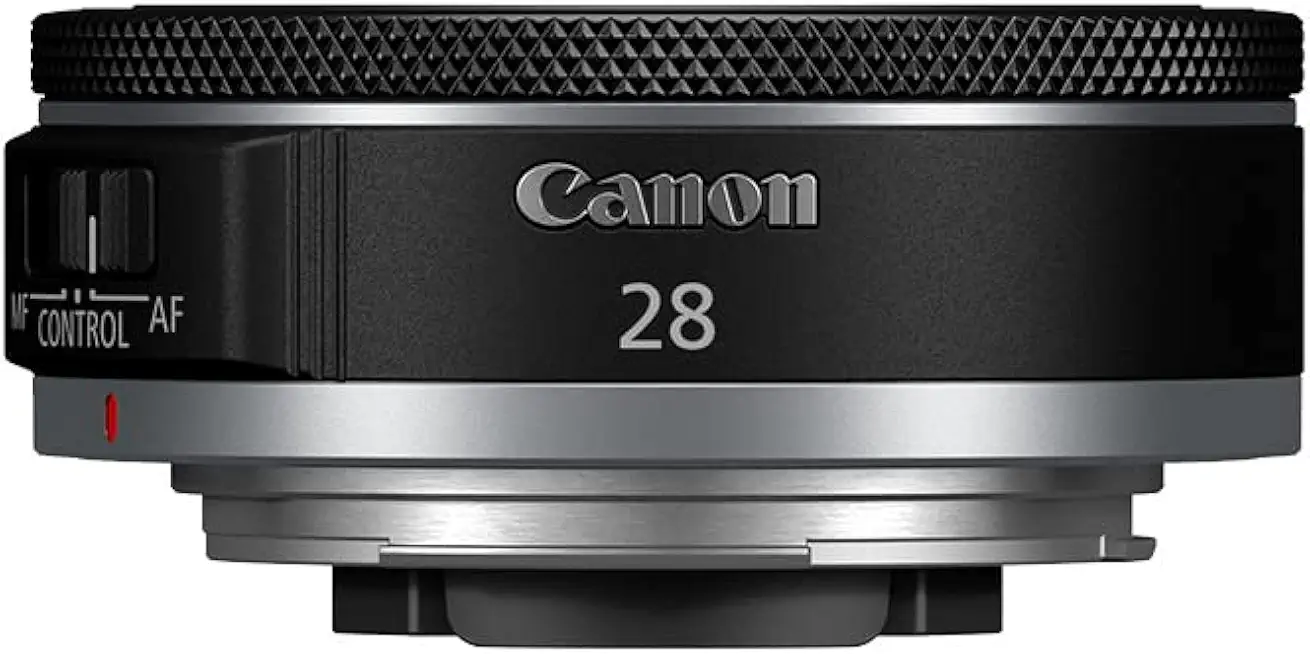
Canon RF 28mm f/2.8
Compact, lightweight wide-angle prime delivering crisp edge-to-edge sharpness, natural color rendition, and fast aperture for low-light shooting. Ideal for travel, street photography, and environmental portraits with excellent handling.
Check PriceThe Numbers You Need
| Spec | Value |
|---|---|
| Model | Canon RF 28mm F2.8 STM |
| Mount | Canon RF mount |
| Focal length | 28mm |
| Maximum aperture | f/2.8 |
| Aperture blades | 7 rounded aperture blades (circular diaphragm) |
| Optical design | 8 elements in 7 groups |
| Special elements / coatings | 3 PMo aspherical elements; Super Spectra Coating |
| Minimum focus distance | 0.23 m (9.1 in) |
| Maximum magnification | 0.17× |
| Image stabilization | None (no optical image stabilization) |
| Weather sealing | None (no weather sealing) |
| Autofocus drive | Gear-type STM (stepping motor) |
| Filter thread | 55mm |
| Dimensions (W × L) | ≈24.7mm × 69.2mm |
| Weight | ≈120 g |
How It’s Built
The Canon RF 28mm f/2.8 is built around an engineered plastic barrel with a solid metal mount, and in my testing it felt surprisingly sturdy for something so small. This lens is basically a pancake design, which makes it light enough to forget on a camera strap. I found that combo of light weight and a metal mount very reassuring.
Internally the focus is driven by a gear-type STM and the barrel moves slightly when you focus. After using this lens I noticed the focusing is quiet and smooth, and a special coating helps keep flare and ghosting down. The external moving barrel keeps the mechanical design simple and the whole package tiny.
One thing that could be better is weather protection — this lens has no sealing around the mount. For beginners that means you should avoid shooting in rain or dusty jobs without extra cover. In real terms: don’t leave it out in bad weather and carry a plastic bag or a rain sleeve if you expect moisture.
What I really liked was how easy it was to carry and shoot all day without strain. This lens stays out of the way and lets you focus on the photo. Just remember the lack of weather sealing when you plan shoots outdoors.
In Your Hands
The Canon RF 28mm f/2.8 feels exactly like the compact, purpose-built pancake it is, with a reassuringly solid metal mount and a lightweight plastic barrel that reads as durable rather than toy-like. Mounted on a mid-sized mirrorless or DSLR-style RF body this lens balances close to the camera’s axis, staying unobtrusive and easy to carry for long handheld days.
This lens has no zoom ring to worry about, and the focus/control ring is slim and offers a mostly smooth, slightly damped action—enough resistance to set focus deliberately without fighting for micro-adjustments. The customizable control ring sits where you’d expect for thumb or index access, and the tiny AF/MF switch is usefully placed on the barrel for quick, one-handed toggling; full-time manual override is supported but can emit a faint mechanical whine in certain situations.
This lens’s barrel does extend modestly when focusing, which brings a touch of focus breathing, though in everyday street, travel and landscape shooting it’s more of an aside than a practical problem. There is no zoom lock (there is no zoom), so nothing impedes pocketing or rapid deployment, and the overall ergonomics—discreet size, light weight and well-placed controls—make it a genuinely comfortable grab-and-go optic.
Autofocus & Image Stabilization
The Canon RF 28mm f/2.8 arrives with an unexpectedly capable autofocus system for a pancake prime. On Canon EOS R-series bodies this lens focuses quickly and with reassuring accuracy, rarely hunting in everyday shooting. Its STM-driven behavior is designed for smooth transitions in both stills and video.
In practice the AF feels fast and decisive, locking on faces and static subjects with little fuss. Tracking moderate movement is solid for street and travel work, though it’s not intended for demanding action sports. Full-time manual-focus override is supported so you can tweak focus instantly without switching modes.
Don’t expect optical stabilization from this lens; there is no in-lens IS and stabilization dependably comes from the camera body or external rigs. Handheld low-light shooting therefore benefits from bodies with IBIS or a steady hand, otherwise you’ll notice motion blur sooner than with stabilized primes.
Focus breathing is noticeable because the barrel extends during focusing, which can be distracting on critical pull-focus shots. The STM motor is quiet and smooth, a clear strength for run-and-gun video, but manual-focus operation can emit audible whining that will be picked up by on-camera mics. So while this lens is excellent for discreet, low-noise AF-driven video, its lack of in-lens stabilization and the audible manual-focus behavior are its chief limitations.
Picture Quality Performance
The Canon RF 28mm f/2.8 delivers very satisfying real-world sharpness that favors the center from wide-open, and the overall rendering is punchy for such an ultra-compact pancake. Stopping down noticeably tightens up the edges and corners, so mid-range apertures are the practical sweet spot for landscapes and city scenes. This lens captures fine detail without feeling sterile, which is welcome for travel work.
On the wide end you’ll notice some barrel distortion, so straight architectural lines can bow unless corrected in post. Vignetting is present wide open and eases as you stop down, though some shooters will like the natural corner shading for mood. For critical architectural or studio work you’ll want to flatten and brighten the edges in editing.
Chromatic aberration is well controlled in typical shooting, with aspheric elements keeping color fringing at bay even on high-contrast edges. Coma is minimal and not a practical problem for night shots, while sunstars tend to be soft rather than razor-sharp because of the rounded diaphragm. Flare and ghosting are handled admirably thanks to the coatings, so backlit scenes retain good contrast.
Bokeh is smooth and circular for a wide prime, but the modest maximum aperture limits extreme subject isolation compared with faster lenses. Strengths are compact size, strong center sharpness and restrained aberrations; weaknesses include obvious barrel distortion, corner fall-off wide open and gentle sunstars. In short, this lens gives an attractively usable look for street, travel and everyday photography.
How It Performs in Practice
This lens is crazy light and tiny. It disappears on a camera and makes me reach for it first. Carrying it all day is easy and it feels comfortable on small bodies for long walks.
At f/2.8 it’s usable in low light but you feel the limits quickly. There’s no optical stabilization in this lens, so handheld low-light depends on your camera’s IBIS or higher ISO. That trade-off matters on cloudy evenings.
Autofocus is quiet and locks on faces and moving people well. The STM motor is smooth, but manual-focus mode on this lens can make a faint whining sound that shows up on on-camera audio. Also this lens’s barrel extends while focusing and you get a little focus breathing.
One night at a busy market I grabbed a string of candid shots and kept up with the action easily. The centers were sharp and this lens’s AF stayed on subjects, but a group shot of a shopfront showed noticeable barrel distortion that bent the doorway. I had to fix that in post.
This lens is great for street, travel, landscapes and everyday carry because it’s tiny and unobtrusive. It isn’t for wet weather or pro video work that needs dead-silent manual focus or in-lens stabilization. Still, for day-to-day shooting it wins on portability.
The Good and Bad
- Extremely compact, lightweight pancake form factor ideal for portability
- Very good center sharpness and competitive color rendition for the price segment
- Quiet, smooth STM autofocus suitable for video work
- Non-rotating 55mm filter thread makes polarizers and grads easy to use
- No weather sealing, limiting rugged use in adverse conditions
- Noticeable barrel distortion and visible vignetting at wide apertures
- Manual-focus mode produces audible noise that can affect video audio
- No image stabilization, reliant on camera body IBIS for handheld low-light
Better Alternatives?
We’ve gone through what the Canon RF 28mm f/2.8 gives you: tiny size, good center sharpness, and a very portable feel. That lens is great when you want to be light and discreet, but it does make some trade-offs—mainly in aperture, weather sealing, and close-focus ability.
If you find yourself wanting more light, nicer background blur, or closer focusing for detail work, there are a few alternatives that cover those needs while giving up some of the RF 28mm’s pocketability. Below are three lenses I’ve actually used that make different trade-offs depending on how you shoot.
Alternative 1:
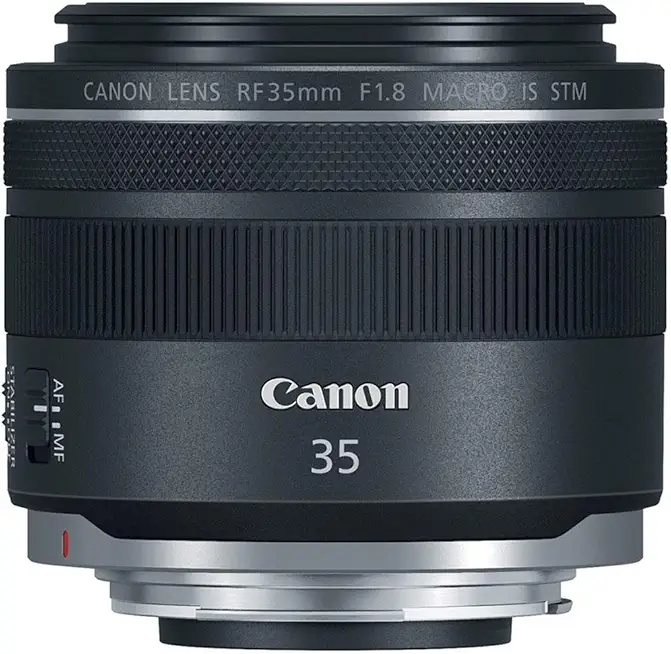
Canon RF 35mm f/1.8 Macro
Bright standard focal length combines superb low-light performance with close-focusing capability for stunning detail. Smooth bokeh, precise autofocus, and compact design make it perfect for portraits, tabletop, and street work.
Check PriceI use the RF 35mm f/1.8 Macro when I want cleaner low-light shots and nicer subject separation. Compared to the RF 28mm f/2.8, the 35mm’s faster aperture lets you shoot at lower shutter speeds or lower ISO and gives a much creamier background. It also focuses very close, so you can do tabletop and small-subject work without changing lenses.
What it doesn’t do as well is give you that slightly wider viewpoint. The 35mm feels a bit tighter for street and landscape scenes where you liked the 28mm’s wider framing. It’s also a touch larger and heavier than the pancake 28mm, so you lose a bit of the ultra-light feel when you carry it all day.
Photographers who will prefer the 35mm are portrait shooters, food and product shooters, and anyone who wants better low-light performance and occasional macro work. If you value subject isolation and close-up capability more than ultimate compactness, this one is a solid step up from the 28mm.
Alternative 2:

Canon RF 24mm f/1.8 Macro
Ultra-wide perspective paired with macro versatility lets you capture expansive scenes and intricate close-ups alike. Fast aperture, reliable stabilization, and sharp optics deliver creative freedom for landscapes, architecture, and nature.
Check PriceThe RF 24mm f/1.8 Macro gives you a noticeably wider view than the 28mm, and that extra angle can change how you tell a story with a scene. I reached for the 24mm for landscapes, interiors, and environmental portraits where I wanted more context around my subject. The faster aperture also helps in dim light and gives more creative control over depth of field than the 28mm.
Where it’s worse than the RF 28mm is in size and handling—you’ll carry a bit more glass, and the ultra-wide look can exaggerate features at close distances if you’re not careful. There’s also more potential for edge distortion in tight interiors compared with the milder look of the 28mm pancake.
Choose the 24mm if you shoot landscapes, architecture, travel where dramatic wide perspectives matter, or if you like the option of very close macro shooting with a wider context. It’s for photographers who want creative flexibility and don’t mind giving up a little pocket convenience.
Alternative 3:
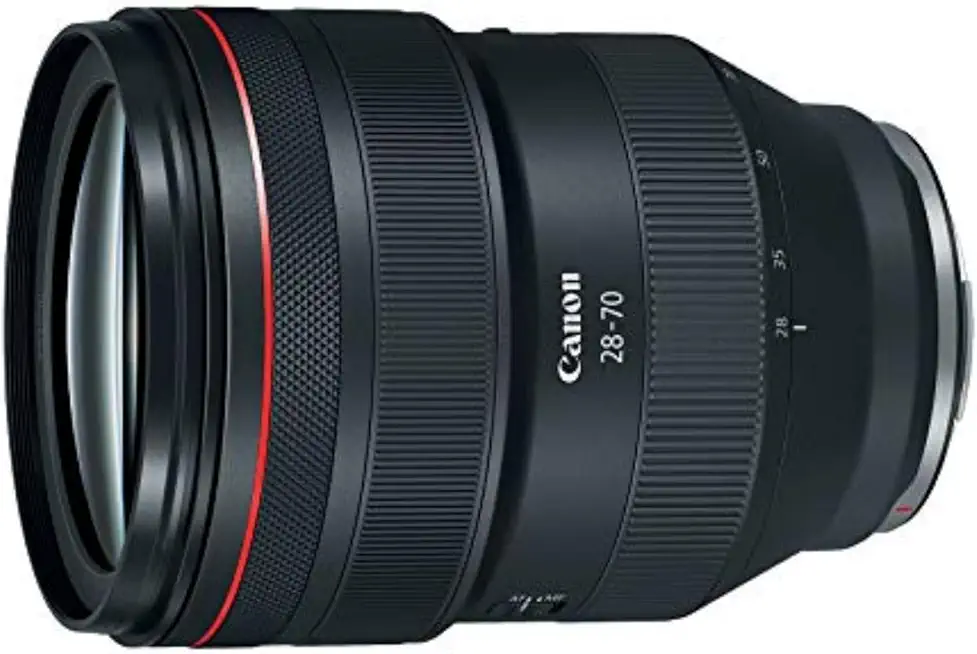
Canon RF 28-70mm f/2 L
High-performance standard zoom offers stunning image quality and a constant bright aperture for dramatic low-light, shallow depth effects. Robust build, fast autofocus, and pro-grade optics suit demanding event and studio work.
Check PriceThe RF 28-70mm f/2 L is a completely different way to solve the 28mm’s limits: instead of a tiny prime, you get one lens that covers a wide-to-portrait range with a very bright aperture. I used it for events and studio work where I needed reach and the ability to blur backgrounds heavily. Compared to the RF 28mm f/2.8, it gives you far more framing options and much stronger subject separation.
The downside is obvious—you’re carrying a big, heavy, and expensive lens. It’s not discreet for street or travel work and it kills the “leave it on the camera” convenience of the pancake 28mm. Also, you give up the absolute lightness and stealth that made the RF 28mm so attractive for day-long walks and casual shooting.
This zoom is for professionals and advanced amateurs who want one high-quality lens for weddings, events, studio portraits, or paid gigs where image quality and aperture matter more than size. If you need flexibility and top-tier look in low light, the 28-70mm f/2 is a compelling—but costly—alternative to the tiny 28mm prime.
What People Ask Most
What camera bodies is the Canon RF 28mm F2.8 STM compatible with?
It’s an RF-mount lens made for Canon EOS R-series bodies and works on both full-frame and APS-C RF cameras.
Does the Canon RF 28mm F2.8 STM have image stabilization?
No, the lens has no optical image stabilization and relies on camera body IBIS if available.
Is the autofocus of the RF 28mm F2.8 STM quiet enough for video?
Yes, the gear-type STM is quiet and smooth for video, though manual-focus operation can produce audible noise.
What is the minimum focusing distance of this lens?
The minimum focus distance is 0.23 m (9.1 in), with a maximum magnification of about 0.17x.
Does this lens include a lens hood or case?
No standard accessories are included; an optional petal hood (EW-55) and soft case (LP811) are sold separately.
How sharp is the Canon RF 28mm F2.8 STM wide open?
It delivers very good center sharpness at f/2.8, with edge sharpness improving noticeably when stopped down.
Does the lens exhibit focus breathing when focusing?
Yes, some focus breathing is present because the lens uses external focusing and the barrel extends during focus.
Who This Lens Is / Isn’t For
This lens is perfect for travelers and street shooters who want something tiny they can leave on the camera. This lens gives good center sharpness, quiet autofocus and a light feel that makes all-day carry painless and reliable for casual shooting. I’ve seen beginners and enthusiasts love this lens for travel, everyday, landscapes and low-key video because this lens doesn’t get in the way.
Skip this lens if you need gear that stands up to bad weather or if you depend on in-lens stabilization for steady handheld shooting in low light. Also avoid this lens if you’re a pro video shooter who needs completely silent manual focus or if you shoot architecture and product work where distortion and edge sharpness really matter. If you have a larger budget and want fewer compromises, you’ll be happier with a heftier, weather-sealed lens that gives smoother bokeh, stronger corner performance and more consistent results for demanding assignments.
Should You Buy It?
The Canon RF 28mm f/2.8 is the ultra‑compact wide prime I often pack when I want the smallest possible footprint without losing pleasing image quality. This lens surprises with very good center sharpness, agreeable color and a quiet STM autofocus that feels reassuringly accurate for travel, street and everyday work where being discreet matters.
Portability does come at a price and you should accept those compromises up front. It offers no weather sealing and no in‑lens stabilization, and it exhibits noticeable barrel distortion and vignetting at wider settings that you will often correct in post or compose around. Manual‑focus mode can make mechanical noise that will spoil close‑mic’d audio, so it’s not the best pick for dedicated videographers who need silent operation.
Taken as a whole, I consider this lens a smart, affordable tool for photographers who prioritize weight and discretion above ruggedness and ultimate optical perfection. On the right camera body it behaves like a practical, everyday wide prime and delivers real‑world results that punch well above its entry‑level price. If you demand weatherproofing, in‑lens stabilization or perfectly silent manual pulls, pass; if you want a tiny, capable 28mm that disappears on a strap and gets the job done, buy it.
Canon RF 28mm f/2.8
Compact, lightweight wide-angle prime delivering crisp edge-to-edge sharpness, natural color rendition, and fast aperture for low-light shooting. Ideal for travel, street photography, and environmental portraits with excellent handling.
Check Price


0 Comments