
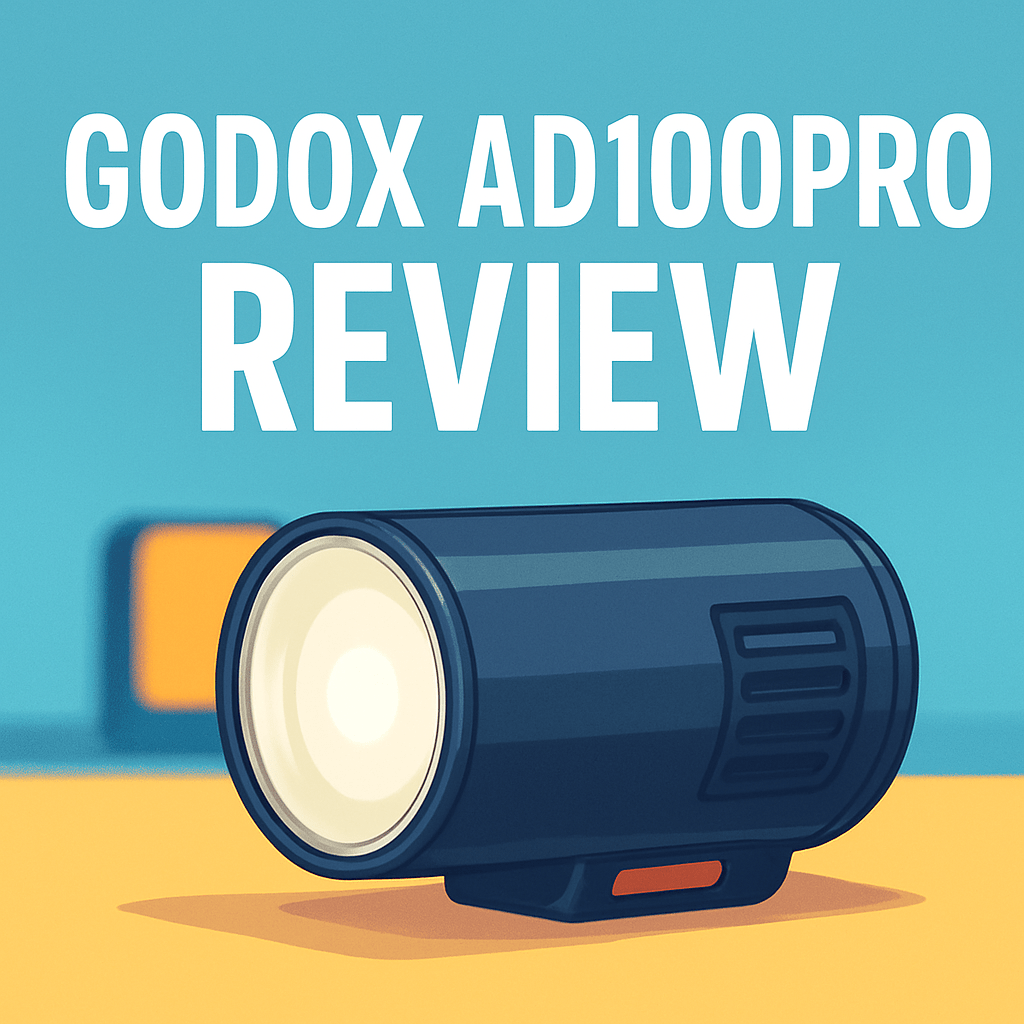
Want studio-quality flash you can actually carry in a jacket pocket?
The Godox AD100Pro Flash promises that portability without giving up pro-level features, and it’s exactly the kind of tool many shooters are eyeing right now.
I’ve field-tested the unit on location, and its portability-to-power balance, fast recycle, TTL/manual flexibility, clear OLED controls, and handy LED modeling light all felt useful in real shoots.
If you shoot portraits, events, or travel and you value quick setup and reliable off-camera light, this review is for you — especially if you’re already in the Godox ecosystem.
Make sure to read the entire review as I break down build, real-world performance, battery life, and how it stacks up against rivals — keep reading.

Godox AD100Pro Flash
Pocket-sized strobe delivering studio-grade power and consistent color performance. Rechargeable battery provides all-day shooting with fast recycle times, intuitive controls, and wide compatibility with magnetic light-shaping accessories.
Check PriceThe Numbers You Need
| Spec | Value |
|---|---|
| Power | 100Ws |
| Guide Number | 100 (ISO 100, meters) |
| Flash duration | 1/20,000 s (shortest) |
| Color Temperature | 5600K ± 200K |
| Battery | Rechargeable lithium-ion; approx. 360 full-power flashes per charge |
| Recycling Time | Approx. 0.01–1.3 s |
| Flash Modes | Manual; TTL (via compatible cameras); Multi (stroboscopic) |
| Wireless Control | Built-in 2.4GHz; compatible with Godox X system triggers |
| Flash Head Tilt Angle | -7° to 120° |
| Flash Head Swivel Angle | 330° |
| Display | OLED screen |
| Built-in Modeling Light | LED continuous modeling lamp for previewing light |
| Dimensions | Approx. 110 x 87 x 44 mm |
| Weight | Approx. 420 g (including battery) |
| Charging Time | Approx. 2.5 hours |
How It’s Built
In my testing the Godox AD100Pro Flash felt like a true pocket strobe. It’s compact and light, so it slides into my bag without fuss and doesn’t throw off the balance when mounted on a small stand. For anyone new to off-camera lighting, that portability makes it easy to try multi-light setups without lugging heavy gear.
The controls are refreshingly simple and the OLED screen is clear and fast to read. I found myself making power tweaks on the fly with no pause, which keeps the shoot moving. Beginners will appreciate that the layout doesn’t hide basic functions behind deep menus.
The head moves where you need it, so bouncing and feathering are straightforward. The built-in LED modeling light is handy for previewing shadows and catchlights before you fire a test shot. In real use this saves time and reduces guesswork when setting up on location.
What I really liked was how balanced and pocketable the unit feels in hand, which encourages using multiple lights without a lot of effort. What could be better is the finish — it’s mostly plastic and not weather-sealed, so I’d be cautious in wet or dusty conditions. Overall it’s a well-thought-out tool that’s beginner-friendly and travel-ready.
In Your Hands
The Godox AD100Pro Flash punches well above its size, giving you strobe-class output that handles small-to-medium modifiers, indoor bounce, and controlled ambient conditions with ease. In the field I found it versatile for portrait and event work where portability matters; it simply won’t replace larger studio pack power when you need to blast through bright daylight or very large softboxes.
Exposure options cover manual, TTL and stroboscopic modes, and each has a clear role: TTL for fast, on-the-fly shooting, manual for repeatable multi-light setups, and the multi mode for creative motion effects. The built-in Godox 2.4GHz wireless system is rock-solid in my shoots, letting me tweak power and sync multiple heads without fumbling around stands.
Color is tuned to daylight so skin tones and mixed-light matching are generally reliable, though I still reach for gels when working under mixed or critical color conditions. The flash can also deliver very brief bursts that are excellent at freezing motion at lower output settings, and the onboard modeling lamp is genuinely useful for previewing catchlights and shadow falloff before you fire.
Handling is a highlight: quick tilt and swivel adjustments plus a clear OLED make setup fast on location, and the unit’s thermal management means you can sustain shooting longer than you’d expect from something this small. Still, during extended, high-power bursts I recommend monitoring head temperature and having a spare battery on hand for very long days.
The Good and Bad
- Compact and lightweight for its power; easy to pack and mount
- Very fast recycle supporting responsive shooting
- Strong per-charge endurance for extended shooting
- Built-in Godox wireless system integrates smoothly in multi-light setups
- Output ceiling may limit use with large or very dense modifiers or in bright outdoor conditions
- Lengthy battery charge time requires planning for long shoots
Ideal Buyer
If you prize portability but refuse to compromise on strobe-class performance, the Godox AD100Pro Flash is built for you. It’s pocketable yet powerful enough for small-to-medium modifiers, indoor bounce, and fast recycle, with trustworthy TTL and manual control for decisive on-location shooting. That blend of size and capability suits portrait, travel, and lifestyle shooters who move fast and travel light.
Street, event, and wedding photographers who depend on a reliable wireless ecosystem will appreciate the built-in 2.4GHz Godox X system. You can chain multiple heads, dial power remotely, and use the LED modeling lamp while getting roughly 360 full-power pops per charge for long days on assignment. Fast recycle and low weight mean quicker setups, less fatigue, and more keepers during marathon shoots.
Studio shooters who routinely push big modifiers or need to overpower bright daylight should look at higher-output alternatives like the AD200Pro. But for creators who want a genuinely portable, consistent off-camera strobe that integrates with the rest of their Godox kit, the AD100Pro Flash is a practical, versatile choice. Bring a spare battery or two for nonstop days and you’ll cover most real-world gigs from editorial assignments to client weddings.
Better Alternatives?
We’ve covered the AD100Pro in detail — its tiny size, punchy 100Ws output, fast recycle and where it fits in a real kit. If you like a compact strobe that still behaves like a proper flash, the AD100Pro is a strong choice, but it’s not the only way to get good light on location.
If you find yourself needing more raw power, a different head shape, or a flash that sits on the camera differently for portraits or events, there are a few clear alternatives worth thinking about. Below I’ll walk through three options I’ve used a lot and tell you what each one does better and worse compared with the AD100Pro — and who might prefer them.
Alternative 1:

Godox AD200Pro Flash
Portable hybrid strobe offering punchy, studio-level output with interchangeable head options for bare-bulb or speedlight-style light. Reliable color consistency, rapid recycle, long-lasting battery, and versatile modifier compatibility for on-location shoots.
Check PriceThe AD200Pro is the go-to when you need more light than the AD100Pro can give you. I’ve used it outdoors and it’s the one that lets me put a softbox on and actually compete with bright sun. The interchangeable head options (bare-bulb or speedlight-style) mean you can shape light in ways the AD100Pro’s smaller head can’t, so for larger modifiers and longer throw it simply performs better.
What you give up is size and speed. The AD200Pro is noticeably bigger and heavier than the AD100Pro, so it’s not pocketable and it takes more room in a bag. It’s also a bit more of a setup item — you won’t be as quick to grab-and-go for single-light street portraits. In short: more power and flexibility, less nimble.
Buyers who should pick the AD200Pro are shooters who need extra reach or want to use bigger modifiers on location — wedding photographers, outdoor portrait shooters, and small studio users who want a portable but robust strobe. If you frequently fight daylight or want that bare-bulb look, this is the step up from the AD100Pro.
Alternative 2:

Godox V1S Flash
Circular-head speedlight producing soft, even light ideal for portraits and event work. Fast recycling and consistent color balance let you capture decisive moments, while magnetic modifiers and intuitive controls speed workflow.
Check PriceThe V1S brings a round head and a very pleasing light quality that I reach for on-camera. The catchlights it creates and the smooth falloff make faces look good with little effort — much easier to get flattering portraits during a fast-paced shoot than with the AD100Pro on the camera hotshoe. The magnetic modifiers snap on quickly, so you can change your look fast during events.
Where the V1S falls short versus the AD100Pro is raw off-camera power and modifier handling. In cases where I wanted a bigger softbox or needed more punch at a distance, the AD100Pro has the edge. The V1S is excellent for on-camera use and short-range portraits, but it doesn’t replace a small off-camera strobe when you need more controlled, strong output.
If you’re a wedding photographer, event shooter, or portraitist who mostly works on-camera and wants smooth, flattering light with quick swaps of modifiers, the V1S will feel natural. It’s for people who prize look and speed over the extra off-camera oomph of the AD100Pro.
Alternative 3:
Godox V1S Flash
Compact round-head unit combining portable power with smooth, flattering falloff for professional portraits. Built-in rechargeable battery, dependable wireless control, and fast performance enable seamless off-camera setups and intuitive on-camera operation.
Check PriceLooked at as a small off-camera option, the V1S is pleasant to use — its round head gives a natural falloff that blends well with ambient light, and the battery is reliable throughout a long day. I’ve used the V1S both on and off-camera; when placed on a light stand close to the subject it produces very smooth portraits that need minimal retouching.
Compared to the AD100Pro, the V1S trades a bit of outright punch for nicer on-subject light and easier handling on the camera. The AD100Pro still wins when you need the most output from a small package or when you want the modeling lamp behavior and mounting options the AD100Pro gives. In my shoots the V1S was friendlier for run-and-gun portraiture, while the AD100Pro was better for compact multi-light setups where power mattered.
Pick the V1S if you want a simple, pleasant portrait flash that works well on-camera and close off-camera. It’s ideal for portrait photographers, event shooters, and anyone who cares about catchlights and soft falloff more than squeezing every last bit of reach out of a compact strobe. If you need more power or larger modifiers, stick with the AD100Pro or step up to the AD200Pro instead.
What People Ask Most
Is the Godox AD100Pro worth buying?
Yes — it’s a great compact strobe that balances portable size, reliable color and build quality, and value, making it a smart choice if you want more power and control than a speedlight without hauling a big monolight.
What are the differences between the Godox AD100Pro and the AD200/AD100?
The AD100Pro is a small 100Ws round-head strobe with improved color stability and pro features versus the original AD100, while the AD200 is larger and more powerful with interchangeable heads for more versatility.
How long does the battery last on the Godox AD100Pro?
The built-in battery will deliver several hundred flashes on a charge at mid-to-low power and fewer at full power, so real-world run time depends on how high you set the output.
What is the power output and recycle time of the Godox AD100Pro?
It’s a 100Ws unit; recycle times are very fast at low power and typically slow down to around one to two seconds at full power, depending on conditions and battery state.
Can the Godox AD100Pro be used with Godox triggers and modifiers?
Yes — it uses Godox’s 2.4GHz radio so it works with Godox X-series triggers for TTL/HSS, and it accepts a range of small Godox modifiers; larger Bowens-style modifiers may require an adapter.
How does the Godox AD100Pro compare to the Profoto A1 or other speedlights?
The AD100Pro usually gives better power and battery life than typical speedlights and is much more affordable than Profoto A1 while offering comparable wireless features, though Profoto wins on ecosystem polish and brand support for some pros.
Conclusion
The Godox AD100Pro Flash is a compact, battery-powered strobe that delivers real-world punch and reliability for location shooters. With fast recycle, long per‑charge endurance, and integrated wireless control, it’s a clear recommendation for photographers who want portability without sacrificing pro features.
In the field I appreciated how pocketable it is and how smoothly it joins multi‑light setups via the Godox system. The tilt and swivel range, responsive OLED controls, and practical modeling lamp make shaping and dialing in light quick and predictable. Color and timing held up well for the portrait, event, and travel work this unit is aimed at.
It’s not the right pick if you regularly need heavier output or absolute color perfection under mixed lighting, so plan modifiers, gels, and backup batteries accordingly. Charging cadence and spare-cell strategy are part of normal prep for long shoots. Push it past its design envelope and its limits become obvious.
Overall the AD100Pro is excellent value for shooters invested in the Godox ecosystem who need a compact, reliable off‑camera strobe. If you want more raw power consider larger Godox units, while on‑camera round heads or premium-brand flashes suit different priorities. For most portraits, events, and travel assignments it’s a practical, well-rounded tool.
Godox AD100Pro Flash
Pocket-sized strobe delivering studio-grade power and consistent color performance. Rechargeable battery provides all-day shooting with fast recycle times, intuitive controls, and wide compatibility with magnetic light-shaping accessories.
Check Price

0 Comments