

How to photograph cocktails and make them pop on your feed?
This guide shows clear, simple steps for lighting, angles, glassware and garnish styling. It also gives camera settings, gear checklists, shot lists and a day-of shoot quick checklist.
You will learn a step-by-step workflow for natural side and back light, how to control reflections, and how to pick the right lens and aperture. Quick fixes for color casts, fingerprints and melted ice are included.
Follow these tips and you will shoot fresh, magazine-ready cocktail photos fast. Let’s dive in and make your drinks look irresistible.
Utilize Natural Light for Best Results
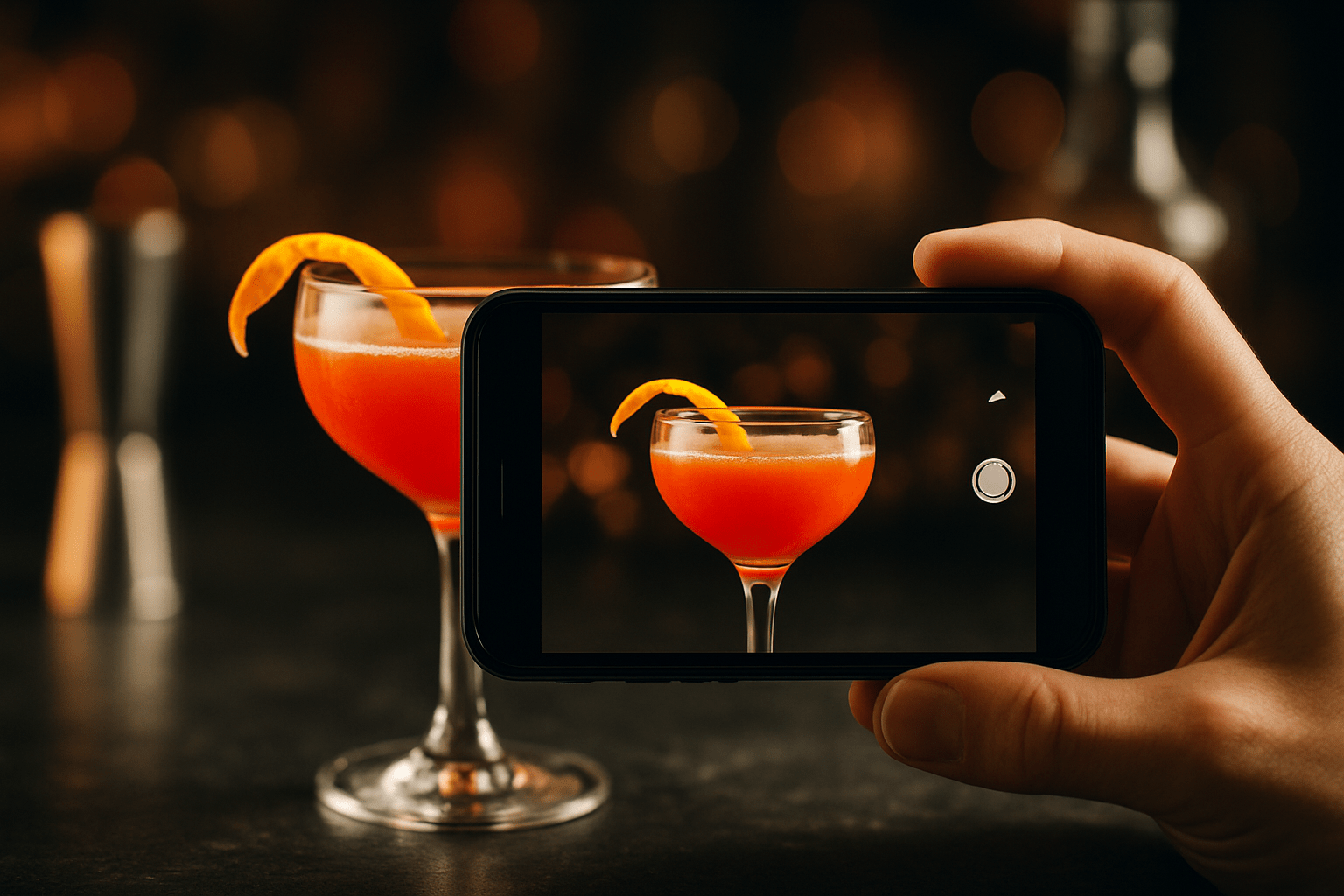
Natural window light makes cocktails glow and keeps colors honest. If you are learning how to photograph cocktails, this is the most forgiving and beautiful place to start.
Side light and backlight reveal what makes drinks special. Backlight shows translucency and bubbles, while side light adds shape and a soft rim that makes glass edges shine.
Set up near a large window where the light can skim across the drink at an angle. North-facing windows or any spot with consistent shade are great because they give even light through the day.
Direct sun can be harsh, but you can tame it. Clip a sheer curtain, a diffusion panel, or even a white shower curtain between the window and your set to soften highlights.
Backlight at golden hour gives warm highlights and gentle gradients in the liquid. On bright midday, use diffusion and shoot in the window’s shade so the cocktail keeps detail and you avoid blown reflections.
Use reflectors and black cards to sculpt the glass. White foam board on the shadow side fills softly, silver adds a punchier highlight, and a black flag deepens shadows to control messy reflections.
Move the cards until you see clean lines on the glass. You are painting with light and dark, so small shifts will change the shape and shine on the rim and stem.
Turn off room lights to avoid mixed color casts. Keep backgrounds neutral, set a custom white balance with a card, or shoot RAW so you can correct tint later without damage.
For camera basics, shoot RAW, keep ISO around 100–400, and use a tripod so you can work at slower shutter speeds. A remote shutter or mirror lock-up helps avoid any shake when you press the button.
Use f/1.8–f/2.8 for dreamy close-ups where the garnish is sharp and the background melts. Choose f/5.6–f/8 for flat lays and groups so the scene stays crisp across the frame.
Step 1: Place your table and cocktail near a big window with light 30–60 degrees off the camera axis, either side-lit or slightly backlit. Keep a bit of distance from the window to reduce harshness.
Step 2: If the sun is direct, slide a diffuser between the window and the drink. Watch the hot spots soften and the color even out as the light spreads.
Step 3: Add a white reflector on the opposite side of the glass to lift shadows. If reflections get busy, bring in a black card near the glass edge to create a clean dark stripe.
Step 4: Test exposure and shoot bracketed frames. Adjust the fill and the diffuser distance until the highlight on the liquid and rim looks bright but not clipped.
If your highlights are too hot, move the diffuser closer to the glass or reduce fill from the silver card. If the image feels flat, pull the white card back or add a black flag to bring contrast to the contours.
If you see a green or orange cast, it is often from mixed lighting. Kill overhead bulbs, set a custom white balance, or correct in RAW with the temperature and tint sliders.
Here is a quick example. I placed a whiskey sour near a shaded window, added a shower curtain for diffusion, and used a white card for fill; the foam held detail and the lemon garnish popped with a clean rim light. Without diffusion, the foam blew out, so I pulled the diffuser in and tilted the glass a touch to shift the brightest reflection, which fixed the issue in seconds.
If you want a compact primer on exposure and setup, this cocktail photography guide can help you lock in the fundamentals before you style the scene.
Once you see how the window shapes the drink, the phrase how to photograph cocktails becomes simple: control the direction, soften the source, and sculpt with white and black cards until the glass sings.
Experiment With Angles for Dynamic Results
Angle changes the story and decides what the viewer feels first. Move your camera and the drink transforms from a technical diagram to a mood piece.
Overhead, or flat lay, is perfect for spreads, menus, and bar tools. Use f/5.6–f/8 and a 35–50mm lens so the top surface, coasters, and garnishes stay in focus without distortion.
The classic hero is the 45-degree or three-quarter angle. It shows the liquid surface, the glass shape, and the garnish at once, and f/2.8–f/4 gives separation without losing key detail.
Table-level or straight-on is best for tall highballs and layered drinks. Keep the horizon straight, use the rule of thirds, and leave negative space for copy or breathing room.
Close-up and macro make textures the star, like sugar rims, foam bubbles, and condensation. A 90–105mm macro at f/4–f/8 balances bokeh with sharpness on the exact point you want.
Plan a simple shot list so you come away with variety. Capture a hero 45-degree shot, an overhead flat-lay of the setup, a straight-on photo of a tall glass, a tight macro of a garnish, a pour or stir in burst mode, and a group or serving scene.
For action, start at 1/500 second or faster and switch to continuous burst. If the window is dim, use off-camera flash with high-speed sync, or embrace a little motion blur on the stir for mood.
Keep composition clean with the rule of odds and strong leading lines from straws, stirrers, or bar tools. Place the hero off-center and let light or props guide the eye back to it.
Case study: I shot a Negroni at a 45-degree angle near a side-lit window with a diffuser. Settings were ISO 100, f/3.2, 1/160 second on a 50mm lens; I then captured a quick overhead of the bar tools and a macro of the orange twist oils.
The lighting diagram in words is simple. Window at left with a diffuser, white card to the right, small black flag near the rear edge of the glass to carve a clean line, and the camera slightly higher than the rim to keep the meniscus visible.
If you are working with a phone, you can apply the same angles. These smartphone tips mirror the angle choices above and help you avoid distortion when you get close.
When you plan angles before pouring, you spend more time shooting and less time fixing. That foresight is a big part of how to photograph cocktails with consistency.
Choose the Right Glassware
Glass choice defines silhouette, highlights, and the story your photo tells. The right glass turns a simple liquid into a character with a clear shape and mood.
Coupe glasses flatter sours and martinis with a low profile and elegant stem. Rocks glasses suit Negronis and old-fashioneds, while highball or collins glasses hold long fizzy drinks that want height and bubbles.
Tall glasses invite straight-on angles and tighter framing, because the height can clip easily at overhead. Short glasses look great from 45 degrees and let you show garnishes and the surface line without distortion.
Pick glassware that is optically clean with minimal branding. Cut crystal throws beautiful highlights for a vintage feel, while plain glass is modern and calm; both work if they match the drink’s mood.
Chill the glass in the freezer so the first pour looks fresh. For controlled condensation on set, spritz a glycerin and water mix on the outside and chill the glass; keep it off the actual drink if the cocktail will be served.
Polish with a microfiber cloth and a little alcohol solution for a streak-free finish. Handle with gloves or tongs so you do not add prints as you move props around the set.
Mind the fill line for a clean look. In a coupe, stop just below the rim so surface tension forms a gentle meniscus; in a rocks glass, finish about a finger below the lip; in a highball, leave 1–2 centimeters for fizz and garnish room.
Style small, balanced accents that fit the scale of the glass. Rim with sugar or salt when it fits the recipe, choose straws and stirrers that do not overwhelm, and consider double-walled or colored glass for a modern twist.
Choosing glassware with purpose is another quiet answer to how to photograph cocktails, because it sets the frame for light, angle, and garnish to do their work.
Highlight the Garnish and Details
Garnish is the drink’s personality, and it often becomes the focal point. Your composition and focus should support it like a portrait of a face.
Pick fresh and vibrant elements that read on camera. Thin citrus twists, firm cherries, crisp herbs, and bright edible flowers add color contrast and shape without blocking the drink.
Keep scale in mind and avoid bulky pieces that hide the surface. Trim the garnish so it sits cleanly on the rim or skewer without sagging or stealing too much attention.
Place with tweezers or tongs so the position is precise. Tilt the garnish slightly toward the camera, remove stray fibers, and fix tiny imperfections before you pour to save time later.
Make details pop with simple tricks. Express citrus oils toward the lens for a micro-spray sparkle, mist the outside of the glass with glycerin and water for a fresh sheen, and frost rims evenly so they catch backlight.
To create or refresh foam, shake with egg white or aquafaba and pour gently, then lift the glass and tap once to settle larger bubbles. A drop or two of bitters can draw a quick pattern, and a handheld frother can revive the head between takes.
Focus on the garnish or the foam crown because that is where the eye lands first. Aperture around f/2.8 for portraits and f/4–f/8 for close details keeps the important texture while still isolating the subject.
Plan three detail frames: a wide hero that shows garnish in context, a close-up of the rim or foam texture, and an action shot such as dropping a cherry or flaming a zest. Always practice safety with flame and keep a damp cloth nearby.
Keep a small toolkit on set with tweezers, a paring knife, a channel zester, a spray bottle, skewers, and a tiny brush for neatness. For more styling ideas that translate well on camera, browse these cocktail styling tips and adapt them to your drink list.
When you treat the garnish like a hero subject, how to photograph cocktails becomes a creative game of shaping light around a tiny sculpture.
Control Reflections on the Glass
Glass reflects everything, so controlling highlights is both a challenge and a creative tool. Use them to shape the glass, not to distract from the drink.
A polarizing filter can reduce glare on non-metal surfaces and darken bright reflections on the liquid. It will not remove hard specular hits on the glass itself, but rotating it can tame hotspots and deepen color in the drink.
Shape reflections with cards like you are drawing lines on the glass. A black card close to the edge creates a clean dark reflection, while a white card gives a soft glowing highlight that adds polish.
Place the cards where the window would reflect, then watch the lines appear as you move them. A narrow black flag at the back edge of a rocks glass can carve a classy vertical stripe that defines the silhouette.
Fix stubborn reflections by tilting or rotating the glass a few degrees. When possible, shift the light or the card rather than the camera so perspective stays consistent.
With strobes or continuous lights, add grids, snoots, or softboxes to make highlights predictable. Strip lights placed to the side can create elegant vertical highlights that mimic a bar window.
Wear dark clothes and pull bright objects out of the room. Use test frames and the mirror-check trick: hold a small mirror where the glass sits and see what the lens will catch as a reflection.
Clean in post with a light touch. Heal dust and small specular dots, use luminosity masks to protect natural highlights, and avoid over-smoothing so the glass still looks real.
Keep a clean-glass kit ready with microfiber cloths, an isopropyl alcohol solution for stubborn marks, compressed air or a soft brush for dust, and a final wipe just before the shot. Do this after you place the cards so you do not add new smudges.
Pack a simple gear and props kit so set days run smooth. Bring a camera body, a tripod, 35, 50, and 85mm primes, a 90–105mm macro, a polarizer, a reflector and diffuser, black cards and flags, a softbox or speedlight, microfiber cloths, tweezers, a spray bottle with water and glycerin, fake ice for long sessions, napkins and tongs, and a jigger with pour tools.
Use this camera-settings cheat sheet as a quick start. For overhead flat-lays, shoot RAW at ISO 100, f/5.6–f/8, around 1/125 second on a 35–50mm lens with a tripod if needed.
For a hero 45-degree portrait, set RAW, ISO 100–200, f/2.8–f/4, and 1/160–1/200 second on a 50–85mm lens. For a macro garnish detail, use RAW, ISO 100, f/4–f/8, 1/160–1/200 second on a 90–105mm macro.
For action pours, shoot RAW, ISO 200–400, f/4, and 1/500 second or faster in burst mode. If you add flash, switch to high-speed sync or bring the pour closer to the light for more power.
Follow a tight shot-day workflow so you do not miss the best moment. Step 1: Set your backdrop and lighting, then test a stand-in glass for exposure and reflections.
Step 2: Prepare and polish glassware, place props, and confirm your angles. Step 3: Pre-make or stage ingredients like ice and garnishes so they are ready to go.
Step 4: Pour, garnish, and shoot the hero frames immediately, using bursts for action. Step 5: Capture close-ups and alternate angles, adjusting cards and reflections between sets.
Step 6: Tidy and reshoot if necessary, and use fake ice or staged condensation when you need repeatable results without melting issues. Keep your shot list visible and check items off as you go.
Post-production is simple when the light is right. Import RAW files, set global white balance, adjust exposure and contrast, add a bit of clarity to the garnish, protect rim highlights, remove dust and stray reflections, match color across images, and export at the right size for web or social.
Watch for common mistakes and fix them early. Avoid fingerprints, overfilled glasses, mixed color casts from room lights, overcrowded props, melted ice, and heavy processing that kills natural texture.
As you practice, you will see reflections as tools instead of problems, and that is the final key in how to photograph cocktails with a polished, consistent look.
Day-of shoot quick checklist: clean glass • charger & spare cards • diffuser & reflector • microfiber cloths • tweezers & zester • glycerin & spray bottle • tripod & remote • shot list printed • RAW + white-balance card
What People Ask Most
What is the easiest way to learn how to photograph cocktails?
Start with natural light, a simple backdrop, and your phone or any camera to practice composition and angles. Focus on one drink at a time and try small changes until you like the result.
How can I reduce reflections and glare on glassware?
Use diffused light from a window or a softbox and move the light source until reflections are minimized. Position the camera to avoid direct light hitting the glass surface.
Which angle is best for photographing cocktails?
Top-down works well for flat-lay scenes and garnish detail, while a 45-degree or eye-level angle highlights height and bubbles. Try both to see which shows the drink’s best features.
Do I need props or backgrounds when I photograph cocktails?
Simple props and neutral backgrounds help tell a story without distracting from the drink. Stick to a few complementary items like a napkin, garnish, or coaster.
How important is styling and garnish when learning how to photograph cocktails?
Styling is very important because fresh garnishes and clean glass edges make the drink look appetizing. Small touches like wiping spills and arranging the garnish improve the photo instantly.
Can I use my smartphone to learn how to photograph cocktails?
Yes, modern phones have great cameras and manual controls you can learn to use. Practice framing, focus, and exposure to get professional-looking shots.
What common mistakes should beginners avoid when photographing cocktails?
Avoid cluttered backgrounds, dirty glass rims, and harsh direct light that creates hot spots. Also, don’t forget to check for fingerprints and condensation before shooting.
Final Thoughts on Photographing Cocktails
Photographing cocktails doesn’t have to be mysterious — with natural side or back light, a clean glass, and careful angles you can turn drinks into mouthwatering images that tell a story; think of the light sweeping from about 270 degrees to create rim highlights that make liquids glow. This approach is especially useful for home bartenders, social creators, menu designers, and photographers who want reliable, repeatable results without fancy gear. We answered the opening question by starting with natural light, giving a simple workflow, angle choices, glass and garnish guidance, and reflection fixes so you can replicate a shoot step by step.
Be realistic: drinks, ice, and garnishes are perishable and reflections will surprise you, so expect to reshoot and schedule extra time for polishing and tweaks. Use the shot list and day-of checklist as a short script, and you’ll find the setups get faster and your images more confident as you practice. Keep experimenting with light and angles, and enjoy how each session sharpens your eye and storytelling.



0 Comments