

How to photograph eclipse and capture the corona without risking your eyes or camera?
This guide will show you simple, safe steps to get great eclipse photos. You will learn the must-have gear, exposure settings, and timing plans.
First we cover safety: certified solar filters, eclipse glasses, and when it is ever safe to remove a filter. Then we break down lenses, tripods, focal‑length sizing, and clear manual exposure and bracketing strategies.
Finally, you get an on‑the‑day shooting schedule, practice drills, printable checklists, and quick processing tips. Follow these steps and you’ll be ready to shoot confidently and come home with strong images.
Safety first: use solar filter and eclipse glasses
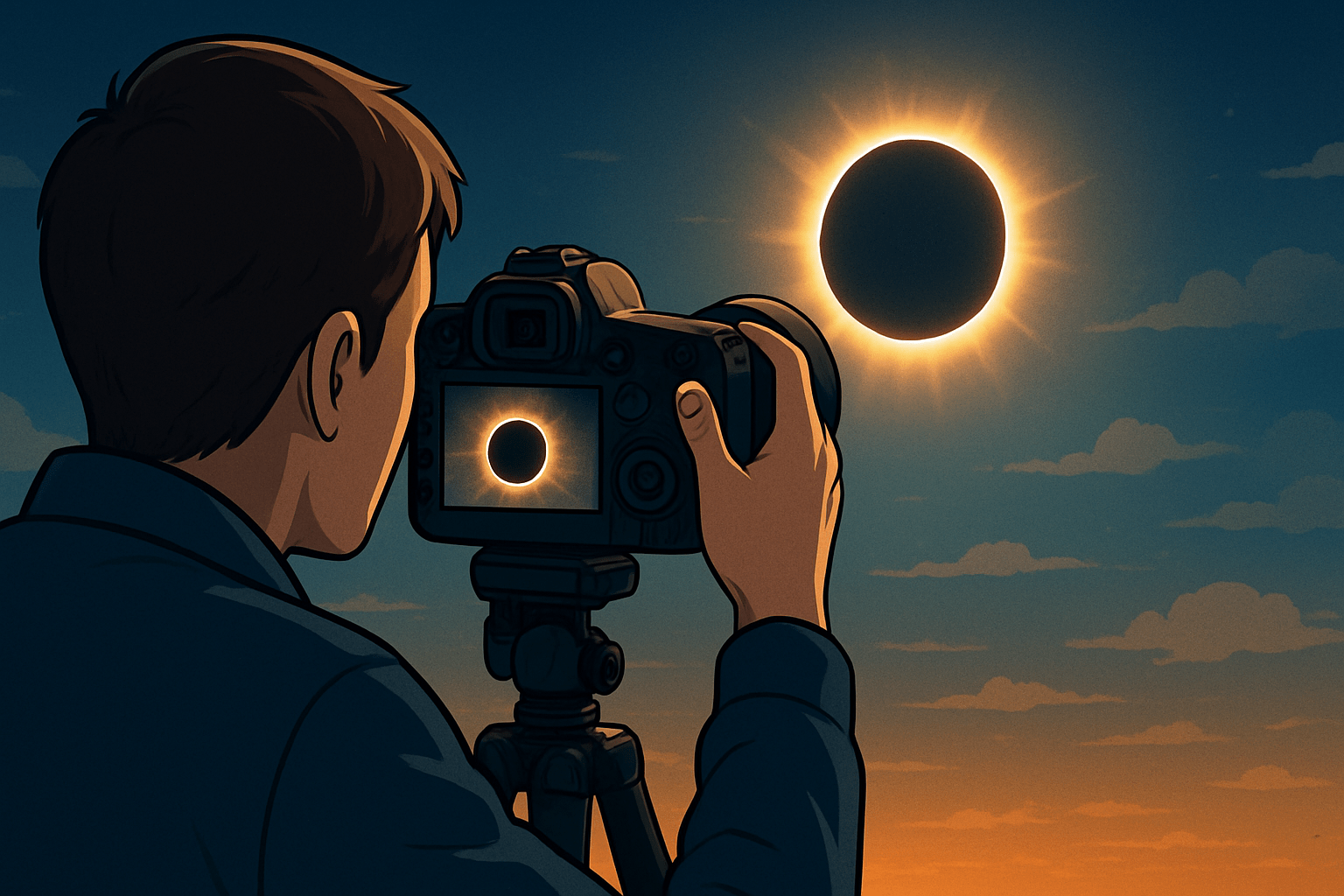
Before we talk about lenses or settings, we must talk about your eyes. If you want to learn how to photograph eclipse safely, you begin with protection. The Sun can blind you in a heartbeat, and it can also burn your camera’s sensor.
Use only eclipse glasses and viewers that meet the ISO 12312‑2 standard. Buy from reputable sources and avoid sunglasses, welding glass not rated for solar viewing, or anything unmarked. Throw away old, scratched, creased, or loose film filters because tiny damage can let in dangerous light.
Your camera needs a proper solar filter on the front of the lens. You can use glass solar filters or film filters like Baader AstroSolar, but they must fully cover the lens opening. Never look through an optical viewfinder or telescope at the Sun without a certified solar filter on the front.
Remove the filter only during totality and only during a total solar eclipse. In a total eclipse, the Sun’s bright disk is fully covered, and the corona becomes visible for a brief window. In an annular or partial eclipse, the bright disk is never fully covered, so you must keep the filter on the entire time.
An unfiltered telephoto lens can act like a magnifying glass and scorch your shutter, aperture blades, or sensor. Avoid pointing an unfiltered lens at the Sun during the partial phases. Limit long, continuous live-view exposure because the sensor can heat up even with a filter in place.
Prefer live view or an electronic viewfinder so your eyes are never directly exposed. If you must use an optical viewfinder, keep your ISO 12312‑2 glasses on while looking through it. A rear LCD with live view keeps both you and the camera safer.
Inspect your solar filters before the big day by holding them up to a bright light and looking for pinholes or damage. Carry a spare filter and a secure mounting method like snug rings, a rubber hood, or gaffer tape. Tape or strap the filter so wind and bumps cannot knock it off at the worst moment.
Make a small on-site kit that lives in your pocket. Include eclipse glasses, a spare pair, two solar filters, gaffer tape, a small inspection flashlight, and a lens cloth. Label the filters and tape ends so you can grab and remove them cleanly.
Here is the most important warning you will read today. “Safety first: if it isn’t safe for your eyes, it isn’t safe for your camera.” Read that again and make it your mantra for the day.
If you need visual examples of safe setups and compositions, browse trusted galleries of eclipse images before you go. You will see filters mounted on the front of the lens, and you will notice that people never point unfiltered optics at the Sun during partial phases. That is how experienced shooters protect gear and vision.
All the gear you need to shoot a solar eclipse
You do not need a room full of equipment to capture an eclipse, but the right pieces make a big difference. Any interchangeable-lens camera can work, and a reliable setup beats a fancy one you do not know. Keep it simple and robust.
The core kit is a camera body, one or two lenses, a front-mounted solar filter sized to the lens, a sturdy tripod, and a remote or intervalometer. Add extra batteries and cards, a lens cloth, gaffer tape, and a good tripod head. A second body for wide-angle scenes is a great bonus.
Mirrorless bodies make things easier because live view is always available and there is no mirror slap. Full-frame cameras help with dynamic range and low-light performance during totality, but APS‑C and Micro Four Thirds work well too. Shoot RAW so you can pull detail from the corona later.
Use the longest lens you can borrow or buy. A 200–400 mm lens gives a nice compromise between size and detail for many sensors. Lenses in the 500–800 mm range start to fill the frame with the solar disk, and 1000 mm or a small telescope gives very detailed close-ups.
Carry a wide-angle lens on a second body for context shots. You can frame the crowd, landscape, and the shrinking daylight while your telephoto watches the Sun. A simple time-lapse with a wide lens also tells a powerful story.
Teleconverters can be helpful, but remember that a 1.4× or 2× converter costs you light and may slow or disable autofocus. Many people switch to manual focus anyway, so the trade can be worth it. Telescope adapters unlock even more reach, but they add complexity, so practice early.
To plan framing, use a simple size estimate. The solar diameter on your sensor in millimeters is roughly focal length times tan(0.53°), which is about focal length times 0.00925. So a 600 mm lens shows a Sun about 5.55 mm wide on the sensor.
To think in pixels, multiply that millimeter size by your sensor’s pixels per millimeter. On full-frame at 36 mm wide and 6000 pixels across, that is about 166.7 pixels per millimeter. So 300 mm gives about 463 pixels, 600 mm about 925 pixels, and 1000 mm about 1542 pixels across the disk.
APS‑C sensors are smaller, so the Sun uses more pixels for the same focal length. With a typical APS‑C width near 23.5 mm and 6000 pixels across, you get about 255 pixels per millimeter. So 300 mm is about 708 pixels, 600 mm about 1416 pixels, and 1000 mm about 2362 pixels.
Use a heavy tripod and a head that can carry your lens easily. Mount the lens by its tripod foot, not by the camera body, to balance the setup. Keep the tripod low, spread the legs, and hang a bag or weight from the center to resist wind.
A gimbal or solid ball head makes tracking the Sun smoother. If you expect gusts, bring small ground stakes or sandbags for extra stability. Practice panning and re-centering while keeping your framing tidy.
A motorized equatorial or alt‑az tracker can keep the Sun centered at long focal lengths. It reduces how often you need to recompose during long bracketing sequences. Tracking is optional and requires polar alignment practice, so do not try it for the first time on eclipse day.
Front-mounted solar filters come as glass or film and both work well if they fit properly. Lenses with complex or oversized hoods may need DIY adapter rings or a snug rubber hood to hold a film sheet. Do not use stacked ND filters; they are not safe for direct solar imaging.
Your remote trigger or intervalometer lets you shoot bracketed bursts without shaking the camera. You can program timed sequences for the partial phases and switch to high-speed burst as you approach the diamond ring. Keep an eye on buffer limits and card space during long sequences.
Add a lens hood to cut flare and give a bit of shade to the filter. Bring a towel or foil wrap to keep electronics cooler in direct sun. Apps like SunCalc or PhotoPills and a printed eclipse timeline will guide timing when nerves spike.
If you want a branded walkthrough of this kind of setup, read how to photograph a solar eclipse with simple gear and repeatable steps. The tools are basic, but the planning is what makes your results shine. Keep your kit light, safe, and familiar.
Manual exposure settings: fixed aperture and ISO, varying shutter speed
The simplest way to get repeatable results is to lock two variables and change one. Set your aperture and ISO, then adjust shutter speed to control exposure as the light changes. That approach is the heart of how to photograph eclipse scenes cleanly.
Every lens has a sharp zone, often between f/5.6 and f/11, where contrast and detail balance well. Test your lens on the Sun with a filter a few days before and note where the limb looks crisp. Avoid very small apertures since diffraction reduces fine detail.
Start at ISO 100 to keep noise low during the partial phases. You have bright light and do not need higher ISO unless your shutter speed becomes too slow. During totality, you can raise ISO modestly if you need faster speeds to freeze motion.
With the solar filter on during the partial phases, use manual exposure and test at ISO 100 and around f/8. Bracket your shutter speed across several stops to cover differences in filter density and haze. A useful example bracket is 1/4000, 1/2000, 1/1000, 1/500, 1/250.
Filter materials vary, so treat those numbers as a start. Some film filters transmit slightly more or less light than glass, so your times may shift. Make a short test bracket and check the histogram before settling on a cadence.
At totality for a total eclipse, you remove the solar filter and the scene changes dramatically. The corona has a huge dynamic range, so capture a wide bracket that spans both inner and outer regions. A common sequence is 1/4000, 1/2000, 1/1000, 1/500, 1/250, 1/125, 1/60, 1/30, 1/15, 1/8, 1/4, 0.5, 1 second.
Fast shutter speeds near the start and end of totality help you catch the diamond ring and Baily’s beads. Use high‑speed continuous shooting for short bursts while you keep the camera steady. Stop the burst quickly to avoid buffering the card with identical frames.
Shoot RAW and plan to blend exposures later for the most natural look. Exposure blending or HDR is perfect for combining inner corona detail with faint outer streamers and prominences. Keep your bracket well organized so post-processing goes smoothly.
Prepare your camera the night before and set a repeatable baseline. Choose RAW, manual exposure mode, manual focus, and turn stabilization off when on a tripod unless your maker allows tripod mode. Use electronic first curtain shutter or mirror up, long-exposure noise reduction off, and a remote or intervalometer.
Focus in live view with the solar filter on the lens. Magnify the view and focus on the sharp limb of the Sun, then tape the focus ring or switch the lens to manual to lock it. Recheck focus after any big temperature change or bump.
Do not trust your camera’s meter when pointing at the filtered Sun. Use the histogram to keep highlights away from the right edge and keep the disk crisp without clipping. Manual exposure with bracketing beats TTL metering for this subject.
Set a fixed white balance like Daylight or about 5200 K to keep a consistent look. You can always adjust white balance in RAW without penalty, but a fixed setting avoids sudden shifts during sequences. Consistency helps when you build composites later.
The 500 rule for stars does not apply to eclipses. That rule avoids star trailing on the night sky and is not relevant when you are shooting the Sun. Treat shutter speed as a creative tool here, not as a motion limit tied to focal length.
Here is a simple field example from a 600 mm lens at f/8. During partial with a film filter I used ISO 100 and 1/1000 as a midpoint and bracketed two stops each way. During totality I captured 1/1000 for the inner corona and stretched to 0.5–1 second for the outer streamers.
If you want a one-stop shop to plan these ranges, bookmark a trusted photography guide and make a quick card with your settings. Keep that card tied to your tripod so you are never guessing. Simple steps prevent the biggest mistakes.
Finally, avoid long, continuous live view when the filter is off at totality. Compose, shoot your bracket, and give the sensor a short break between long exposures. Your images will look better, and your camera will stay cooler.
Shooting schedule around eclipse phases with adjustments to camera settings
An eclipse day moves fast, so know the key times by their shorthand. First contact (C1) starts the partial phase, second contact (C2) starts totality, third contact (C3) ends totality, and fourth contact (C4) ends the event. Build your plan around those four moments.
Arrive early and set up 30–60 minutes before C1. Compose, lock focus, secure filters with tape, and run test exposures with a short bracket. Check batteries and cards, start your intervalometer plan, and confirm with any assistants who is doing what.
From C1 to C2, keep the solar filter on the lens at all times. Run a gentle cadence such as a bracket every 10–30 seconds, or a slow continuous pace if you have battery and memory to spare. Keep your histogram healthy and re-center the Sun as it drifts.
In the final minute before C2, switch to high-speed burst for beads and the diamond ring. Assign the filter removal to one person or practice a one-hand removal that does not shake the lens. Your goal is a clean, fast move exactly at totality.
At C2 of a total eclipse remove the filter and start your coronal bracket right away. Capture a quick fast burst for the diamond ring, then follow with your planned sequence that spans very fast to around one second. Take a couple of longer exposures for the outer corona if seeing is steady and wind is calm.
Watch your clock as you approach C3 and prepare to reverse the move. At C3, put the filter back on exactly as the bright Sun peeks out. Then return to your partial-phase bracket and keep shooting until C4.
If totality is short, around 20–30 seconds, simplify the plan. Prioritize the diamond ring and a tight bracket that covers inner and mid corona. A second camera with a wide lens can record the crowd and the sudden darkness.
With a medium totality of 60–90 seconds, you have time to stretch. Run a longer bracket set, check focus once, and add one or two wide shots of the landscape. Do not rush if you are working alone.
For long totality beyond two minutes, you can change focal length or try a couple of compositions if you have practiced. Capture a thorough bracket to map the full corona, then swing to a wide scene for the atmosphere. Keep a mental timer so you do not miss the return of the Sun.
An intervalometer can free your hands during the partial phase. Pre-program a bracketed sequence that repeats on a timer so you can monitor framing and people instead of menus. During totality, switch to manual control for bursts and precise bracketing.
Sync all clocks the morning of the event and print your local timeline. Many shooters use an audible countdown so everyone knows when to remove and reapply filters. Redundant timekeeping prevents costly mistakes under pressure.
Clouds happen, and you can still tell a great story if the Sun hides. Shoot the changing light, the crowd, and the environment, and grab the Sun when it peeks through gaps. If a camera fails, move to your backup lens or body and keep going.
Practice focusing and shooting beforehand
Practice is how you remove panic and replace it with rhythm. You will be calmer, safer, and your images will show it. A one-hour rehearsal pays off more than a new accessory.
Rehearse attaching and removing your solar filter quickly without shifting the lens. Practice focusing in live view on the Sun with the filter on, then mark the focus position on the lens with tape. Run a full timeline drill with your planned brackets and watch how your buffer and cards behave.
Pick a nearby park and practice your tripod setup in real wind. Keep the legs low, the weight hanging, and the head tight. Smooth moves and a stable base are your best friends on the day.
Make a small printable checklist with your camera, lenses, filters, tripod, remote, batteries, cards, tape, cloth, glasses, and your local C1–C4 times. Add a quick troubleshooting line for focus shift, full cards, low power, and slipping filters. Keep that sheet in your bag and on your phone.
As you finalize your plan, gather a few visual aids that make decisions easy under stress. Print a quick exposure card for your focal length, a sun size guide in pixels for your sensor, and a one-page timeline with recommended shutter ranges per phase. Include a simple diagram of safe filter mounting and a three-step sequence that shows when to remove and reapply the filter during a total eclipse.
Plan your processing approach before you shoot so your brackets have purpose. Shoot RAW, label your bracket series, and aim for a clean stack where you blend the inner corona, outer streamers, and any small prominences. Use gentle noise reduction for the longer frames and dodge lightly to reveal delicate structure.
Keep a short mental list of what not to do when excitement peaks. Never remove the filter during an annular or partial eclipse, never use a damaged or unmarked filter, and never trust the live histogram alone without checking highlights on the disk. Do not forget backup batteries and cards because eclipses chew through both.
Make a small, printable checklist with 10–15 items that walks you from setup to C4. Add a quick settings cheat-sheet you can photograph with your phone and tape to the tripod. Short, clear notes will save you from menu diving when the sky turns dark.
Finally, keep your tone and plan practical and calm. Use short steps for on-the-day actions, and include one or two scenarios you have rehearsed, like a cloud pass or a quick filter reattachment. Safety callouts belong in your notes more than once, because that is how to photograph eclipse events and enjoy every second of them.
What People Ask Most
What basic gear do I need to photograph an eclipse?
You just need a camera, a sturdy tripod, and a proper solar filter for the bright phases, plus a remote shutter or timer to reduce shake.
Can I safely photograph the sun during an eclipse?
Yes, but only with a certified solar filter on your lens for any time the bright sun is visible, and never look through an unfiltered viewfinder.
How should I compose a simple eclipse photo?
Frame the sun off-center to include a foreground subject or leave space for the sky, and plan your shots ahead so you can react quickly.
What camera settings should a beginner use when learning how to photograph eclipse?
Start with a low ISO, a faster shutter for the bright phases, and be ready to lengthen exposures during totality to capture the corona.
How can I practice before the eclipse to get better results?
Rehearse your setup during a clear day by photographing the sun with a filter, practice changing settings quickly, and time your sequence beforehand.
What common mistakes should beginners avoid when photographing an eclipse?
Avoid forgetting a solar filter, skipping a tripod, and not planning shot timing, which can all ruin your images or risk your eyesight.
Can a smartphone be used to photograph an eclipse?
Yes, a phone can capture good images with a steady mount, a solar filter over the lens, and by using exposure lock or a camera app with manual controls.
Final Thoughts on Photographing a Solar Eclipse
If you were wondering how to photograph an eclipse without missing the moment or risking your sight, this guide answered that exact question. A quick practice run of about 270 seconds before the event, plus the checklist of certified filters, tripod setup, and exposure brackets, gives you the calm and control to shoot the phenomenon well. The core benefit isn’t flashier gear but predictable results: safer shooting, fewer surprises, and images that actually show the corona and fleeting beads.
One realistic caution: don’t treat filter removal as improvisation — a single slip can cost eyesight or your sensor, so rehearse the handoff and time it to the official contacts. This plan is aimed at careful enthusiasts and pros who want repeatable results, though beginners who follow the steps will benefit just as much. You practiced the focus routines, learned safe exposure ranges, and now you’ll be ready to turn that opening curiosity into memorable, well-exposed photographs and shared stories.



0 Comments