

How to photograph flower arrangements so they look fresh, detailed, and magazine-ready?
This guide gives a clear workflow from planning and prep to lighting, shooting, and editing. You get a 5-shot list, a pre-shoot checklist, and simple camera settings you can use right away.
Updated for 2026, it covers backgrounds, angles, aperture tips, and quick fixes for common mistakes. Follow the five main sections to plan, shoot, and edit beautiful floral photos step by step.
How to Photograph Flower Arrangements: Tips for Stunning Results
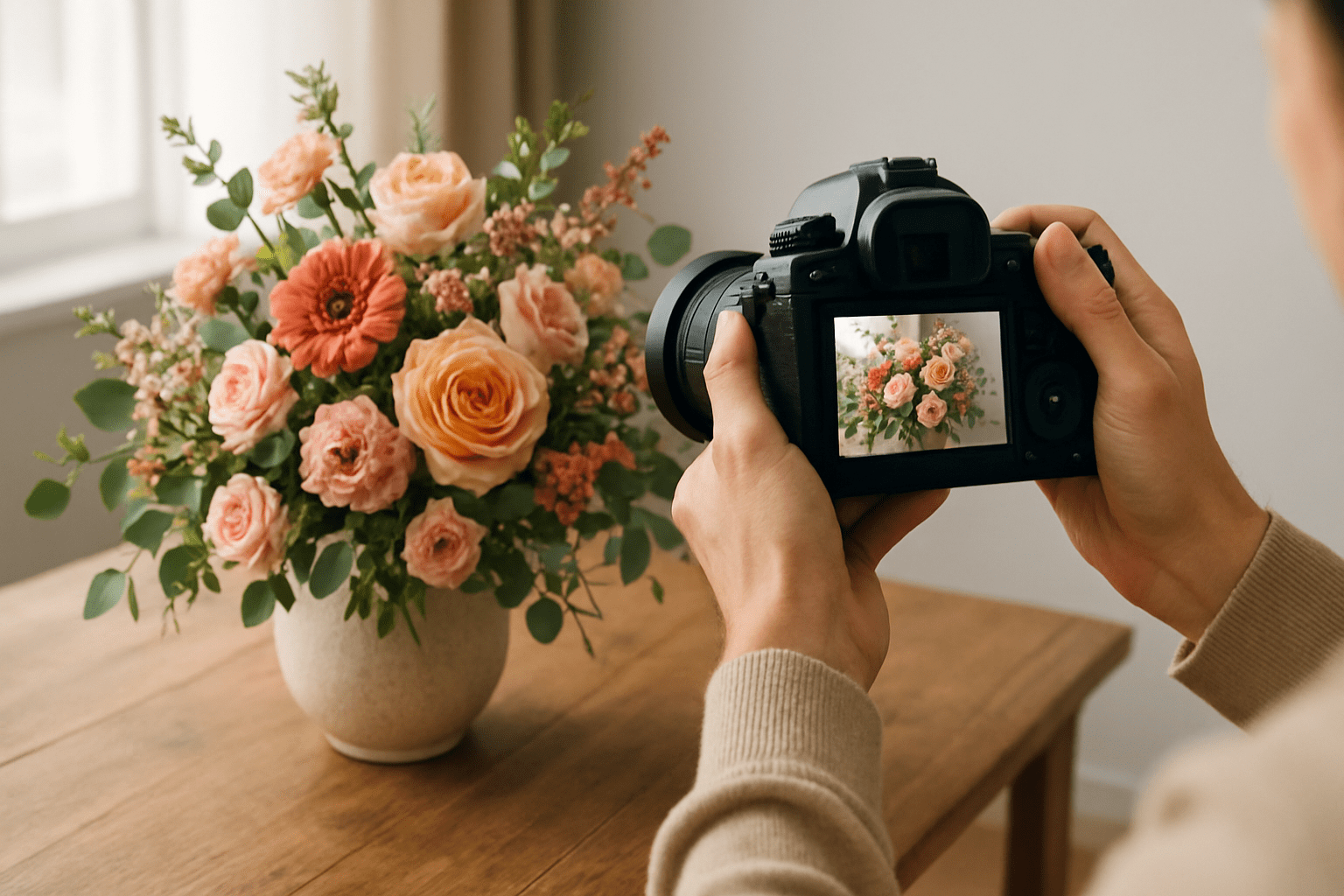
If you want a simple path from idea to final photo, start with a small plan and follow a repeatable flow. This is the cleanest way to learn how to photograph flower arrangements without feeling overwhelmed. Think of it as Plan, Prep, Light, Shoot, and Edit.
Plan the mood first. Pick a color palette, a style, and one or two props that support the flowers rather than steal attention. A quick sketch helps you visualize angles and background choices.
Prep the flowers and the set. Clean the vase, add fresh water, trim stems at an angle, and remove damaged petals or leaves. Wipe the table and glass so you do not fix dust later.
Choose light next. Place the arrangement by a bright window, ideally with soft overcast or gentle side light. Diffuse hard sun with a sheer curtain and bounce light with a white card to soften shadows.
When you shoot, use a tripod, keep ISO at 100–200, and try bracketing exposures for safety. Vary angles from straight on to overhead, and check your histogram to protect highlights. Work slowly and refine the scene after each frame.
Edit the RAW files with small, careful moves. Set white balance, remove specks, and crop with intention. Keep the flowers’ natural color and texture as your guide.
A quick pre‑shoot checklist saves time on set. Have fresh flowers, a few vases, scissors or pruners, floral tape or washi, a spray bottle, a clean background or backdrop, a diffuser like a sheer curtain, a white card reflector, a tripod, a remote release, a lens cloth, spare memory cards, and a charged battery.
Here is a simple gear plan that works for most scenes. Carry a camera with a spare battery, a 90–105mm macro or an 85mm portrait lens, a 50mm or 35mm for wider context, a sturdy tripod, a remote release, a translucent panel or diffuser, white foam board, a microfiber cloth, a lens hood, and a polarizing filter for glass or leaves.
Use this quick camera setting cheat sheet as a starting point. Indoor window light full arrangement works well at 50mm, ISO 100–200, f/8 on a tripod. Close macro is clean with a 100mm macro, ISO 100–200, f/5.6–8, and focus stacking if you need more depth; flat‑lay overhead is tidy at 35mm, f/5.6–8, with even light across the frame.
Build a simple five‑shot list so you leave with variety. Make a full establishing shot at 35–50mm around f/5.6–8, a three‑quarter medium at 50–85mm around f/4–8, and a tight macro detail at 90–105mm macro at f/2.8–5.6 or f/8 for more depth. Add an overhead flat‑lay at 35–50mm at f/5.6–8, and a creative backlit or reflection frame at 50–85mm, exposing for highlights and bracketing.
Plan a few supporting images to tell a mini story. Suggested hero: a full arrangement in soft window light; suggested alt text “Full flower arrangement in soft window light on wooden table.” Add a macro close‑up of petal texture with alt text “Macro detail of rose petal texture,” a flat‑lay with alt text “Overhead flat‑lay of flowers and styling tools,” a backlit silhouette with alt text “Backlit bouquet showing translucent petals,” and a quick before/after edit with alt text “Before and after flower photo edit.”
If you want more step‑by‑step basics, this beginner’s guide pairs well with the workflow above. Combine both and you will have a repeatable routine you can trust. Use it each time you approach a new arrangement.
The Importance of Natural Lighting
Natural light keeps colors true and falloff gentle, which flatters petals and leaves. It also reveals translucence, letting thin petals glow rather than look dull. That is why window light or open shade often beats complicated artificial setups.
Bright overcast is ideal because the sky acts like a giant softbox. On sunny days, try mid‑morning or late afternoon for warm side or back light, then move a step closer to the window to control contrast. Avoid harsh midday sun unless you can place the arrangement in shade.
Positioning changes the mood quickly. Side light adds texture and form by creating soft shadows across the blooms. Backlight adds a rim glow and brings translucence to life.
If you want even light with minimal shadows, use gentle front light or add a white reflector to fill. A white foam board works as well as a pro reflector. For drama, subtract light with a black card to deepen shadow and shape the bouquet.
Control the light you have. Diffuse direct sun with a sheer curtain or a translucent panel so highlights do not blow out. Turn off indoor lamps to avoid mixed color temperatures, or set a matching white balance if you must keep them on.
Watch exposure when backlit. Protect the highlights on pale petals by dialing negative exposure compensation and bracketing. Later, you can lift shadows in the RAW file with less quality loss than fixing clipped highlights.
Small moves matter in natural light. Slide the arrangement a few inches to change shadow direction or reduce glare on glass. This micro‑adjustment often fixes problems faster than any edit.
For deeper ideas on shaping window light and composition, see these still life flower photos techniques. Pair them with the workflow above to master how to photograph flower arrangements in any room. You will start seeing your window as a flexible studio.
Choosing the Right Background
The background sets mood and helps the flowers stand out. It should support the subject, not compete with it. When in doubt, keep it simple and let color and shape do the talking.
Seamless paper gives a clean studio look and keeps attention on form and color. Wood or a tabletop feels warm and natural, while marble or tile adds an elegant, cool tone. Fabric or linen reads soft and lifestyle, and a dark wall can create a rich painterly look.
Mirrors or glossy tiles can add reflections that double shapes. Use them carefully so they do not outshine the bouquet. A small tilt of the surface can control where reflections appear.
Create depth by pulling the arrangement away from the wall. That little gap adds soft shadows and makes the background blur more pleasing. Choose background colors that complement the blooms for harmony or contrast them for punch.
Keep patterns subtle or push them out of focus with a wider aperture. If the backdrop is busy, a shallower depth of field smooths distractions fast. Negative space also helps the eye rest and adds elegance.
Match props and vases to the style of the arrangement. A simple vase suits modern designs, while textured vessels fit rustic scenes; always clean glass and water, and remove bubbles or messy stems in clear vases. Pick one focal prop and keep the scale appropriate so the flowers remain the star.
If you want more quick styling ideas, try these simple techniques for cleaner frames. Learning how to photograph flower arrangements is often about subtraction rather than addition. Remove one item, then reassess the balance.
Experimenting with Different Angles
Changing perspective transforms the story of your arrangement. Pick the angle that best highlights shape, texture, and stem lines. Small shifts can reveal a brand‑new character.
Overhead or flat‑lay angles suit table spreads, recipe scenes, or floral styling kits. A 45‑degree view often feels like how we naturally see a vase on a table. Eye‑level works for tall arrangements with strong vertical lines.
Try a low angle for silhouettes or bold negative space against a window. A tight side profile can showcase stem structure, leaf curves, and vases with interesting shapes. Step closer to fill the frame and build impact.
For clean overheads, use a tripod with a ball head or an extension arm. Wedge or elevate the arrangement with small props to fine‑tune height and tilt. Include a foreground bloom to add depth and lead the eye.
Get creative by shooting through foliage or glass for dreamy diffusion. Mirrors and puddles can echo shapes and add symmetry. You can even place an extra stem near the light to cast a designed shadow across the scene.
Experimenting with Aperture and Depth of Field
Depth of field controls what is sharp and what melts away. It isolates a hero bloom or holds an entire arrangement in focus. This choice sets the mood as much as lighting.
For a single bloom with soft bokeh, try f/1.8–f/4. For groups or full arrangements, f/5.6–f/11 holds shape without feeling clinical. Flat‑lays usually look good at f/5.6–f/8 so edges stay clean across the frame.
Macro needs more care because depth is razor thin. Aim for f/5.6–f/11 and place focus on the most important petal or the flower’s “eye.” Focusing slightly forward of center often renders the most pleasing depth on rounded blooms.
When you need edge‑to‑edge sharpness, use focus stacking. Put the camera on a tripod, keep exposure steady, and shift focus in small steps from front to back. Merge the frames later in software for a crisp, natural result.
Keep ISO low at 100–400 and use a tripod for slower shutter speeds. A polarizer helps tame reflections on leaves or glass vases, and exposure bracketing is smart in contrasty backlight. Always shoot RAW to preserve subtle petal tones.
Finish with a simple post‑processing checklist. Set white balance, adjust exposure, and recover shadows or highlights if needed; remove dust, stray petals, or bubbles; crop for strong composition, add gentle sharpening, and export in high‑res and web sizes. With these steps, you will master how to photograph flower arrangements with clarity and style.
What People Ask Most
What basics should I start with when learning how to photograph flower arrangements?
Focus on simple composition, good lighting, and sharp focus to make your arrangements look their best.
Do I need an expensive camera to learn how to photograph flower arrangements?
No, a smartphone or basic camera works well if you use steady hands, good light, and simple backgrounds.
How can I use natural light to photograph flower arrangements effectively?
Place the arrangement near a window with soft, indirect light or diffuse harsh sun with a sheer curtain to avoid strong shadows.
What kind of background should I choose when I photograph flower arrangements?
Use a plain or subtly textured background that contrasts with the flowers so the arrangement remains the focal point.
How do I create depth and interest when I photograph flower arrangements?
Try different angles, include foreground elements, and use selective focus to separate layers and add visual depth.
What common mistakes should I avoid when I photograph flower arrangements?
Avoid cluttered backgrounds, poor lighting, soft focus, and over-editing, which can all distract from the flowers.
How much editing is appropriate after I photograph flower arrangements?
Make small adjustments to exposure, white balance, and crop for a natural look, and skip heavy filters that change colors too much.
Final Thoughts on Photographing Flower Arrangements
You came wondering how to make flower photos sing, and this guide answered that with a clear start-to-finish workflow, a handy shot list, and lighting and aperture tips you can use right away. If a short prompt helps, jot “270” in your notes as a reminder to check Plan, Prep, and Light before you lift the camera, and don’t forget the small styling touches that make an image feel finished. The real payoff is confidence—less guessing and more beautiful, repeatable photos for hobbyists, florists, and content creators who want honest, expressive floral imagery.
Be realistic: tiny details matter, so watch for blown highlights, mixed color temps, and dirty water, and give yourself time to tweak styling between frames. We showed how to choose and control natural light, pick backgrounds, vary angles, and use aperture to shape depth so you’ll know which choice matches the mood you want. Keep practicing and experimenting—your next session will teach you more, and the results will keep getting better.





0 Comments