
How to photograph hummingbirds and capture their iridescent colors and razor-fast wings?
This guide gives a simple four-step recipe: plan → set up → observe → shoot. You will get quick, copyable camera settings for bright sun and for shade.
You will also learn what gear matters — from budget to pro — and when to use very high shutter speeds or short-duration flash. I explain feeder and perch placement, how to read hummingbird behavior, and how to compose and edit for sharp eyes and smooth backgrounds.
The article includes cheat-sheets, example photos with EXIF, and fast troubleshooting tips so you can start shooting right away. Read on and you will have a clear field workflow and settings to try at your next feeder session.
How to take great hummingbird photos
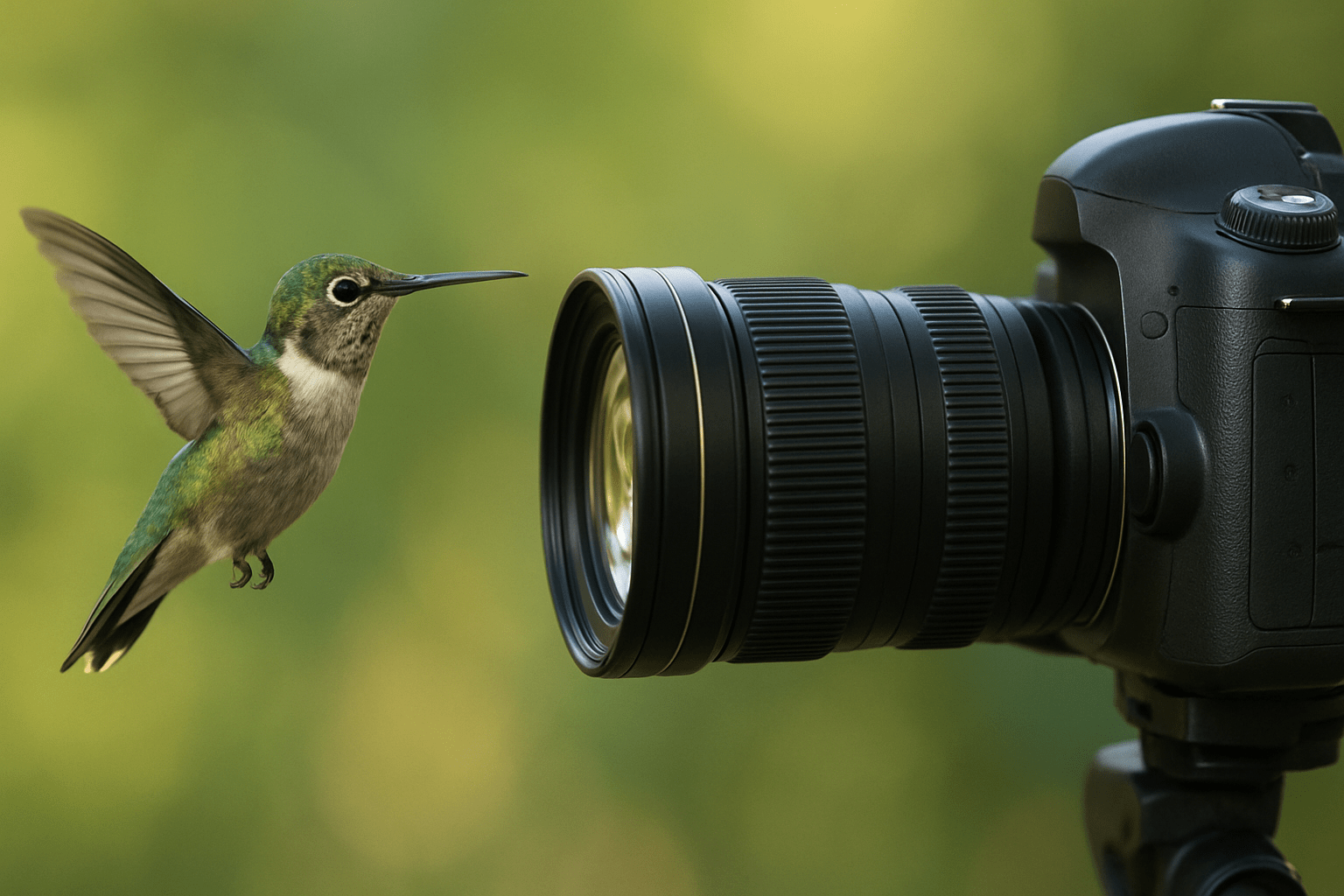
If you want a fast, field-ready plan for how to photograph hummingbirds, use this four-step recipe. Plan your spot and light, set up a feeder or flower with a clean background, observe the birds quietly, then shoot short bursts when the bird lines up. Keep it simple, and repeat the same shot until you nail the eye sharp and the wings where you want them.
Here is a quick path you can remember. Set your camera to a high shutter speed or prepare a flash, pre-focus on a perch or a feeder port, wait still with your finger half-pressing focus, then fire short bursts as the bird approaches and hovers. Review, adjust, and shoot again.
Make a short checklist before you begin. Shoot RAW, turn on back-button focus, use high-speed burst mode, and prioritize the eye for focus. Keep your distance, avoid stress, and never block access to food or nests.
Use a simple field workflow so you don’t miss the first bird. Scout your background and wind direction, then place the feeder where the bird will face you with light on the eye. Pre-set your camera, do a test on a perch, and confirm exposure on the background before the first visit.
Plan a setup timeline to avoid rushing. Place feeder and perches 30–60 minutes before peak activity, then step back and let the area calm down. Sit quietly, minimize movement, and breathe slowly so your hands stay steady.
Starter settings for bright sun are easy to copy. Try 1/3200s, f/5.6, ISO 400 and adjust ISO until your histogram is healthy. In softer light, try 1/2000s, f/4, ISO 1600 and ride ISO higher if you need more speed.
Use patience strategies that actually work. Sit-and-wait beats chase-and-swing every time with hummingbirds, and ten quiet minutes often brings a return to the same perch. If you must move, do it between visits, not during a hover.
Read behavior to predict moments. Many birds pause on a favorite twig after feeding, and they lift slightly before a quick dart or chase. Watch head angle and throat color to anticipate that tiny sideways hop that lines up the eye.
Fix common problems in the field. If the bird is too small in the frame, move your perch closer to the feeder port and pre-focus there. If the feeder pulls focus, set a smaller AF area and aim at the eye, and if red plastic clips in highlights, angle the feeder so it reflects sky, not sun.
When you want deeper guidance and visual examples, browse this helpful set of hummingbird photos. Seeing working setups will speed up your learning in the field. Keep your plan simple, and keep repeating it.
Repeat the mantra every time you step out: plan, set up, observe, shoot. It is a quiet craft, not a chase. That is the heart of how to photograph hummingbirds without stress for you or the bird.
Essential gear & setup
Hummingbirds demand fast autofocus, clean high ISO, and generous frames-per-second. A camera body that does 12–20 fps or more helps you catch the wing position you want. If your camera performs best at high ISO, you can run faster shutter speeds even in shade.
Telephoto zooms give the most flexibility. A 100–400mm or 150–600mm covers yard distance well, while a 70–200mm works for close setups where you control perches. For intimate portraits or flower detail, a fast prime like 135mm or a macro lens can be a joy.
Add at least one speedlight if you want wing-freezing flash. One flash can work if you balance ambient, but two speedlights off-camera give more even light and shorter effective duration. Use wireless triggers or optical slaves so you can place the lights safely away from the feeder.
Support matters more than you think. A light tripod or sturdy monopod removes arm fatigue and keeps your framing steady, and a small ball head is enough for typical zooms. For heavy glass, a gimbal helps you track without fighting gravity, and a beanbag is great for fence posts or car windows.
Soften your flash with simple diffusers or a small softbox. Bounce cards help spread light, and colored gels can tame overly red feeders. High-speed sync lets you use faster shutters but reduces flash power, while normal sync at 1/200–1/250s keeps flash duration short and crisp.
Props and background shape your image more than gear does. Use real flowers when possible and offer natural twigs for perches at a pleasing angle. A simple posterboard backdrop a few feet behind the perch can give clean bokeh and control color, which is helpful if the backyard is cluttered.
Place feeders and perches with intent. A single straight twig near a favorite port gives repeatable focus, and rotating the feeder a few degrees can hide the plastic while keeping nectar accessible. Space multiple feeders apart to reduce fights and give you more shooting lanes.
Buying on a budget is doable. A mid-level APS-C body with 11 fps and a 70–300mm lens will make solid photos if you sit closer, and a single speedlight can freeze motion in shade. In the mid-range, a fast-tracking mirrorless body with a 100–400mm zoom covers almost every yard setup with ease.
Going pro raises your keeper rate. A flagship mirrorless body with sticky subject AF and a 150–600mm lens gives range and speed, while two off-camera flashes make perfect wing detail. Autofocus speed and burst rate matter here because the bird’s position changes every fraction of a second.
If you want a deeper dive on setup angles and pacing, this set of practical field tips is a fine supplement. Use it to refine your perch distance and light placement. Small adjustments often create a big jump in sharpness and background quality.
Camera settings & techniques to freeze motion
You can freeze hummingbird wings in two main ways. The first is pure shutter speed in bright light, and the second is short-duration flash in lower ambient. Each approach has trade-offs you should know before you press the shutter.
Natural light freeze is simple and works in sun. Start at 1/2000–1/4000s, f/5.6–f/8, ISO 200–800, and expose to the right without clipping. Wings may still show a hint of motion, which often looks natural and elegant.
In shade or early morning, keep speed high and open the aperture. Try 1/2000s, f/4–f/5.6, ISO 1600–6400 depending on your camera. Noise is fine if the eye is sharp and the pose is strong; you can clean noise later.
Flash freeze leans on short flash duration. Dial 1/200–1/250s (your sync speed), set f/5.6–f/8, ISO 200–400, and run manual flash at 1/8–1/32 power because lower power gives shorter, crisper bursts. Two lights at lower power beat one light at higher power.
Autofocus should stay in continuous mode. Use a small single point or a tight zone on the head or eye, and separate focusing to your back button. Pre-focus on the perch or port so the lens doesn’t hunt when the bird appears.
Shoot in short, smart bursts. Lead the bird slightly and fire two to four frames, pause, and fire again as it hovers and backs up. If you like remote work, pre-focus and use an intervalometer to catch visits without your presence.
Use manual flash power for predictable results. High-speed sync can help balance harsh sun but cuts power, so keep your lights close and diffused. Test each flash power level at your working distance and note which settings freeze wings without harsh shadows.
Here is a cheat-sheet of five starter settings you can copy in the field. Bright sun hover: 1/3200s, f/5.6, ISO 400 with AF-C and high-speed drive. Backlit rim light: 1/2500s, f/4, ISO 800 and bias exposure up a third to save the silhouette.
Perch portrait in shade: 1/1600s, f/4, ISO 3200 with eye AF and a monopod. Flash freeze at feeder: 1/200s, f/7.1, ISO 200, two flashes at 1/16 power about two feet away. Golden hour hover: 1/2000s, f/5, ISO 1600 with a touch of negative exposure to hold brilliance in the throat.
Troubleshooting is part of the craft. If wings smear, raise shutter speed or lower flash power to shorten duration; if focus hunts, pre-focus on the perch or switch to a smaller AF box. If red feeder highlights clip, angle the feeder to reflect sky or place a small diffuser between sun and plastic.
To test flash power quickly, stand at your shooting distance and fire at a swinging cord or pencil. Examine motion streak length at each power level and pick the shortest streak that still lights the bird well. Keep those notes taped to your bag for fast recall.
When you want more real-world walk-throughs on frozen wings and staging, scan these essential techniques. Combine them with your notes, then adjust for your backyard light. Practice is what unlocks consistent results in this niche.
Positioning, attractants, and behavior
Good images start with smart positioning. Place the feeder where you can stand or sit at a slight angle to the bird so the eye catches light. Keep enough distance for your focal length, usually 10–15 feet for 200–400mm and 20–30 feet for 500–600mm.
Think about the background first, then the bird. Move the feeder so the furthest trees or hedges form a distant, smooth color, and avoid bright patches or white walls. Extra background distance creates creamy bokeh at modest apertures.
Perch placement is your secret weapon. A thin natural twig near a favored port lets you pre-focus and capture a clean frame without plastic. Set it slightly above the feeder height at a diagonal angle so the bird lands side-on with a good head turn.
If you use more than one feeder, space them. Keep a few yards between units so dominant birds cannot guard them all, and add extra perches so subordinates have resting spots. This spacing reduces chaos and gives you calmer shooting windows.
Attract birds with safe nectar and native flowers. Mix one part white sugar to four parts water, boil, cool, and never use dyes or honey. Clean feeders every one to three days in heat and every three to five days in cooler weather to prevent harm.
Props can be ethical if used with care. Slip a cut flower stem into a water pick near the feeder and frame so only the flower shows, while the bird still feeds at the normal port. Keep sessions short and remove anything that could confuse or trap a bird.
Learn routine behaviors to predict action. Birds often arrive at dawn and late afternoon, visit several times every hour, and guard a favorite perch that you can pre-focus on. Watch for territorial displays like tail flares and loud chips that signal a chase you can frame wider.
Minimize disturbance so birds act naturally. Use a small blind or sit behind cover, wear neutral colors, and move only between visits. Avoid nesting areas, respect local laws, and never block access to food or shelter.
When birds get too aggressive, change the field. Add another feeder out of sight, scatter perches at different heights, and shift your timing so you shoot during quieter breaks. This spreads pressure and opens more predictable shooting chances.
Here is a quick problem-and-fix run you can remember in the yard. If focus grabs the feeder, move the AF point to the eye and pre-focus on the perch; if wings blur, increase shutter speed or drop flash power; if background is cluttered, shift your angle or push the feeder further from the hedge. If the bird is too small, move the perch closer to your lens sweet spot; if the eye is dull, change your angle so it catches a specular highlight; if noise is heavy, keep the shot and clean it later in software.
A simple do and don’t set keeps things safe. Do keep nectar fresh, clean gear and hands, and quit early if a bird shows stress; don’t use glue, traps, or sticky substances, and don’t crowd or block flight paths. This is the respectful heart of how to photograph hummingbirds in your own space.
Composition, lighting choices & post-processing essentials
Compose with intent, not chance. Leave clean space in front of the bird when it flies or hovers, and place a perched bird off-center to make the frame breathe. Tight crops work for eye and throat detail, while wider frames can tell the story of feeding or chasing.
Light can make or break iridescence. Side-light reveals texture, while backlight makes wings glow with a delicate rim that feels magical. Golden-hour light brings warmth and softer contrast, and a small reflector off-camera can lift shadows without spooking the bird.
Control the background before you press the shutter. Increase background distance and pick colors that complement the species, like soft green for a Ruby-throat or warm beige for a Rufous. Use f/4–f/5.6 for creamy blur while keeping enough depth to hold the beak and eye.
Shoot RAW so you have room to adjust. Start your edit with white balance, open shadows carefully, and protect the glittering highlights on the throat by pulling highlights first. Apply noise reduction to the background and selective sharpening to the eye, bill, and fine feather lines.
Here are three quick edit recipes that save tricky files. For a noisy high-ISO hover, set color noise reduction around moderate strength, add light luminance noise reduction, and sharpen only the head and eye with a small-radius mask. For a slightly underexposed backlit shot, lift shadows gently, add a touch of dehaze, and warm white balance by a small amount to keep glow.
For overexposed red feeder highlights, lower red saturation in the HSL panel, pull highlights, and use a small brush to reduce exposure only on the plastic. Then crop to remove any extra plastic, leaving the bird and flower as the story. Keep edits natural and consistent across a series.
Export with the end use in mind. For web, 2048 pixels on the long edge with standard output sharpening looks clean and loads fast; for prints, export at full resolution with a subtle, print-profiled sharpen. Lightroom handles catalog and basic edits, Photoshop is best for detailed cleanup, and Topaz tools are handy for denoise and sharpening when ISO climbs.
Example image, perched close-up: Canon R7 with 100–400mm at 350mm, 1/2000s, f/5.6, ISO 800, natural shade with reflector fill, distance about 12 feet. The eye is sharp and the background is a distant hedge. Feeder hidden and a natural twig added near a favorite port.
Example image, hovering with frozen wings: Nikon Z9 with 300mm f/4 PF and 1.4x, 1/4000s, f/5.6, ISO 640, bright sun, distance about 15 feet. Wings are crisp and the throat glow holds detail. A small negative exposure kept iridescence from clipping.
Example image, backlit rim light: Sony A1 with 200–600mm at 500mm, 1/2500s, f/5.6, ISO 1600, late evening backlight, distance about 18 feet. The rim light edges the wings and tail, and the bird stands out against a dark grove. A small reflector gave a sparkle in the eye.
Example image, territorial chase: Canon R6 Mark II with 70–200mm at 135mm, 1/3200s, f/4, ISO 2000, natural light, distance about 22 feet. Two birds cross the frame with space to move into. A wider frame and high burst rate caught the peak overlap.
Example image, feeder setup: Fujifilm X-H2S with 150–600mm at 400mm, 1/200s, f/7.1, ISO 200, two speedlights at 1/16 power with small diffusers, distance about 10 feet. The feeder is angled away, and a cut flower is in frame as the bird hovers. Flash short duration froze the wings cleanly.
Example image, macro-ish flower sip: OM-1 with 90mm macro, 1/2500s, f/4, ISO 3200, open shade, distance about 6 feet. The bird leans into a native salvia with soft bokeh. Noise was handled in post while preserving eye detail.
Example image, before/after edit: Nikon Z8 with 500mm f/5.6 PF, 1/2000s, f/5.6, ISO 3200, mixed light, distance about 20 feet. Before had magenta cast and hot feeder highlights; after used white balance correction, highlight pull, and selective color to tame reds. Final crop removed stray plastic and centered the story on bird and bloom.
Tie it all together with a simple rhythm. Prepare your scene, pick a setting that fits the light, and practice the same move until the frame sings. That is how to photograph hummingbirds with grace, consistency, and joy in any small backyard.
What People Ask Most
How do I photograph hummingbirds without scaring them?
To photograph hummingbirds, move slowly, stay quiet, and use natural cover or a hide so they don’t notice you.
What is the best time of day to photograph hummingbirds?
Early morning and late afternoon give softer light and higher activity, making it easier to get clear shots.
Can I photograph hummingbirds with a smartphone?
Yes, you can photograph hummingbirds with a phone by using burst mode, steadying the camera, and being patient for the right moment.
How close should I get when I photograph hummingbirds?
Keep a comfortable distance so they act naturally and use zoom or crop later instead of approaching them directly.
How can I attract hummingbirds to photograph them?
Use fresh nectar feeders, plant native flowering plants, and provide a small water source to encourage visits.
What common mistakes should beginners avoid when photographing hummingbirds?
Avoid sudden movements, chasing birds, and relying only on flash; instead, practice patience and learn their feeding patterns.
Is it possible for beginners to capture a hummingbird’s wings in sharp detail?
Beginners can sometimes capture wing detail by shooting in good light and aiming for hovering moments, but starting with steady body shots is easier.
Final Thoughts on How to Take Great Hummingbird Photos
You can capture striking, tack-sharp hummingbird images by following a simple field recipe—plan, set up, observe, shoot—and using a handful of copyable settings and lighting tricks. Even a quick 270-second setup test will show how much prep matters, and this guide walked you through gear tiers, camera presets, behavior cues, and composition so you’re ready when the bird arrives.
The core benefit is consistency: you’ll end up with more keepers, clearer wing detail, and stronger portraits once you control light, focus, and timing. Be realistic—short sessions won’t always produce hero shots, and flash or very high ISO takes practice to avoid harsh light or noise; enthusiasts with basic camera skills will get the most from these tips.
We opened with a four-step how-to and answered it with starter settings, mounting and lighting options, and troubleshooting so you won’t be guessing in the field. There are rewarding moments ahead as you practice, turning tiny wings into memorable images.





0 Comments