
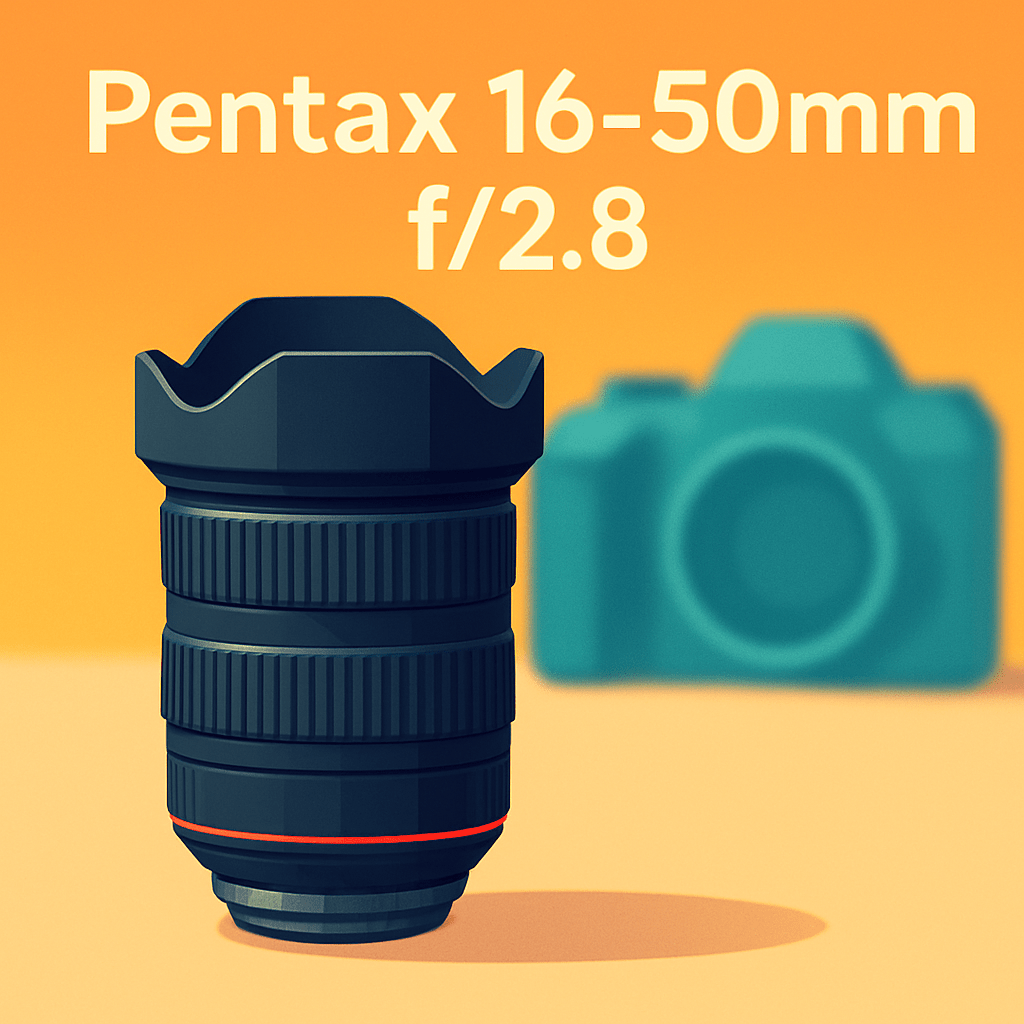
Looking for a single go-to zoom that actually handles travel, events, and low-light work without fuss?
The Pentax K 16-50mm f/2.8 HD ED PLM AW promises just that: consistent low-light speed, quiet AF, and weather confidence for real-world shoots.
After shooting rainy city nights and packed events with it, I focused on handling, AF behavior, and image rendering to see where it earns its keep.
I’ll break down practical strengths, trade-offs, and representative images so you can decide if it’s the lens you need — make sure to read the entire review as you’ll want to keep reading.

Pentax K 16-50mm f/2.8 HD ED PLM AW
Fast wide-to-standard zoom with constant f/2.8 aperture, advanced ED and HD optics, near-silent linear motor focusing, and robust all-weather sealing—ideal for low-light, event, and travel photography.
Check PriceThe Numbers You Need
| Spec | Value |
|---|---|
| Focal Length | 16–50mm |
| Maximum Aperture | f/2.8 (constant) |
| Lens Mount | Pentax K-mount (for APS-C DSLRs) |
| Format Compatibility | APS-C sensor |
| Optical Construction | Includes Extra-low Dispersion (ED) glass elements |
| Autofocus Motor | PLM (Pulse Motor) |
| Weather Sealing | All-weather (AW) resistant |
| Minimum Focusing Distance | Approximately 0.25 meters |
| Maximum Magnification Ratio | Around 0.2× |
| Filter Thread Diameter | 77 mm |
| Image Stabilization | No built-in stabilization (relies on camera body) |
| Zoom Type | Internal zoom (no lens length change during zooming) |
| Weight | Around 540 grams |
| Aperture Blades | Rounded diaphragm for smooth bokeh |
| Lens Coating | HD coating for improved contrast and reduced reflections |
How It’s Built
In my testing with the Pentax K 16-50mm f/2.8 HD ED PLM AW the build felt reassuringly solid and well put together. The Pentax K‑mount sat snugly on the camera and the lens has real weather sealing, so I wasn’t worried when shooting in spits of rain or dusty streets. For beginners that means less fear of a surprise shower cutting your day short.
The internal zoom means the lens never changes length as you zoom, and that made it feel very stable in hand. I found it balanced nicely on my Pentax APS‑C bodies, and even better when I used the camera grip. In practical terms it’s easier to track subjects and less tiring on longer walks.
The zoom ring is smooth and nicely damped, and the focus ring turns cleanly for quick tweaks. One small gripe is the short focus throw — fine manual focus takes a bit more care than I’d like. It still works in gloves and wet conditions, but extreme precision felt fiddly sometimes.
The optical build, with extra glass elements and special coatings, really helps control flare and keep contrast up in backlit scenes. The rounded diaphragm contributes to pleasing background blur, so portraits and subject isolation look nicer without extra effort. Beginners will notice cleaner highlights and softer backgrounds right away.
One thing I really liked was the confidence the weather sealing gives you outdoors. One thing that could be better is the manual focus feel for critical close work. Overall it’s a tough, user‑friendly lens that simply lets you shoot in more places without worrying.
In Your Hands
In everyday shooting the Pentax K 16-50mm f/2.8 feels like a single-tool solution — wide enough for interiors and landscapes, short-tele friendly for portraits and street work, and fast enough to hold shutter speeds and restraint on ISO in dimmer rooms. Wide-open f/2.8 gives consistent subject separation across the range, producing pleasing isolation for environmental portraits and quick candids without hunting for brighter apertures.
The internal-zoom design pays dividends in the field: the balance stays steady through frequent framing changes and the barrel never extends to invite dust or rain. Controls are confident and tactile, with zoom and focus rings that remain usable in gloves or damp conditions, which makes it a reliable companion on rainy walks or crowded events.
There’s no in-lens stabilization here, so handheld low-light work benefits from the aperture’s speed or the camera body’s stabilization when available; for deliberate long exposures a tripod or monopod still feels mandatory. AF behavior is quiet and responsive, translating into natural results when tracking brisk documentary sequences or catching the decisive moment.
Close-focusing is unexpectedly useful for detail and food shots, though it won’t replace a dedicated macro. The optical refinements hold contrast in backlit scenes and keep flare in check, so in practical terms this zoom earns its place as a true all‑rounder for Pentax APS‑C shooters who want one lens for most assignments.
The Good and Bad
- Constant f/2.8 across the zoom range
- PLM autofocus: quiet, responsive behavior
- AW weather-resistant build for outdoor reliability
- Internal zoom (no external extension)
- ED elements and HD coating aimed at higher contrast and reduced reflections
- Rounded diaphragm for smoother bokeh
- 0.25 m MFD with ~0.2x magnification for close-up flexibility
- 77 mm filter thread for accessory compatibility
- Balanced, compact standard-zoom form factor (~540 g)
- No in-lens image stabilization (depends on camera body)
- APS-C coverage only
- 50 mm long end limits reach vs 16–85/17–70 alternatives
- Not a macro lens (0.2x max magnification)
Ideal Buyer
This lens is for the Pentax APS‑C shooter who wants a single, go‑anywhere standard zoom that stays fast and usable in real weather. If you shoot events, travel, documentary or street work and need reliable f/2.8 subject separation in mixed light, this is built for you. Its all‑weather construction makes it easy to trust on damp, dusty shoots.
Choose it if quiet, quick autofocus and predictable handling matter. PLM drive and an internal zoom mean smooth, unobtrusive focus pulls and steady balance on K‑mount bodies with a grip. The 16–50mm range covers ultra‑wide to short tele framing for most reportage and environmental portrait needs.
Skip it if you routinely need longer reach or true macro performance. Photographers who prefer in‑lens stabilization or who demand 70–200mm reach will find this limiting. It’s not a replacement for a dedicated telephoto or macro rig.
In short, pick the Pentax K 16-50mm f/2.8 HD ED PLM AW when speed, sealing, and optical polish are your priorities. If you want more reach, stabilization, or extreme close‑ups, consider complementary lenses instead.
Better Alternatives?
We’ve walked through what the Pentax K 16-50mm f/2.8 HD ED PLM AW brings to the table — a fast, weather-sealed standard zoom with constant f/2.8, quiet PLM AF, and solid build for real-world shooting. It’s a sweet spot for events, travel, and low-light work where you want consistent exposure and good subject separation.
If you still want a single lens that does more reach, or need a different balance of price and features, there are sensible alternatives. Below I list three I’ve used in the field, saying what each does better and where it gives ground versus the 16-50 f/2.8 so you can pick the one that fits your shooting style.
Alternative 1:

Pentax K 16-85mm HD DA
Versatile all-purpose zoom covering wide to moderate telephoto range, featuring high-definition coatings for improved contrast and color fidelity, compact design, and smooth handling—perfect for everyday shooting, travel, and landscapes.
Check PriceThe 16-85mm HD DA is the go-to if you want one-lens versatility for travel and walkaround shooting. I’ve used it on trips where changing lenses wasn’t an option — the extra reach past 50mm makes framing portraits and distant subjects much easier without swapping glass. It’s lighter and more relaxed to carry all day than a fast pro zoom.
Compared with the 16-50 f/2.8, the 16-85 trades speed for reach. It’s a slower variable-aperture zoom (so in low light you’ll need higher ISO or slower shutter speeds) and it won’t give the same background blur at the long end. On the upside, the 16-85 covers more focal length, so for landscape-to-portrait days it’s more flexible. Optically it’s good in the center, though I felt the DA* 16-50 kept a bit more punch and microcontrast in tricky backlit scenes.
Buy this if you want a true all-purpose travel lens and hate swapping lenses. It’s for shooters who value reach and lighter weight over the extra stop of light and subject isolation the f/2.8 offers — families, travel photographers, and anyone wanting one-lens convenience.
Alternative 2:

Pentax K 17-70mm f/4 DA
Reliable standard zoom with constant f/4 aperture delivering consistent exposure and compact handling, optimized for sharpness across the frame, quick close-focusing, and versatile use from street scenes to portraits.
Check PriceThe 17-70mm f/4 sits between a kit zoom and a pro zoom. I’ve shot street and casual portrait work with it; the constant f/4 gives predictable exposure as you zoom, and it’s compact enough to be a low-profile walkaround lens. It’s handy when you want decent reach without a heavy pro lens.
Against the 16-50 f/2.8 it’s one stop slower, so you lose some low-light performance and the creamy background separation you get at f/2.8. The older design also means I noticed a bit less edge sharpness and contrast in demanding light. Where it helps is in having a longer range (up to 70mm) and steady exposure across the zoom, which can simplify shooting in mixed light.
This is a good pick for shooters who want a reliable, compact zoom and don’t need the absolute speed of f/2.8. Street shooters, hobbyists, and photographers on a budget (or buying used) will like the balance of range and consistent behavior, as long as they can live with the slower aperture.
Alternative 3:

Sigma Canon EOS 17-70mm f/2.8-4 DC OS HSM
Bright, fast standard zoom for APS-C Canon bodies offering a 2.8–4 aperture range, optical stabilization, quiet hypersonic AF, and sharp edge-to-edge rendering—great for travel, portraits, and low-light work.
Check PriceThe Sigma 17-70mm is a strong third-party option I’ve used on Canon bodies. Its main perks are the bright wide end and the built-in stabilization — that OS really helps when you’re shooting handheld in low light and your camera doesn’t have in-body stabilization. It also focuses very close for detailed near shots, which is handy for product or food work.
Compared to the Pentax 16-50 f/2.8, the Sigma is not a like-for-like match: it’s a variable-aperture lens that’s fastest at the wide end and slows as you zoom, so you don’t have f/2.8 across the whole range. Where it shines is the stabilization and the close-focus capability — I could grab slower shutter speeds without blur and get tight detail shots without changing lenses. However, the Sigma’s feel and weather protection are more consumer-grade than the Pentax pro zoom, and on a Pentax body you’d need an adapter, so it’s really a better match for Canon shooters.
Choose the Sigma if you shoot Canon APS-C and want a bright, do-it-all travel zoom with stabilization and strong close-focus ability. It’s for people who value in-lens stabilization and near-macro performance more than the full-time f/2.8 speed and pro-level weather sealing of the Pentax 16-50.
What People Ask Most
How sharp is the Pentax 16-50mm f/2.8 ★?
Very sharp in the center right from f/2.8 and becomes excellent across the frame stopped to around f/4–f/8, with only minor edge softness at the widest settings.
Is the Pentax 16-50mm f/2.8 ★ weather-sealed?
Yes — it’s built as a weather-resistant Pentax ★ lens and pairs well with Pentax weather-sealed bodies for shooting in rain or dust.
Does the Pentax 16-50mm f/2.8 ★ have image stabilization?
No, the lens itself doesn’t include optical stabilization; Pentax relies on in-body stabilization (SR) in compatible camera bodies.
What cameras and mounts is the Pentax 16-50mm f/2.8 ★ compatible with?
It’s designed for the Pentax K-mount (APS-C) DSLR line and works on most Pentax DSLRs; on full-frame bodies it will typically require crop mode or may vignette.
Is the Pentax 16-50mm f/2.8 ★ good for low-light and portrait photography?
Yes, the constant f/2.8 makes it very capable in low light and fine for environmental and half-body portraits, though longer primes give stronger background blur for tight headshots.
What is the filter thread size, weight, and physical dimensions of the Pentax 16-50mm f/2.8 ★?
Specifications differ by version, so check the exact model page; generally expect a professional mid‑size zoom (not as small as kit glass) with a common filter thread and a weight/size that’s noticeably heftier than consumer zooms.
Conclusion
The Pentax K 16-50mm f/2.8 HD ED PLM AW is, in my book, a thoughtfully engineered pro-grade standard zoom that earns its place in a working photographer’s bag. It brings consistent speed, confident weather sealing, and an autofocus character that stays out of the way while you shoot. This lens feels like a tool built for assignments, not just weekend outings.
Its real strengths are practical and immediate: dependable low-light performance, quiet and snappy AF behavior, internal zoom stability, and optical refinement that keeps contrast and bokeh pleasing in real-world use. Those attributes add up to a lens that performs across events, travel, street work, and fast-paced reportage without fuss. Handling in adverse conditions is a clear advantage.
No product is perfect, and the trade-offs here are straightforward. There’s no in-lens stabilization, so you’ll lean on body IS or support, the tele reach tops out earlier than some all-in-one walkaround options, and close-focus utility stops short of true macro work. None of those are dealbreakers if your priorities are speed and reliability.
Bottom line: choose this lens if you value a fast, weather-sealed standard zoom with polished optics and quiet PLM AF. If you need longer reach, broader walkaround coverage, or in-lens stabilization, consider the longer-reach Pentax option, the steadier-budget f/4 alternative, or the Sigma that trades reach and adds OS and closer focusing. For most Pentax APS-C pros and enthusiasts, this is a winning, purposeful choice.
Pentax K 16-50mm f/2.8 HD ED PLM AW
Fast wide-to-standard zoom with constant f/2.8 aperture, advanced ED and HD optics, near-silent linear motor focusing, and robust all-weather sealing—ideal for low-light, event, and travel photography.
Check Price

0 Comments