
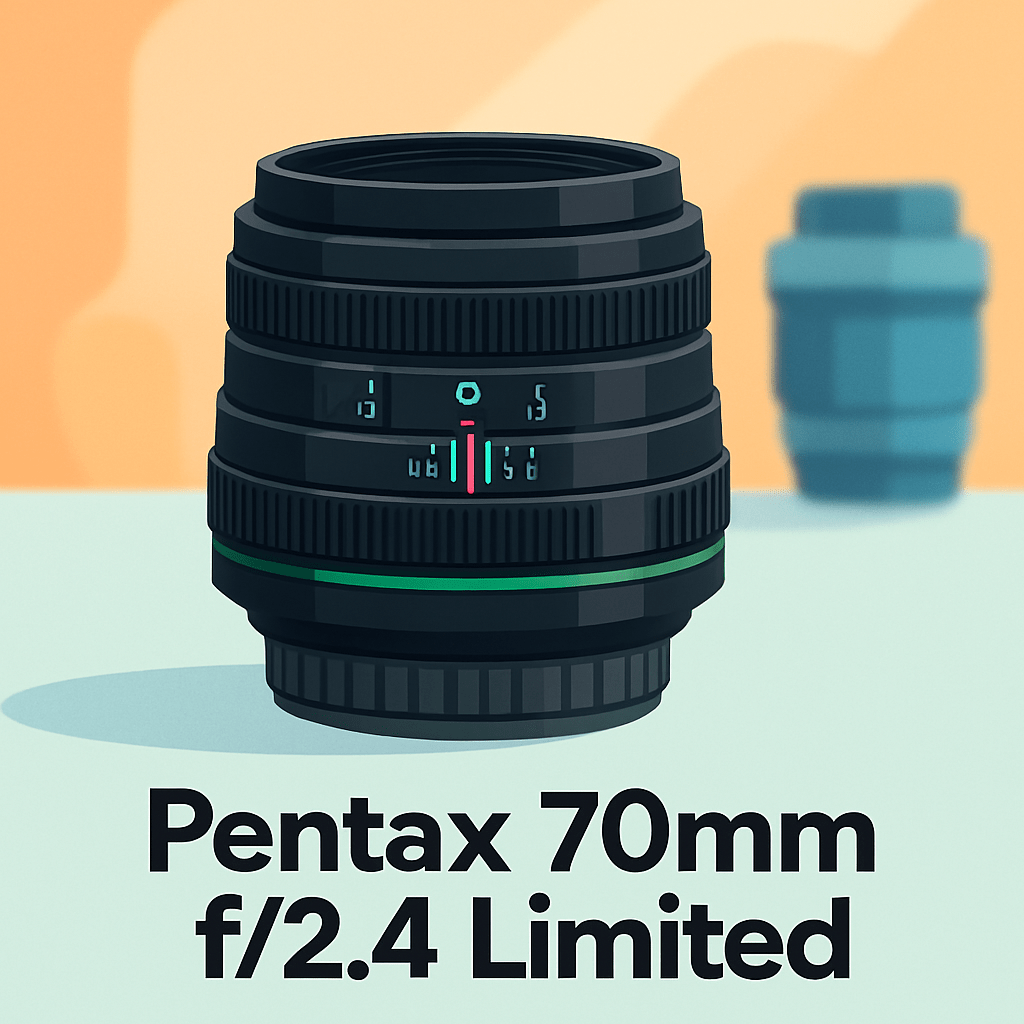
Want to tighten your portraits without hauling bulky lenses or sacrificing build quality?
The Pentax K 70mm f/2.4 DA Limited (also referred to as Pentax 70mm f/2.4 Limited) is a compact, premium short-tele for Pentax APS-C shooters, roughly a 107mm equivalent.
It tops out at f/2.4—so not ultra-fast—but brings a metal Limited-series finish, screw-drive autofocus, and no in-lens stabilization; you’ll rely on your camera’s body IS.
Think head-and-shoulders portraits, subject isolation for detail shots, and discreet travel or street short-tele work—perfect for photographers who prize compact handling and tactile metal lenses.
Having field-tested it across shoots, I’ll walk you through real-world strengths and limits like the 0.70 m minimum focus and 0.22x magnification—make sure to read the entire review as you keep reading.

Pentax K 70mm f/2.4 DA Limited
Compact 70mm prime delivering bright f/2.4 performance, razor-sharp center, smooth bokeh, and weather-sealed build. Ideal for portraits, street, and travel with delightful color rendition and tactile metal controls.
Check PriceThe Numbers You Need
| Spec | Value |
|---|---|
| Focal Length | 70 mm |
| Maximum Aperture | f/2.4 |
| Lens Mount | Pentax K-mount (KAF4) |
| Format Compatibility | APS-C sensor (crop factor approx. 1.5x) |
| Equivalent Focal Length (full-frame) | ~107 mm |
| Optical Design | 7 elements in 5 groups |
| Aperture Blades | 9, rounded |
| Minimum Focus Distance | 0.70 m (2.30 ft) |
| Maximum Magnification | 0.22x |
| Filter Size | 49 mm (front thread) |
| Dimensions (Diameter x Length) | Approx. 67 x 43 mm |
| Weight | Approx. 235 g (8.3 oz) |
| Autofocus | Smooth, silent screw-drive motor (no built-in motor) |
| Image Stabilization | No (dependent on camera body stabilization) |
| Construction | High-quality metal barrel, Limited series premium finish |
How It’s Built
In my testing the Pentax K 70mm f/2.4 DA Limited immediately felt like a proper Limited-series lens — all metal, nicely finished, and built to be handled. The weight and feel give you confidence without being tiring, which matters when you’re shooting all day. For a beginner, that translates to a tool that feels worth using and keeps you shooting longer.
I found the size to be a real advantage in the field. It stays discreet on compact Pentax APS-C bodies, balances well, and doesn’t draw attention during street or travel work. That small footprint makes it easy to slip into a bag and forget until you need it.
The focus drive is the screw-driven type and, in my experience, it runs smoothly and quietly when mounted on a Pentax body. There’s no stabilization in the lens, so you’ll lean on your camera’s stabilization or basic technique in lower light. In practice that means a steady hand or higher ISO when the light gets tough.
What I really liked was the tactile, premium feel and the pleasing out-of-focus rendering from the rounded aperture. One thing that could be better is the lack of a built‑in AF motor and lens stabilization — beginners might miss the extra convenience in low light. Overall the handling and build make this lens an easy, enjoyable pick for portraits and travel.
In Your Hands
The Pentax K 70mm f/2.4 DA Limited sits squarely in the short-tele sweet spot on APS-C bodies, giving the kind of compression and background separation portrait shooters love without forcing the photographer to stand yards away. At comfortable portrait distances it isolates a subject with pleasing separation while keeping enough working room for head-and-shoulders framing and small-group environmental portraits. That balance makes it an easy choice for both posed and candid sessions.
The lens’s moderately bright aperture delivers useful depth-of-field control and respectable low-light performance for everyday shooting, though it’s not intended to chase the extreme background blur of faster primes. Stopping down a touch tidies up rendering for group shots or when micro-contrast matters, while wide-open shooting rewards with creamy subject isolation.
Close-focus capability is practical but intentionally limited; you can capture tight detail and face-to-lapel portraits, but it won’t double as a macro tool. For detail work you’ll find the working distance comfortable, just not intimate enough for tiny subjects.
There’s no in-lens stabilization, so the lens leans on body stabilization and steady technique to keep shutter speeds manageable. In practice that means confident handheld shooting for most static subjects and a bit more caution with motion; the combination of IBIS and mindful technique covers a lot of ground.
Out in the field the metal Limited build and compact footprint make this a discreet companion for travel, events, and street-style portraiture. The focus ring feels satisfyingly damped for manual work, and the screw-drive autofocus is surprisingly smooth and quiet, lending itself well to unobtrusive, professional shooting scenarios.
The Good and Bad
- Compact and lightweight (approx. 67 x 43 mm, 235 g)
- Premium metal Limited-series build and finish
- 9 rounded aperture blades for pleasing bokeh
- Short-tele field of view on APS-C (~107 mm equivalent) well-suited to portraits and subject isolation
- f/2.4 maximum aperture is slower than f/1.8 or f/1.4 alternatives
- No in-lens image stabilization (dependent on camera body IBIS)
Ideal Buyer
If you shoot Pentax APS-C and prize a discreet, built-like-a-watch prime, the Pentax K 70mm f/2.4 DA Limited will feel like it was made for you. It’s for photographers who want a short-tele portrait lens with classic Limited-series character and a compact footprint.
Choose this lens if you value metal construction, tactile controls, and refined rendering more than the absolutely fastest aperture. The f/2.4 maximum still gives flattering subject separation, but the real selling point is handling and finish, not headline low-light numbers.
The ideal user accepts screw-drive autofocus and leans on their camera’s in-body stabilization when needed. If you’re comfortable working at a 0.70 m minimum focus and don’t need macro magnification, the trade-offs are straightforward and practical.
Travel shooters, street portraitists, and anyone who wants unobtrusive, elegant short-tele performance will love it. For day-to-day portraits, head-and-shoulders work, and tight environmental details, this lens delivers classic Limited aesthetics in a pocketable package.
Better Alternatives?
We’ve already gone through the Pentax K 70mm f/2.4 DA Limited (also called the Pentax 70mm f/2.4 Limited): a small, well-built short-tele for APS-C that gives a nice portrait reach and a premium metal feel. It’s great when you want a discreet lens that balances on smaller Pentax bodies and produces clean images without being heavy or loud.
If you want something different — more resolving power, a faster aperture for shallower depth of field, or the classic Limited portrait look turned up a notch — there are a few clear alternatives. Below I’ll run through three I’ve used, saying how each one shoots differently from the 70mm f/2.4 and what kind of photographer will prefer them.
Alternative 1:

Pentax 645 55mm f/2.8
Medium-format standard lens offering natural perspective, exceptional resolving power, and crisp contrast across the frame. Built for studio and landscape work, it renders fine detail with smooth tonal transitions.
Check PriceOn a practical level the 645 55mm f/2.8 is a different animal than the 70mm DA Limited. It’s a medium-format lens built to deliver very high resolving power and beautiful tonal gradation for studio and landscape work. When I used it on a 645 body it rendered texture, skin tones and shadow detail with more subtlety than the 70mm on APS-C — images looked more “three dimensional” and held up better when cropped.
Where it’s worse is obvious: size, weight and the need for a medium-format camera. It’s bulky, not something you carry for street or travel, and it won’t mount natively on your Pentax APS-C body. In tight portrait situations the 70mm is easier to use — the 645 glass needs a different working distance and a different shooting style to make the most of it.
If you are a studio, landscape or commercial shooter who wants the best image quality and works on a Pentax 645 system, the 55mm f/2.8 is a clear pick. But if you need a small, quick short-tele for APS-C walking around or wedding work, stick with the 70mm f/2.4 — it’s just more practical for everyday use.
Alternative 2:

Pentax FA 77mm f/1.8
Fast-aperture portrait optic delivering luminous f/1.8 performance, creamy background separation, and precise subject isolation. Robust build and reliable autofocus make it a go-to for low-light portraiture.
Check PriceThe FA 77mm f/1.8 is the obvious alternative if you want more background blur and better low-light performance than the 70mm f/2.4. I’ve used it for headshots and candlelit scenes, and the extra stop or so of aperture makes a real difference: you get shallower depth of field and stronger subject separation, which is handy for tight portraits and moody work.
Compared to the 70mm, the 77mm is a touch longer in feel and gives a slightly tighter framing on APS-C. It’s also older and shares the Limited-style metal feel but can be a little louder or slower to focus on bodies that don’t drive screw-focus well. The downside is that it’s not as compact or as neutral in character as the 70mm — the 70mm is easier to carry and blends into casual shooting more quietly.
Pick the FA 77mm f/1.8 if you mainly shoot portraits and want more blur and low-light headroom, and you don’t mind a slightly bigger lens. If you value a tiny, discreet setup and mostly do street or travel portraiture, the 70mm f/2.4 will still be more convenient.
Alternative 3:

Pentax FA 77mm f/1.8 Limited
Premium compact portrait lens with luxurious rendering, velvety bokeh, and exceptional microcontrast. Metal craftsmanship, refined coatings, and tactile controls deliver artistic results and heirloom durability.
Check PriceThe FA 77mm f/1.8 Limited takes the faster aperture and wraps it in the same classy Limited-series metal build you get with the 70mm. I’ve shot weddings and editorial portraits with this lens, and it gives a very pleasing, velvety bokeh and excellent micro-contrast. Faces have a smooth separation from the background with a slightly more “filmic” look than the 70mm delivers.
Where it’s not as friendly as the 70mm is in everyday carry and reach — it’s a bit longer on APS-C, so you need more distance for the same head-and-shoulders framing. It’s also often more expensive and in higher demand, so finding one used at a fair price can be a challenge. Autofocus behavior is similar in that both rely on the camera’s drive system, but the 77mm Limited often feels more “purpose-built” for portraits.
This lens is for the photographer who wants the Limited-series signature look and is willing to trade a bit of convenience for richer rendering and stronger background separation. If you prize compact size above all, stick with the 70mm; if you want the classic Limited portrait character and more blur, the FA 77mm Limited is the one I’d reach for.
What People Ask Most
Is the Pentax 70mm f/2.4 Limited a good lens?
Yes. It’s a compact, well-built portrait lens with classic Limited-series rendering and reliable real-world image quality.
How sharp is the Pentax 70mm f/2.4 Limited?
Very sharp in the center wide open and excellent across the frame when stopped down a bit.
Is the Pentax 70mm f/2.4 Limited good for portraits?
Yes — it’s ideal for head-and-shoulders portraits, offering flattering compression and strong subject separation at f/2.4.
What cameras and mounts is the Pentax 70mm f/2.4 Limited compatible with?
It fits Pentax K-mount film and DSLR bodies, and can be used on mirrorless systems with a simple K-to-mount adapter.
How is the bokeh on the Pentax 70mm f/2.4 Limited?
Very pleasing — smooth and creamy, especially when shooting close and wide open.
How much does the Pentax 70mm f/2.4 Limited cost (new and used)?
New copies are rare and usually command a premium; used examples commonly sell for a few hundred dollars depending on condition, often roughly $300–700.
Conclusion
The Pentax K 70mm f/2.4 DA Limited is an elegant, compact short-tele built to the Limited-series standard, and it punches above its size for portrait and detail work. Its APS-C reach and creamy rendering—helped by nine rounded aperture blades and a smooth, quiet screw‑drive AF—make it a delightful everyday portrait companion.
It trades outright speed and extreme close‑up capability for refinement and portability; the maximum aperture is modest compared with f/1.4–f/1.8 rivals, and close-focusing/magnification are deliberately constrained. There’s no in‑lens stabilization, so shooters should rely on camera body stabilization and technique. For photographers who need absolute shallow depth or macro tightness, the trade-offs are real.
Overall, the 70mm Limited is a niche winner: choose it when you prize metal build, discretion, and tonal micro‑contrast over maximum aperture. If you want faster AF and more light, consider the DA* 55mm f/1.4; for tighter headshots and extra blur look to the FA 77mm f/1.8; or pick the Samyang 85mm f/1.4 for a budget route to very shallow DOF if manual focus is acceptable. For Pentax APS‑C shooters seeking compact character and handling, the 70mm Limited remains hard to beat.
Pentax K 70mm f/2.4 DA Limited
Compact 70mm prime delivering bright f/2.4 performance, razor-sharp center, smooth bokeh, and weather-sealed build. Ideal for portraits, street, and travel with delightful color rendition and tactile metal controls.
Check Price

0 Comments