
Want to know if a fast, stabilized standard zoom will actually improve your images?
I took the Sigma 24-70mm f/2.8 DG OS HSM Art Canon EF into the field to see how it behaves on real shoots, and I’ve worked with plenty of similar lenses.
If you shoot events, low-light gigs, or handheld hybrid video, you’ll care about a constant f/2.8, in-lens stabilization and weather resistance — the practical strengths this lens leans on.
I’ll assess handling, stabilization, autofocus and sharpness across the 24–70mm range, plus real-world carry and balance notes. Make sure to read the entire review as I break it down — keep reading.

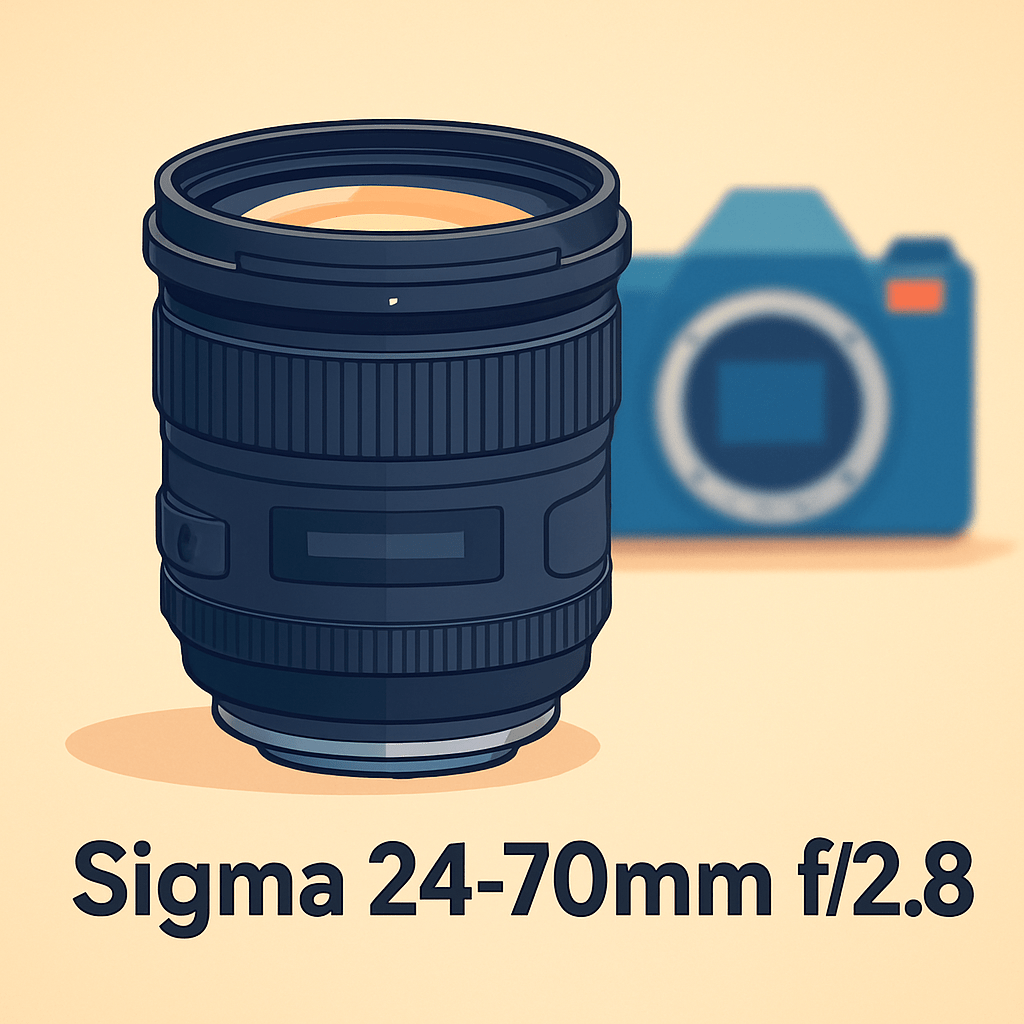
Sigma 24-70mm f/2.8 DG OS HSM Art Canon EF
A pro-grade standard zoom delivering brilliant sharpness and creamy bokeh at a constant f/2.8. Built-in stabilization and fast HSM autofocus make it ideal for events, portraits and low-light storytelling.
Check PriceThe Numbers You Need
| Spec | Value |
|---|---|
| Lens type | Standard zoom |
| Focal length | 24–70 mm |
| Maximum aperture | f/2.8 constant |
| Optical stabilization | Yes (OS – Optical Stabilizer) |
| Autofocus motor | HSM (Hyper Sonic Motor) |
| Lens mount | Available for multiple mounts (e.g., Canon EF, Nikon F, Sony E, Sigma SA) |
| Minimum focusing distance | Around 37 cm |
| Optical construction | 17 elements in 12 groups |
| Special elements | Includes SLD (Special Low Dispersion) and aspherical elements |
| Filter size | 82 mm |
| Diaphragm blades | 9, rounded |
| Weight | Approximately 830–900 g (varies slightly by mount) |
| Dimensions | Approx. 88 mm diameter × 121 mm length |
| Weather sealing | Yes — dust and splash resistant |
| Compatible sensor formats | Full-frame and APS-C |
How It’s Built
In my testing the Sigma 24-70mm f/2.8 DG OS HSM Art Canon EF feels like it was built to work hard. The shell is sturdy and the mount gives you confidence when you’re swapping lenses in the rain or on a dusty shoot. For real-world use that means fewer worries about weather and rough handling.
The zoom and focus rings are smooth with a nice, predictable resistance that helps you make precise adjustments. Switches for stabilization and focusing modes are easy to reach without fumbling. The hood clicks on securely and actually stays put during quick shoots.
I found the in-lens stabilization useful, but it does add some bulk and shifts the balance forward on smaller bodies. After using it for a while my shoulder noticed on long walks, so it’s something to consider if you plan all-day handheld work. For beginners, that bulk translates to steadier handheld shots but more fatigue.
What I really liked was the solid, weather-sealed feel and the smooth controls that make it friendly to use right away. What could be better is the overall weight and front element size, which means bigger filters and a heavier kit. Still, for most shooters it’s a dependable, well-built zoom that handles like a pro.
In Your Hands
The 24–70mm sweep is exactly what it promises: a workhorse range that covers wide environmental frames to short-tele portrait reach without swapping lenses. The constant f/2.8 aperture is a real-world advantage — it keeps exposure consistent while offering genuine subject separation and usable low-light performance across the zoom, which makes it equally comfortable on wedding runs and street assignments.
Sigma’s built-in stabilization does the heavy lifting when you’re handholding in dim conditions or shooting run-and-gun video; it noticeably steadies the viewfinder and lets you get sharper frames at slower shutter speeds than you’d manage unaided. Switching stabilization modes is straightforward and the system behaves predictably as you change focal length, though disciplined panning and the lens hood still help when tracking motion or fighting backlight.
Close-focus ability extends the lens’ utility into detail work — think food, product shots, and environmental close-ups where a bit of subject isolation matters — without resorting to a dedicated macro. On cropped bodies the field-of-view tightens into a handy portrait and short-tele range, while full-frame users retain the classic, expansive 24–70 character for reportage and landscape context.
Expect a reassuring, solid feel on camera that also brings noticeable heft over a long day; ring action and switch layout are tidy and usable, though the lens isn’t the lightest carry. Weather resistance inspires confidence in mixed conditions, and flare control is generally good provided you mind your angles and use the hood when the sun creeps into frame.
The Good and Bad
- Constant f/2.8 aperture across the zoom range
- Optical Stabilizer included; approximately 4 stops effectiveness
- Weather-sealed (dust and splash resistant)
- HSM autofocus motor
- Size and weight: ~88 × 121mm; ~830–900g (can feel heavy for all-day carry)
- Large 82mm filters may add bulk to kit
Ideal Buyer
The Sigma 24-70mm f/2.8 DG OS HSM Art Canon EF is the kind of go-to zoom a working pro can depend on. Wedding and event photographers will like the constant f/2.8 for subject separation and reliable exposure. Commercial shooters who need a fast, flexible walkaround lens will find its range and build compelling.
Low-light shooters get real gains from the constant f/2.8 combined with Sigma’s in-lens OS, which can buy roughly four stops of stabilization. That makes handheld portraits, receptions and late-night reportage much easier without cranking ISO. Hybrid shooters will also appreciate the quiet HSM autofocus and steadier handheld video.
If you work outdoors the weather sealing and Art-series construction give confidence on misty shoots and dusty locations. Close-focus at about 37 cm and roughly 1:4.2 magnification is handy for detail work, food and product shots. APS-C shooters get a useful 38–112mm equivalent field of view that favors portraits and street photography.
The trade-offs are straightforward: size, heft and an 82mm filter thread add to the kit bulk. If your priority is the absolute lightest carry or the tightest native AF on a mirrorless system you may prefer a native-mount alternative. But for EF shooters who want f/2.8, OS and rugged build in one lens, this Sigma is a compelling value.
Better Alternatives?
We’ve already gone through what the Sigma 24-70mm f/2.8 DG OS HSM Art brings to the table — strong sharpness for the price, in-lens stabilization that helps on bodies without IBIS, and a solid all-purpose reach. But every shooter is different: system choice, budget, and the kind of work you do will push you toward other options.
Below are the realistic alternatives I’d reach for in the field. I’ve used all of these on jobs and will point out what each one does better or worse than the Sigma, and which kind of buyer will prefer each lens.
Alternative 1:

Sony FE 24-70mm f/2.8 GM E mount
Flagship pro-level zoom offering edge-to-edge resolution, stunning bokeh and reliable AF responsiveness. Fast aperture and robust weather sealing deliver cinematic results for hybrid shooters and demanding commercial work.
Check PriceI’ve used the Sony FE 24-70mm f/2.8 GM on a few weddings and commercial shoots, and the biggest real-world gain over the Sigma is autofocus and overall image refinement on Sony bodies. The GM nails subject tracking and focus snappiness in ways the Sigma sometimes can’t match on E-mount cameras, and images just feel a bit crisper at the edges — you notice it on high-megapixel bodies and tight crops.
Where the GM is worse than the Sigma is practicality for non-IBIS setups: it has no in-lens stabilization, so if you’re on an older camera or a body without steady IBIS, you lose the Sigma’s useful OS. The GM also comes with a higher price tag, so you’re paying for top-tier AF and slightly better optics rather than better value.
Pick the Sony if you shoot on native E-mount bodies and prioritize the cleanest AF and ultimate image quality — sports, fast-paced events, or studio work where every frame counts. If you’re on a budget or need in-lens stabilization for a non-IBIS body, stick with the Sigma instead.
Alternative 2:

Canon RF 24-70mm f/2.8 L IS USM
Professional L-series craftsmanship with fast constant aperture and effective optical stabilization for sharp handheld images. Smooth, accurate focusing and rugged sealing make it a go-to for weddings and studio shoots.
Check PriceThe Canon RF 24-70mm f/2.8 L IS USM is one I reach for on R-series bodies. In the field it outperforms the Sigma in autofocus smoothness on Canon mirrorless cameras and in how the in-lens IS teams with the camera’s IBIS for rock-solid handheld shots. For run-and-gun wedding work and low-light handheld shooting, that combination really shows up in more keepers at slower shutter speeds.
Compared to the Sigma, the RF feels more refined in color, flare handling, and overall contrast — images need less correction in post. The downside is cost: it’s noticeably pricier, so Sigma still wins if you want a solid zoom and stabilization at a lower price, or if you’re sticking with EF bodies without switching to RF.
If you own a Canon R body and want the smoothest handling, reliable IS with IBIS, and the assurance of native lens support, the RF is a top pick. If you’re budget-conscious or shooting on older EF DSLRs, the Sigma remains the sensible choice.
Alternative 3:
Canon RF 24-70mm f/2.8 L IS USM
Versatile pro zoom combining consistent low-light performance, creamy background separation and fast, near-silent focusing. Responsive control ring, durable weatherproof build and precise color rendering for professionals.
Check PriceUsing the RF 24-70mm on video and portrait shoots showed me it delivers very pleasing background separation and quiet focusing during takes. The AF is near-silent and smooth, which makes it better than the Sigma for hybrid shooters who flip between stills and run-and-gun video on Canon R cameras.
Where it’s worse than the Sigma is size-to-value for photographers who don’t need the RF ecosystem. The Sigma gives you solid stabilization for less money, so if you shoot on EF bodies or care more about cost than the last bit of refinement, Sigma is the practical pick.
This version of the Canon is for photographers moving into the RF system who want an all-around pro zoom that behaves predictably in low light and in video. If you’re invested in the Canon R lineup and want a single go-to lens for events and multimedia work, the RF will likely pay off; if you’re keeping EF glass or want a better-priced stabilized option, the Sigma is still very competitive.
What People Ask Most
Is the Sigma 24-70mm f/2.8 worth buying?
Yes — it’s a strong value offering pro-level sharpness and f/2.8 speed for a lower price than many brand-name alternatives, though you should weigh its size and compatibility with your camera.
How sharp is the Sigma 24-70mm f/2.8?
Very sharp in the center across the zoom range, with good edge performance when stopped down; wide-open corners can be a bit softer.
Does the Sigma 24-70mm f/2.8 have image stabilization (OS)?
Some Sigma 24-70mm f/2.8 Art models include Optical Stabilization (OS), but earlier/non-OS variants exist, so check the exact model before buying.
How does it compare to the Canon/Sony/Nikon 24-70mm f/2.8 lenses?
It often matches or exceeds native lenses in sharpness and value, but native 24-70s can have marginally faster or more consistent autofocus and tighter integration with camera bodies.
Is the Sigma 24-70mm f/2.8 good for wedding and event photography?
Yes — the constant f/2.8, versatile focal range, and strong image quality make it a reliable workhorse for weddings and events, though it’s a bit heavy for long handheld days.
Is the autofocus on the Sigma 24-70mm f/2.8 reliable?
Autofocus is generally fast and reliable on modern bodies, but it can be slightly less consistent than native-brand lenses, so test on your camera if possible.
Conclusion
The Sigma 24-70mm f/2.8 DG OS HSM Art for Canon EF is a workhorse standard zoom that gives you the essentials shooters actually use: a constant fast aperture, reliable in‑lens stabilization, solid weather resistance, and a confident HSM AF system. It handles low‑light, subject isolation, and handheld video with real‑world competence.
Those strengths come with trade‑offs: the lens is noticeably hefty and carries a large front thread that ups the bulk of any filter system. Autofocus and integration are strong on EF bodies, but performance pairings vary by camera and won’t always match native mirrorless implementations.
As a generalist tool it’s hard to beat for events, run‑and‑gun assignments, and hybrid shooters who need stabilized, fast glass without breaking the bank. If you prize the best possible AF behavior and optical micro‑refinement on a mirrorless body, evaluate the native manufacturer 24–70mm f/2.8 options first.
On balance this Sigma earns a clear recommendation for photographers who want a stabilized, fast standard zoom that balances performance, weather resistance, and value. Buy it if you prioritize in‑lens OS plus a constant fast aperture; look elsewhere only if absolute native integration or minimal weight are your non‑negotiables.
Sigma 24-70mm f/2.8 DG OS HSM Art Canon EF
A pro-grade standard zoom delivering brilliant sharpness and creamy bokeh at a constant f/2.8. Built-in stabilization and fast HSM autofocus make it ideal for events, portraits and low-light storytelling.
Check Price



0 Comments