
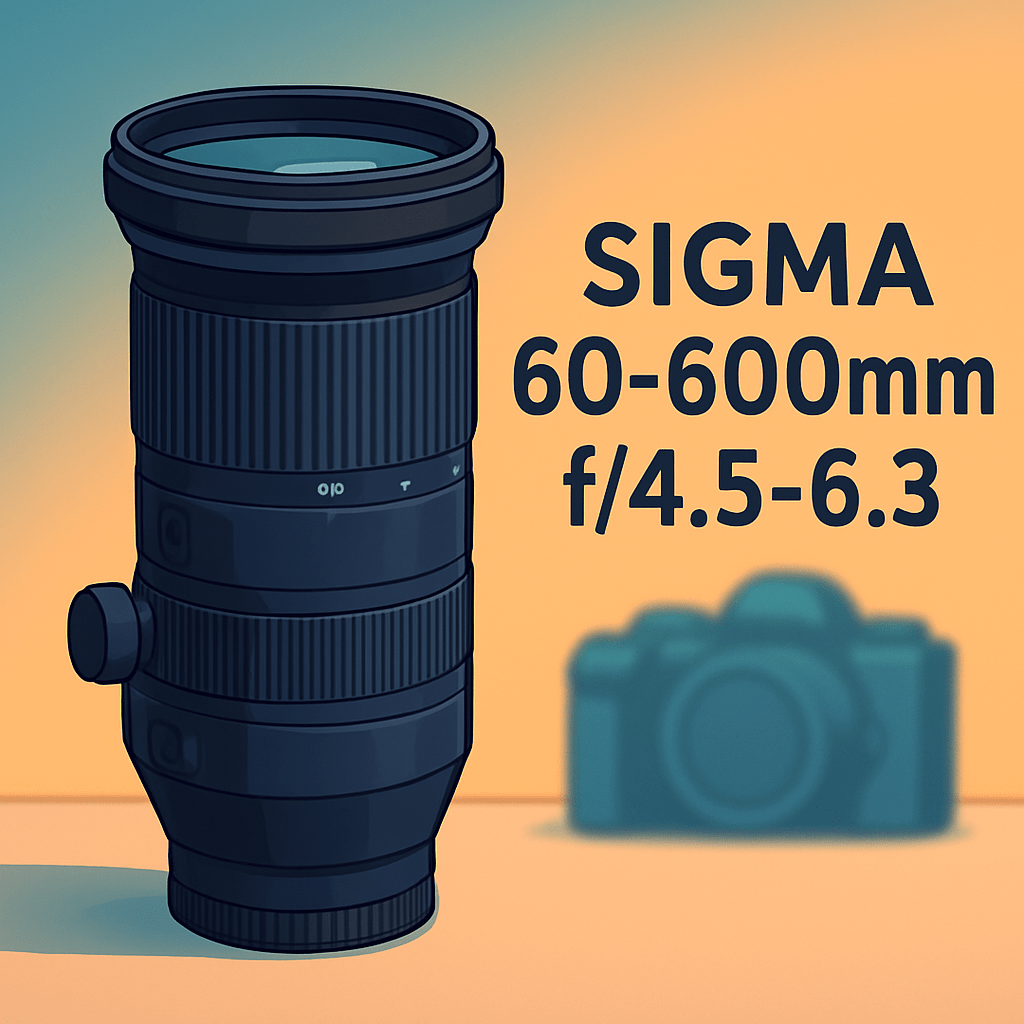
Want one lens that takes you from backyard birds to distant game without swapping glass?
I took the Sigma 60-600mm F4.5-6.3 DG DN Sony E Mount into the field to see if that promise holds up under real shooting conditions.
It’s a 10x super-telephoto all-in-one for Sony E full-frame users, with in-lens stabilization and weather sealing that aim to deliver practical reach and reliability; we’ll weigh portability versus versatility and how the variable aperture shapes exposure choices at long focal lengths. Make sure to read the entire review as I break down handling, AF behavior, and image performance — keep reading.

Sigma 60-600mm F4.5-6.3 DG DN Sony E Mount
Massive zoom range covers everything from field portraits to distant wildlife, delivering sharp, contrast-rich images with fast autofocus and durable, weather-resistant construction—built for handheld shooting and serious outdoor photographers.
Check PriceThe Numbers You Need
| Spec | Value |
|---|---|
| Focal length | 60–600mm |
| Maximum aperture | f/4.5–6.3 |
| Lens mount | Compatible with full-frame cameras (Sony E-mount / L-mount depending on variant) |
| Optical Stabilization | Yes (OS) |
| Autofocus motor | HSM (Hyper Sonic Motor) |
| Minimum focusing distance | Approximately 2.0 m |
| Filter size | 95 mm |
| Lens construction | 25 elements in 19 groups |
| Lens weight | Approximately 2,895 g |
| Aperture blades | 9, rounded |
| Optical design | Includes special low-dispersion and aspherical elements |
| Format compatibility | Full-frame and APS-C (with crop factor) |
| Weather sealing | Yes (dust- and splash-proof) |
| Maximum magnification ratio | Around 1:3.3 (0.3x) |
| Image stabilization effectiveness | Up to 4 stops correction |
How It’s Built
In my testing the Sigma 60-600mm F4.5-6.3 DG DN Sony E Mount feels like a serious tool in the hands. It’s heavy — about 2.9 kg — and you’ll notice it after a few minutes of handholding, but it balances reasonably well on full-frame Sony bodies. For real-world shoots I ended up using a monopod or a stout strap for long sessions.
The front element is big and accepts large filters, so handling and storage need a little planning. I found swapping filters on the go is awkward compared with smaller lenses, but the hood and caps fit securely and keep things protected. Beginners should expect to carry a small kit bag or tray for filters and support gear.
Weather sealing makes a real difference in field use; I shot in mist and light rain without worry. One thing I really liked was that confidence — you can keep shooting when the weather turns. One thing that could be better is the weight, which limits how long you can comfortably handhold it.
The zoom throw is long but smooth, and changing focal lengths is predictable once you get used to it. Rounded aperture blades give pleasing highlights and smoother background blur than I expected from a lens this versatile.
Build quality feels solid with a firm mount and no wobble in my testing unit (Sony E-mount). If you’re new to long glass, plan for support and practice your transitions — the lens rewards patience with huge reach and dependable handling.
In Your Hands
In the field on a Sony E-mount body, the lens’s built-in stabilization proved impressively effective, letting me handhold for many shots that would otherwise have needed a monopod. At extreme reach you still benefit from support — the stabilization buys time and confidence, but it isn’t a substitute for a solid platform when precision matters.
Carrying one optic that covers short tele to super-tele changes the shooting rhythm: I found myself staying with the camera longer, shifting composition rather than swapping glass. That convenience is real for wildlife, field sports, and travel, though mastering the long throw of the zoom takes a little practice to transition quickly between focal lengths.
The lens’s close-focus capability opens up opportunistic semi-close-up work that complements distant shots, even if it’s not a dedicated macro tool. Nine rounded diaphragm blades help render specular highlights smoothly, and background blur remains pleasing throughout much of the range, especially when you isolate a subject against distant backgrounds.
Sigma’s optical design does a good job controlling color fringing and distortion in everyday scenes, and coatings keep flare manageable in challenging light. Contrast and micro-contrast feel punchy in typical shooting situations, though the extreme edges can relax compared with the center at the longest focal lengths.
Used on APS-C bodies the reach becomes even more useful for distant subjects, but that also increases the need for steady support. For long days in the field, a comfortable strap or monopod makes this lens far more usable while preserving the freedom to react fast when action appears.
The Good and Bad
- Extremely versatile 60–600mm coverage in one lens (10x superzoom)
- Optical Stabilization rated up to ~4 stops
- Weather-sealed (dust- and splash-proof)
- 9 rounded diaphragm blades for potentially pleasing bokeh
- Heavy: approx. 2,895 g; prolonged handholding is demanding
- Variable aperture f/4.5–6.3 limits light at the long end
Ideal Buyer
If you want one lens that can go from environmental portraits and field sports to distant birds and shorelines, the Sigma 60-600mm F4.5-6.3 DG DN Sony E Mount is built for you. It’s for photographers who prefer versatility over hauling multiple optics. It’s especially useful for travel and assignment work where swapping glass isn’t practical.
Wildlife and outdoor shooters who need weather sealing and reliable in-lens stabilization will appreciate what this 10x super-tele offers. The reach lets you stay on subjects that would otherwise mean climbing trees or changing lenses mid-action. The optical stabilization helps handheld shots, but support is still smart at the long end.
Bring this lens if you’re comfortable managing a roughly 2.9 kg tool and pairing it with a monopod, strap system, or tripod for long days. Full-frame users get true wide-to-super-tele coverage and APS-C shooters gain even more framing reach for distant targets. That makes it a solid tool for pros and serious hobbyists who spend hours in the field.
Choose it if coverage and convenience matter more than the absolute fastest apertures or the lightest kit. The Sigma makes sense when one lens that does almost everything is more valuable than optimal low-light speed or pocketable handling. If you want native Sony E-mount performance with extreme reach in one package, this is a strong contender.
Better Alternatives?
We’ve looked closely at the Sigma 60–600mm and what makes it such a useful one-lens solution. It covers everything from short tele to extreme reach, but that same versatility means trade-offs in weight, handling, and how it behaves on native mirrorless bodies. If you’re thinking about a different route, the right alternative depends on whether you want lighter carry, stronger native autofocus on Sony bodies, or a more focused reach for birds and distant action.
Below are three real-world alternatives I’ve used in the field. I’ll explain where each one beats the Sigma and where it falls short, and who I’d recommend each to based on how I shot with them.
Alternative 1:

Tamron SP 150-600mm F5-6.3 Di G2 Nikon F Mount
Long-reach telephoto performance with refined optics and effective vibration compensation for crisp shots at extreme distances. Responsive autofocus, smooth zoom control, and weather-sealed build make it a wildlife and sports favorite.
Check PriceThe Tamron 150–600 G2 is a classic choice if you want long reach without the Sigma’s 60mm short end. In the field I found it easier to carry for long walks and it’s friendlier on a monopod or lighter camera bodies. Its vibration compensation keeps handheld shots usable at long distances, so you can get good bird and wildlife shots without hauling a heavy support rig.
Where it loses to the Sigma is versatility and native mirrorless behavior. You give up the 60–150mm range, so you’ll need a second, wider lens if you want that short-tele flexibility. Also, because the G2 is a DSLR-era design, on Sony mirrorless setups you can end up using an adapter and the autofocus and tracking aren’t always as snappy or reliable as a native E-mount lens like the Sigma.
If you’re on a budget, mostly shoot wildlife or sports at mid-to-long distances, and don’t need the 60mm end, the Tamron is a solid pick. I’d recommend it to people who want a lighter, long-reach workhorse and who don’t mind carrying a separate wide zoom for shorter shots.
Alternative 2:

Sony FE 200-600mm F5.6-6.3 G
Versatile full-frame telephoto engineered for reliable, handheld reach—delivers consistent sharpness, quick autofocus, and built-in stabilization. Lightweight handling and robust construction support long days tracking birds, planes, or distant action.
Check PriceThe Sony FE 200–600mm really shines on Sony bodies. I noticed better, more consistent autofocus and subject tracking compared with adapting older DSLR lenses. It feels balanced on Sony bodies and is easier to follow birds in flight thanks to the native AF and good stabilization—hands-down better for pure birding and fast action on Sony cameras.
What you trade away compared with the Sigma is short-range flexibility. The Sony starts at 200mm, so you lose that 60–200 portion entirely. If you often need to switch between environmental shots and tight wildlife frames without changing lenses, the Sigma still wins for convenience. The Sony is more of a specialized tool for long-distance work.
Choose the Sony FE 200–600mm if you shoot a lot of birds, planes, or long-range sports on a Sony body and want reliable AF and lighter handling. It’s the lens I’d reach for when I know I’ll be tracking small, fast subjects and want the best chance of keeping them in focus.
Alternative 3:
Sony FE 200-600mm F5.6-6.3 G
Premium telephoto lens offering exceptional resolution and contrast across the zoom range. Quiet, accurate focusing, sturdy tripod collar, and weather resistance provide confidence for fieldwork and demanding wildlife assignments.
Check PriceOn longer shoots the Sony’s build and ergonomics made a real difference for me. The tripod collar and balance make it comfortable on a gimbal head or tripod, and its AF noise and focus behavior felt quieter and more predictable when tracking subjects for long bursts. I found it easier to get consistently sharp sequences compared to the Sigma when I was on a Sony body.
However, the Sony won’t replace the Sigma if you need one-lens convenience. The Sigma’s 60–600 range covers a lot of ground in one piece of glass; the Sony forces you to plan your kit around long reach. Also, if you want a little more reach at the short end for portraits or closer environmental shots, the Sigma still offers more room to work.
In short, pick the Sony FE 200–600mm if you prioritize native Sony autofocus, steady handling for long tracking sessions, and a lens that feels purpose-built for long-distance subjects. If you want a single lens to do everything from short tele to extreme reach, stick with the Sigma instead.
What People Ask Most
Is the Sigma 60-600mm f/4.5-6.3 a good lens?
Yes — it’s an impressive, very versatile super-telezoom that gives huge reach and good overall image quality for a single-lens solution, but it makes trade-offs in weight, autofocus speed, and peak sharpness versus primes.
Is the Sigma 60-600mm worth buying for wildlife and bird photography?
Yes if you want one lens to cover everything from wide to extreme telephoto and value reach over ultimate sharpness; serious pros who need the fastest AF and the sharpest images may prefer primes or higher-end telephotos.
How much does the Sigma 60-600mm f/4.5-6.3 weigh and is it portable?
It’s heavy (about 3 kg / ~6–7 lbs) and not pocket portable, so plan to use a tripod or monopod for long shoots and travel with padding or a sturdy case.
Does the Sigma 60-600mm have image stabilization and weather sealing?
Yes — it includes optical image stabilization and a weather-sealed build suitable for field use in light rain and dusty conditions.
Is the Sigma 60-600mm compatible with 1.4x and 2x teleconverters?
Yes, Sigma lists compatibility with 1.4x and 2x teleconverters, but expect reduced autofocus performance and some image-quality loss, with 1.4x being the more practical choice.
How sharp is the Sigma 60-600mm at 600mm?
It’s usable at 600mm but softer than at shorter focal lengths and benefits from stopping down and good technique; don’t expect prime-level edge-to-edge sharpness at the long end.
Conclusion
The Sigma 60-600mm F4.5-6.3 DG DN Sony E Mount is the kind of lens that changes how you think about reach; it turns a photography bag into a one-lens toolkit for environmental, wildlife, and distant-subject work. It sacrifices compactness and the brightest apertures to deliver unmatched coverage, reliable stabilization, and weather-sealed confidence in the field. For shooters who prize flexibility over featherweight handling, this lens is fundamentally liberating.
That freedom comes with compromises: the lens is hefty to carry for long handheld sessions and the variable aperture and large front element mean you must manage exposure and support thoughtfully. Autofocus and stabilization are very capable on modern bodies, yet you can expect the usual trade-offs of a long-range superzoom when lighting drops or action becomes frantic. Consider this a pragmatic tool — not a nimble one — that rewards planning and the right support.
Overall value sits with photographers who want 60–600mm coverage without constant lens changes and who accept the physical cost to gain that reach. If you prioritize lighter handling, the fastest apertures, or the last degree of native AF snappiness, look at narrower-range options instead. For many outdoor shooters the Sigma 60-600mm delivers a rare combination of versatility, protection, and performance that makes those trade-offs worth it.
Sigma 60-600mm F4.5-6.3 DG DN Sony E Mount
Massive zoom range covers everything from field portraits to distant wildlife, delivering sharp, contrast-rich images with fast autofocus and durable, weather-resistant construction—built for handheld shooting and serious outdoor photographers.
Check Price


0 Comments