
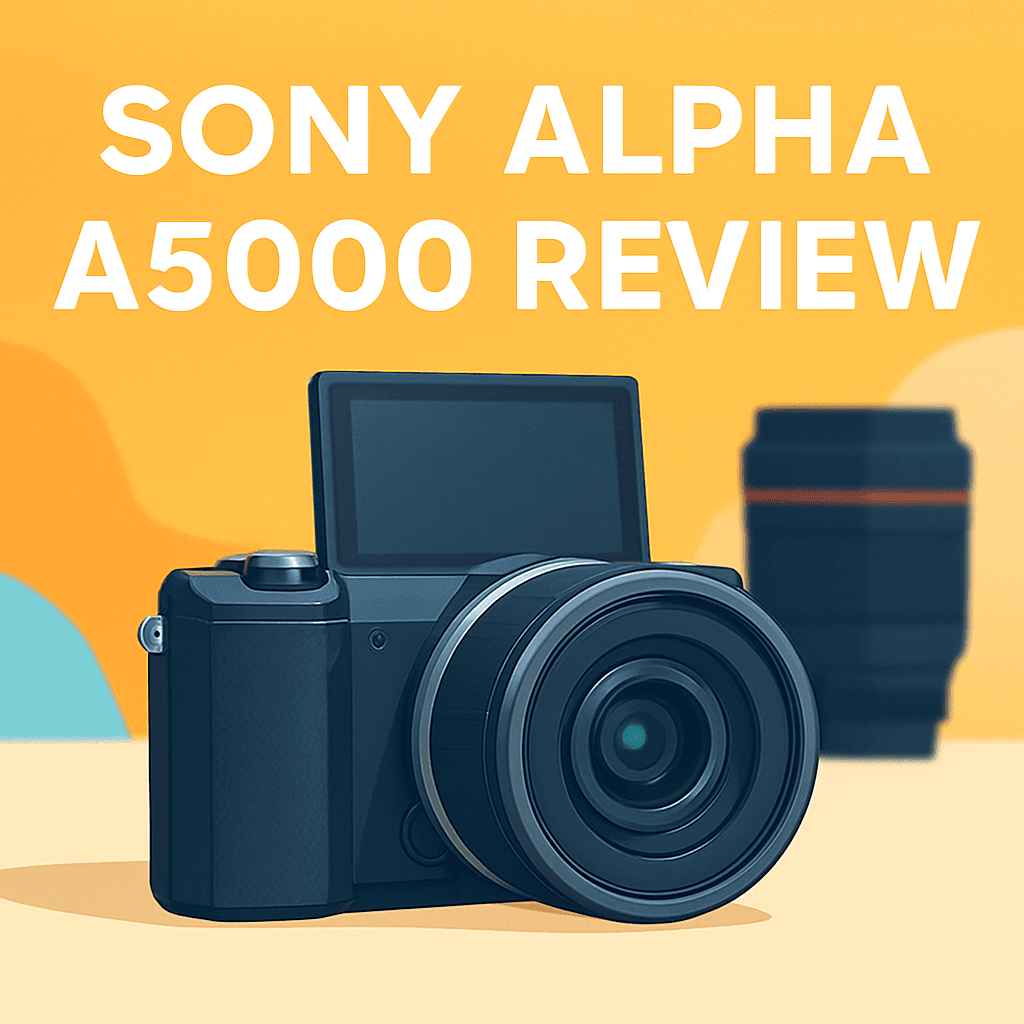
Want to know if the Sony Alpha A5000 Camera can up your image quality without extra bulk?
This sony alpha a5000 review focuses on practical results for travel, street, and everyday shooters.
I’ve shot the A5000 in the field and lived with it on trips.
Its compact APS‑C body, tilting screen, built‑in Wi‑Fi and simple 1080p make shooting and sharing effortless.
I’ll cover handling, autofocus, low‑light usability, stills, video, and where it fits today.
It’s compact and capable, but lacks an EVF, in‑body stabilization, and advanced AF—make sure to read the entire review to see where it truly fits, keep reading.

Sony Alpha A5000 Camera
Ultra-compact mirrorless featuring a large APS-C sensor for crisp images, fast autofocus, tilting LCD and built-in Wi‑Fi. Lightweight and easy to carry—ideal for travelers and everyday photography.
Check PriceThe Numbers You Need
| Spec | Value |
|---|---|
| Sensor | 20.1 MP APS-C |
| Lens Mount | E-mount |
| Image Stabilization | No |
| Autofocus | Contrast Detection AF |
| Continuous Shooting | 3.5 fps |
| ISO Range | 100–16000 |
| Video Resolution | 1080p at 30 fps |
| LCD | 3.0″ Tilting Touchscreen |
| Viewfinder | None |
| Built-in Wi-Fi | Yes |
| Memory Card Slot | Single SD slot |
| Battery Life | Approximately 420 shots |
| Weight | Approximately 269 g |
| Dimensions | 110 x 62.5 x 36 mm |
| Color Options | Black, White, Silver, Pink |
How It’s Built
In my testing the Sony Alpha A5000 feels like a real pocketable camera. It’s light and small enough that it disappears in a day bag, so I took it everywhere without thinking twice. For travel and street work that ease of carry really matters.
I found the tilting rear screen useful for low and high angles, and it made framing more creative and relaxed. Composing with the screen only does mean you’ll fight glare in bright sun since there’s no viewfinder. A quick hand over the screen or angling it down usually fixed that in the field.
The control layout is clean and simple, which is great for beginners who don’t want a handful of dials. What I really liked was the uncluttered design — it lets you focus on shooting. What could be better is a touchscreen or more dedicated controls, because I had to dive into menus more than I expected.
The body feels plasticky but solid in a reassuring way, and the finish options make it fun to personalize. After using it for a while I appreciated the color choices for casual shooters who want something that looks good as well as works well.
Ergonomically it’s fine for one-handed use with small lenses, though larger lenses upset the balance. Buttons are small but usable, and the tilting range gave me plenty of compositional freedom. For beginners this is a friendly, forgiving body — just plan on a grip or strap for longer shoots.
In Your Hands
The Sony Alpha A5000 delivers a very usable real‑world experience when you match expectations to its design. Its contrast‑detect autofocus is steady and accurate on still subjects and portraits, and face detection generally keeps heads sharp, but it will slow or hunt in low contrast or dim scenes where a faster AF system would simply snap on.
Responsiveness lives in the “reliable, not rapid” lane—startup and shot‑to‑shot behavior feel smooth for everyday shooting, while the modest continuous rate means you won’t miss casual moments but won’t nail fast action as often. Menus and controls are straightforward, which keeps the workflow uncluttered even if advanced shooters may miss quicker physical access to settings.
Battery life is hearty enough to get through a typical day of roaming and snapshots if you’re mindful about power use, and simple habits—like switching off wireless when idle and carrying a spare cell—extend that confidence for longer outings. In practice this camera is more companion than workhorse.
Built‑in Wi‑Fi is one of the A5000’s best conveniences: pairing is painless and image transfer or remote shooting is genuinely useful for travel and social sharing. Composing on the tilting rear screen only works well for most angles, though bright sun and the absence of a viewfinder make shading the screen or using low angles a common workaround.
Without in‑body stabilization you’ll want stabilized lenses or a steady hand for slower shutter situations, and a tripod for deliberate low‑light work. The single card slot keeps things simple but reminds you to offload and back up regularly rather than relying on redundancy in‑camera.
The Good and Bad
- Compact and lightweight (approximately 269 g; 110 x 62.5 x 36 mm)
- 20.1 MP APS-C sensor
- 3.0″ tilting screen for flexible framing
- Built‑in Wi‑Fi for transfer and remote control
- No in‑body image stabilization
- No viewfinder
Ideal Buyer
The Sony Alpha A5000 Camera is for photographers who prize pocketable, lightweight gear without sacrificing APS‑C image quality. Its 20.1MP sensor and 3.0″ tilting screen make it a natural choice for travel, street, and everyday carry. If you want something unobtrusive and fast to pull out, this is it.
Shooters comfortable composing on a rear screen rather than hunting for an EVF will feel at home. Built‑in Wi‑Fi makes quick sharing and remote control easy for beginners and hobbyists. If you prize convenience over pro‑level controls, the A5000 streamlines the workflow.
Photographers whose work centers on static or moderately paced subjects—portraits, city scenes, landscapes—will get the most out of its contrast‑detect AF and 3.5 fps burst. Casual videographers who only need 1080p/30 for social clips will also be satisfied. It’s not aimed at sports or fast‑action shooters.
Buyers who can live without in‑body stabilization and who understand the ISO 100–16000 envelope will be rewarded with a light, capable tool. Beginners, travelers, and anyone moving from a smartphone to a dedicated interchangeable‑lens system will find the A5000 intuitive and affordable. If you anticipate needing speed, tracking, or pro video features, look higher up the lineup.
Better Alternatives?
We’ve already walked through the Sony Alpha A5000 — what it handles well and where it falls short — so if you still want more speed, better autofocus or a more modern screen and video options, there are a few clear choices to consider. Below I’ll lay out three practical alternatives I’ve used in the field and how they compare to the A5000 in real shooting situations.
These picks are about real differences you’ll notice while shooting: how often you get a sharp keeper, how nice your JPEGs look straight out of camera, whether a touchscreen or a viewfinder makes a day of shooting easier, and which camera fits different kinds of buyers.
Alternative 1:

Sony Alpha A5100 Camera
High-resolution compact mirrorless with a 24MP APS-C sensor and lightning-fast hybrid autofocus. Touchscreen controls, quick continuous shooting and wireless connectivity let you capture sharp portraits and action with ease.
Check PriceI’ve used the A5100 a lot when I needed a tiny camera that just performs. Compared to the A5000 it gives you noticeably faster and more confident autofocus — especially for kids, pets and street moments where subjects move unpredictably. The touchscreen makes selecting a focus point quick, and the higher resolution gives you a bit more room to crop without losing detail.
Where the A5100 doesn’t improve on the A5000 is in some of the same basic trade-offs: no built-in viewfinder, no in-body stabilization, and it still won’t replace a proper vlogging rig if you need a headphone jack or pro audio. Ergonomically, it feels the same pocketable size, so you keep portability but gain better AF and image detail for everyday shooting.
If you like staying in the Sony E system and want a small step up that makes a real difference in keeper rate and framing flexibility, the A5100 is the one I’d recommend. It’s ideal for travel shooters and parents who need something quick and reliable without getting heavier or more complex.
Alternative 2:

Fujifilm X-A7 Camera
Stylish, lightweight mirrorless offering a 24MP sensor, vibrant color profiles and a large 3.5-inch touchscreen. User-friendly controls, 4K video and creative film simulations make it perfect for expressive photographers.
Check PriceThe X-A7 is a different vibe from the A5000 — I reached for it when I wanted nicer-looking JPEGs without fuss. Fujifilm’s colors and film-simulation modes make portraits and street scenes pop right out of the camera, so you’ll do less editing. The big touchscreen is lovely for quick framing and vlogging-style selfies and it feels modern and friendly in use.
On the downside, in my hands the X-A7’s autofocus isn’t as consistently fast at tracking quick-moving subjects as Sony’s hybrid systems. For static portraits, travel shots, and social content it shines, but if your shoot involves fast action the A5000 (or A5100) will catch more keepers. Also, switching to Fuji means a different lens lineup and a learning curve if you’re used to Sony glass.
Choose the X-A7 if you care a lot about out-of-camera color, a big touch screen, and a camera that’s fun to use for lifestyle and social shooting. If you prioritize straight-out JPEG looks and a friendly interface over raw AF speed, this one will make your life easier.
Alternative 3:

Canon EOS R50 Camera
Compact, versatile mirrorless engineered for content creators: excellent Dual Pixel autofocus, 24MP sensor, vari-angle touchscreen, and 4K video. Fast, reliable performance for vlogging, portraits and everyday shooting.
Check PriceThe Canon EOS R50 is the most modern-feeling option here. In real use its autofocus locks on and keeps tracking subjects much more reliably than the A5000’s contrast-detect system, which means you’ll get more usable shots during run-and-gun shoots. The flip-out screen and 4K video make it a strong pick if you shoot both stills and video, and having a viewfinder helps when you’re shooting in bright daylight.
Where it trades off is size and cost: it’s a bit larger and, depending on lenses, more expensive than the tiny A5000. It also doesn’t magically fix stabilization for all hand-held video — you still need lenses with stabilization or a gimbal for steady motion. Battery and menu layouts felt different to me, and if you’re deeply invested in Sony glass you’ll want to consider lens costs when switching systems.
If you make videos as often as photos, or you want a reliable autofocus system for mixed shooting (vlogs, portraits, fast moments), the R50 is the one I’d pick. It’s aimed at content creators and hybrid shooters who want better AF and a modern screen, even if that means carrying a slightly larger kit.
What People Ask Most
Is the Sony Alpha A5000 a good camera?
Yes — it’s a compact, entry-level mirrorless with a 20MP APS-C sensor that delivers very good image quality for the price, though it lacks advanced features found on newer models.
Is the Sony A5000 a mirrorless camera?
Yes, the A5000 is a mirrorless interchangeable-lens camera in Sony’s Alpha line.
How does the Sony A5000 compare to the Sony A5100?
The A5100 is the stronger choice with a higher-resolution sensor and much better autofocus, while the A5000 is cheaper and still gives solid image quality for casual shooters.
Does the Sony A5000 have a viewfinder?
No, the A5000 does not have a built-in electronic viewfinder — only a tilting rear LCD.
Can the Sony A5000 record 4K video?
No, the A5000 records up to Full HD 1080p only and does not support 4K recording.
Is the Sony A5000 good for beginners?
Yes, it’s a great starter camera thanks to its small size, straightforward controls, and good image quality, but advanced users may find its features limited.
Conclusion
The Sony Alpha A5000 Camera is a compact APS‑C mirrorless that delivers focused value for photographers who prize portability. It pairs a capable sensor with a tilting rear screen, straightforward handling and built‑in Wi‑Fi for fast sharing. It delivers crisp stills and honest color in everyday conditions.
It’s not without compromises. There is no viewfinder or in‑body stabilization, autofocus relies on contrast‑detect, and burst and video capabilities feel modest. Composing on the rear screen in bright sun can be frustrating.
That mix makes the A5000 a strong fit for travel, street and everyday stills where compactness and long battery life matter. If you shoot mostly static subjects and prefer simplicity over cutting‑edge features, you’ll be satisfied. Built‑in Wi‑Fi makes sharing and remote capture effortless on the go.
If you need snappier AF, a modern touchscreen or more robust video, consider the A5100, Fujifilm X‑A7 or Canon EOS M200 instead. For everyone else who wants a lightweight, no‑frills shooter that still produces pleasing results, the A5000 remains a sensible, budget‑minded choice. Weigh these trade‑offs against your shooting priorities before buying.
Sony Alpha A5000 Camera
Ultra-compact mirrorless featuring a large APS-C sensor for crisp images, fast autofocus, tilting LCD and built-in Wi‑Fi. Lightweight and easy to carry—ideal for travelers and everyday photography.
Check Price



0 Comments