
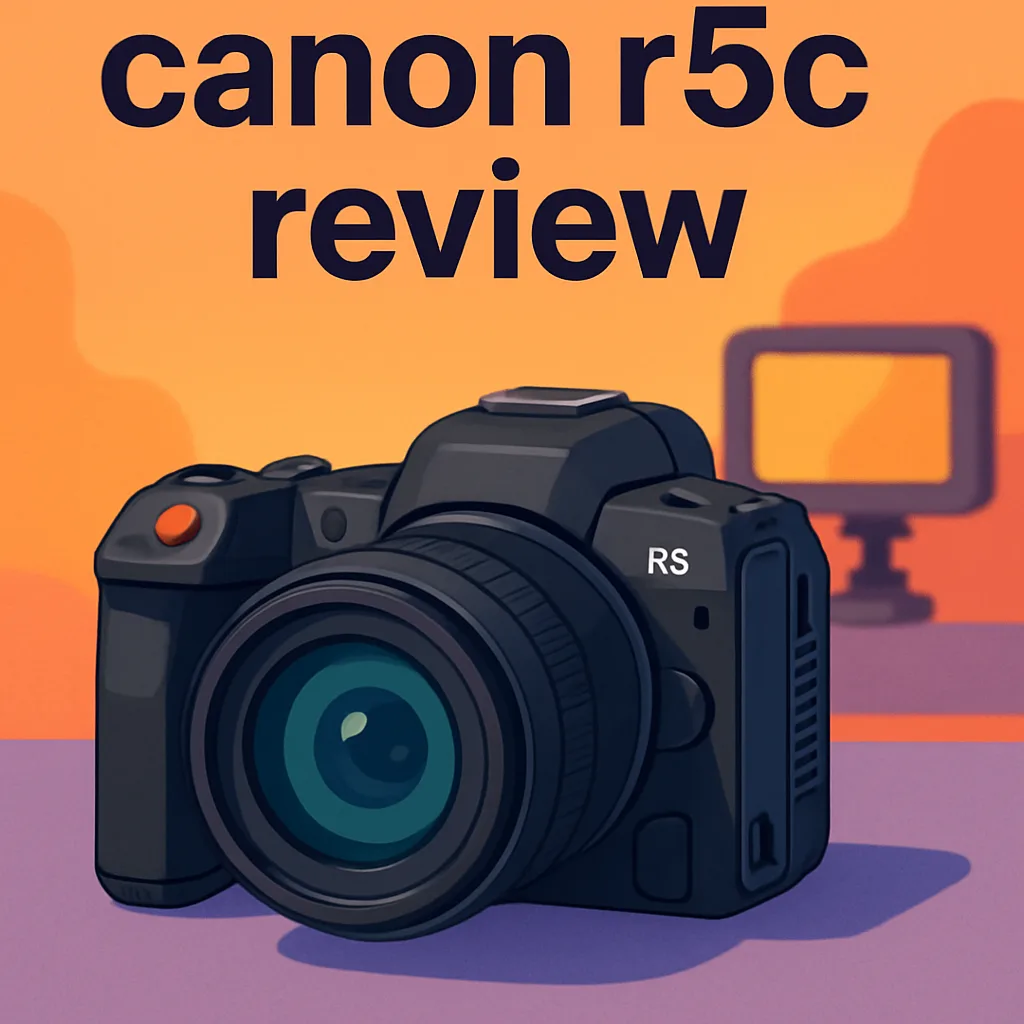
Ever wished you could ditch a second camera and still get cinema-grade footage?
The Canon EOS R5 C Camera it’s promising hybrid freedom for pros and ambitious creators.
I personally field-tested the Canon EOS R5 C Camera and compared it with a couple of close rivals.
If you’re a filmmaker, videographer, or pro photographer, this camera aims to simplify your workflow.
It’s got strengths in high-res stills, cinema-grade video, and cooling that lets you record longer.
There’s one headline compromise: limited battery life during heavy video use.
That’ll force you to plan power or carry spares.
I’ll cover what matters on set and in post; keep reading as I will reveal something shocking about the Canon EOS R5 C Camera that could change your photo quality.

Canon EOS R5 C Camera
Hybrid full-frame cinema/stills rig delivering 8K RAW capture, active cooling for extended recording, advanced autofocus, versatile RF lens compatibility, and professional color science for filmmakers demanding high-resolution motion and photo performance.
Check PriceThe Numbers You Need
| Spec | Value |
|---|---|
| Sensor | Full-frame 3:2 CMOS, 36 x 24 mm, 47.1 megapixels |
| Still image resolution | Up to 8192 × 5464 pixels |
| Max internal 8K video | 8192 × 4320 up to 30 fps (internal) |
| Max 8K with external power | 8192 × 4320 up to 60 fps (requires external power) |
| High-speed video | 4K up to 120 fps |
| Video formats | Cinema RAW Light, XF-AVC, MP4 |
| Autofocus | Dual Pixel CMOS AF with Eye AF and EOS iTR AF X |
| Dynamic range | Canon Log 3 — up to 14 stops (potentially 15 in ideal conditions) |
| Cooling | Active cooling fan for unlimited recording time |
| Storage | Dual card slots: CFexpress and SD UHS-II |
| Connectivity | USB Video Class support (UVC) for streaming |
| Assignable controls | 13 assignable buttons |
| LCD monitor | Vari-angle LCD |
| Viewfinder | High-definition electronic viewfinder |
| Weight | Approximately 680 g |
How It’s Built
In my testing the Canon EOS R5 C felt surprisingly compact and lightweight for its class. The body has a solid, confidence-inspiring heft without feeling bulky. That balance makes it easy to carry all day on location.
I found the construction to be robust with dust and moisture resistance that actually matters in the field. That means less stress when shooting in light rain or dusty environments. You can keep working instead of worrying about the weather.
The vari-angle LCD is a real winner in real-world use. After using it for a while I loved shooting low or high angles and even vlogging handheld. The electronic viewfinder is sharp and handy when the sun is blasting.
Controls are clearly aimed at pros, with a good number of assignable buttons and customizable layouts. In my testing that allowed me to tailor the camera to how I work. Beginners might feel overwhelmed at first, though.
What I really liked was the grip and overall ergonomic design that lets you shoot for long stretches without hand fatigue. One thing that could be better is clearer labeling or simpler menus to get new users up to speed faster.
In Your Hands
In my shoots the Canon EOS R5 C’s active cooling truly changes the day-to-day rhythm: I could run extended cinema-grade captures on multi-hour shoots without worrying about thermal cutouts, which is a relief on documentary and long-take gigs. The body stayed composed under sustained workloads that would force many mirrorless rigs to cool down, so you spend more time shooting and less time babysitting gear.
It delivers ultra-high-resolution video and generous high-frame-rate options for slow-motion work, and the autofocus keeps pace, locking onto eyes and faces with reassuring consistency even when subjects move unpredictably. That mix makes it seamless to pivot between handheld documentary moments and carefully lit interview setups without sacrificing sharpness or timing.
Cinema RAW Light and XF-AVC provide real-world flexibility in postproduction, giving files that grade cleanly while preserving highlight and shadow nuance for demanding color work. The camera’s autofocus systems and tracking translate into less manual intervention on set, which speeds workflows for one-person crews and small teams alike.
Practical trade-offs surface in extended video days: battery endurance becomes the operational constraint, so I routinely plan external power or battery rotations, and the cooling fan can be audible on quiet sets, necessitating careful audio placement or lavalier use. Despite those considerations, its reliable handling of high-resolution footage and robust video feature set make it a true workhorse for hybrid professionals who plan power and audio logistics in advance.
The Good and Bad
- Very high resolution and strong dynamic range performance
- Active cooling system removes internal recording time limits
- Wide range of professional video formats including Cinema RAW Light
- Robust Dual Pixel CMOS AF with Eye AF and EOS iTR AF X
- Limited battery life under intensive video recording
- Cooling fan introduces audible noise during operation
Ideal Buyer
The Canon EOS R5 C Camera is built for filmmakers and high-end videographers who demand cinema-grade 8K capture without time limits. Its active cooling enables unlimited internal 8K recording at 30fps and can support 8K/60fps with external power, so long-form documentaries, commercials and event coverage stay uninterrupted. If your productions rely on prolonged takes, large-format detail and reliable thermal management, this body is designed for that purpose.
Hybrid shooters who need top-tier stills and cinema features will appreciate the 47.1MP full-frame sensor and 8192 x 5464 still output alongside 4K/120p slow motion. Dual Pixel CMOS AF with Eye AF and EOS iTR AF X keeps subjects locked whether you’re shooting portraits, interviews or motion-heavy sequences. The compact, robust build with a vari-angle LCD and assignable controls makes it practical for tight run-and-gun and controlled-set workflows.
Production teams will value Cinema RAW Light, XF-AVC, MP4 and Canon Log 3 with up to 14 stops for grading and flexible postproduction. Expect superb autofocus and codec options for mixed photo/video shoots, but plan around two trade-offs: battery endurance under heavy video use and audible fan noise during quiet takes. Bring spare batteries or run external power and the R5 C will slot into demanding workflows with minimal compromise.
Better Alternatives?
We’ve already gone deep on the Canon EOS R5 C and what it brings as a hybrid stills-and-cinema tool. If you liked parts of the R5 C but have different needs—more stills focus, more speed for sports, or a camera built just for movies—there are solid choices to consider.
Below I’ll lay out three real-world alternatives I’ve used, what each does better or worse than the R5 C, and which shooter would get the most from each one.
Alternative 1:

Canon EOS R5 Camera
Mirrorless full-frame powerhouse with 45MP sensor, blazing continuous shooting, in-body stabilization, precise eye-detection autofocus, and professional video capabilities—ideal for high-resolution photographers seeking speed, versatility, and exceptional image quality.
Check PriceI’ve shot weddings and long editorial days with the Canon EOS R5, and it feels like a pure photographer’s tool compared to the R5 C. The R5 gives you the same high-res stills quality, snappy autofocus, and very clean files. In real use it’s easier to carry all day, and you don’t get the fan noise you’ll hear on the R5 C when recording long video.
Where the R5 falls short versus the Canon EOS R5 C Camera is in long-form video. The R5 overheats sooner if you push heavy 8K or long 4K clips, so it’s not the go-to for marathon video shoots. Also, if you need cinema-style codecs and unlimited recording time, the R5 C is the one that handles that better.
If you’re mainly a photographer who wants great video as a bonus, you’ll prefer the R5. It’s best for wedding photographers, portrait shooters, and editorial work where high-res stills, lighter kit, and quiet operation matter more than nonstop cinema recording.
Alternative 2:

Canon EOS R3 Camera
Pro-level action camera with stacked full-frame sensor, ultra-fast burst rates, lightning autofocus with eye/subject tracking, superb low-light performance, and robust build for demanding sports, wildlife, and news photographers.
Check PriceWhen I switch to the Canon EOS R3 for sports or wildlife, the difference is immediate — the camera locks on and keeps up. The R3 is built for speed: faster bursts, tougher build, and autofocus that tracks erratic subjects better than the R5 C in fast-action situations. In low light it also feels more confident for handheld work.
But compared to the Canon EOS R5 C Camera, the R3 isn’t a hybrid cinema machine. You give up the R5 C’s cinema features like internal 8K options and the longer unrestricted recording that active cooling brings. The R3’s image files are great for action, but it’s lower on megapixels than the R5 C’s stills capability if you need huge crops or poster-sized prints.
The R3 is the camera for sports shooters, wildlife photographers, and news shooters who need speed, reliability, and excellent tracking. If your work is mostly fast stills and occasional video, the R3 will serve you better than a cinema-focused R5 C.
Alternative 3:

Canon EOS C70 Cinema Camera
Compact RF-mount cinema solution combining Super35 sensor, cinematic color science, and industry-standard codecs for 4K capture. Lightweight, ergonomic design with professional audio/connectivity—perfect for indie filmmakers and run-and-gun productions.
Check PriceI’ve used the Canon EOS C70 on documentary shoots and short films, and it feels like a proper cinema tool. For long takes and audio work it’s better than the R5 C: it has cinema ergonomics, built-in XLR options, and a workflow that’s easier for grading and sound. The Super35 sensor and dedicated video controls make shooting for a film pipeline smoother.
On the flip side, the C70 won’t match the Canon EOS R5 C Camera for stills. If you need high-resolution photos, the C70 isn’t designed for that. Also, the look and depth of field feel different because it’s Super35, not full-frame like the R5 C, so your lenses and framing will behave differently in practice.
Choose the C70 if you’re a filmmaker focused on video quality, audio, and a cinema workflow. It’s great for indie movies, commercial shoots, and run-and-gun documentaries where long recording, pro audio, and easy grading are what matter most.
What People Ask Most
What is the maximum resolution for video recording?
Up to 8K (8192 x 4320) internally at 30fps, and up to 60fps when using external power.
Does it overheat during long recording sessions?
No — the active cooling fan lets you record extended 8K clips without overheating limits.
What autofocus features does it include?
Dual Pixel CMOS AF with Eye AF and EOS iTR AF X for reliable subject tracking.
Can it handle various video formats?
Yes — it records Cinema RAW Light, XF-AVC, and MP4 for flexible workflows.
How does it handle dynamic range?
It uses Canon Log 3, delivering about 14 stops of dynamic range (potentially 15 in ideal conditions).
Is it suitable for professional audio recording?
Yes — it supports the multi-function shoe and accessories like the TASCAM CA-XLR2d-C for pro XLR inputs.
Conclusion
The Canon EOS R5 C Camera is a rare hybrid that really delivers on both sides of the fence. Its stills and video capabilities feel purpose-built rather than compromised, and the active cooling turns theoretical endurance into real-world reliability. For anyone who shoots long-form projects and high-resolution imagery, it’s hard to argue with the results.
Strengths are obvious in day-to-day use: image quality, flexible professional codecs, dependable autofocus, and that cooling system which removes recording anxiety. These strengths translate into fewer interruptions, smoother workflows, and more confidence on set. For production-minded shooters the camera simply raises the floor of what you can accomplish without extra gear.
The tradeoffs are real but manageable. Battery performance under continuous heavy video work will demand planning, and the cooling fan introduces an audible element that matters in some recording environments. Neither flaw is fatal, but both affect how you deploy the camera and what accessories you budget for.
Overall, the Canon EOS R5 C Camera is a high-value tool for filmmakers and hybrid professionals who prioritize uninterrupted, cinema-level capture with top-tier stills. If your projects demand that combination and you accept the power and noise considerations, this is a camera that pays dividends in speed, quality, and peace of mind.
Canon EOS R5 C Camera
Hybrid full-frame cinema/stills rig delivering 8K RAW capture, active cooling for extended recording, advanced autofocus, versatile RF lens compatibility, and professional color science for filmmakers demanding high-resolution motion and photo performance.
Check Price


0 Comments