
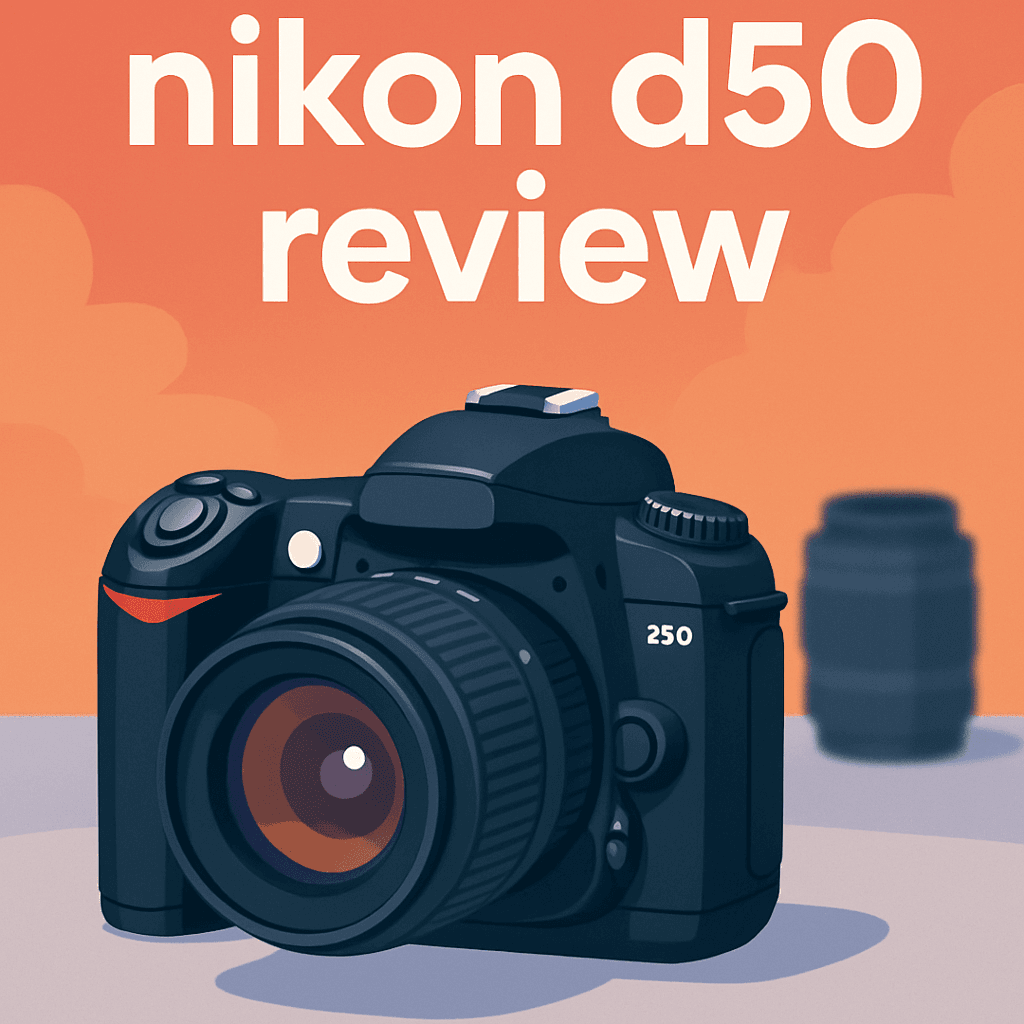
?Thinking about leaving your point-and-shoot for a camera that looks and feels more serious but won’t overwhelm you? You want sharper results without getting lost in menus or jargon.
I personally field-tested the Nikon D50 DSLR Camera. I pitted it against a couple of close rivals to compare real shooting results.
It’s aimed at beginners swapping from compacts. It delivers easy controls, fast autofocus, and an interchangeable-lens system that helps you grow.
In practice you’ll grab better portraits and sharper travel shots faster. You’ll learn manual settings without feeling overwhelmed or slowed down.
The trade-off is old-school limits in low-light and no video features. Night scenes and modern workflow needs can feel constrained.
It’s compact enough to carry all day. It still feels like a proper SLR.
Still, it teaches solid photographic habits. Keep reading as I’ll reveal a surprising trick with the Nikon D50 DSLR Camera that could improve your photo quality drastically.

Nikon D50 DSLR Camera
Lightweight, user-friendly DSLR designed for beginners; delivers sharp images, intuitive controls, and reliable performance. Perfect for learning photography, capturing travel moments, and upgrading from point-and-shoot simplicity.
Check PriceThe Numbers You Need
| Spec | Value |
|---|---|
| Sensor resolution | 6.1 megapixels |
| Sensor type/size | APS-C CCD (23.7 mm × 15.6 mm) |
| ISO sensitivity | 200–1600 |
| Lens mount | Nikon F mount |
| LCD screen | 2.0-inch polysilicon TFT LCD, 130,000 pixels |
| Continuous shooting | Up to 2.5 frames per second |
| Storage | Secure Digital (SD) cards |
| Autofocus | 5-point AF system with AF-assist illuminator |
| White balance | 6 presets plus custom |
| Built-in flash | Yes (pop-up) |
| Accessory shoe | Yes |
| Live View | No |
| Video recording | No |
| In-body image stabilization | No |
| Battery life | Up to 2,000 shots per charge |
How It’s Built
In my testing the Nikon D50 feels like a compact mid-size SLR—small enough to carry around but with real camera presence. Its shape makes it easy to hold and steady when you shoot. For beginners that means less fidgeting and more pictures.
The built-in flash pops up reliably and the top shoe lets you add a better flash or other accessories. I liked how easy it was to use the direct-print option with PictBridge when I wanted quick prints without a computer. What could be better is the grip; my larger hands found it a bit snug during long sessions.
Button layout is straightforward and I found the most-used controls where my fingers naturally fall. After using it for a while I could change settings without taking my eye off the viewfinder, which is huge when you’re learning. That simple layout makes it forgiving for beginners.
The body feels solid for day-to-day use and held up after a few trips and short hikes. In real life that means you can treat it like a proper camera without worrying too much about delicate handling. Overall, the D50’s design makes the jump from point-and-shoot to DSLR less intimidating.
In Your Hands
Out of the box the Nikon D50 feels like a thoughtful step up from a compact camera: menus are straightforward, buttons are logically placed, and the viewfinder-centric workflow quickly becomes second nature for photographers new to interchangeable lenses. The built-in flash and accessory shoe add practical flexibility without complicating the shooting experience, making it easy to experiment with fill light or off-camera accessories.
Autofocus performance punches above what you might expect from an entry model, locking onto subjects with a confident, practical speed that keeps pace with everyday shooting situations. An assist light helps when ambient light falls away, so focus remains usable in dim interiors or evening scenes.
For learners, the blend of scene modes and full manual controls is especially effective: automatic settings let you capture reliably while manual options invite experimentation with aperture, shutter, and exposure compensation. The control layout and direct access to key functions reduce friction when transitioning from point-and-shoot habits to deliberate exposure decisions.
The camera’s ability to record RAW and JPEG files simultaneously is a real-world advantage for shooters who want quick turnarounds while retaining the latitude of raw processing. Continuous shooting is modest but serviceable for casual action and everyday moments, and overall the D50 delivers a reassuring, capable performance that rewards hands-on practice.
The Good and Bad
- Easy to use
- Fast autofocus
- Interchangeable lenses via Nikon F mount
- Good image quality for a 6.1MP CCD
- Limited ISO range (200–1600)
- Does not support video recording
Ideal Buyer
The Nikon D50 is ideal for newcomers who want to step up from a point-and-shoot without feeling overwhelmed. It suits people who prize a straightforward interface and fast autofocus for day-to-day shooting.
Users who want both scene modes and full manual controls will find the D50 especially accommodating. It’s a camera that lets you grow into manual exposure while still providing helpful automated options.
Photographers curious about interchangeable lenses but wary of larger systems will appreciate the D50’s compact mid‑size SLR footprint and Nikon F mount. Built‑in flash, accessory shoe and solid 6.1MP image quality make it a practical learning tool. The ability to record RAW plus JPEG supports serious study of exposure and processing.
It’s not aimed at videographers or high‑ISO night shooters given the lack of video, Live View and a limited ISO ceiling. Buyers who value simple ergonomics, reliable AF and a low-cost entry into Nikon glass will be most satisfied. Consider it a stepping stone toward more modern bodies if you later want video or higher resolution.
Hobbyists shooting travel, families and street scenes will enjoy its balance of control and simplicity. It’s an affordable classroom for photographers finding their voice.
Better Alternatives?
We’ve already gone through the Nikon D50 and what it does well — a simple, friendly DSLR for people moving up from point‑and‑shoots. But technology moved on a lot since the D50, so if you want better low‑light performance, faster autofocus, video, or a different feel in your hands, there are a few modern options worth thinking about.
Below I’ll run through three real alternatives I’ve used in the field. I’ll point out what each one does better and where it falls short compared to the D50, and who I’d recommend each camera to based on actual shooting experience.
Alternative 1:

Nikon Z50 Mirrorless Camera
Compact, high-performance mirrorless with fast autofocus, crisp image quality, and 4K video capability. Lightweight body, comfortable grip, and versatile lens compatibility make it ideal for content creators and travelers.
Check PriceThe Z50 is a modern mirrorless camera that feels night-and-day different from the D50 when you’re shooting. In practice it focuses faster, handles low light far better, and gives you a live electronic view of exposure — so you see the final look as you shoot. It also does video, which the D50 can’t, so if you want both stills and clips the Z50 covers both without juggling two cameras.
Where it’s worse than the D50 is mostly in the small details: battery life is shorter than the old D50 stamina, and if you already own lots of old F‑mount lenses you’ll either need an adapter or start buying Z lenses. The Z50 also feels different in the hand — lighter and more compact — which some people like, but those who prefer the solid, classic SLR feel of the D50 may miss it.
I’d pick the Z50 if I were traveling, making video, or wanting a small but powerful camera with quick autofocus. It’s the best step up for a D50 owner who wants modern shooting tools and cleaner high‑ISO photos, but consider lens plans and battery habits when you move to mirrorless.
Alternative 2:

Nikon Z fc Mirrorless Camera
Stylish retro-inspired body combined with modern mirrorless performance, delivering vibrant images and responsive controls. Excellent tilting screen, crisp electronic viewfinder, and creative features for photographers who value design and function.
Check PriceThe Z fc gives you similar modern guts as the Z50 but wrapped in a retro, tactile body with real dials for shutter and ISO. Shooting with it feels deliberate and fun — great for street and portrait work where feel and quick manual changes matter. Like the Z50 it has fast focus, live view, and video, so it fixes many of the D50’s limits.
Compared to the D50, the Z fc is better for photographers who want style and hands‑on control. It’s worse if you’re on a tight budget or want the simplest possible learning camera: the Z fc costs more and draws attention because of its look. It also shares the same mirrorless tradeoffs as the Z50 — shorter battery life and a need to plan lens compatibility if you have older F‑mount glass.
If you care about how a camera handles and looks as much as how it performs, the Z fc is a lovely choice. I’d recommend it to street shooters, travel photographers who want something that feels special, and content makers who want a camera that’s both stylish and capable.
Alternative 3:

Nikon D7500 DSLR Camera
Robust enthusiast-level DSLR offering high-speed shooting, excellent low-light performance, and detailed image quality. Durable weather-sealed body, intuitive controls, and advanced autofocus for sports, wildlife, and travel photography.
Check PriceThe D7500 is a much more capable DSLR in day‑to‑day shooting than the D50. In my experience it handles fast action and low light far better, gives you longer runs of continuous shooting, and stands up to bad weather thanks to better sealing and a tougher build. If you like the optical viewfinder and want to keep using F‑mount lenses without adapters, this is the clear upgrade.
Where the D7500 falls short versus the D50 is mainly about size and simplicity. It’s heavier and busier — more buttons and menus — so it’s not as simple a learning camera as the D50. Also, while it adds features the D50 lacks (like modern autofocus and higher ISO performance), it doesn’t give you the instant exposure preview that a mirrorless camera offers.
I’d recommend the D7500 to serious hobbyists or shooters who do sports, wildlife, or travel in tough conditions and who prefer an optical viewfinder. It’s the right pick if you want rugged performance and full compatibility with older Nikon lenses and you don’t need the mirrorless perks like an electronic preview or smaller body.
What People Ask Most
What is the ISO range?
200 to 1600.
Can the Nikon D50 record video?
No, it does not support video recording.
What type of storage does it use?
Secure Digital (SD) cards.
Is it compatible with older lenses?
Yes; the built-in autofocus motor provides compatibility with older AF lenses.
Does it have image stabilization?
No in-body stabilization; you can use lenses that include stabilization.
How many shots per battery charge?
Up to 2,000 shots per charge.
Conclusion
The Nikon D50 DSLR Camera remains a compact, approachable SLR that rewards photographers who want straightforward handling and dependable still‑image results. Its layout is friendly to beginners, autofocus feels impressively quick for its generation, and the interchangeable lens system opens creative options. For those focused on photography fundamentals rather than bells and whistles, image quality still holds up under many real‑world shooting conditions.
However, the D50’s aging feature set imposes clear, practical limits in modern shooting workflows. There’s no video capability, no live‑view convenience and no in‑body stabilization, which reduces flexibility for hybrid shooters and low‑light work. Limited sensitivity and the absence of contemporary conveniences mean it struggles where newer bodies excel.
As a recommendation, the Nikon D50 DSLR Camera is an excellent entry‑level tool for learners, hobbyists and anyone upgrading from a compact point‑and‑shoot at a modest cost. It delivers strong value if you prioritize ergonomics, lens versatility and a gentle learning curve over cutting‑edge specs. If you need video, higher resolution or modern autofocus and connectivity, invest in a current mirrorless or higher‑end DSLR instead.
Nikon D50 DSLR Camera
Lightweight, user-friendly DSLR designed for beginners; delivers sharp images, intuitive controls, and reliable performance. Perfect for learning photography, capturing travel moments, and upgrading from point-and-shoot simplicity.
Check Price


0 Comments