
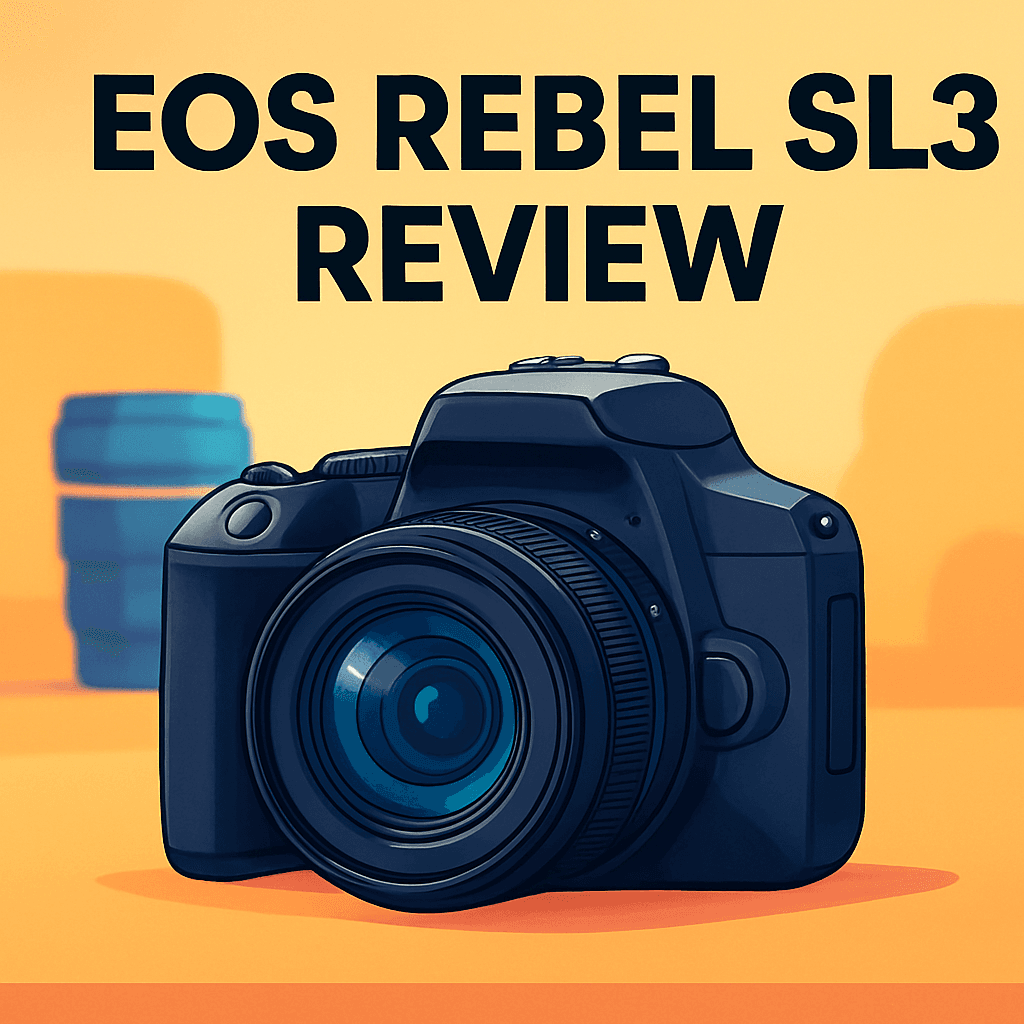
Want to step up your image quality without lugging a bulky camera? If you’re wondering whether the Canon EOS Rebel SL3 Camera fits your needs, this hands-on review will help.
I field-tested it on travel days, family events, and quick portrait sessions to see where it shines and where it struggles.
If you shoot travel, vlogs, or family photos, you’ll appreciate its small size, long battery life, and flip touchscreen. It promises easier Live View autofocus for everyday shooting.
I’ll cover handling, autofocus, stills and video usability, plus comparisons to rivals. Make sure to read the entire review — keep reading.

Canon EOS Rebel SL3 Camera
Compact, lightweight DSLR offering powerful image quality and intuitive controls—ideal for travel and vlogging. Vari-angle touchscreen, Dual Pixel autofocus, 4K video, and excellent battery life for all-day shooting.
Check PriceThe Numbers You Need
| Spec | Value |
|---|---|
| Sensor | 24.1 MP APS-C |
| Lens Mount | EF-S |
| Dimensions | 122.4 x 92.6 x 69.8 mm |
| Weight | 449 grams |
| Video Resolution | 4K at 24p |
| Autofocus | Dual Pixel CMOS AF |
| ISO Range | 100-51,200 (expandable to 100-102,400) |
| Continuous Shooting | 5 fps |
| Shutter Speed | 1/4000s to 30s |
| LCD Screen | Vari-angle 3.0-inch touchscreen |
| Recording Media | SD / SDHC / SDXC (UHS-I) |
| Autofocus Points | 9 points |
| Battery Life | Approximately 1070 shots per charge |
| Connectivity | Wi-Fi, Bluetooth |
| Image Stabilization | Lens-based |
How It’s Built
In my testing the Canon EOS Rebel SL3 Camera feels like a friendly little workhorse that you actually want to take along. It’s compact and light enough that I stopped worrying about lugging a camera and started thinking about shots. That kind of pocketable feel makes it an easy choice for travel and everyday use.
The grip is comfy for most hands and the buttons are laid out in a simple, logical way. I liked how approachable the controls are when you’re coming from a phone or a compact camera. What could be better is a slightly larger grip or a few more direct control dials for users who want faster tweaks on the fly.
The vari-angle touchscreen is a real highlight in my tests. Neck-level or ground-level shots, plus quick selfie-style framing for vlogs, are so much easier with that flip screen and touch controls. The built-in Wi‑Fi and Bluetooth made transferring images and remote shooting painless during a busy event day.
The camera balances nicely with most lightweight Canon EF and EF-S lenses, and it stays comfortable on a strap for long walks. It uses standard SD cards so beginners don’t need special media, and that everyday portability means you’ll actually shoot more. After using it for a while I found it perfect for learning, as long as you stick to lighter glass.
In Your Hands
In regular shooting the Canon EOS Rebel SL3 feels purpose-built for travel, family gatherings, and everyday moments, delivering a responsive experience that keeps pace with fast-changing scenes without feeling fussy. Its continuous shooting and buffer behavior are perfectly fine for casual action and holiday sports, though you’ll notice a clear difference when switching to RAW-heavy capture—expect a more deliberate heartbeat between sequences. The camera’s menus and general responsiveness lean toward beginners but still satisfy experienced users who value a camera that just gets out of the way.
Autofocus behavior is a study in contrasts: the optical viewfinder’s basic AF array is steady for posed portraits and recomposed shots, while Live View shines thanks to Canon’s Dual Pixel implementation, producing smooth, confidence-inspiring focus transitions for kids, pets, and tabletop shoots. In practical terms I reached for Live View for anything that moved, and the touch-to-focus interface made quick framing changes painless. Keep in mind that 4K capture does impose some compromises in focus feel and framing that push me back to Full HD for run-and-gun work.
The vari-angle touchscreen is a genuine workflow boost, making low and high angles effortless and simplifying vlogging or solo shooting. Menus are snappy and wireless transfer works well for rapid sharing between camera and phone, which keeps a busy shooting day flowing.
Battery endurance proved excellent across event days, meaning fewer clutch changes and more time behind the camera, and UHS-I card compatibility supports most standard workflows without drama. For photographers who prioritize portability and dependable Live View performance, the SL3 delivers a reassuringly usable package in real-world conditions.
The Good and Bad
- Compact and lightweight body (122.4 x 92.6 x 69.8 mm; 449 g)
- Strong battery life (~1070 shots)
- Vari-angle 3.0-inch touchscreen improves flexibility and usability
- Dual Pixel CMOS AF in Live View is smooth for stills/video
- 9-point OVF AF is basic compared to more advanced arrays
- 4K video with noticeable crop and reduced AF performance
Ideal Buyer
The Canon EOS Rebel SL3 Camera is for photographers who prize portability and battery endurance on real days out. Its lightweight body, vari-angle touchscreen and long battery life make it a superb companion for travel, family events, and everyday street work. Pair it with small EF‑S zooms or a fast prime and you’ve got a compact kit that’s easy to carry all day.
Beginners stepping up from phones or compacts will appreciate the simple controls and reassuring Dual Pixel Live View autofocus. Hybrid shooters who mostly capture stills and 1080p video, with the occasional 4K clip, will find the SL3 both friendly and capable. Vloggers who value a flip screen, touch focus and easy wireless sharing will feel right at home.
This isn’t the camera for a sports shooter who needs fast OVF tracking, nor for videographers who demand flawless, full‑frame‑style 4K AF and features. Action photographers should look toward faster bodies like the T8i or mirrorless options with better continuous AF. If your priority is compact, dependable stills and everyday video with long battery life, the SL3 is hard to beat.
Better Alternatives?
We’ve already gone through what makes the Canon EOS Rebel SL3 a solid choice: small body, great battery life, a flip touchscreen, and very usable Dual Pixel AF in Live View. That combination makes it a friendly camera for beginners and travel shooters.
If you want more speed, a different color look, or a different shooting feel, there are a few clear alternatives worth considering. Below are three I’ve used in real life and how they compare to the SL3 for real shooting situations.
Alternative 1:

Canon EOS 850D Camera
Designed for enthusiasts seeking speed and versatility: high-resolution sensor, responsive autofocus, fast continuous shooting, and a user-friendly vari-angle touchscreen. Reliable connectivity and robust image processing for creative work.
Check PriceI’ve shot events and family outings with the EOS 850D and its biggest real-world win over the SL3 is speed and viewfinder focus. The 850D feels livelier when tracking subjects through the optical viewfinder and its burst rate gives you more keepers for kids and fast moments. If you use the OVF a lot, you’ll notice a more confident feeling when subjects move.
Where the 850D falls short versus the SL3 is in size and a few video trade-offs. It’s a bit larger and heavier, so you lose some of that grab-and-go charm of the SL3. Also, like the SL3, 4K on the 850D is cropped and doesn’t offer the same smooth Dual Pixel AF in 4K — so for everyday video the Live View AF is great, but for serious 4K work neither camera is ideal.
Buyers who prefer the 850D are people who want a Canon DSLR but need faster action handling and more direct controls. If you shoot sports, family chaos, or just like a camera that feels more “pro” in your hands, the 850D is the logical step up from the SL3.
Alternative 2:

Nikon D5600 Camera
Portable DX-format camera delivering sharp 24MP images, expressive color, and long battery life. Intuitive touchscreen with seamless smartphone sharing, reliable autofocus, and creative modes that inspire confident shooting in any situation.
Check PriceI’ve used the D5600 mainly for portraits and landscapes, and where it really shines is color and still-image feel. The JPEGs and RAW files have a different, often richer color character than Canon’s; skin tones and greens can look very pleasing straight out of camera. For someone who shoots mainly stills and cares about color, the D5600 can be more satisfying than the SL3.
On the downside, the D5600 lacks the SL3’s modern Live View autofocus strength and it doesn’t do 4K video. Live View focus is noticeably slower than Canon’s Dual Pixel system, so composing and focusing in the screen — and shooting video — feels less snappy. If you plan to shoot a lot of video or rely on fast touch-to-focus, the SL3 will feel easier to use.
The D5600 fits buyers who are stills-first: landscape shooters, portrait seekers, and people who want long battery life and a pleasant color rendering. If your main work is photos and you like Nikon’s color, go D5600; if you want better Live View AF and video features, stick with the SL3.
Alternative 3:
Nikon D5600 Camera
A versatile beginner-to-enthusiast body offering excellent image detail, responsive performance, and flexible compositional tools. Built-in wireless transfer, helpful guide modes, and reliable autofocus make capturing dynamic scenes effortless.
Check PriceThinking of the D5600 a second time but from a user-learning angle: its guide modes and easy menus make it a great teacher. When I showed new shooters how to frame, change settings, and transfer photos to their phones, the D5600 felt approachable and helpful. The camera’s wireless transfer and guide features are practical for folks learning the ropes who still want very good image detail.
Compared to the SL3, the D5600 is friendlier for a stills learner but behind on video and Live View AF. If you plan to experiment with pictures, try different lenses, and mostly shoot stills, the D5600 gives a forgiving and enjoyable experience. If your plan includes vlogging or fast Live View work, the SL3’s touchscreen focus and Dual Pixel AF will make life easier.
Choose this version of the D5600 if you want a camera that helps you get better photos fast and you value image quality and simple sharing. If you want stronger Live View video performance and a very compact Canon option, the SL3 still has the edge.
What People Ask Most
Is the Canon EOS Rebel SL3 worth it?
Yes — it’s a compact, easy-to-use DSLR with good image quality and a vari-angle touchscreen, but not the best choice if you need cutting-edge autofocus or uncropped 4K video.
How does the Canon EOS Rebel SL3 compare to the Canon EOS M50?
The M50 is mirrorless with faster autofocus and more modern video features, while the SL3 gives you an optical viewfinder, slightly better battery life, and access to the DSLR handling experience.
What are the pros and cons of the Canon EOS Rebel SL3?
Pros: small, lightweight body, great image quality for the class, easy controls and flip touchscreen; Cons: older AF system, cropped 4K video, and no in-body stabilization.
Is the Canon EOS Rebel SL3 good for beginners?
Yes — it’s beginner-friendly with guided menus, reliable auto modes, and a learning curve that suits new photographers well.
Does the Canon EOS Rebel SL3 shoot 4K video?
Yes, but 4K is heavily cropped and lacks the Dual Pixel AF performance found in many newer cameras, so it’s limited for serious video work.
What lenses are compatible with the Canon EOS Rebel SL3?
It accepts Canon EF and EF-S lenses, giving you a wide selection of Canon and third-party lenses to choose from.
Conclusion
Canon EOS Rebel SL3 is a clear, practical choice for photographers who want a small, approachable DSLR that performs well in everyday shooting. Its long battery life, vari-angle touchscreen and Canon’s Live View autofocus make it unusually easy to use in real-world situations. The camera also offers 4K capture, but with meaningful caveats that temper its appeal to serious videographers.
Its strengths are obvious: portability, endurance, intuitive touchscreen operation and reliable Live View focus that helps nail portraits and travel shots. Its limits are equally plain — an older optical AF array, modest burst abilities, dependence on lens stabilization and compromised 4K autofocus/crop mean it won’t satisfy action or advanced video needs. It’s forgiving for learning, but not the tool for demanding, fast-paced work.
That balance defines who should buy it: beginners and hobbyists who value simplicity, long runtime and access to Canon’s broad lens ecosystem. If you routinely chase fast subjects, step up to Canon’s more action‑oriented models; if you want modern mirrorless live‑view or different color processing, consider the Fujifilm or Nikon alternatives instead.
Bottom line — the SL3 is a smart, focused camera that delivers everyday value and an easy learning curve. Choose it for travel, family and casual hybrid shooting; look elsewhere when speed or uncompromised 4K video are priorities.
Canon EOS Rebel SL3 Camera
Compact, lightweight DSLR offering powerful image quality and intuitive controls—ideal for travel and vlogging. Vari-angle touchscreen, Dual Pixel autofocus, 4K video, and excellent battery life for all-day shooting.
Check Price

0 Comments