
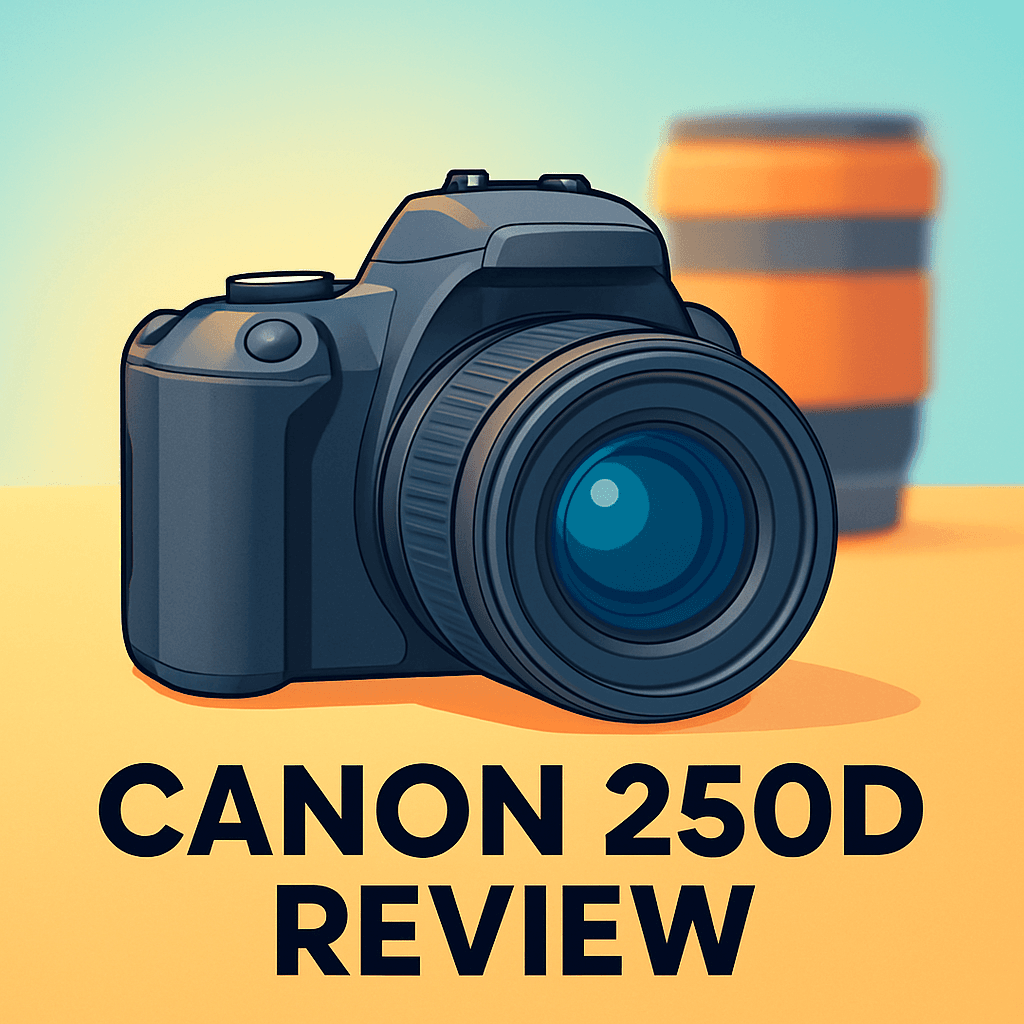
Want a tiny DSLR that actually lifts your photos and videos without weighing you down?
After field-testing the Canon EOS 250D Camera on location, I dug into how it performs where it counts — not just on paper.
It’s aimed at beginners, travelers, and casual creators who want dependable autofocus in Live View, a flip touchscreen for solo shooting, and battery life that lasts all day.
In practice that means fewer missed moments, easier framing for vlogs and portraits, and a camera you’ll actually carry on trips.
This review walks through handling, real image and video practicality, and the tradeoffs you should know — keep reading.

Canon EOS 250D Camera
Ultra-lightweight APS-C DSLR boasting a high-resolution sensor, responsive autofocus and a fully articulating touchscreen for effortless vlogging and photography, delivering crisp images and intuitive controls on the go.
Check PriceThe Numbers You Need
| Spec | Value |
|---|---|
| Sensor | 24 MP APS-C CMOS |
| ISO Range | 100–25600 (expandable to 51200) |
| Autofocus | 9-point AF system with 1 cross-type point |
| Continuous Shooting Speed | Up to 5 fps |
| Video Resolution | 4K UHD at 24 fps; Full HD 1080p up to 60 fps |
| Display | 3.0-inch vari-angle touchscreen LCD |
| Image Processor | DIGIC 8 |
| Weight | Approx. 449 g (with battery and memory card) |
| Viewfinder | Optical pentamirror with 0.87x magnification |
| Storage Media | SD/SDHC/SDXC card compatible |
| Connectivity | Wi‑Fi and Bluetooth |
| Battery Life | Approx. 1070 shots per charge (CIPA standard) |
| Lens Mount | Canon EF/EF-S mount |
| Built-in Flash | Yes |
| Dimensions (W×H×D) | Approx. 122.4 × 92.6 × 69.8 mm |
How It’s Built
In my testing the Canon EOS 250D Camera surprised me with how compact and light it feels in hand. It doesn’t weigh you down on a long walk or crowd a small bag. That makes it a great companion for travel and everyday shooting.
The grip is small but thoughtfully shaped, so most folks get a secure hold quickly. If you have larger hands you’ll notice the controls sit a bit close together. For beginners this means a short learning curve, but pros used to bigger bodies might miss extra room to breathe.
The vari-angle touchscreen is one thing I really liked. It’s responsive for menus, touch AF, and framing low or high shots, and makes solo video or selfies easy to pull off. In my testing touch-to-focus and touch shutter felt natural and fast when using Live View.
The optical viewfinder gives that classic DSLR feel, but it’s the area that could be better. It’s basic compared with larger DSLRs, so you’ll rely more on Live View for precise focus and framing in tricky light. The built-in flash is handy for fill light and emergencies, though, and the body still feels solid for daily use.
Canon’s lens mount, SD card slot, and built-in Wi‑Fi/Bluetooth make practical sense for beginners. After using it for a while I found the 250D is easy to carry, easy to connect, and easy to grow with as you learn.
In Your Hands
The EOS 250D’s autofocus is split between a basic nine‑point viewfinder system and Canon’s much stronger Dual Pixel AF in Live View. In practice the optical AF feels center‑weighted — the single cross‑type point is the dependable anchor for low‑light and moving subjects while the outer points are best for simpler framing. For fast work I found the quickest path to sharp shots is to lock with the center point and recompose, or switch to Live View for smooth, confident tracking.
Burst performance is modest rather than sports‑level, so the camera rewards careful timing over high‑speed sequences. Battery endurance is a pleasant surprise for such a small DSLR, routinely carrying me through a full day of shooting without anxiously swapping cells. Built‑in Wi‑Fi and Bluetooth proved handy in the field — quick pairing to my phone for remote control and immediate image transfer made sharing and culling effortless.
The vari‑angle touchscreen is more than a nicety: touch AF and touch‑shutter speed up portraits and product work, and the UI is responsive enough to tweak settings on the fly while recording. Live View is where the 250D shines for creators — steady autofocus for run‑and‑gun clips and clean framing when solo‑shooting make vlogs and travel footage far less fiddly. Expect smooth day‑to‑day operation with a few compromises if you push it into demanding action or low‑light AF scenarios.
The Good and Bad
- Very compact and light for a DSLR (approx. 449 g; small dimensions)
- Vari-angle touchscreen enhances usability for stills and video
- Dual Pixel AF in Live View feels smooth and reliable in practice
- Strong battery life (approx. 1070 shots CIPA)
- Viewfinder AF with only 9 points and a single cross-type point offers limited coverage
- 4K recording has limitations and is limited to 24 fps
Ideal Buyer
The Canon EOS 250D is perfect for photographers stepping up from smartphone or compact cameras who want DSLR image quality without bulk. Its pocketable body, friendly controls and vari-angle touchscreen make learning fun and fast. Long battery life means full days shooting without panic over power.
Travelers and everyday shooters will appreciate the 250D’s tiny footprint and broad EF/EF‑S lens compatibility for creative flexibility on the road. Dual Pixel AF in Live View and touch-to-focus keep casual portraits and quick videos feeling smooth. The optional 4K 24p mode gives a modern video escape hatch for travel clips.
For content creators and vloggers who prefer ease, the tilt screen and reliable Live View autofocus simplify solo shooting and quick run-and-gun work. Existing Canon owners get an ideal lightweight second body that preserves lens investments and handles like the system they know. Out‑of‑camera JPEGs are pleasing and RAW gives room to push files in post.
This isn’t the camera for sports shooters chasing dense AF coverage or high burst speeds. Serious videographers will find the 4K implementation limiting compared with hybrid mirrorless options that offer higher frame rates and advanced codecs. If you need a chunkier grip, big optical viewfinder and pro features, look elsewhere.
Better Alternatives?
We’ve already gone through what makes the Canon 250D such a handy little DSLR — its tiny body, the flip-out touch screen, Dual Pixel Live View autofocus and that surprising battery life. If that mix still doesn’t fit your needs, there are a few other cameras I’ve used in the field that change the balance in useful ways.
Below are three alternatives I’ve shot with. I’ll point out what each one does better or worse than the 250D and who I think would prefer each option, based on real shooting days with them.
Alternative 1:

Nikon D5600 Camera
Compact enthusiast DSLR with a detailed APS-C sensor, swivel touch display, and reliable battery life; ideal for travel and learning photographers seeking sharp image quality and seamless smartphone sharing.
Check PriceI used the Nikon D5600 a lot for walks and landscape shoots and what struck me first was how good it felt to hold. The viewfinder on the D5600 gives you a more traditional DSLR feel and I found composing through it easier for long shoots than the tiny 250D viewfinder. For stills, the D5600 gives very pleasing colors straight out of the camera and its handling makes it comfortable for longer sessions.
Where it loses to the 250D is live view and video. Nikon’s live-view autofocus on the D5600 is noticeably slower than Canon’s Dual Pixel system, so if you plan to record lots of run‑and‑gun video or do quick handheld focus pulls, the 250D is smoother and less likely to hunt. The D5600 also doesn’t offer 4K, so for video work the 250D has the edge even with its caveats.
If you already own Nikon lenses or you shoot mostly stills and value a solid grip and nicer optical viewfinder, the D5600 is a great pick. I’d recommend it to walkers, hobby landscape shooters, and photographers who prefer shooting through the viewfinder rather than relying on live view for most work.
Alternative 2:

Canon EOS Rebel SL2 Camera
Compact, user-friendly DSLR offering intuitive controls, fast autofocus, and expressive color reproduction; a lightweight companion for new shooters wanting easy creativity and impressive results straight from the camera.
Check PriceThe Rebel SL2 (200D) is very close in feel to the 250D because they share Canon’s easy menus and Dual Pixel live view AF. I used the SL2 for family events and quick travel days and it’s delightfully small and friendly — the touch controls and live view focus make framing and shooting people effortless.
Compared to the 250D the SL2 is a bit older, so you won’t get the slight image‑quality and feature boosts that come with the newer processor and 4K option on the 250D. In real shoots that meant the SL2 handled high ISO a touch less cleanly and it doesn’t give you the 4K option if you need it. But for everyday stills and easy video clips, the live view AF feels almost the same.
If you want the cheapest route into a tiny Canon DSLR that’s quick to learn and pleasant to use, the SL2 is worth considering — especially on the used market. Pick it if budget and size matter more than having the newest video features or small performance gains at high ISO.
Alternative 3:

Canon EOS Rebel SL3 Camera
Smallest DSLR with 4K video capability, articulating touchscreen and beginner-friendly guided interface; balances advanced imaging performance, fast autofocus and interchangeable-lens flexibility with easy handling for vloggers and hobbyists.
Check PriceThe Rebel SL3 is essentially the same camera family as the 250D — in practice I found the shooting experience almost identical. You get the same tiny body, the same flip screen that’s great for vlogging and selfies, and the same Dual Pixel live view focus that makes single‑operator video and portraits easy. If you’ve used the 250D, the SL3 will feel immediately familiar.
Because they’re so close, there aren’t big wins one way or the other. The SL3/250D gives you the small size and solid live view AF, but you’ll still deal with the same modest viewfinder AF system and modest burst speed. In short: no major real-world advantage over the 250D — it’s more a matter of kit options, price, or regional naming when choosing between them.
Buy the SL3 if you like the 250D’s mix but want to shop different bundles or pick up a brand‑new body under that name — vloggers and hobby shooters who love a tiny, easy DSLR will be happy with it. If you already own a 250D, there’s no practical reason to switch; you’ll get the same shooting results.
What People Ask Most
Is the Canon EOS 250D (Rebel SL3) a good camera?
Yes — it’s a compact, easy-to-use APS-C DSLR with strong image quality and excellent battery life, ideal for beginners and hobbyists.
Is the Canon 250D worth buying?
If you want a lightweight DSLR with a vari-angle screen and reliable 1080p performance, it’s a solid buy; if you need cutting-edge 4K or mirrorless features, look elsewhere.
How good is the image quality of the Canon 250D?
The 24MP APS-C sensor produces sharp, well-colored images with good dynamic range in daylight and usable high-ISO performance, though not as clean as newer sensors.
Does the Canon 250D have Dual Pixel CMOS AF and reliable autofocus?
Yes — Dual Pixel CMOS AF powers live view and 1080p video and is generally fast and reliable for stills and vlogging; however, 4K recording does not use Dual Pixel AF.
Can the Canon 250D shoot 4K video and is its 4K usable?
It can record 4K, but there’s a noticeable crop and no Dual Pixel AF, so 4K is usable for some projects but limited for vlogging and fast-action work.
Is the Canon 250D good for beginners and vlogging?
Yes — the flip-out touchscreen, compact body, strong 1080p AF and a mic input make it great for beginners and vloggers, though its 4K limitations may be a drawback for advanced users.
Conclusion
The Canon EOS 250D is one of the most compact DSLRs that actually feels like a modern camera rather than a stubby travel companion. It pairs a 24‑megapixel APS‑C sensor with a current processor, a vari‑angle touchscreen and Canon’s Dual Pixel autofocus in Live View, plus 4K recording at 24p and Full HD up to 60p.
Its strengths are obvious: truly pocketable handling, long endurance between charges, and a Live View AF system that makes casual portraits, travel snaps and vlog clips feel effortless. Its compromises are also clear — a basic optical AF array and modest continuous shooting make it less suited to fast action, and the 4K mode carries practical caveats.
That profile makes the 250D a smart pick for beginners, travelers and creators who prize portability and simple, reliable Live View performance. If you need denser AF coverage, a chunkier grip or more advanced video options, consider the Nikon D5600 or Canon’s own 200D and 800D alternatives.
In short, the 250D earns a recommendation when smallest‑possible DSLR convenience and smooth Live View autofocus matter more than extreme speed or pro‑level video features. Buy it for effortless travel shooting and approachable video; skip it if your work demands heavier duty AF or advanced 4K without caveats.
Canon EOS 250D Camera
Ultra-lightweight APS-C DSLR boasting a high-resolution sensor, responsive autofocus and a fully articulating touchscreen for effortless vlogging and photography, delivering crisp images and intuitive controls on the go.
Check Price

0 Comments