
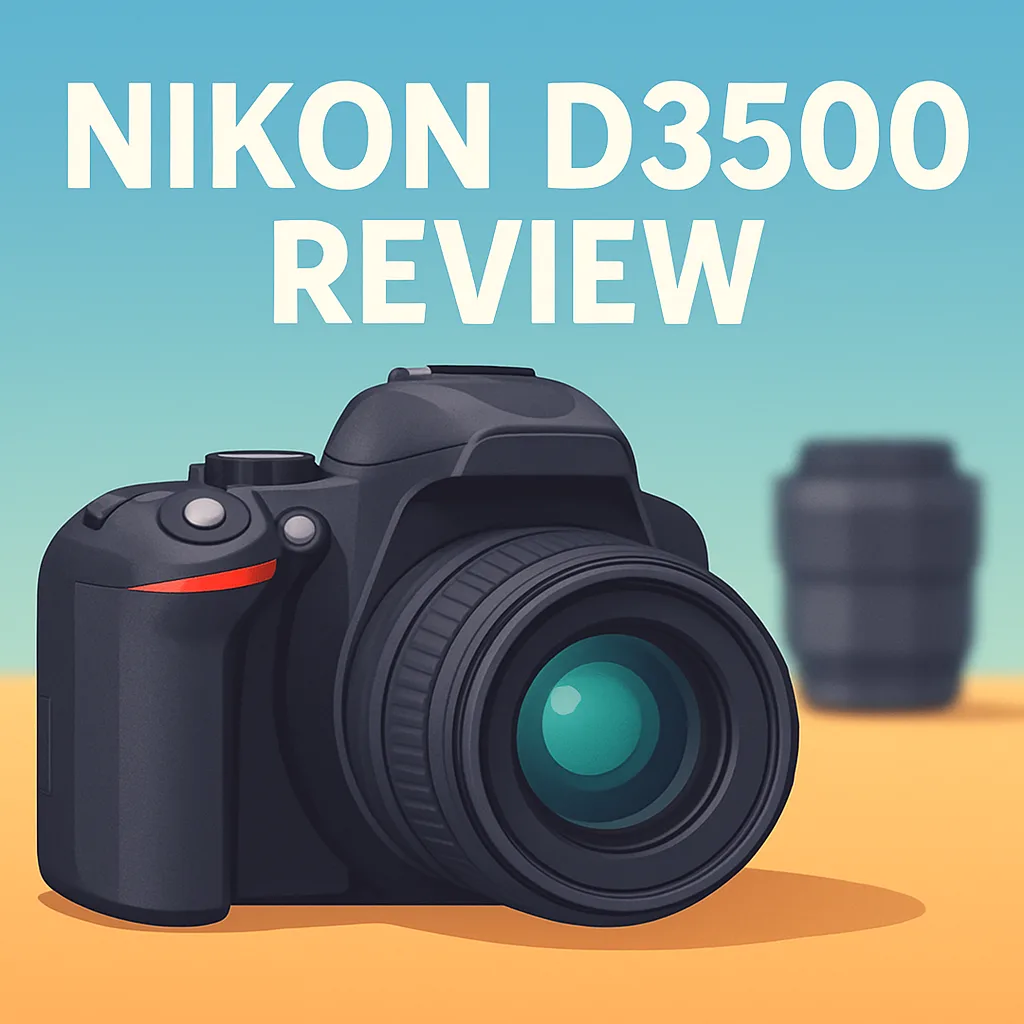
Want better photos without drowning in menus and gizmos?
I field-tested the Nikon D3500 across walks, family shoots, and travel. It shows how simplicity and stamina translate to dependable results in real-world shooting.
This review focuses on who benefits most — beginners, travelers, and families — and why 24MP image quality, long battery life, simple handling, and easy sharing matter. I’ll also flag tradeoffs like the fixed non-touch screen, 11-point AF, and ~95% viewfinder coverage. Make sure to read the entire review as I unpack handling, image quality, and real-world tradeoffs — keep reading.

Nikon D3500 Camera
Lightweight, beginner-friendly DSLR with a 24.2MP sensor, impressive battery life, and easy-to-use Guide Mode—ideal for learning photography while delivering sharp images, responsive performance, and reliable low-light results.
Check PriceThe Numbers You Need
| Spec | Value |
|---|---|
| Sensor | 24.2 MP APS-C |
| ISO range | 100–25600 |
| Image processor | EXPEED 4 |
| Autofocus points | 11 points |
| Max burst rate | 5 fps |
| Video | Full HD 1080p at 60 fps |
| Viewfinder type | Optical pentamirror, 95% coverage |
| LCD | 3.0″ , 921k dots, fixed |
| Storage | SD, SDHC, SDXC |
| Connectivity | SnapBridge (Bluetooth) |
| Lens mount | Nikon F-mount |
| Maximum shutter speed | 1/4000 sec |
| Battery life | 1550 shots (CIPA) |
| Dimensions | Approx. 124 x 97 x 70 mm |
| Weight | Approx. 415g (body only) |
How It’s Built
In my testing the Nikon D3500 Camera felt like a true grab-and-go DSLR. The body is light and compact, so wearing it on a strap all day didn’t wear me out. That makes it great for travel and family outings where you want decent glass without a heavy pack.
I found the optical viewfinder comfortable to use, but remember it shows slightly less than what the final photo captures. That 95% coverage means you’ll want to leave a little extra room when you compose. The rear screen is bright and sharp, but fixed, so low or high-angle shots mean getting creative with your stance.
Controls are simple and friendly for beginners, with a clear mode dial and easy menus that don’t overwhelm. The grip is pleasantly secure — a real win in my testing — though quick changes to things like ISO or AF settings aren’t as fast as on more advanced bodies. Beginners will appreciate the straightforward layout, even if pros miss direct control wheels.
SnapBridge Bluetooth made casual transfers and remote triggering painless for social sharing, though it’s not as fast as a cable or Wi‑Fi. The card slot takes standard SD cards; I’d use a reliable UHS‑I card for stills and one rated for video if you plan to shoot lots of 1080/60p. That setup kept my workflow simple and dependable in real shoots.
In Your Hands
The Nikon D3500 delivers a steady, workmanlike responsiveness that suits everyday shooting and family action without fuss. Its continuous burst capability is reliable enough to catch fleeting expressions and casual sports, and the camera’s top shutter speed keeps pace for bright conditions and mild motion-stopping needs. You don’t get pro-level rapid-fire tracking, but for most moments it’s satisfyingly competent.
Battery life is one of the camera’s real-world superpowers, letting you shoot through long days of travel and events without hunting for outlets. That endurance changes how you plan outings—fewer spare batteries and more uninterrupted shooting—so you end up focusing on composition instead of power management.
From startup to menu navigation the experience is deliberately simple: quick to power up, easy to understand, and forgiving while you learn. The fixed rear screen and optical viewfinder steer you toward an old-school, deliberate shooting style, and SnapBridge’s Bluetooth pairing makes social sharing and casual remote operation straightforward, if not lightning-fast compared with tethered transfers.
The Nikon F-mount opens a wide, practical lens ecosystem that rewards experimentation with affordable zooms and compact primes. Pairing the body with a small prime noticeably improves portraits and low‑light versatility, so the kit scales nicely as your skills and needs evolve.
The Good and Bad
- 24.2 MP APS-C sensor paired with EXPEED 4
- Excellent rated battery life: 1550 shots (CIPA)
- 5 fps continuous shooting for casual action
- Compact, lightweight body (approx. 415 g)
- Fixed, non-touch 3.0″ LCD limits shooting angles and ease of operation
- 11 AF points offer limited coverage and flexibility vs. higher-tier systems
Ideal Buyer
If you prize simplicity and all-day reliability over bells and whistles, the Nikon D3500 is built for you. Its long battery life and straightforward controls make it easy to focus on picture-making rather than menus. It’s aimed at photographers who prefer dependable results over cutting-edge autofocus or touchscreens.
This is an excellent first DSLR for someone learning exposure and composition without being overwhelmed. The 24.2MP sensor delivers image quality that rewards practice and grows with you. The learning curve stays gentle while the files give room to edit and improve.
Travelers and hobbyists will appreciate the compact, lightweight body and the comfort of an optical viewfinder for fast, tactile shooting. It sits lightly on a strap and won’t tire your shoulder on long walks. Its size makes it a natural companion for day trips, city streets, and easy carry-on packing.
Families and casual shooters get dependable stills and smooth 1080/60p for occasional video, plus Bluetooth SnapBridge for quick social sharing. If you want a no-fuss camera that simply works for events and vacations, the D3500 answers that call. For parents and casual videographers, the D3500 hits the sweet spot between quality and simplicity.
Better Alternatives?
We’ve already dug into what makes the Nikon D3500 a great, no-nonsense starter DSLR: fantastic battery life, simple controls, and reliable 24MP image quality. If those are your priorities, the D3500 is hard to beat. But some shooters will want a few missing features—like an articulating screen, stronger live-view autofocus, or more AF points—so it’s worth looking at a few close alternatives.
Below are three cameras I’ve used in real shoots that trade some of the D3500’s strengths for extra flexibility. I’ll point out what each one does better or worse in real shooting terms, and who I’d recommend each to so you can pick the right tradeoff for your style.
Alternative 1:

Nikon D5600 Camera
Versatile mid-range DSLR featuring a 24.2MP sensor, articulating touchscreen, and Bluetooth/Wi‑Fi for seamless sharing. Creative shooting modes and improved autofocus make it perfect for growing enthusiasts and travel photographers.
Check PriceI’ve shot with the D5600 on a few trips and the big, obvious win over the D3500 is the flip-out touchscreen. It makes low-angle shots, quick overhead framing, and casual video or vlogging so much easier than hunting for the right angle with a fixed screen. The D5600’s live-view focusing also feels more confident than the D3500’s—when I used the screen to frame people, the camera found focus faster and I missed fewer shots.
The D5600 also gives you more AF points when shooting through the viewfinder, so you can place focus more precisely without recompose tricks. That matters when you’re shooting kids or street scenes and want predictable focus. The tradeoff is battery life: in my shoots the D5600 ran down faster than the D3500, so you’ll want a spare battery for a full day out. It’s also a bit pricier and slightly more complex if you liked the D3500’s bare-bones simplicity.
If you’re a travel shooter or growing enthusiast who wants an easier time with live-view, video, and creative framing, the D5600 is a smart step up. If you primarily need the longest possible battery and the simplest controls for walkaround shooting, stick with the D3500 instead.
Alternative 2:

Canon EOS Rebel SL3 Camera
Compact, user-friendly DSLR offering 24.1MP stills and 4K video, plus a vari-angle touchscreen for vlogging. Lightweight body, intuitive controls, and strong battery life for on-the-go creators.
Check PriceUsing the Canon SL3 made me appreciate how much a good live-view AF changes shooting. Canon’s Dual Pixel system locks onto faces quickly when I’m shooting people or handheld video—far smoother than the D3500’s live-view focus. The flip-out screen is also excellent for low and high angles or vlogging, so if you plan to shoot from the screen a lot you’ll notice a real difference.
Where the SL3 falls short versus the D3500 is simple endurance: battery life isn’t as long, so you’ll need to manage power on long outings. Also, its 4K mode is handy on paper but comes with limits (cropped field of view and no Dual Pixel AF in 4K), so if you were hoping for full-on 4K video use you may find it restrictive compared to how smoothly the SL3 does Full HD with live AF. The SL3 is lighter and very easy to carry, though, which makes it great for day trips.
I’d recommend the SL3 to vloggers and everyday shooters who want a tiny, easy camera with great live-view focus and a tilting screen. If you value long battery life and the simplest controls for stills, the D3500 still has the edge.
Alternative 3:
Canon EOS Rebel SL3 Camera
Ideal for beginners seeking compact power: responsive Dual Pixel autofocus in Live View, user-assist guides, and a comfy grip deliver crisp photos, easy framing, and quick setup for everyday shooting.
Check PriceOn longer shoots I appreciated the SL3’s friendly menus and guide mode—Canon really leans into helping new users get usable shots quickly. The Dual Pixel AF makes framing with the screen feel natural, and the camera’s light weight means you’re more likely to carry it all day than a heavier body. In practice that led to more keepers when I was out walking the city or working small family sessions.
That said, compared to the D3500 you trade away raw battery stamina and the simple, long-running reliability of a no-frills shooter. The SL3 can also feel a bit plasticky in the hand and some advanced users may miss the D3500’s optical viewfinder behavior. For beginners who want a comfy grip, easy setup, and strong screen-based autofocus, the SL3 is a great option.
If you’re new to DSLR shooting and want a small camera that helps you learn while giving good live-view performance, reach for the SL3. If you’re prioritizing all-day battery life and the simplest possible DSLR experience, stick with the D3500.
What People Ask Most
Is the Nikon D3500 a good camera?
Yes — it’s an excellent entry-level DSLR with a 24MP APS-C sensor that delivers sharp images and reliable performance for beginners.
Is the Nikon D3500 still worth buying?
Yes if you want an affordable, easy-to-use camera with great battery life and image quality, but skip it if you need 4K, a touchscreen, or advanced autofocus.
Nikon D3500 vs D5600 — which is better?
The D5600 is better for features (articulating touchscreen and improved live-view AF), while the D3500 wins on price, battery life, and simplicity for new photographers.
Does the Nikon D3500 shoot 4K video?
No — it records up to Full HD 1080p video only.
Does the Nikon D3500 have Wi‑Fi or Bluetooth?
It doesn’t have Wi‑Fi but includes Bluetooth (SnapBridge) for basic image transfer and remote control.
What lens should I buy for the Nikon D3500?
Keep the 18-55mm kit for general use, add a 50mm f/1.8 for portraits or a 35mm f/1.8 for low-light and street work, and choose an 18-140mm or 70-300mm if you need more zoom.
Conclusion
The Nikon D3500 Camera remains a smart, photographer-tested entry-level DSLR that delivers dependable image quality and a refreshingly simple experience for learning photographers. Its 24MP APS-C sensor and Nikon’s EXPEED processing produce pleasing detail, color and tonal rendering, while the optical viewfinder and Full HD video keep shooting intuitive and engaging. Add class-leading battery endurance and compact handling, and you have a camera that simply keeps working through a long day.
The tradeoffs are deliberate and straightforward: a fixed, non-touch rear screen that limits creative angles, a conservative 11-point AF layout with modest coverage, and an optical viewfinder that crops your framing slightly below what the file will record. Connectivity favors Bluetooth transfers over faster options, and video tops out at Full HD—good for casual use but short of modern filmmaking needs. Those limits are the price of simplicity and endurance.
For first-time DSLR owners, travel shooters and families who prioritize reliability, battery life and a focused learning platform, the D3500 is an excellent, no-frills choice that rewards thoughtful shooting. If you require an articulating touchscreen, denser AF or more advanced video, look to the alternatives; otherwise this camera offers consistently excellent real-world value and a straightforward path into photography.
Nikon D3500 Camera
Lightweight, beginner-friendly DSLR with a 24.2MP sensor, impressive battery life, and easy-to-use Guide Mode—ideal for learning photography while delivering sharp images, responsive performance, and reliable low-light results.
Check Price



0 Comments